
AI Agents & Automation: Unlock Business Transformation
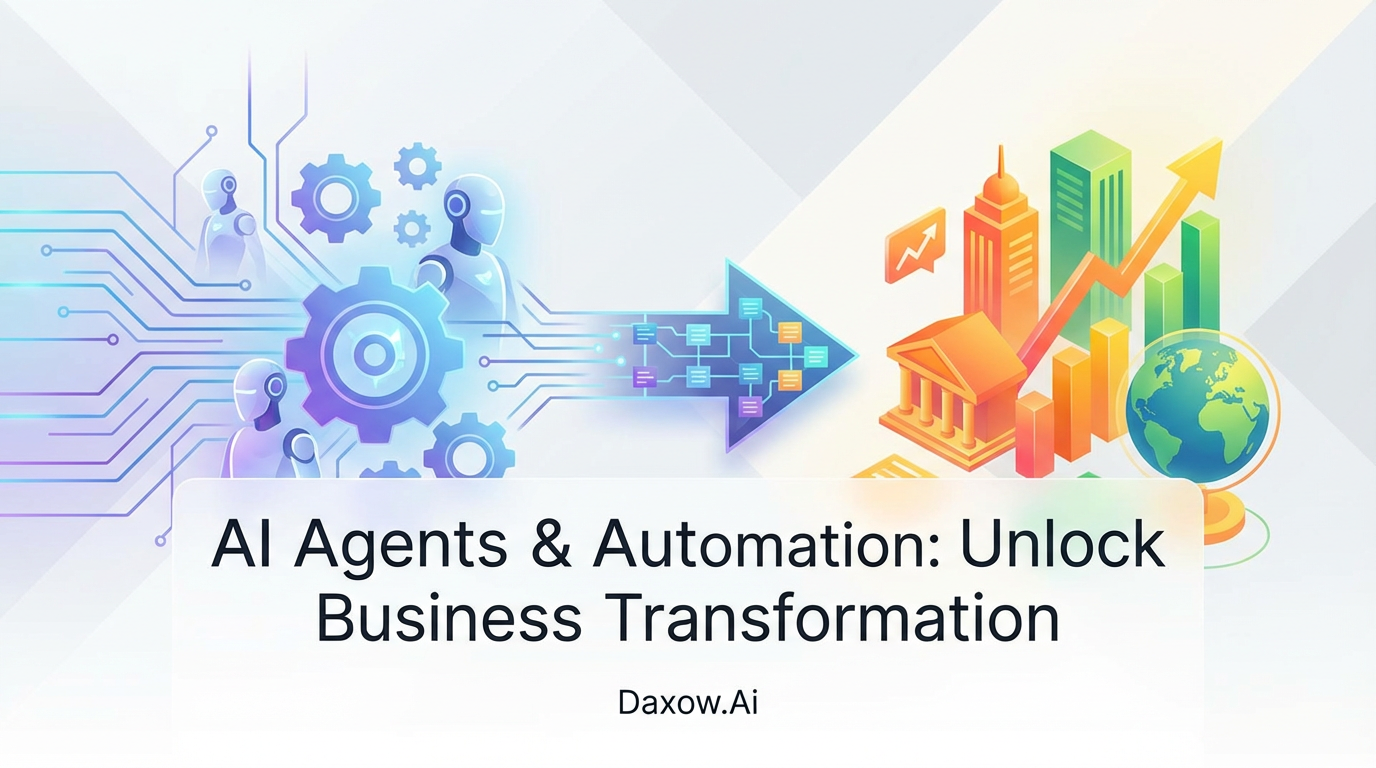
Convert repetitive work into measurable ROI with AI agents and workflow automation. Practical use cases, implementation steps, and Daxow.ai's approach.
Unlocking Business Transformation: The Power of AI Agents and Automation
Estimated reading time: 12 minutes
Key Takeaways
- AI agents combined with workflow automation enable scalable, efficient, and auditable business processes.
- Businesses can reduce manual tasks, improve productivity, and enhance customer experiences through AI automation.
- Industry-specific use cases demonstrate tangible KPIs like faster processing, cost reduction, and improved compliance.
- A phased implementation approach reduces risk and maximizes ROI with clear best practices.
- Daxow.ai offers end-to-end custom AI systems designed for measurable business outcomes and seamless integration.
Table of Contents
- Unlocking Business Transformation: The Power of AI Agents and Automation
- What AI Agents and Automation Mean for Businesses
- Practical Use Cases — Industry-by-Industry Applications
- How AI Agents and Automation Drive Business Outcomes
- Implementation Steps and Best Practices
- Technical Considerations for Reliable AI Automation
- Daxow.ai — How We Help Build Custom AI Systems
- ROI and Business Value — What Decision-Makers Should Expect
- Practical Action Plan — How to Start This Quarter
- Common Pitfalls and How to Avoid Them
- Final Thoughts — Turning Automation into a Competitive Advantage
- Frequently Asked Questions
Unlocking Business Transformation: The Power of AI Agents and Automation
AI agents are autonomous software systems that execute tasks, make decisions, and orchestrate workflows across your technology stack. When combined with workflow automation, they transform processes that once required human oversight into fast, repeatable, and auditable operations. The result: organizations can scale without proportionally increasing headcount, reduce errors, and redirect employees to higher-value work.
- Core capability: Automate repetitive work and augment complex decision-making.
- Tangible outcomes: Faster processing times, lower operational costs, improved customer satisfaction, and stronger compliance.
Below we translate research-backed principles into a practical playbook for business leaders.
What AI Agents and Automation Mean for Businesses
From manual tasks to autonomous execution
AI agents handle both rule-based and predictive tasks. Examples include data extraction from invoices, automated classification of support tickets, and predictive alerts for supply chain disruptions. Workflow automation ties these agents together into end-to-end processes so systems — not people — move data, trigger actions, and close loops.
Business-aligned benefits
- Reduce manual tasks: Eliminate repetitive data entry, routing, and status updates.
- Improve productivity: Free staff for strategic initiatives and customer-facing work.
- Enhance customer experience: Faster response times and personalized interactions through customer support automation.
- Governance and compliance: Centralized control reduces shadow AI risk and maintains audit trails.
Practical Use Cases — Industry-by-Industry Applications
E-commerce — Personalization and support at scale
Problem: High volume of nuanced customer queries and manual product content updates.
AI Solution:
- AI agents handle multi-channel customer inquiries and escalate only complex cases to humans.
- Workflow automation generates personalized recommendations, automatically updates product descriptions, and drafts targeted social content.
Expected KPIs: Reduced average handle time (AHT) by 30–50%, conversion uplift through personalization, and lower content production costs.
Healthcare — Document automation and predictive logistics
Problem: Large volumes of patient documents and fragile supply chains.
AI Solution:
- Data extraction agents convert clinical forms and invoices into structured records.
- Predictive agents forecast supply shortages and trigger procurement workflows.
Expected KPIs: Faster claims processing, improved compliance rates, and reduced stockouts through early alerts.
Finance — Fraud detection and automated reconciliation
Problem: Manual transaction reviews and time-consuming reconciliation.
AI Solution:
- Real-time anomaly detection agents flag suspicious activity.
- Reconciliation agents match transactions across systems and auto-open exceptions for human review.
Expected KPIs: Reduced fraud loss, faster month-end close, and fewer manual reconciliation hours.
Real Estate — Market analysis and listing optimization
Problem: Labor-intensive market research and inconsistent listing quality.
AI Solution:
- Agents analyze market data to recommend pricing.
- Content automation generates standardized, SEO-optimized listing descriptions.
Expected KPIs: Faster time-to-list, improved lead quality, and optimized pricing accuracy.
HR — Screening, onboarding, and talent analytics
Problem: Slow candidate screening and administrative onboarding tasks.
AI Solution:
- Resume parsing and chat-based pre-screening agents shortlist candidates.
- Onboarding workflows automate document collection, compliance checks, and training assignments.
Expected KPIs: Shorter time-to-hire, reduced administrative workload, and better retention indicators through early engagement.
How AI Agents and Automation Drive Business Outcomes
Orchestration and human-in-the-loop design
AI agents should be designed to orchestrate with existing rule-based systems and human oversight. That hybrid approach ensures reliability while retaining the ability to handle exceptions and sensitive decisions.
- Orchestration: Agents coordinate APIs, databases, and third-party services to complete tasks end-to-end.
- Human-in-the-loop: Critical decision points route to humans for review, maintaining accountability and ethical control.
Measuring success with relevant metrics
To connect automation to business value, adopt precise KPIs:
- Processing time reductions (hours/days saved).
- Cost per transaction or task.
- Error or exception rates.
- Customer satisfaction (CSAT/NPS).
- Time-to-resolution for support tickets.
- Revenue impact (conversion lift, upsell rates).
Implementation Steps and Best Practices
1. Define goals and prioritize processes
- Identify processes that are repetitive, rule-based, and high-volume.
- Set measurable objectives (e.g., reduce invoice processing time by 60%).
- Secure stakeholder alignment and a sponsorship model.
2. Assess data readiness and tool selection
- Audit data for completeness, quality, and compliance requirements.
- Choose technologies that integrate with your stack and support NLP and predictive modeling.
- Favor modular platforms that enable API-based integrations and versioned deployment.
3. Build cross-functional teams
- Assemble product owners, engineers, data scientists, and domain SMEs.
- Train staff on new workflows and the rationale for automation to ensure adoption.
- Define roles for monitoring and model retraining.
4. Pilot, test, and learn
- Start with small, high-impact pilots to demonstrate quick wins.
- Measure model performance (accuracy, F1 score) and business KPIs.
- Iterate quickly based on real-world feedback.
5. Deploy, monitor, and scale
- Deploy modularly using APIs and cloud infrastructure.
- Monitor with dashboards and alerting for performance drift.
- Retrain models and refine prompts and decision thresholds regularly.
Best practices summary
- Avoid scope creep: Use KPIs to keep projects focused.
- Promote adoption: Share early wins and document processes.
- Governance: Prevent shadow AI by centralizing deployments and access controls.
- Scalability: Use hybrid cloud or modular architectures that grow with needs.
Technical Considerations for Reliable AI Automation
Integration and connectivity
Successful automation requires robust integrations with CRMs, ERPs, ticketing systems, and cloud storage. Agents should access and write data through secure APIs to maintain data integrity.
Security, privacy, and compliance
- Implement role-based access controls and encryption in transit and at rest.
- Ensure models respect data minimization and privacy policies.
- Maintain audit logs for compliance and traceability.
Observability and model maintenance
- Track model performance metrics over time.
- Implement alerting for drift and degradation.
- Schedule retraining and maintain a feedback loop from end users.
Daxow.ai — How We Help Build Custom AI Systems
Discovery and process analysis
We map current workflows, identify bottlenecks, and prioritize automation candidates.
Deliverable: A tailored process analysis with clear ROI projections.
Custom AI design and development
We build AI agents that perform specific tasks: data extraction, lead qualification, customer support automation, and more.
Agents are integrated into your stack through secure APIs and connectors.
End-to-end automation and orchestration
We deliver full workflow automation: from trigger to completion, including human approvals where needed.
Result: Reduced manual tasks and consistent, auditable operations.
Systems integration and data connectivity
We ensure seamless integration with CRMs, ERPs, ticketing systems, and cloud storage.
We implement robust data pipelines that maintain data quality and compliance.
Ongoing support and scaling
We monitor performance, retrain models, and iterate features.
We provide documentation and training to ensure adoption and continuous improvement.
ROI and Business Value — What Decision-Makers Should Expect
AI automation delivers both direct and indirect financial benefits.
- Efficiency gains: Targeted processes can see 20–50% improvements in throughput and reduced cycle times.
- Cost reduction: Lowered labor costs for repetitive work and fewer errors reduce operational expenses.
- Revenue uplift: Better customer support and personalized experiences drive higher conversions and upsell rates.
- Resilience: Automated, well-monitored systems reduce downtime and accelerate recovery from disruptions.
Quantifying the value requires baseline metrics and continuous measurement. Daxow.ai builds dashboards to track throughput, cost per transaction, customer experience, and compliance metrics so you can measure ROI from day one.
Practical Action Plan — How to Start This Quarter
If you want to move from planning to execution this quarter, follow this concise plan:
- Book a 2–4 hour discovery session to map 2–3 high-impact processes.
- Run a rapid pilot (4–8 weeks) for one prioritized process—e.g., invoice processing or customer support automation.
- Measure pilot KPIs and expand to adjacent processes in 6–12 weeks.
- Roll out governance, retraining schedules, and integrations for long-term scale.
Quick wins to consider
- Automate ticket triage to reduce response times.
- Deploy a document extraction agent for invoices and contracts.
- Implement a lead qualification agent that routes high-intent prospects to sales.
Common Pitfalls and How to Avoid Them
- Overambitious scope: Start small with measurable goals.
- Poor data readiness: Clean and standardize data before training models.
- Lack of ownership: Assign process owners and stakeholders.
- Ignoring governance: Create policies to prevent shadow AI and ensure compliance.
Final Thoughts — Turning Automation into a Competitive Advantage
Unlocking Business Transformation: The Power of AI Agents and Automation is about combining intelligent agents with disciplined workflow automation to create systems that work reliably and scale. Organizations that adopt a methodical, KPI-driven approach capture significant efficiency gains, improve customer experience, and free human teams for high-value work.
Take the next step: Book a free consultation with Daxow.ai to request a process analysis for your company. We’ll identify high-impact automation opportunities, estimate ROI, and outline a practical roadmap to deploy AI agents that reduce manual tasks and boost productivity. Contact us to build a custom AI system and begin your transformation.
Frequently Asked Questions
What are AI agents and how do they differ from traditional automation?
AI agents are autonomous software systems capable of executing complex, decision-driven tasks and orchestrating workflows. Unlike traditional automation, which relies on fixed rules, AI agents use machine learning and predictive models to adapt and improve over time.
How can workflow automation improve customer experience?
Workflow automation accelerates response times, personalizes interactions, and ensures consistent service delivery by automating routine customer support tasks and enabling AI agents to focus on higher-value engagements.
What industries benefit most from AI automation?
AI automation benefits a wide range of industries including e-commerce, healthcare, finance, real estate, and human resources, each with tailored use cases that drive efficiency, reduce costs, and improve outcomes.
How does Daxow.ai support AI automation implementation?
Daxow.ai offers end-to-end services including process analysis, custom AI agent development, system integration, workflow automation, and ongoing support to ensure rapid time-to-value and sustained business impact.