
AI Agents for Workflow Automation: Cut Manual Tasks & Boost Productivity
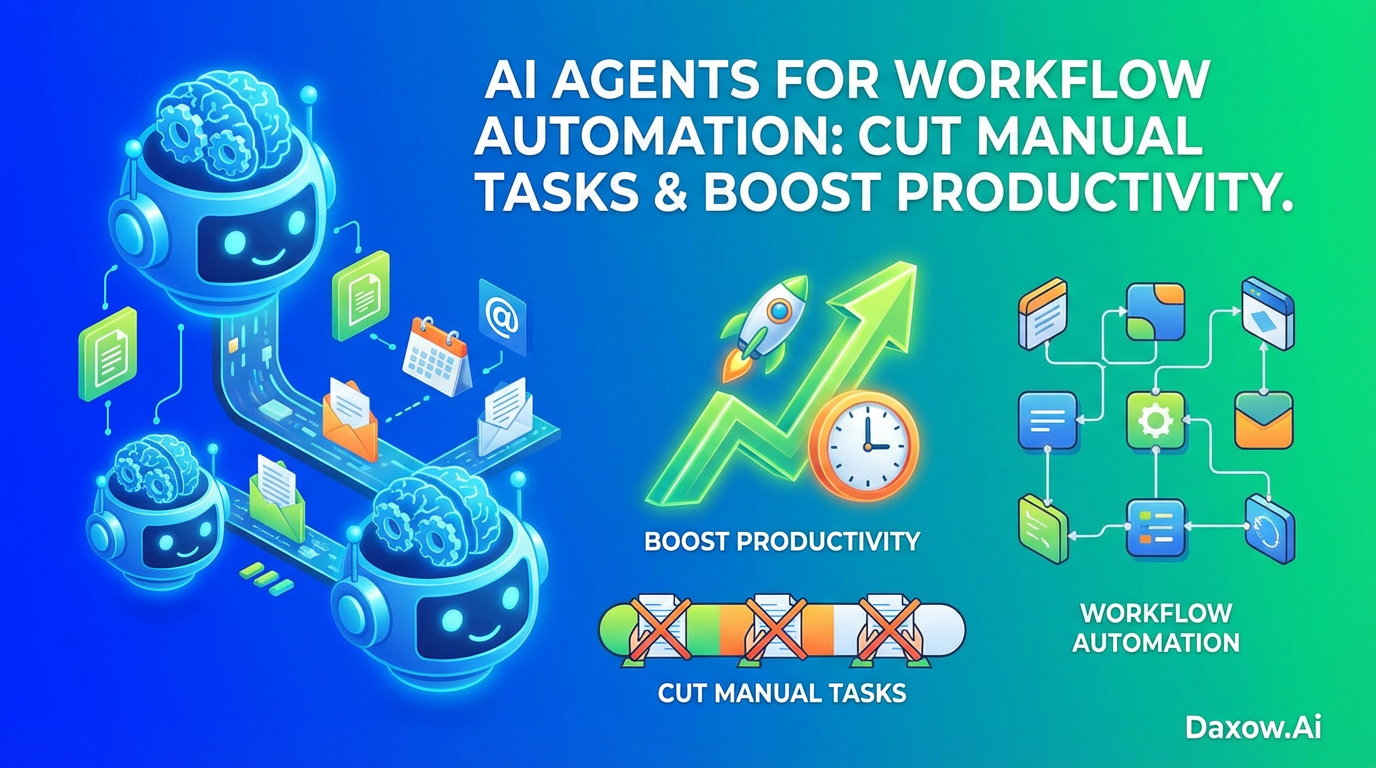
Discover how AI agents automate workflows to eliminate manual tasks, improve accuracy, and boost productivity. Includes roadmap, use cases, ROI and governance.
AI Agents for Workflow Automation: How to Eliminate Manual Tasks and Boost Productivity
Estimated reading time: 12 minutes
Key Takeaways
- AI agents combine language understanding, decision logic, and system connectivity to automate complex workflows.
- Deployment requires thorough process discovery, prototyping, training, and governance for lasting impact.
- Use cases span technology, e-commerce, finance, real estate, and healthcare, demonstrating measurable ROI.
- Risk management and compliance are vital, including data privacy and human oversight.
- Choosing the right partner like Daxow.ai ensures custom AI automation with proven outcomes.
Table of Contents
- Why AI Agents for Workflow Automation Matter
- How AI Agents Work in Workflow Automation
- AI Agents for Workflow Automation — Implementation Roadmap
- Use Cases: AI Agents for Workflow Automation Across Industries
- Measuring ROI and Defining Success
- Risk Management, Security, and Compliance
- Operationalizing AI Agents for Ongoing Value
- Choosing the Right Partner to Build AI Agents for Workflow Automation
- Frequently Asked Questions
Why AI Agents for Workflow Automation Matter
Businesses face growing pressure to do more with less: faster delivery, higher accuracy, and better customer outcomes. Traditional automation such as rules-based RPA and scheduled scripts handle predictable tasks, but modern workflows involve unstructured data, exceptions, and decision-making that require contextual understanding. AI agents bridge that gap by combining language understanding, decision logic, and connectivity to execute end-to-end tasks across systems.
Key business benefits:
- Reduce manual tasks and employee burnout.
- Increase productivity by automating repetitive and semi-structured processes.
- Improve customer support automation through faster, consistent responses.
- Enable sales automation that qualifies leads and hands off high-value prospects.
- Lower operational costs and improve compliance by reducing human error.
How AI Agents Work in Workflow Automation
AI agents are autonomous software components designed to carry out specific tasks by:
- Ingesting data from emails, documents, forms, or APIs.
- Understanding intent and extracting entities using NLP.
- Applying business rules and learned policies to decide next steps.
- Interacting with systems (CRMs, ticketing, ERPs) via integrations.
- Learning from feedback and improving performance over time.
Architectural building blocks:
- Data ingestion and extraction (document OCR, APIs).
- Intent and entity recognition (NLP models).
- Decision engine (rules + ML-driven policies).
- Orchestration layer (workflow engine, triggers).
- Integrations and connectors (CRM, helpdesk, finance systems).
- Monitoring and human-in-the-loop interfaces.
AI Agents for Workflow Automation — Implementation Roadmap
1. Process Discovery and Prioritization
- Map current workflows to identify repetitive, high-volume, or error-prone tasks.
- Evaluate business impact: time saved, cost reduction, customer satisfaction improvement.
- Prioritize processes with clear ROI and technical feasibility.
2. Define Agent Capabilities and Success Metrics
- Specify what the AI agent must do (e.g., qualify leads, route tickets, extract invoices).
- Define KPIs: reduction in manual hours, response time, error rate, conversion uplift.
- Establish data privacy and compliance requirements.
3. Prototype and Integrate
- Build a minimum viable AI agent to validate assumptions quickly.
- Integrate with core systems (CRM, ticketing, ERP) using secure APIs.
- Implement fallback routes and human-in-the-loop review for exceptions.
4. Train, Test, and Iterate
- Train NLP models with domain-specific data to improve accuracy.
- Run A/B testing in production to measure business impact.
- Iterate using feedback loops and analytics dashboards.
5. Scale and Govern
- Standardize agent deployment, monitoring, and versioning.
- Define governance policies: access control, audit trails, compliance checks.
- Establish ongoing optimization and model retraining schedules.
Use Cases: AI Agents for Workflow Automation Across Industries
Technology & SaaS — Customer Support Automation
Use case:
- AI agents triage incoming support tickets by intent and urgency.
- Agents provide instant answers for common issues and escalate complex tickets to human agents with context.
Business impact:
- Reduce manual tasks for support teams by up to 60%.
- Improve first-response time and customer satisfaction.
- Lower support costs through automation of repetitive queries.
How Daxow helps:
- Design custom chatbots and conversational AI that integrate with support platforms.
- Build agents that execute follow-up actions (reset passwords, escalate refunds).
- Connect analytics to track resolution times and automate workflow improvements.
E-commerce — Order Processing and Returns
Use case:
- Agents process orders, validate payment and shipping information, and automate return authorizations by extracting data from customer emails and documents.
Business impact:
- Reduce manual processing times from hours to minutes.
- Improve accuracy in refunds and restocking.
- Enhance customer experience with faster resolution.
How Daxow helps:
- Implement document extraction and CRM integrations to automate order lifecycle.
- Create automation that triggers fulfillment and notifies customers with personalized communications.
Finance — Invoice Processing and Reconciliation
Use case:
- AI agents extract invoice data, validate against purchase orders, and post entries to accounting systems.
Business impact:
- Reduce AP processing costs and cycle times.
- Decrease payment errors and improve vendor relationships.
- Free finance teams to focus on higher-value analysis and controls.
How Daxow helps:
- Deploy intelligent document processing pipelines with OCR and entity extraction.
- Integrate with ERPs to automate posting and reconciliation.
- Implement audit trails and exception workflows for compliance.
Real Estate — Lead Qualification and Transaction Coordination
Use case:
- Agents qualify incoming leads by analyzing inquiries, scheduling viewings, and initiating document packs for transactions.
Business impact:
- Increase lead conversion by ensuring quick follow-up.
- Reduce manual coordination for agents and administrators.
- Improve operational transparency across transactions.
How Daxow helps:
- Build AI agents that integrate with property management systems and calendars.
- Automate document generation and signature collection.
- Provide dashboards that track pipeline and automate reminders.
Healthcare — Patient Intake and Claims Processing
Use case:
- AI agents intake patient forms, extract clinical and insurance data, and submit claims or pre-authorizations.
Business impact:
- Reduce administrative burden on clinical staff.
- Improve claims accuracy and speed payments.
- Enhance patient experience with faster intake and communication.
How Daxow helps:
- Create HIPAA-compliant data extraction and routing solutions.
- Integrate with EHRs and payer systems for end-to-end automation.
- Implement secure human-in-the-loop workflows for sensitive decisions.
Measuring ROI and Defining Success
Quantifying success is essential for executive buy-in. Focus on metrics that matter to stakeholders.
Primary ROI metrics:
- Hours automated per month and associated labor cost savings.
- Reduction in error rates and compliance incidents.
- Improvement in customer response time and Net Promoter Score.
- Increase in conversion rates (for sales automation) or first-contact resolution (for support).
- Reduction in process cycle time (e.g., invoice-to-pay days).
Practical approach to ROI:
- Start with a pilot on a high-volume process.
- Measure baseline performance for 2–4 weeks.
- Deploy AI agents and track the same KPIs for an equivalent period.
- Model annualized savings, accounting for development and maintenance costs.
- Factor in indirect gains: employee reallocation to higher-value tasks, improved customer retention.
Risk Management, Security, and Compliance
AI agents introduce operational and regulatory considerations. A robust implementation mitigates risk while preserving agility.
Key considerations:
- Data privacy: Ensure secure storage, encryption, and least-privilege access.
- Auditability: Maintain logs for decisions and actions taken by agents.
- Human oversight: Implement human-in-the-loop checkpoints for high-risk or ambiguous cases.
- Bias and fairness: Monitor models for unintended behavior and correct with retraining and guardrails.
- Vendor and integration security: Vet third-party connectors and conduct penetration testing.
How Daxow ensures safe deployments:
- Security-first design with role-based access and encryption.
- Comprehensive logging and dashboards for governance.
- Compliance support tailored to industry regulations (finance, healthcare, etc.).
- Continuous monitoring and scheduled model reviews.
Operationalizing AI Agents for Ongoing Value
Building an AI agent is phase one. Capturing ongoing value requires disciplined operations.
Best practices:
- Centralized orchestration: Manage agents and workflows from a unified control plane.
- Continuous learning: Collect labeled feedback to retrain models and refine rules.
- Version control: Track model and workflow changes for reproducibility.
- Cross-functional teams: Combine domain experts, engineers, and business owners in governance.
- Change management: Communicate process changes and re-skill staff where automation shifts responsibilities.
How Daxow supports operations:
- End-to-end managed services: from development to production support.
- Training and documentation for operational teams.
- Custom monitoring and alerts to ensure SLAs are met.
Choosing the Right Partner to Build AI Agents for Workflow Automation
Selecting a vendor determines success. Look for partners that combine technical depth with business process expertise.
What to evaluate:
- Experience designing domain-specific AI agents and workflow automation.
- Track record integrating with enterprise systems and complex environments.
- Ability to deliver measurable ROI and produce case studies.
- Security and compliance practices.
- Flexible pricing and a clear roadmap for scaling automation.
Why Daxow.ai
- Custom AI solutions tailored to your processes and data.
- End-to-end process automation from discovery to production and support.
- System integrations and data connectivity that ensure agents can execute real tasks across your tech stack.
- Proven focus on reducing operational costs and improving ROI through prioritized automation.
- Building AI agents that execute real tasks, not just prototypes—designed for reliability and auditability.
Learn more about our custom AI automation services and how we help you unlock maximum value from your workflows.
Frequently Asked Questions
What kind of tasks can AI agents automate?
AI agents can automate a wide range of tasks including data extraction, lead qualification, customer support triage, invoice processing, document routing, and more complex decision-making workflows.
How do AI agents integrate with existing systems?
AI agents use APIs and connectors to integrate with CRMs, ERP systems, ticketing platforms, and other enterprise applications, enabling end-to-end process automation across your technology stack.
What measures ensure security and compliance when deploying AI agents?
Key measures include secure data storage, encryption, access controls, comprehensive audit trails, human-in-the-loop oversight, and adherence to industry-specific regulatory requirements such as HIPAA or financial compliance frameworks.
How can I measure the ROI of AI agent deployments?
ROI is measured by tracking metrics such as manual hours saved, cost reductions, error rate decreases, improvements in customer satisfaction scores, cycle time reductions, and increases in conversion or resolution rates after deployment.