
AI Agents for Workflow Automation: Reduce Manual Tasks
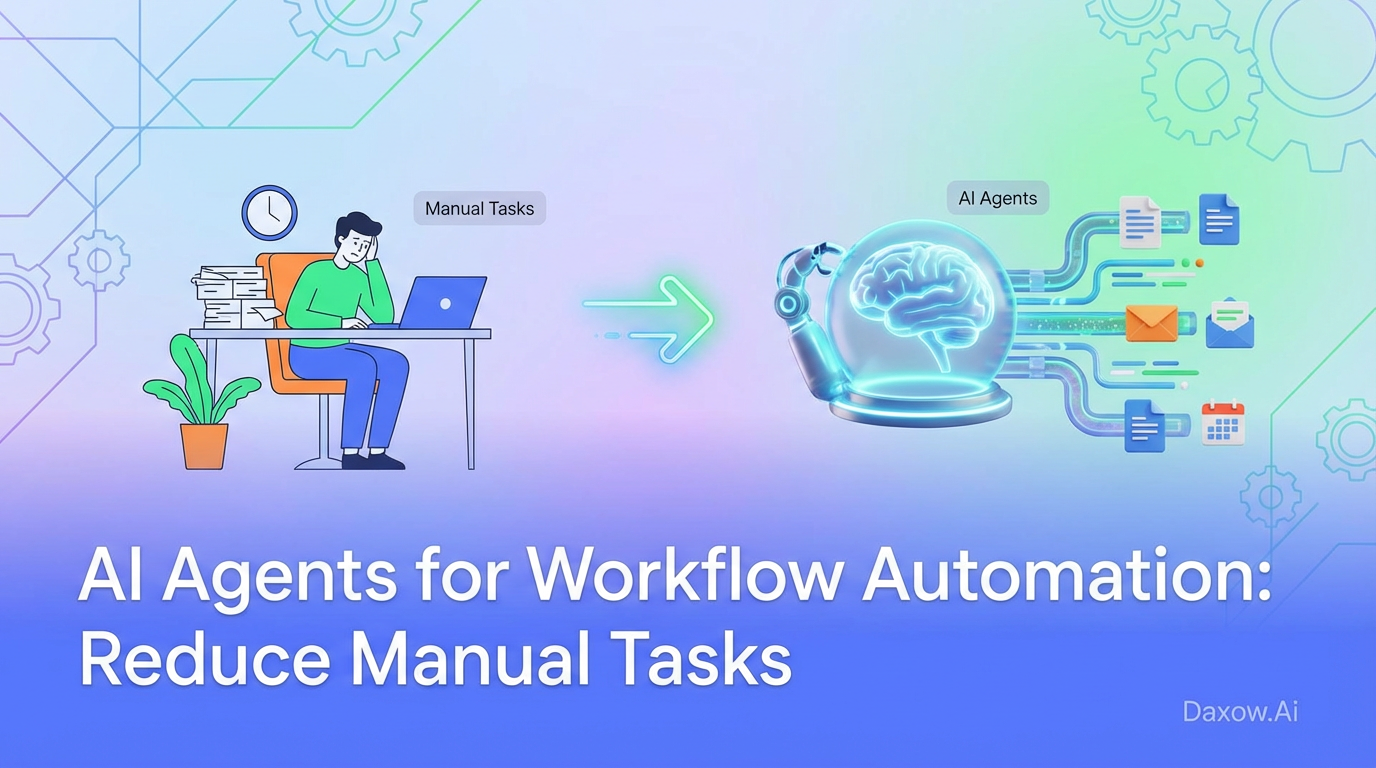
Learn how AI agents automate workflows to cut manual tasks, speed processes, and boost productivity. Includes steps, industry use cases, KPIs, and Daxow.ai
AI Agents for Workflow Automation: How to Reduce Manual Tasks and Boost Productivity
Estimated reading time: 15 minutes
Key Takeaways
- AI agents enhance workflow automation by enabling adaptive decision-making and integrating heterogeneous systems.
- Businesses benefit from reduced manual tasks, improved productivity, and operational cost savings.
- Implementation requires mapping workflows, defining agent roles, integrating systems, building and monitoring agents, and scaling with governance.
- Daxow.ai supports the full AI agent lifecycle with custom solutions, integrations, human-in-the-loop controls, and continuous optimization.
- Industry use cases span e-commerce, customer support, finance, healthcare, real estate, HR, and sales automation.
Table of Contents
- Introduction
- AI Agents for Workflow Automation: What Decision-Makers Need to Know
- Business Benefits of AI Agents for Workflow Automation
- Practical Steps to Implement AI Agents for Workflow Automation
- How Daxow.ai Supports the Full Lifecycle
- Use Cases: AI Agents for Workflow Automation across Industries
- Measuring ROI and KPIs for AI Agents for Workflow Automation
- Common Challenges and How to Mitigate Them
- Architecture Patterns and Technical Considerations
- Getting Started: A Simple Pilot Blueprint
- Why Partner with Daxow.ai
- Conclusion and Next Steps
- Frequently Asked Questions
Introduction
AI Agents for Workflow Automation are rapidly reshaping how businesses run daily operations. From automated lead qualification to end-to-end customer support workflows, AI agents can execute complex tasks, coordinate systems, and reduce manual efforts that slow teams down. This article explains what decision-makers need to know about deploying AI agents for workflow automation, provides actionable implementation guidance, and presents industry-specific use cases. Throughout, we highlight how Daxow.ai helps organizations design, deploy, and scale custom AI systems that deliver measurable ROI.
AI Agents for Workflow Automation: What Decision-Makers Need to Know
AI agents are software components that can perceive context, make decisions, and take actions across systems without constant human intervention. When combined with workflow automation, they transform fragmented processes into continuous, efficient flows.
Key characteristics of effective AI agents:
- Contextual understanding: interpret documents, messages, and data from multiple sources.
- Task execution: perform transactions, update systems, and trigger human handoffs.
- Integration capability: connect with CRMs, ERPs, ticketing systems, and APIs.
- Auditability and control: maintain logs and allow governance and overrides.
Why businesses adopt AI agents for workflow automation:
- Reduce manual tasks across teams such as operations, finance, HR, and support.
- Improve productivity by enabling staff to focus on strategic work.
- Accelerate response times for customers and internal stakeholders.
- Lower operational costs through automation and error reduction.
- Scale processes without linear increases in headcount.
How AI agents differ from traditional automation:
- Traditional automation follows fixed rules and sequences.
- AI agents add adaptive decision-making, language understanding, and end-to-end orchestration across heterogeneous systems.
Business Benefits of AI Agents for Workflow Automation
Operational benefits:
- Faster processing times: AI agents reduce manual steps in invoice processing, claims handling, and onboarding.
- Higher throughput: increased capacity for handling customer inquiries and transactions.
- Consistency and compliance: automated decision logs and rule enforcement reduce errors.
Strategic benefits:
- Better customer experience: near-instant responses, proactive notifications, and personalized interactions.
- Data-driven insights: automated capture of structured data for analytics and forecasting.
- Improved employee satisfaction: shifting staff from repetitive tasks to value-added activities.
Practical Steps to Implement AI Agents for Workflow Automation
- Map and prioritize workflows
- Identify processes with high volume, frequent exceptions, or long manual cycles.
- Prioritize by potential cost savings, customer impact, and ease of integration.
- Define agent responsibilities and outcomes
- Define what the AI agent must do: classify, extract, decide, or act.
- Set KPIs: reduction in manual hours, process cycle time, error rate, and customer satisfaction.
- Design integrations and data flows
- Inventory systems (CRM, ERP, ticketing, document repositories).
- Define APIs, webhooks, and secure data transfer requirements.
- Build and train agents
- Use labeled data and process rules to train models for classification, extraction, and dialogue.
- Combine ML models with business rules and human-in-the-loop checkpoints.
- Deploy incrementally with monitoring
- Start with pilot projects in a controlled environment.
- Monitor performance, log decisions, and collect exception cases for retraining.
- Scale and govern
- Expand to adjacent workflows, standardize APIs, and apply governance frameworks for model updates and compliance.
How Daxow.ai Supports the Full Lifecycle
- Discovery and process analysis: We map your workflows, quantify savings, and build a prioritized roadmap.
- Custom AI agents: We design agents that handle classification, extraction, task orchestration, and multi-system actions.
- Workflow automation: We implement orchestration layers that coordinate agents with your CRMs, ERPs, and productivity tools.
- Integrations and data connectivity: We build secure connectors and ensure data quality for reliable AI decisions.
- Human-in-the-loop and governance: We implement review UIs, audit logs, and rollback controls to align with compliance requirements.
- Managed scaling and optimization: Continuous monitoring, retraining, and performance tuning to increase ROI over time.
Use Cases: AI Agents for Workflow Automation across Industries
E‑commerce — Order processing and returns
Problem: Manual order reviews and return approvals create delays and increase costs.
AI agent solution: Automatically validate orders against fraud patterns, verify payment and shipping details, and process low-risk orders end-to-end. For returns, extract information from customer messages and receipts, classify return reasons, issue shipping labels, or escalate exceptions to human agents.
Business impact: Faster order fulfillment, reduced chargebacks, and lower customer support workload.
Customer support automation — Ticket triage and resolution
Problem: High ticket volume and repetitive queries overwhelm support teams.
AI agent solution: Classify incoming tickets, extract intent and entities, auto-suggest KB articles or send automated replies for common issues. For complex cases, pre-fill case notes and route to the right specialist.
Business impact: Reduced response times, higher first-contact resolution, and lower operational costs.
Finance — Invoice processing and reconciliation
Problem: Accounts payable teams spend hours extracting data and reconciling invoices.
AI agent solution: Use intelligent document processing to extract invoice fields, validate against POs, and create payment proposals in the ERP. Handle exceptions with predefined escalation workflows.
Business impact: Faster processing, fewer errors, and improved cash flow management.
Healthcare — Patient intake and prior authorization
Problem: Lengthy manual intake and insurance authorization processes cause delays and administrative burden.
AI agent solution: Extract and validate patient information from forms, verify coverage, assemble required documentation, and submit prior authorization requests to payers. Keep clinicians informed of status changes via EMR updates.
Business impact: Shorter wait times, improved billing accuracy, and higher provider productivity.
Real Estate — Lease management and compliance
Problem: Managing lease renewals, compliance documents, and tenant queries is manual and error-prone.
AI agent solution: Monitor lease expirations, draft renewal notices, extract clauses from lease documents for compliance checks, and automate tenant communications.
Business impact: Reduced vacancies, automated compliance monitoring, and improved tenant experience.
HR and administrative workflows — Candidate screening and onboarding
Problem: Recruiters spend time screening resumes and collecting documents from new hires.
AI agent solution: Automatically screen candidates against role requirements, schedule interviews, and assemble onboarding packets while verifying identity documents and compliance training.
Business impact: Faster time-to-hire, improved candidate experience, and reduced HR admin time.
Sales automation — Lead qualification and follow-up
Problem: Sales teams waste time on low-quality leads and manual follow-up.
AI agent solution: Score leads based on firmographics and behavior, qualify via automated outreach, and create prioritized tasks in the CRM. Trigger personalized sequences for high-value prospects.
Business impact: Higher conversion rates, optimized seller time, and predictable pipeline growth.
Measuring ROI and KPIs for AI Agents for Workflow Automation
Define metrics before building:
- Operational KPIs: manual hours saved, task cycle time reduction, throughput increase.
- Financial KPIs: cost per transaction, error-related cost reduction, savings from headcount reallocation.
- Customer KPIs: NPS, response time, first-contact resolution.
- Compliance KPIs: reduction in audit findings or regulatory penalties.
Example ROI calculation:
If an accounts payable process has 5 FTEs handling 20,000 invoices annually, and AI automation reduces manual effort by 60%, effective FTE savings are 3 positions. Factor in reduction in errors and earlier discounts captured via faster processing to estimate total annual benefits. Compare benefits against implementation and ongoing operating costs to calculate payback period and ROI.
Common Challenges and How to Mitigate Them
Challenge: Data silos and integration complexity
Mitigation: Prioritize common integration points, use secure connectors, and design a centralized orchestration layer.
Challenge: Change management and employee buy-in
Mitigation: Communicate benefits clearly, involve users in design, and provide training and human-in-the-loop controls.
Challenge: Model drift and performance degradation
Mitigation: Implement monitoring, periodic retraining, and exception capture workflows.
Challenge: Compliance and auditability
Mitigation: Maintain decision logs, version models, and allow supervisory overrides.
Daxow.ai’s practical approach to these challenges:
- Integration-first architecture: We design agents that connect smoothly to existing systems and respect data governance.
- Pilot-first strategy: We reduce risk by piloting with measurable success criteria.
- Human-centered design: We build interfaces for review and escalation to ensure adoption and trust.
- Continuous improvement: Ongoing monitoring and retraining as part of managed services.
Architecture Patterns and Technical Considerations
Orchestration layer:
- Acts as the control plane for AI agents.
- Manages task queues, retries, and human handoffs.
- Provides audit trails and metrics.
Hybrid automation:
- Combine rule-based automation, RPA, and AI agents.
- Use rules for deterministic steps and AI for classification, extraction, and decisioning.
Security and compliance:
- Enforce least-privilege access to systems.
- Encrypt data in transit and at rest.
- Log all agent actions for auditability.
Scalability:
- Design agents statelessly where possible.
- Use queueing and asynchronous processing for high-volume workloads.
Getting Started: A Simple Pilot Blueprint
- Select one high-impact workflow (e.g., invoice processing or lead qualification).
- Map the process end-to-end and identify automation opportunities.
- Build a minimum viable agent to handle a subset of tasks with human review.
- Measure outcomes against baseline KPIs for 30–90 days.
- Iterate, expand scope, and integrate additional systems.
Why Partner with Daxow.ai
- Experience across industries: We deliver tailored solutions for finance, healthcare, e-commerce, real estate, HR, and enterprise support.
- End-to-end delivery: From discovery to deployment and ongoing optimization.
- Business-focused outcomes: We align automation with measurable KPIs and clear ROI.
- Custom AI agents that execute real work: Not experiments—agents that make decisions, act across systems, and reduce manual workload.
- Flexible engagement models: Pilot-based, fixed-scope, or managed services depending on client needs.
Conclusion and Next Steps
AI Agents for Workflow Automation unlock significant operational and strategic value when executed with clear priorities, strong integrations, and governance. By automating repetitive tasks, improving decision speed, and connecting systems, businesses can reduce manual tasks, boost productivity, and improve customer and employee experiences.
If you are ready to evaluate which workflows to automate first or want a partner to design and build custom AI agents, Daxow.ai can help. Our process-focused approach ensures solutions that integrate with your systems, lower costs, and deliver measurable ROI.
Book a free consultation with Daxow.ai to request a process analysis for your company and start building a custom AI system that reduces manual tasks and drives productivity. Contact us today to begin.
Frequently Asked Questions
What are AI agents in workflow automation?
AI agents are intelligent software components that can perceive context, make decisions, and execute tasks automatically across multiple systems without ongoing human intervention.
How do AI agents differ from traditional automation?
Unlike traditional automation that follows fixed rules, AI agents use adaptive decision-making, natural language understanding, and orchestrate workflows across diverse applications for more flexible and intelligent automation.
Which industries benefit most from AI agents?
Industries such as e-commerce, finance, healthcare, real estate, HR, customer support, and sales find significant value from AI agents due to their complex and high-volume workflows.
How does Daxow.ai support AI agent implementation?
Daxow.ai provides end-to-end services, including workflow analysis, custom AI agent design, secure integrations, governance frameworks, pilot deployments, and continuous optimization to maximize ROI.