
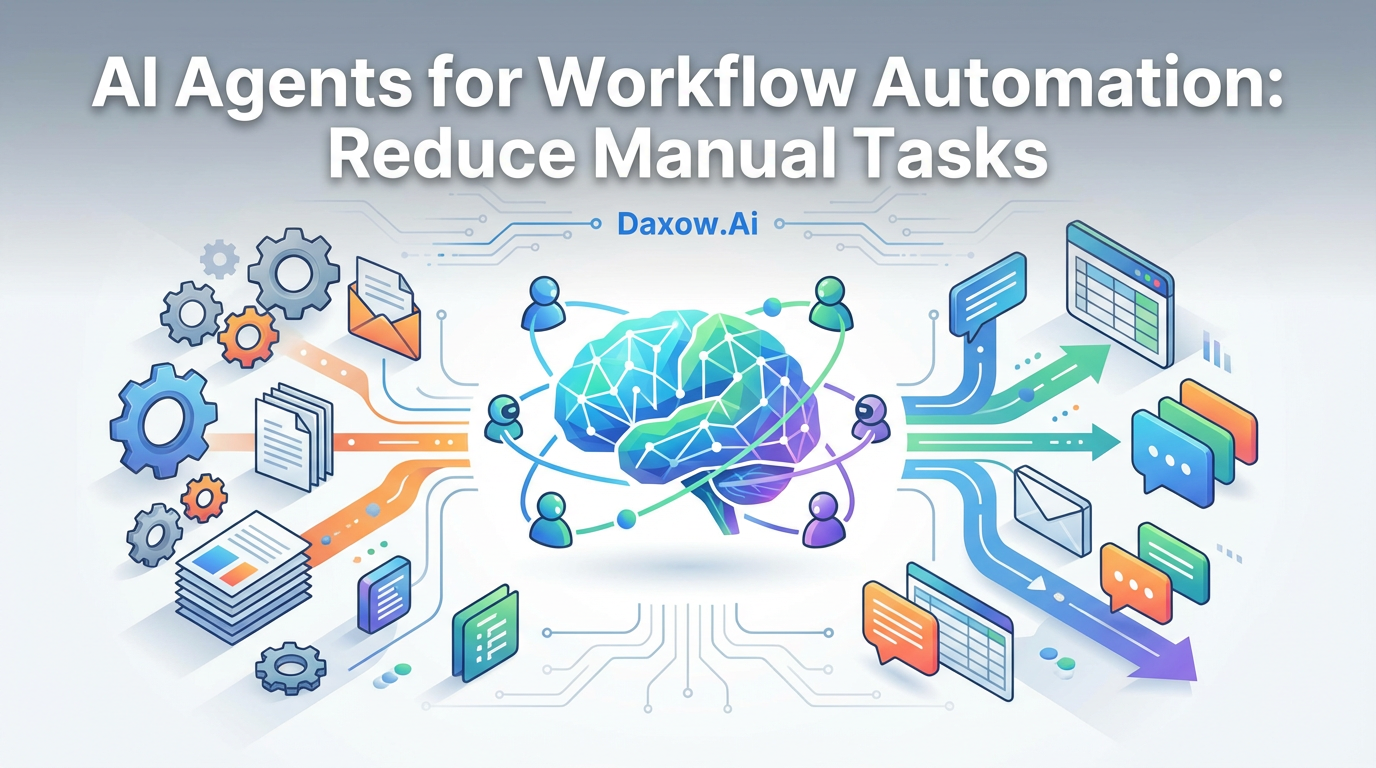
AI Agents for Workflow Automation: Reduce Manual Tasks
AI agents automate workflows to cut manual tasks, boost productivity, and deliver measurable ROI, with practical use cases and implementation steps.
AI Agents for Workflow Automation: How Businesses Can Reduce Manual Tasks and Boost Productivity
Estimated reading time: 15 minutes
Key Takeaways
- AI agents automate repetitive, rule-based workflows, delivering up to 70% reduction in processing time.
- Integrations with CRMs, ERPs, and ticketing systems are critical for maximizing automation ROI.
- Practical use cases span e-commerce, healthcare, finance, real estate, and HR sectors.
- Effective implementation involves discovery, data readiness, agent design, testing, and continuous improvement.
- Maintaining human oversight and governance ensures compliance and robust exception handling.
- Daxow.ai specializes in building customized AI agent solutions that measurably reduce manual effort and boost productivity.
Table of Contents
- Introduction
- Why AI Agents for Workflow Automation Matter Now
- Key Research Findings
- AI Agents for Workflow Automation — Core Concepts and Capabilities
- Use Cases Across Industries — Practical Examples
- Designing and Implementing AI Agents for Workflow Automation
- Measuring ROI and Business Outcomes
- Implementation Considerations and Best Practices
- Common Pitfalls and How to Avoid Them
- How Daxow.ai Helps Build AI Agents for Workflow Automation
- Next Steps — An Implementation Roadmap
- Conclusion and Call to Action
- Frequently Asked Questions
Introduction
AI Agents for Workflow Automation are rapidly moving from experimentation to core business capability. Organizations that adopt intelligent agents to orchestrate routine tasks and decisions are seeing measurable improvements in efficiency, accuracy, and customer experience. In this article we examine the strategic value of AI agents, present research-backed insights, and provide practical implementation guidance and use cases across industries. If your goal is to reduce manual tasks, accelerate workflows, and improve ROI from business automation, this guide explains how to get there—and how Daxow.ai designs and implements end-to-end AI solutions that execute real work.
Why AI Agents for Workflow Automation Matter Now
- Businesses face growing pressure to operate faster while containing costs. Manual, repetitive processes are a primary source of delay and error.
- Advances in natural language processing, integrations, and low-code orchestration make it feasible to build AI agents that act autonomously across systems.
- Early adopters report reductions in turnaround time, improved customer satisfaction, and redeployment of staff to higher-value activities.
Key Research Findings
- Automation of repetitive tasks can reduce processing time by up to 70% in targeted workflows. This translates directly into labor cost savings and capacity gains.
- AI-driven customer support automation reduces average handle time and increases first-contact resolution by enabling agents to access unstructured knowledge faster.
- Sales automation powered by AI agents improves lead qualification conversion rates by applying consistent criteria and timely follow-up.
- Integrating AI agents with CRMs and enterprise systems delivers the biggest returns when data flows are reliable and instruments for monitoring are in place.
These findings emphasize two things: first, the potential for substantial productivity gains; second, that success depends on robust integration, data quality, and tailored agent behavior. Daxow.ai specializes in designing AI agents and workflow automation that account for these realities.
AI Agents for Workflow Automation — Core Concepts and Capabilities
What is an AI agent in business automation?
An AI agent is a software component that perceives its environment (data, messages, system states), reasons about actions (rules, ML models, business logic), and executes tasks (API calls, messages, document updates) to achieve specific goals. Unlike simple bots, modern AI agents combine:
- Natural language understanding to interpret requests and documents.
- Decisioning logic to choose next steps and escalate when needed.
- System-level integrations to read and write across CRMs, ERPs, ticketing systems, and databases.
- Observability to log decisions, measure outcomes, and enable governance.
Typical capabilities that deliver business value
- Automated lead qualification and routing.
- Intelligent document extraction and data entry.
- Multichannel customer support with escalation logic.
- Purchase order processing and invoice reconciliation.
- Onboarding workflows for HR and finance.
Each capability reduces manual tasks and reassigns human effort to judgment-heavy work.
Use Cases Across Industries — Practical Examples
E-commerce — order handling and returns
Problem: Manual order exception handling and returns processing creates delays and customer dissatisfaction.
AI agent solution:
- Automatically classify return reasons from customer messages and images.
- Validate purchase history and warranty rules by calling the ERP.
- Issue RMA, schedule pickup or send return labels, and update inventory.
- Trigger refunds or exchanges through payment gateway integrations.
Impact:
- Reduce manual tasks for customer service teams by up to 60%.
- Shorter resolution times, improving customer retention and reducing return overhead.
Healthcare — prior authorizations and referral coordination
Problem: Prior authorization and referral workflows are paper-heavy and slow, delaying care.
AI agent solution:
- Extract required clinical details from referrals and medical records.
- Cross-check payer rules and prepare prefilled authorization forms.
- Submit to payer portals via secure APIs and track status until approval.
- Notify providers and patients automatically of status changes.
Impact:
- Lower administrative costs, faster approvals, and improved patient care timelines.
- Better compliance through audit-ready logs maintained by the agent.
Finance — accounts payable automation
Problem: Invoice processing involves data entry, three-way matching, and exception handling.
AI agent solution:
- Extract invoice data using advanced OCR and contextual understanding.
- Match invoices to POs and receipts; flag discrepancies automatically.
- Route exceptions to the appropriate approver with suggested resolutions.
- Schedule payments and reconcile bank statements.
Impact:
- Reduce manual tasks in AP teams, improve cash flow visibility, and decrease late payment penalties.
Real estate — tenant onboarding and maintenance requests
Problem: Tenant onboarding requires contract signing, identity verification, and setup across systems.
AI agent solution:
- Guide tenants through e-signature workflows and ID verification.
- Automatically populate property management systems and notify maintenance teams.
- Triage maintenance requests by urgency and dispatch vendors with estimated time windows.
Impact:
- Faster move-ins, fewer administrative errors, and better tenant experience.
HR — candidate screening and employee onboarding
Problem: Screening resumes and coordinating onboarding are time-consuming and inconsistent.
AI agent solution:
- Screen applicants based on role-specific criteria and score-fit candidates.
- Schedule interviews, send reminders, and collate feedback.
- Initiate onboarding tasks—equipment orders, access provisioning, and training assignments—when hiring is confirmed.
Impact:
- Increase productivity of recruiting teams and shorten time-to-hire.
Designing and Implementing AI Agents for Workflow Automation
Step 1 — Process discovery and prioritization
- Map current workflows end-to-end and quantify time spent on each task.
- Identify high-volume, rule-based tasks where automation yields quick wins.
- Prioritize by business impact, data availability, and integration complexity.
Daxow.ai approach: We perform a structured process analysis to identify where AI agents can immediately reduce manual tasks and where deeper automation will produce strategic benefits.
Step 2 — Data readiness and integrations
- Assess data quality, system APIs, and access controls.
- Define data transformation and mapping requirements.
- Plan integrations with CRMs, ERPs, ticketing tools, and document repositories.
Daxow.ai capability: Our engineers build secure connectors and data pipelines so AI agents operate reliably across systems while maintaining compliance.
Step 3 — Agent design and logic
- Define decision trees, escalation rules, and thresholds.
- Combine deterministic rules with ML models where variability exists.
- Design human-in-the-loop interventions for exceptions.
Daxow.ai capability: We create custom AI agents tuned to your business logic, including conversational front-ends for employees and customers.
Step 4 — Testing, monitoring, and governance
- Validate agent behavior against historical data and pilot in controlled environments.
- Implement observability: metrics on accuracy, throughput, time-savings, and exception rates.
- Set governance for model updates, auditing, and compliance.
Daxow.ai delivers production-grade monitoring and governance frameworks so decision-makers can measure ROI and maintain control.
Step 5 — Scale and continuous improvement
- Iterate on agent performance using logged outcomes.
- Expand to adjacent workflows and integrate additional data sources.
- Retrain models and refine rules based on real-world usage.
Daxow.ai helps scale automation across departments while ensuring reliable performance and aligned business outcomes.
Measuring ROI and Business Outcomes
Metrics to track
- Time saved per process (hours reduced).
- Reduction in manual interventions (percentage).
- Cost savings (FTE-equivalent reductions or reallocation).
- Accuracy improvements (error rate decline).
- Customer experience indicators (NPS, CSAT, response times).
- Revenue impact for sales automation (conversion uplift).
Example ROI calculation
Example: A sales operations team spends 500 hours/month qualifying leads. An AI agent that automates lead scoring and initial outreach reduces manual time by 70%.
- Hours saved = 350 hours/month.
- If average fully loaded cost is $40/hour, monthly savings = $14,000.
- Annualized savings = $168,000, excluding additional revenue uplift from faster follow-up.
This straightforward model highlights how AI agents for workflow automation often pay back implementation costs within months.
Implementation Considerations and Best Practices
Start with clear, measurable objectives
- Define what “success” looks like for each automated process.
- Align with finance and operations on metrics and timelines.
Maintain human oversight for exceptions
- Design agents to escalate complex cases to humans.
- Use human feedback to improve models and rules.
Ensure data security and compliance
- Implement role-based access and encryption for sensitive data.
- Maintain audit trails for automated decisions.
Invest in integration and data hygiene
- Reliable integrations determine agent reliability.
- Clean, normalized data reduces model errors and exception rates.
Adopt continuous improvement and change management
- Communicate benefits to frontline teams and provide training.
- Monitor performance and iterate to increase automation coverage.
Daxow.ai’s methodology embeds these best practices into each engagement, ensuring practical, low-risk deployments.
Common Pitfalls and How to Avoid Them
- Over-automation without governance: Build safeguards and incremental rollout plans.
- Ignoring edge cases: Pilot in high-volume, low-risk areas first to learn.
- Poorly integrated systems: Prioritize integration work before agent deployment.
- One-size-fits-all models: Customize agent behavior to specific business rules.
Daxow.ai mitigates these risks with phased implementations, robust testing, and tailored agent design.
How Daxow.ai Helps Build AI Agents for Workflow Automation
- End-to-end service: From process discovery to production deployment and monitoring.
- Custom AI agents: Designed to execute tasks, not just provide recommendations.
- System integrations: Secure connectors to CRMs, ERPs, ticketing systems, and data stores.
- Workflow automation: Orchestration layers that combine agents, human approvals, and scheduled tasks.
- Measurable ROI focus: We prioritize automations that deliver rapid cost savings and productivity gains.
- Ongoing support: Continuous model tuning, feature expansion, and governance.
Whether you need customer support automation, sales automation, or document automation across finance and HR, Daxow.ai delivers tailored solutions that reduce manual tasks and increase productivity.
Next Steps — An Implementation Roadmap
- Conduct a free process analysis to identify top automation candidates.
- Pilot an AI agent on one high-impact workflow (4–8 weeks).
- Measure and validate savings, then scale progressively across departments.
- Establish a governance and improvement cycle for continued gains.
Conclusion and Call to Action
AI Agents for Workflow Automation are a pragmatic way to reduce manual tasks, boost productivity, and improve customer and employee experience. The technical building blocks are mature; the differentiator is thoughtful design, integration, and governance. Daxow.ai partners with businesses to design, build, and scale AI agents that perform real work—delivering measurable cost savings and operational improvements.
Book a free consultation with Daxow.ai or request a process analysis for your company to identify the fastest path to automation and measurable ROI. Contact us to build a custom AI system that transforms your workflows.
Frequently Asked Questions
What types of tasks can AI agents automate in business workflows?
AI agents can automate repetitive and rule-based tasks such as lead qualification, document processing, customer support triage, purchase order handling, invoice reconciliation, and onboarding workflows.
How do AI agents integrate with existing enterprise systems?
AI agents connect via APIs and connectors to CRMs, ERPs, ticketing systems, and databases, enabling them to read and update data autonomously while maintaining security and compliance.
Is human oversight still necessary when using AI agents?
Yes, human oversight is critical for handling exceptions, escalating complex cases, and continuously improving AI models through feedback loops.
How soon can I expect ROI from implementing AI agents?
Many organizations see payback on AI agent implementations within a few months due to significant reductions in manual labor, faster processing, and improved customer outcomes.