
Transform Operations with AI Agents and Workflow Automation
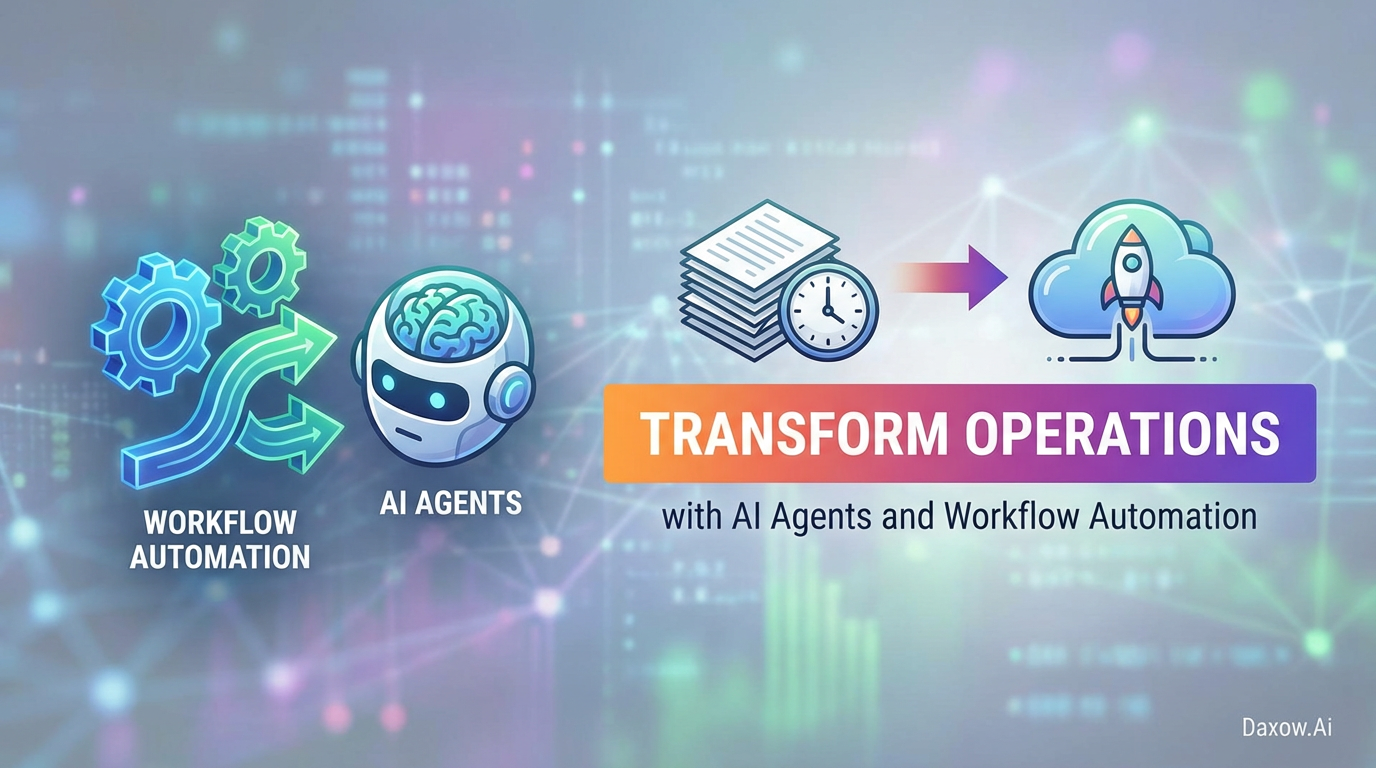
Guide to designing, implementing, and scaling AI agents for workflow automation, with use cases, ROI methods, integration tips, and governance best practices.
AI Agents for Workflow Automation: Transforming Business Operations
Estimated reading time: 12 minutes
Key Takeaways
- AI agents automate repetitive tasks, reducing error rates and manual effort by up to 70%.
- Workflow automation powered by AI improves response times, scalability, and service quality across industries.
- Successful AI automation requires clean data, system integrations, and human-in-the-loop governance.
- Daxow.ai delivers custom AI agents and end-to-end automation solutions that increase productivity and ROI.
- Measuring impact via KPIs and phased implementation is essential for scaling AI-driven workflows effectively.
Table of Contents
- AI Agents for Workflow Automation: Transforming Business Operations — Key Research Findings
- Business Value of AI Agents and Workflow Automation
- Use Cases — Practical Examples Across Industries
- Designing and Implementing AI Agents and Workflow Automation
- Technical Considerations — Integrations, Security, and Governance
- Measuring ROI and Business Outcomes
- Implementation Roadmap — From Pilot to Enterprise Automation
- Quick Wins and Practical Tips
- Why Partner with Daxow.ai for Business Automation
- Frequently Asked Questions
AI Agents for Workflow Automation: Transforming Business Operations — Key Research Findings
- Automation reduces routine work and error rates. Industry reports consistently show that automating repetitive tasks reduces human error and frees staff for higher-value activities. Organizations that apply AI to document processing and ticket triage report major drops in processing times and rework.
- AI agents improve response times and service quality. Automated agents handling first-line support and lead qualification deliver faster resolution and consistent answers, improving customer satisfaction metrics.
- Scalability and cost efficiency. Workflow automation powered by AI agents enables companies to scale operations without proportional headcount growth, improving operational margins.
- Integration and data quality are decisive. Successful deployments rely on clean data flows and tight system integrations. AI performance and ROI decline when data is siloed or inconsistent.
- Governance and human-in-the-loop remain essential. Best practice research emphasizes human oversight, audit trails, and explainability to manage risk and regulatory compliance.
These findings underline two truths: the technology is mature enough to drive meaningful ROI, and the greatest gains come from combining AI agents with thoughtful process design and enterprise integrations.
Business Value of AI Agents and Workflow Automation
Quantifiable benefits
- Reduced manual tasks: AI agents can automate high-volume repetitive tasks such as data entry, ticket classification, and routine approvals, often eliminating 30–70% of manual effort per process.
- Faster cycle times: Automated workflows reduce process cycle time—customer responses and document approvals can shift from days to minutes.
- Higher productivity: With AI handling routine work, knowledge workers spend more time on strategy, complex problem solving, and customer relationships.
- Improved accuracy and compliance: AI-driven data extraction and validation lower error rates and support consistent compliance with policies.
- Cost savings and ROI: By reducing FTE hours and error-related costs, many organizations achieve payback within months on targeted automation projects.
Strategic advantages
- Competitive differentiation: Faster service and personalised automation increase customer loyalty.
- Business continuity: Automated agents provide reliable performance during surges in demand.
- Data-driven insights: Automated processes generate richer telemetry for continual improvement.
Use Cases — Practical Examples Across Industries
E‑commerce — Order Processing & Customer Support Automation
- Business problem: High volumes of order inquiries, returns, and manual order verification.
- AI solution: AI agents extract order details, validate inventory, initiate refund/return workflows, and handle common customer queries through chatbots integrated with CRM and order management systems.
- Outcomes: Reduced manual order handling by up to 60%, faster refunds, improved NPS, and fewer escalations to human agents.
Healthcare — Patient Intake & Document Automation
- Business problem: Manual patient intake, insurance verification, and clinical documentation create administrative bottlenecks.
- AI solution: Intelligent document processing to extract patient data, automated insurance eligibility checks, and AI agents that pre-fill EMR fields and flag inconsistencies for clinician review.
- Outcomes: Lower administrative overhead, faster patient processing, and improved clinician satisfaction by freeing time for patient care.
Finance — Invoice Processing & Compliance Monitoring
- Business problem: High-volume invoice processing, manual approvals, and regulatory reporting overhead.
- AI solution: AI agents extract invoice data, match POs, route exceptions to approvers, and automatically populate accounting systems while maintaining audit trails.
- Outcomes: Reduced invoice cycle time, fewer payment delays, and stronger compliance with reporting requirements.
Real Estate — Lead Qualification & Property Management Automation
- Business problem: Slow lead response, fragmented customer data, and repetitive tenant communications.
- AI solution: AI agents qualify leads from multiple channels, schedule viewings, generate contracts, and automate tenant onboarding tasks with CRM integration.
- Outcomes: Faster conversion rates, improved agent productivity, and consistent tenant communications.
HR & Administration — Candidate Screening and Employee Onboarding
- Business problem: Time-consuming resume screening, background checks, and manual onboarding steps.
- AI solution: Automated resume parsing, candidate scoring, interview scheduling, and generation of onboarding checklists and documentation.
- Outcomes: Shorter time-to-hire, reduced recruiter effort, and smoother new-hire experiences.
Customer Support & Sales Automation — Intelligent Ticket Triage and Lead Routing
- Business problem: High ticket volumes and misrouted leads causing slow responses and lost opportunities.
- AI solution: AI agents classify incoming tickets, extract intents and entities, auto-respond to common queries, and route complex issues to the right teams. For sales, AI qualifies leads and schedules meetings.
- Outcomes: Faster SLA compliance, improved conversion rates, and better utilization of human agents for high-value conversations.
Designing and Implementing AI Agents and Workflow Automation
Step 1 — Process discovery and value mapping
- Conduct workshops to map current workflows.
- Identify high-volume, high-friction tasks with measurable KPIs.
- Prioritize quick-win automations that reduce manual tasks and improve customer outcomes.
Step 2 — Data assessment and integration planning
- Audit data sources and quality.
- Define integration points with CRMs, ERPs, ticketing systems, and document repositories.
- Plan APIs, webhooks, and secure connectors to ensure reliable data flow.
Step 3 — Build AI agents and workflows
- Design AI agents with clear task boundaries (e.g., document extraction, ticket triage, scheduling).
- Implement human-in-the-loop checks for exceptions and governance.
- Build end-to-end workflows: trigger → AI processing → action → logging → escalation.
Step 4 — Test, iterate, and scale
- Pilot in controlled environments, measure impact on KPIs, and iterate on models and rules.
- Expand scope and integrate additional systems based on pilot results.
- Monitor performance and retrain models as processes and data evolve.
Throughout these steps, Daxow.ai helps organizations by conducting process analyses, designing custom AI agents, implementing workflow automation, and integrating systems end-to-end to reduce manual tasks and improve productivity.
Technical Considerations — Integrations, Security, and Governance
System Integrations and Data Connectivity
- API-first design: Agents must interact reliably with CRMs, ERPs, and ticketing platforms. Plan for robust APIs and secure connectors.
- Data normalization: Standardize formats before handing data to AI agents to improve extraction accuracy.
- Event-driven automation: Use event triggers and webhooks to ensure timely agent execution and to maintain audit trails.
Security and Compliance
- Access control: Apply role-based access to AI systems and logs.
- Data privacy: Encrypt sensitive data at rest and in transit; ensure agents respect consent and retention policies.
- Auditing: Maintain complete audit trails of agent decisions and human overrides for compliance and traceability.
Governance and Human Oversight
- Human-in-the-loop: Define thresholds for when AI agents act autonomously and when human review is required.
- Explainability: Provide interpretable outputs and rationale for automated actions, especially in regulated industries.
- Continuous monitoring: Track model drift, performance, and business impact to prevent degradation.
Daxow.ai provides technical architecture design, secure integration development, and production-grade monitoring to ensure your automation operates reliably and compliantly.
Measuring ROI and Business Outcomes
Key metrics to track
- Reduction in manual hours: Measure time saved across roles and processes.
- Cycle time reduction: Track how long tasks take before and after automation.
- Error rate and rework: Monitor improvements in accuracy.
- Customer experience metrics: NPS, CSAT, response time, and resolution time.
- Cost savings: Quantify reduced FTE costs and error-related losses.
- Throughput and scalability: Measure volume handled without incremental hiring.
Example ROI calculation
- Estimate average processing time per task and volume per month.
- Calculate time saved by automation and convert to FTE equivalents and cost savings.
- Include implementation costs, ongoing maintenance, and expected productivity gains.
- Use conservative assumptions and track results to refine projections.
Daxow.ai helps build measurement frameworks and dashboards so decision-makers can see real-time ROI and justify further investment in business automation.
Implementation Roadmap — From Pilot to Enterprise Automation
Phase 1 — Pilot (4–8 weeks)
- Select 1–3 high-impact processes.
- Build minimal viable AI agents and simple workflows.
- Measure KPIs and refine models.
Phase 2 — Scale (3–6 months)
- Expand to additional processes and integrate with enterprise systems.
- Introduce advanced automation (orchestration, multi-agent workflows).
- Harden security and governance.
Phase 3 — Operate & Optimize (ongoing)
- Continuous monitoring, model retraining, and process improvement.
- Regularly add new agents as business needs evolve.
- Institutionalize automation as part of operational strategy.
Daxow.ai delivers an end-to-end approach: from process discovery and pilot implementation to enterprise-scale orchestration and continuous optimization—helping companies reduce operational costs and improve ROI.
Quick Wins and Practical Tips
- Start with high-volume, rule-based tasks for fastest impact.
- Combine AI agents with workflow automation to complete end-to-end processes (not just one-off tasks).
- Maintain simple, auditable decision paths to build stakeholder trust.
- Regularly retrain models with domain-specific data to improve accuracy.
- Involve end users early to ensure automation matches real needs.
Why Partner with Daxow.ai for Business Automation
- Process expertise: We map workflows and identify automation opportunities that deliver measurable business value.
- Custom AI systems: We design AI agents that execute real tasks—document extraction, ticket triage, lead qualification, and more.
- End-to-end automation: From API integrations to workflow orchestration, we automate processes across tools and teams.
- Cost and ROI focus: We prioritize automations that reduce manual tasks, lower operational costs, and improve productivity.
- Secure, compliant deployments: We build with governance, explainability, and data security in mind.
Whether you need an AI agent to automate customer support, a workflow to speed invoice processing, or a full automation platform integrated with your CRM and ERP, Daxow.ai can design and deliver a tailored solution.
Introduction
AI Agents for Workflow Automation: Transforming Business Operations is rapidly becoming the strategic priority for organizations that want to reduce manual tasks, improve productivity, and deliver better customer experiences. This article explains why AI agents and workflow automation matter today, summarizes key research-backed findings, and offers an actionable roadmap for business leaders to design, implement, and scale AI-driven automation. Practical use cases across industries show how AI agents can be applied to real tasks—supported by how Daxow.ai designs custom AI systems, integrates them with existing tools, and measures business impact.
Conclusion and Call to Action
AI Agents for Workflow Automation: Transforming Business Operations is no longer an experimental concept—it is a practical strategy for businesses that want to reduce manual work, boost productivity, and improve customer experiences. By combining AI agents with workflow automation, robust integrations, and strong governance, organizations in e-commerce, healthcare, finance, real estate, HR, and customer support can achieve rapid, measurable results.
Book a free consultation with Daxow.ai to request a process analysis for your company and begin building a custom AI system that reduces manual tasks, lowers operational costs, and increases productivity. Contact us to start your automation transformation.
Frequently Asked Questions
What types of tasks can AI agents automate?
AI agents can automate high-volume, repetitive tasks such as data entry, ticket classification, lead qualification, document processing, and routine approvals across various industries.
How does Daxow.ai ensure data security in AI automation?
Daxow.ai implements role-based access controls, encrypts data both at rest and in transit, and maintains complete audit trails to ensure compliance with security and privacy standards.
Is human oversight necessary when using AI agents?
Yes, best practices recommend human-in-the-loop governance to monitor exceptions, ensure explainability, and maintain compliance with regulations and business policies.
How can I measure the ROI of AI workflow automation?
By tracking metrics such as reduction in manual hours, cycle time improvements, error rate reductions, customer satisfaction scores, cost savings, and throughput increases, businesses can evaluate the real impact of AI automation initiatives.