
Unlock Business Growth with AI Agents and Workflow Automation
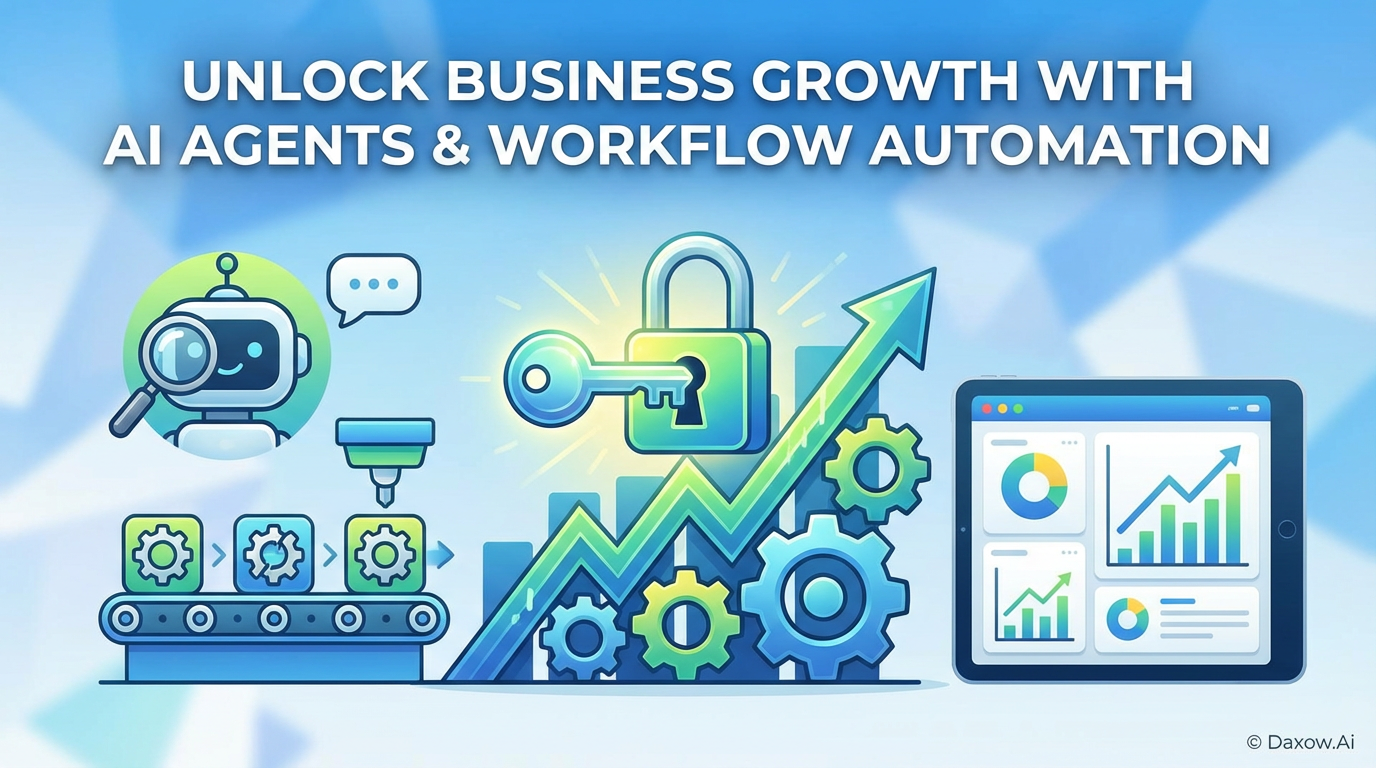
How Daxow.ai leverages AI agents and workflow automation to cut manual work, reduce costs, improve accuracy, and scale operations—includes roadmap and KPIs.
Unlocking Business Growth: The Transformative Power of AI Agents and Automation
Estimated reading time: 15 minutes
Key Takeaways
- AI agents and workflow automation drive significant productivity and cost improvements across industries.
- Daxow.ai provides a practical roadmap and custom AI agent solutions for scalable business automation.
- Successful implementations require clear KPIs, rigorous data preparation, and continuous monitoring.
- Measurable ROI includes up to 50% productivity gains and 90% reduction in error rates within 12-18 months.
- Cross-industry use cases range from personalized customer engagement to fraud detection and resume screening.
Table of Contents
- Introduction
- AI Agents and Automation Benefits
- Practical Use Cases: How AI Agents Drive Results Across Industries
- How AI Agents and Workflow Automation Deliver Tangible Business Value
- Implementation Roadmap: From Process Assessment to Full Automation
- Best Practices and Common Pitfalls
- Operational Considerations and Risk Management
- Measuring Success: KPIs and Expected ROI
- Practical Roadmap Example: Sales Automation Pilot (90 Days)
- Getting Started with Daxow.ai
- Frequently Asked Questions
Introduction
Unlocking Business Growth: The Transformative Power of AI Agents and Automation is not a theoretical promise — it is a practical pathway for organizations that want to reduce manual work, accelerate decision-making, and scale operations. Since our founding in Estonia in 2024, Daxow.ai has helped companies map existing workflows, identify high-impact automation opportunities, and build custom AI systems that execute real tasks across the enterprise.
This article explains what AI agents and workflow automation mean for business leaders, shows industry-specific use cases, presents an implementation roadmap, and highlights measurable ROI and KPIs to track success.
AI Agents and Automation Benefits
AI agents and automation combine machine learning, natural language processing, and workflow orchestration to perform tasks autonomously. These systems shift organizations away from manual, error-prone processes toward scalable, repeatable workflows. Key outcomes include:
- Significant productivity gains — businesses report up to 40–50% improvements in team output when routine work is automated.
- Measurable cost reductions — automating tasks like invoice processing and lead qualification reduces processing costs and error rates.
- Faster, more accurate decisions — predictive analytics and anomaly detection allow teams to act before problems escalate.
- Improved customer experience — automation personalizes interactions at scale, reducing response times and increasing satisfaction.
AI agents act as proactive digital workers: they ingest structured and unstructured data, execute multi-step workflows, and interact with business systems like CRMs and ERPs. Paired with workflow automation, they create end-to-end processes that minimize human intervention and preserve data continuity across tools.
Practical Use Cases: How AI Agents Drive Results Across Industries
E-commerce
Use case: Personalized customer conversations and supply chain alerts.
- AI agents handle complex customer queries via chatbots, generate personalized product descriptions, and summarize review sentiment to inform merchandising.
- Workflow automation triggers inventory reorders when predictive models forecast stockouts.
- Business impact: faster resolution times, higher conversion rates through personalization, and fewer lost sales from stockouts.
- How Daxow helps: design chatbots integrated with commerce platforms, implement predictive inventory models, and connect order/warehouse systems.
Healthcare
Use case: Document automation and clinical decision support.
- Agents extract clinical data from notes, populate EHR fields, and flag anomalies in patient vitals for clinician review.
- Automation routes tasks (e.g., prior authorizations) to the correct teams with required documentation attached.
- Business impact: reduced administrative backlogs, improved compliance, and earlier intervention on patient risk signals.
- How Daxow helps: build HIPAA-compliant ingestion pipelines, automate document extraction, and create clinician-facing AI assistants.
Finance
Use case: Fraud surveillance, reconciliation, and forecasting.
- AI agents monitor transactions for suspicious patterns, automatically reconcile invoices with payments, and generate cash-flow forecasts from historical patterns.
- Workflow automation executes exception handling with human-in-the-loop approvals when needed.
- Business impact: faster fraud detection, lower reconciliation labor costs, and better-informed treasury decisions.
- How Daxow helps: implement secure connectors to banking and accounting systems, deploy anomaly detection models, and automate exception workflows.
Real Estate
Use case: Lead qualification and market intelligence.
- Agents score inbound leads, enrich profiles with market data, and auto-generate property listings and emails.
- Automation ensures hot leads are routed to agents within SLAs.
- Business impact: higher lead-to-deal conversion, reduced agent time on admin tasks, and more accurate pricing decisions.
- How Daxow helps: integrate lead sources with CRMs, build scoring models, and automate listing generation.
Human Resources
Use case: Resume screening and onboarding automation.
- AI agents parse CVs, rank candidates by fit, schedule interviews, and populate HR systems with onboarding paperwork.
- Sentiment analytics track employee feedback to flag retention risks.
- Business impact: shorter time-to-hire, consistent candidate evaluation, and improved employee retention.
- How Daxow helps: create candidate pipelines, implement automated scheduling and document workflows, and build HR dashboards.
Customer Support
Use case: Customer support automation and escalation.
- Chatbots and AI agents resolve routine requests, summarize case histories for agents, and automatically escalate complex issues.
- Automation monitors SLAs and triggers remediation workflows when targets are missed.
- Business impact: lower support costs, faster resolution, and improved NPS.
- How Daxow helps: design hybrid human-AI support systems, integrate with ticketing platforms, and automate escalation rules.
How AI Agents and Workflow Automation Deliver Tangible Business Value
AI agents are not just tools; they are digital teammates that execute repeatable, rules-based tasks and cognitive functions. When coupled with workflow automation, they deliver measurable benefits:
- Reduce manual tasks: Free teams from repetitive data entry, triage, and routing work.
- Increase productivity: Reallocate human effort to strategic tasks that require judgment and creativity.
- Improve accuracy: Cut error rates (e.g., invoice processing errors may drop by up to 90% with automation).
- Scale without linear headcount increases: Handle higher volumes with the same or smaller teams.
- Enhance customer experience: Provide faster, personalized responses through customer support automation and sales automation.
Daxow.ai specializes in integrating AI agents with existing business systems—CRMs, ERPs, ticketing tools—so data flows seamlessly and workflows execute reliably. This systems-level approach preserves institutional knowledge and avoids creating new silos.
Implementation Roadmap: From Process Assessment to Full Automation
-
Discover and Prioritize
- Assess current workflows and identify processes that are highly repetitive, rule-based, or data-intensive.
- Set measurable objectives (e.g., reduce average handle time by 30%, or cut invoice processing costs by 40%).
- Daxow role: run a process analysis workshop and produce a prioritized automation roadmap.
-
Prepare Data and Integrations
- Clean, standardize, and map data sources. Ensure privacy and compliance requirements are addressed.
- Build APIs and connectors to centralize data access.
- Daxow role: implement secure data pipelines and integrations with your CRM, ERP, and document repositories.
-
Design Target Workflows and Agents
- Define end-to-end workflows, decision points, and human-in-the-loop handoffs.
- Design AI agents’ capabilities: NLP for text understanding, classification for triage, and predictive models for forecasting.
- Daxow role: co-design workflows with stakeholders and prototype AI agents for targeted tasks.
-
Pilot and Validate
- Deploy small-scale pilots to validate accuracy, latency, and user acceptance.
- Track pilot KPIs: task completion rate, error rate, processing time, and user satisfaction.
- Daxow role: run pilots, collect feedback, and iterate models and workflows.
-
Scale and Operate
- Roll out automation across teams, monitor performance, and schedule regular retraining.
- Implement governance for change management and security.
- Daxow role: provide managed services, monitoring dashboards, and continuous optimization support.
Best Practices and Common Pitfalls
- Avoid shadow AI: centralize governance and document approved agent capabilities.
- Design hybrid workflows: allow human override and clear escalation paths.
- Invest in observability: monitor model drift and operational metrics.
- Deliver quick wins: start with processes that offer fast payback to build buy-in.
- Train and communicate: provide user training and highlight time saved to reduce resistance.
Operational Considerations and Risk Management
- Data privacy and compliance: build privacy-by-design systems and enforce access controls.
- Model explainability: provide transparent decision logs for regulated environments.
- Security: secure APIs, credential management, and encrypted data stores are essential.
- Change management: communicate the role of AI agents and provide training to maximize adoption.
- Continuous improvement: establish retraining schedules and feedback loops so models remain accurate and aligned with business objectives.
Daxow provides governance frameworks, secure architectures, and observability tooling to mitigate these risks while enabling rapid delivery.
Measuring Success: KPIs and Expected ROI
Decision-makers should measure both operational metrics and business outcomes:
Key KPIs
- Process cycle time reduction (e.g., time from ticket open to resolution)
- Error rate reduction (e.g., misclassified claims or invoice mismatches)
- Cost per transaction or case
- Customer satisfaction (CSAT/NPS)
- Lead-to-deal conversion rates for sales automation
- Time saved per employee or FTE reduction
- Model accuracy and drift metrics
Expected ROI
- Productivity increases: 20–50% improvements are common after automation.
- Error reductions: up to 90% in tasks like invoice processing.
- Financial returns: strategic implementations can deliver 3–5x ROI within 12–18 months.
- Speed to value: fraud detection and reconciliation automation often yield ROI within weeks.
Daxow works with clients to define a KPI dashboard aligned with strategic goals and to translate those metrics into clear ROI estimates for each automation initiative. Learn more about our KPI dashboards and ROI frameworks on our Solutions page.
Practical Roadmap Example: Sales Automation Pilot (90 Days)
- Week 1–2: Process mapping and data access setup.
- Week 3–4: Build lead scoring model and integrate with CRM.
- Week 5–6: Implement automated lead routing and email sequence triggers.
- Week 7–8: Pilot with a subset of leads; measure conversion lift and lead response time.
- Week 9–12: Iterate, expand to all regions, and train sales staff on workflows.
Outcome: Reduced lead response time, higher qualified lead rate, and increased sales productivity.
Getting Started with Daxow.ai
Daxow.ai builds tailor-made AI agents and workflow automation solutions that connect to your systems, reduce manual tasks, and scale outcomes. Our end-to-end approach includes:
- Process analysis and prioritization to target high-impact automations.
- Custom AI agents for document automation, lead qualification, customer support automation, and more.
- Seamless integrations with CRMs, ERPs, and collaboration tools.
- Production-grade deployment, monitoring, and continuous optimization.
- Governance, compliance, and security baked into every solution.
If your organization is ready to move from exploratory pilots to operational AI, Daxow can guide the entire journey from concept to scaled automation. Visit our About page to learn more about our approach and expertise.
Frequently Asked Questions
What are AI agents, and how do they differ from traditional automation?
AI agents are autonomous software programs that use machine learning, natural language processing, and decision-making to perform complex, multi-step tasks across business systems. Unlike traditional automation, which follows fixed rules, AI agents adapt and optimize their actions based on data and context.
How does Daxow.ai ensure data privacy and security?
Daxow.ai builds privacy-by-design architectures with secure data pipelines, encrypted storage, and strict access controls. Our solutions comply with industry regulations such as GDPR and HIPAA depending on the use case, protecting sensitive business and customer information.
What kind of ROI can we expect from AI agent implementations?
Clients typically see 20–50% productivity improvements and up to 90% reductions in error rates within 12 to 18 months. Financial returns can be 3 to 5 times the initial investment, with some automation initiatives delivering ROI in weeks. Results depend on strategic alignment and deployment scale.
How does the implementation roadmap work?
The roadmap includes discovery and prioritization, data preparation, workflow and AI design, pilot validation, and scaling. Daxow.ai provides expert guidance and managed services at every stage to ensure successful adoption and continuous improvement.