
AI Agents Transforming Workflow Automation: Use Cases & ROI
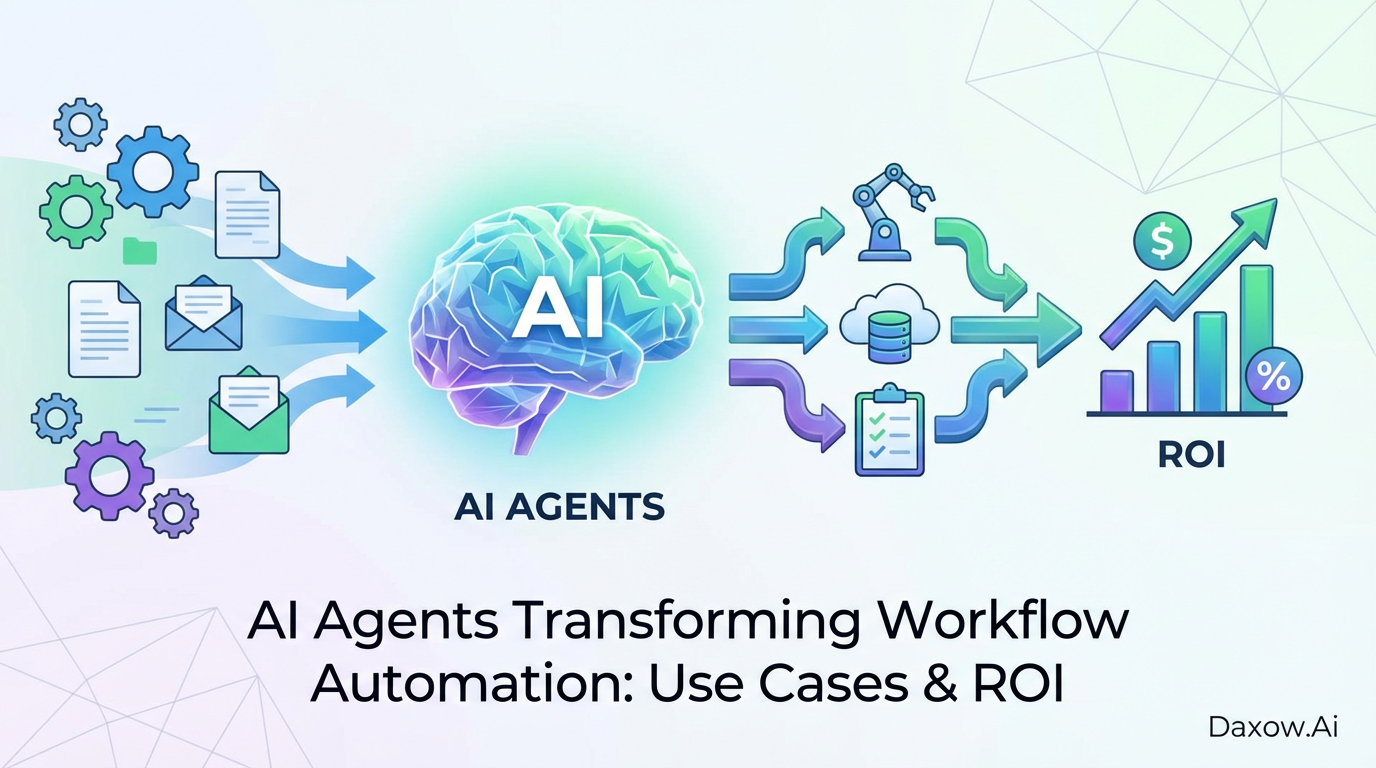
Learn how AI agents automate workflows to cut manual work, speed resolution, reduce costs, and improve CX. Includes use cases, KPIs, and a practical implementation framework.
How AI Agents Are Transforming Workflow Automation
Estimated reading time: 15 minutes
Key Takeaways
- AI agents significantly reduce manual tasks and improve accuracy in workflows.
- Integration of large language models, RPA, and document understanding enables intelligent automation.
- Industry use cases span e-commerce, healthcare, finance, real estate, HR, and customer support.
- Daxow.ai provides end-to-end AI agent design, deployment, and governance services.
- Tracking KPIs and phased implementation ensures measurable ROI and scalability.
Table of Contents
- How AI Agents Are Transforming Workflow Automation — Strategic Impact
- Research Insights and Business Outcomes
- Use Cases — Practical Examples Across Industries
- Implementation Framework — From Process Discovery to Production
- Technical Considerations and Best Practices
- Measuring ROI — What to Track
- Common Pitfalls and How to Avoid Them
- How Daxow.ai Designs and Delivers AI Agent Solutions
- Getting Started — A Practical First Project
- Frequently Asked Questions
How AI Agents Are Transforming Workflow Automation — Strategic Impact
AI agents are autonomous or semi-autonomous software entities that perform defined tasks by interacting with systems, data, and people. When incorporated into workflow automation, they move beyond rule-based automation to decision-driven execution. The strategic consequences include:
- Higher productivity: AI agents handle repetitive tasks, freeing staff for strategic work.
- Faster cycle times: Actions that once required human triage happen in seconds.
- Improved accuracy: Natural language understanding and contextual reasoning reduce errors.
- Operational scalability: More throughput without linear headcount increases.
- Better customer experience: Faster, personalized responses and end-to-end issue resolution.
Key technologies powering AI agents in workflow automation include large language models (LLMs), RPA connectors, document understanding systems, and event-driven orchestration. Combining these creates systems capable of parsing emails, extracting data from documents, updating CRMs, and even negotiating simple exceptions — all while logging decisions and outcomes for auditability.
Research Insights and Business Outcomes
Recent industry research shows organizations that implement advanced automation and AI see measurable returns. Typical outcomes we observe with clients include:
- Reduction in manual work by 30–70% for targeted processes.
- Average case resolution time reduced by 40–80% in customer support automation.
- Lead qualification and routing improved by 50%, increasing sales-ready leads.
- Processing cost per transaction lowered by 20–60% in document-heavy workflows.
These improvements derive from the combination of workflow automation and intelligent decision-making performed by AI agents. Daxow.ai specializes in measuring baseline KPIs and designing solutions that make these outcomes repeatable and auditable.
Use Cases — Practical Examples Across Industries
E-commerce — Automated Order Exception Handling
Problem: Manual triage of order exceptions (out-of-stock, address errors, payment disputes) creates delays and escalations.
AI Agent Capability:
- Monitor order events from the commerce platform.
- Read customer communications and invoices.
- Automatically attempt resolution steps (retry payment, suggest alternative SKU, offer self-service return labels).
- Escalate to human agents with context and suggested next actions.
Impact:
- Reduced manual intervention by up to 60%.
- Improved delivery times and customer satisfaction.
- Lower operational costs and fewer chargebacks.
Healthcare — Prior Authorization and Intake Automation
Problem: Prior authorization and patient intake require significant manual form filling and document verification.
AI Agent Capability:
- Extract relevant fields from referrals and medical records.
- Populate payer forms and check authorization requirements.
- Initiate follow-ups with providers for missing information.
- Track authorization status and notify clinicians.
Impact:
- Faster authorizations, reducing treatment delays.
- Reallocation of clinical admin staff to patient-facing tasks.
- Reduced denials due to incomplete submissions.
Financial Services — KYC and Document-Based Onboarding
Problem: Manual Know Your Customer (KYC) reviews are slow and error-prone.
AI Agent Capability:
- Extract identity and financial data from uploaded documents.
- Cross-check against internal and regulatory rules.
- Flag high-risk profiles and produce human-review packets.
- Automate low-risk approvals and system onboarding steps.
Impact:
- Onboarding time cut by 70% for low-risk customers.
- Higher throughput with consistent compliance checks.
- Reduced compliance costs and faster revenue recognition.
Real Estate — Tenant Screening and Lease Automation
Problem: Tenant applications and lease setups require background checks and contract customization.
AI Agent Capability:
- Parse applications and combine with public records and credit data.
- Generate customized lease documents using templates and variable clauses.
- Schedule move-in tasks and integrate with property management systems.
Impact:
- Faster leasing cycles and reduced vacancy times.
- Fewer contract errors and consistent legal language.
- Improved landlord and tenant satisfaction.
HR and Administrative — Candidate Screening and Onboarding
Problem: Recruiters spend hours screening candidates and manually creating onboarding tasks.
AI Agent Capability:
- Parse resumes and job descriptions to pre-score candidates.
- Schedule interviews and send follow-up communications.
- Generate onboarding task lists, create internal accounts, and initiate training workflows.
Impact:
- Time-to-fill reduced, better recruiter productivity.
- Improved candidate experience and faster ramp-up for new hires.
Customer Support and Sales Automation
Problem: High volume of repetitive support queries and inbound leads that require qualification.
AI Agent Capability:
- Provide first-contact resolution with context-aware answers using knowledge bases.
- Capture intent and qualify leads with targeted questions.
- Route high-quality leads directly to sales reps with CRM updates and conversation summaries.
Impact:
- Higher first contact resolution rates.
- Sales automation increases qualified leads, improving conversion rates.
- Reduced support backlog and faster SLA compliance.
Implementation Framework — From Process Discovery to Production
1. Process Discovery and Value Mapping
- Identify high-volume, high-cost processes.
- Map current-state workflows and decision points.
- Quantify baseline KPIs: time, cost, error rates, customer impact.
- Outcome: prioritized roadmap focused on maximum business value.
2. Feasibility and Data Assessment
- Assess data sources, quality, and integration points.
- Determine the degree of task variability and exception rates.
- Define success metrics and compliance constraints.
- Outcome: technical feasibility report and proof-of-concept scope.
3. Prototype and Pilot (Minimum Viable Agent)
- Build a narrow-scope AI agent to automate a specific subtask.
- Connect to necessary systems (CRM, ticketing, ERP) and document stores.
- Run trials in simulated and live environments.
- Outcome: validated agent with measurable KPIs and user feedback.
4. Scale and Integrate
- Harden the agent for production with monitoring, error handling, logging, and role-based access.
- Integrate with orchestration tools to combine multiple agents into workflows.
- Implement data governance and audit trails.
- Outcome: enterprise-ready automation with defined SLAs.
5. Continuous Improvement and Governance
- Monitor agent performance and retrain models as needed.
- Track cost savings and productivity metrics to calculate ROI.
- Maintain compliance and security reviews.
- Outcome: sustained value and adaptive automation.
Daxow.ai provides full support across these phases — from initial process analysis to building custom AI agents and ensuring long-term operational governance.
Technical Considerations and Best Practices
- Start with clear KPIs: Focus on measurable outcomes (cases/hour, cost per transaction).
- Hybrid human-AI workflows: Design for safe handoffs when agents encounter exceptions.
- Data-first approach: Clean, structured data increases agent accuracy and reduces retraining cycles.
- Integrations matter: Connectors to CRMs, ERPs, and communication platforms are essential for end-to-end automation.
- Auditability and explainability: Log decisions and provide human-readable rationales for compliance and trust.
- Security and privacy: Implement encryption, access controls, and data minimization.
- Change management: Train staff on new workflows and emphasize job enrichment rather than replacement.
Measuring ROI — What to Track
- Time saved per task and total labor hours reduced.
- Error rate reduction and associated cost avoidance.
- Throughput increases (cases processed per day).
- Customer satisfaction and NPS changes.
- Revenue impact from improved lead qualification or reduced churn.
- Total cost of ownership, including maintenance and model retraining costs.
Daxow.ai helps clients build dashboards to monitor these KPIs and link automation outcomes to financial results.
Common Pitfalls and How to Avoid Them
- Over-automation: Trying to automate highly variable judgment tasks without human oversight. Solution: use hybrid flows and pilot first.
- Ignoring data quality: Poor input data leads to unreliable agents. Solution: invest in data extraction and validation.
- Lack of integration: Agents that can’t act on systems create alerts but no outcomes. Solution: prioritize system connectivity early.
- No clear ownership: Without business sponsors, projects stall. Solution: appoint process owners and SLAs.
How Daxow.ai Designs and Delivers AI Agent Solutions
Daxow.ai brings a practical, value-driven approach to building AI agents and workflow automation:
- Custom solution design: We analyze existing workflows and design AI agents that execute real tasks, not theoretical proofs-of-concept.
- End-to-end automation: From document extraction and intent classification to action execution and system updates.
- Systems integration: We connect agents to CRMs, ERPs, ticketing systems, and communication channels for full process automation.
- Security and compliance: Built-in governance, logging, and privacy-preserving architectures.
- Managed deployment and scaling: Ongoing monitoring, model maintenance, and continuous improvement to protect ROI.
Every implementation is tailored to the client’s infrastructure and business goals, ensuring the automation aligns with operational realities and growth plans.
Getting Started — A Practical First Project
- Choose a high-volume process with repetitive tasks and good data availability (e.g., invoice processing, lead qualification, or support triage).
- Define success metrics and timeline (typically 8–12 weeks for a pilot).
- Build a minimum viable agent to handle 60–80% of standard cases.
- Measure results, refine the agent for edge cases, then scale.
Daxow.ai’s pilots are designed to be low-risk, high-impact, and rapidly demonstrable.
Frequently Asked Questions
What types of tasks are best suited for AI agent workflow automation?
Tasks that are repetitive, rule-based with some decision points, and involve processing structured or semi-structured data are ideal candidates for AI agent automation.
How does Daxow.ai ensure compliance and security in AI agent deployments?
We implement robust data governance, encryption, role-based access controls, and audit trails to ensure compliance with industry regulations and protect sensitive data.
Can AI agents completely replace human workers?
AI agents excel in automating routine tasks but are most effective when integrated into hybrid workflows where humans handle exceptions and complex decision-making.
How long does it typically take to implement an AI agent pilot project?
A focused pilot usually takes 8–12 weeks from process discovery through deployment and initial measurement.