
Drive Business Growth with AI Agents & Workflow Automation
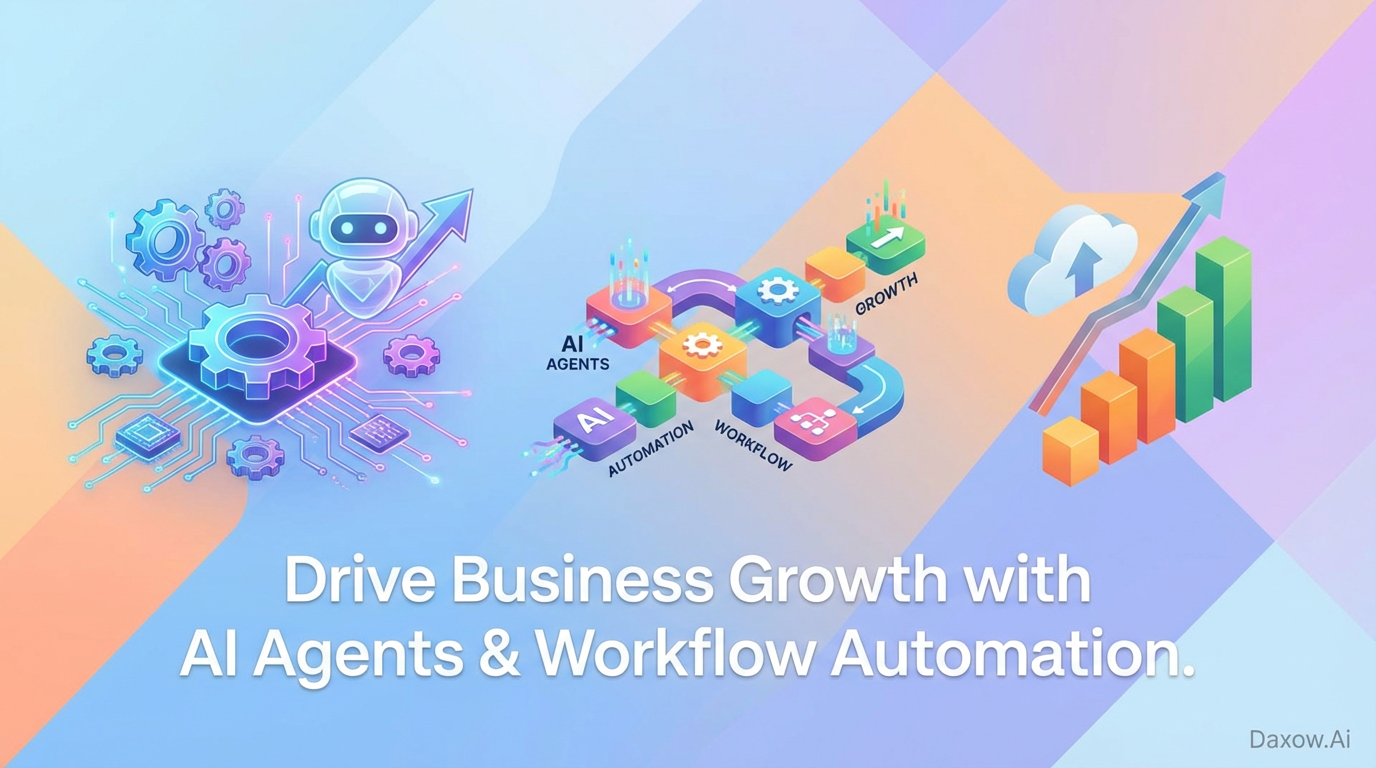
Learn how AI agents plus workflow automation boost productivity, cut costs, and deliver measurable ROI—includes industry use cases and a Daxow.ai implementation roadmap.
Unlocking Business Growth: The Power of AI Agents and Workflow Automation
Estimated reading time: 15 minutes
Key Takeaways
- AI agents and workflow automation transform repetitive tasks into efficient, reliable processes.
- Implementing AI automation leads to productivity gains, cost reduction, and improved customer experience.
- Industry-specific use cases demonstrate measurable benefits across e-commerce, healthcare, finance, real estate, HR, and customer support.
- A clear, modular implementation roadmap enhances adoption and scalability.
- Daxow.ai provides end-to-end AI automation solutions tailored to your business goals.
Table of Contents
- Unlocking Business Growth: The Power of AI Agents and Workflow Automation
- Why AI Agents and Workflow Automation Matter for Business
- Industry Use Cases — Practical Examples Where AI Agents and Workflow Automation Deliver
- How to Implement AI Agents and Workflow Automation — A Practical Roadmap
- Architecture and Technology Choices — What to Consider
- Measuring ROI and Business Impact
- How Daxow.ai Helps You Deliver Business Automation with AI Agents
- Implementation Example — From Discovery to Production (Typical Timeline)
- Common Pitfalls and How to Avoid Them
- Next Steps — How to Get Started with Daxow.ai
- Frequently Asked Questions
Unlocking Business Growth: The Power of AI Agents and Workflow Automation
Defining the terms
AI agents are autonomous software entities that perceive input (documents, messages, telemetry), reason (NLP, rules, predictive models), and take actions (update CRM, trigger workflows, respond to customers) without continuous human intervention.
Workflow automation is the orchestration layer that connects systems and processes—moving data, enforcing business rules, and ensuring tasks progress from start to finish automatically.
Together, AI automation and workflow automation create systems that not only execute tasks but learn, adapt, and improve outcomes over time. That combination is the key to achieving higher productivity and to drastically reducing manual tasks across the enterprise.
Why AI Agents and Workflow Automation Matter for Business
Business outcomes and value
- Faster processing, lower cost: Automating routine tasks cuts processing time and reduces headcount dependency. Typical implementations show 30–50% productivity gains and error reductions up to 90%.
- Better customer experience: Customer support automation speeds responses and improves resolution rates, increasing NPS and retention.
- Scalability without proportional cost: Automated processes scale with volume; incremental cost is far lower than hiring.
- Actionable insights: AI agents can detect anomalies, forecast demand, and flag risks in real time, enabling proactive decisions rather than reactive firefighting.
The role of data and integration
- Data quality is foundational. Reliable AI requires clean, accessible data and strong governance—standardized formats, labeled datasets for training, and privacy controls.
- System integrations unlock value. Connecting CRMs, ERPs, ticketing systems, and document stores creates a single operational workflow where AI agents can act across systems to complete tasks end-to-end.
Industry Use Cases — Practical Examples Where AI Agents and Workflow Automation Deliver
E-commerce — Lead qualification and customer support automation
Scenario: High volume of incoming customer queries and unqualified leads slows sales.
Solution: Deploy AI agents to:
- Automatically qualify leads through chat and web forms using intent classification and scoring.
- Route qualified leads into the CRM with enrichment (company data, purchase intent).
- Run customer support automation to answer common inquiries, escalate complex cases to humans with context and suggested responses.
Impact: Higher conversion rates, faster sales cycles, and reduced manual triage. Expect 20–40% faster lead response and improved conversion by focusing human sellers on high-value prospects.
Healthcare — Patient intake and document automation
Scenario: Administrative burdens from manual scheduling and medical record processing slow throughput.
Solution: Combine OCR, NLP, and AI agents to extract key data from intake forms, populate EHR fields, schedule follow-ups, and prepare clinician summaries from patient notes.
Impact: Reduced administrative time, fewer transcription errors, and improved patient throughput. Resources freed to focus on care delivery and patient engagement.
Finance — Fraud detection and invoice reconciliation
Scenario: Manual reconciliation and fraud monitoring are slow and error-prone.
Solution: AI agents continuously analyze transaction patterns and flag anomalies; workflow automation routes suspicious cases to compliance teams with pre-filled evidence packs. Invoice OCR and matching logic reconcile vendor invoices to POs automatically.
Impact: Faster detection of fraud, reduced losses, and up to 40% faster invoice processing cycles.
Real estate — Market analysis and lead scoring
Scenario: Agents and brokers receive many inquiries while market trends shift rapidly.
Solution: AI agents gather public listings, price changes, and customer interactions; automated workflows update listings, create targeted outreach, and score leads by readiness to transact.
Impact: Shorter deal cycles, improved conversion, and better allocation of sales resources.
HR and Recruitment — Resume screening and onboarding
Scenario: High volume of applicants and repetitive onboarding paperwork.
Solution: Natural language processing sorts and ranks resumes against job profiles, schedules interviews, and triggers onboarding flows (account creation, training assignments) when a candidate is hired.
Impact: Faster time-to-hire, consistent candidate experience, and fewer administrative bottlenecks.
Customer Support — End-to-end ticket automation
Scenario: Large ticket backlogs with repetitive requests.
Solution: AI agents classify incoming tickets, resolve routine cases with automated replies or knowledge base suggestions, and escalate complex tickets with context and suggested next steps.
Impact: Higher first-response and resolution rates, reduced manual workload for support teams, and improved customer satisfaction.
How to Implement AI Agents and Workflow Automation — A Practical Roadmap
1. Define clear goals and prioritize high-impact processes
- Start with a targeted business objective: reduce invoice processing time by 40%, cut support average handle time (AHT) by 30%, or improve lead-to-opportunity conversion by 25%.
- Conduct a process audit to identify repetitive, rule-based tasks where AI agents and automation will have immediate ROI.
2. Assess data readiness and compliance
- Inventory data sources and evaluate quality, accessibility, and compliance constraints.
- Standardize formats and establish data governance. Build privacy-preserving workflows where needed.
3. Design modular, integrated systems
- Choose a modular architecture: AI agent layer (NLP, models), orchestration/workflow engine, and integrations (CRM, ERP, ticketing, storage).
- Favor APIs and middleware for robust data exchange and monitoring.
4. Build cross-functional teams
- Bring together domain experts, data engineers, ML engineers, product managers, and operations leads. Assign clear SLAs and ownership.
- Train stakeholders on new processes to avoid shadow-AI risks and ensure adoption.
5. Pilot small, measure, then scale
- Launch a pilot focused on a single, high-value process. Measure accuracy, time savings, error reduction, and business KPIs.
- Use feedback loops to retrain models and tune workflows before scaling.
6. Monitor and optimize continuously
- Implement dashboards for real-time monitoring (precision/recall for models, throughput, error rates).
- Plan retraining and model governance to keep systems aligned with changing data and regulations.
Architecture and Technology Choices — What to Consider
Core components
- AI Agents: Use models fine-tuned for your domain (NLP for support, classifiers for lead scoring, anomaly detection for finance).
- Workflow Engine: Orchestration that handles state, retries, approvals, and SLA enforcement.
- Integrations: Connectors to CRMs, ERPs, communication channels, and document stores.
- Data Layer: Secure storage, logging, and feature stores for model inputs.
Technology selection criteria
- Scalability and reliability.
- Ease of integration with existing systems.
- Support for explainability and compliance.
- Tools for monitoring, retraining, and rollback.
Measuring ROI and Business Impact
Key metrics to track
- Productivity: Time saved per process, tasks automated.
- Accuracy and quality: Error rate reductions, model precision/recall.
- Cost: Reduced manual FTE hours, faster cycle times.
- Customer metrics: NPS, CSAT, response and resolution times.
- Operational KPIs: Invoice cycle time, lead-to-opportunity conversion, time-to-hire.
Typical ROI profile
Short-term wins often appear within 3–6 months for targeted automation pilots. Many organizations recoup investments within 6–12 months and realize long-term improvements such as 30–50% productivity gains and significant error reductions.
How Daxow.ai Helps You Deliver Business Automation with AI Agents
End-to-end discovery and design
Daxow.ai begins with a structured process analysis to identify where AI automation will yield the greatest impact. We map current workflows, quantify loose ends, and prioritize opportunities by ROI and feasibility.
Deliverable: A prioritized automation roadmap aligned with your business objectives.
Custom AI agent development and workflow automation
We design and build AI agents tailored to your domain: lead qualification bots, document automation agents, fraud detection models, and customer support automations.
We pair agents with robust workflow automation so tasks are completed end-to-end—no manual handoffs unless necessary.
Integration and systems connectivity
Daxow.ai connects AI agents to your CRM, ERP, ticketing systems, and databases. Our integration layer ensures data flows reliably and securely.
We implement audit trails, access controls, and compliance features to meet regulatory requirements.
Deployment, monitoring and continuous improvement
We deploy solutions with monitoring dashboards and model governance. Our approach ensures transparent performance metrics and scheduled retraining routines.
We also provide change management support and training to accelerate adoption and minimize disruption.
Outcome-driven engagements
Daxow.ai engagements focus on measurable outcomes: reduced manual tasks, faster customer responses, fewer errors, and clear cost savings.
We provide the analytics and reporting to demonstrate ROI and to support incremental scaling across departments.
Implementation Example — From Discovery to Production (Typical Timeline)
Week 0–2: Discovery and prioritization
- Process mapping, data audit, KPI definition.
- Stakeholder alignment and pilot selection.
Week 3–8: Prototype and validation
- Build AI agent prototype and a minimal workflow integration.
- Run tests on historical and live data, measure accuracy and business KPIs.
Week 9–16: Pilot deployment and iteration
- Deploy pilot in production scope with monitoring.
- Collect feedback, retrain models, and optimize workflows.
Month 4–12: Scale and governance
- Expand automation to adjacent processes, integrate more systems, and institutionalize monitoring and retraining schedules.
Common Pitfalls and How to Avoid Them
- Starting without clear business goals: Define KPIs first. Avoid building tech for its own sake.
- Underestimating data quality needs: Invest in data cleanup and governance before model training.
- Over-customization: Start with proven patterns; only customize when necessary to capture unique value.
- Ignoring change management: Train staff and create clear owner roles to avoid resistance and shadow automation.
Next Steps — How to Get Started with Daxow.ai
If you want to transform repetitive processes, reduce manual tasks, and unlock productivity with AI agents and workflow automation, Daxow.ai offers a pragmatic, outcome-driven approach:
- Request a free process analysis to identify high-impact automation opportunities.
- Book a free consultation to discuss tailored AI agent solutions and integration strategies.
- Contact us to build a custom AI system that delivers measurable ROI and scales with your business.
Book a free consultation with Daxow.ai today to start your automation roadmap and turn manual work into measurable business value.
Frequently Asked Questions
What are AI agents and how do they differ from traditional automation?
AI agents are autonomous software entities that can perceive inputs, reason using NLP and predictive models, and take actions without continuous human intervention. Traditional automation often follows rigid scripts without adaptive reasoning.
How does workflow automation complement AI agents?
Workflow automation orchestrates the sequence of tasks across systems, managing data flow, business rules, and task advancement. AI agents perform intelligent decision-making and action within this orchestrated environment.
What industries benefit most from AI agents and workflow automation?
E-commerce, healthcare, finance, real estate, HR and recruitment, and customer support are key industries with demonstrated benefits. Many other sectors can also gain by automating repetitive, data-driven tasks.
How can Daxow.ai support my organization’s AI and automation journey?
Daxow.ai provides end-to-end discovery, custom AI agent development, integration with existing systems, deployment, monitoring, and continuous improvement to deliver measurable ROI aligned with your unique business goals.