
AI Agents for Business: Automate Workflows & Cut Manual Tasks
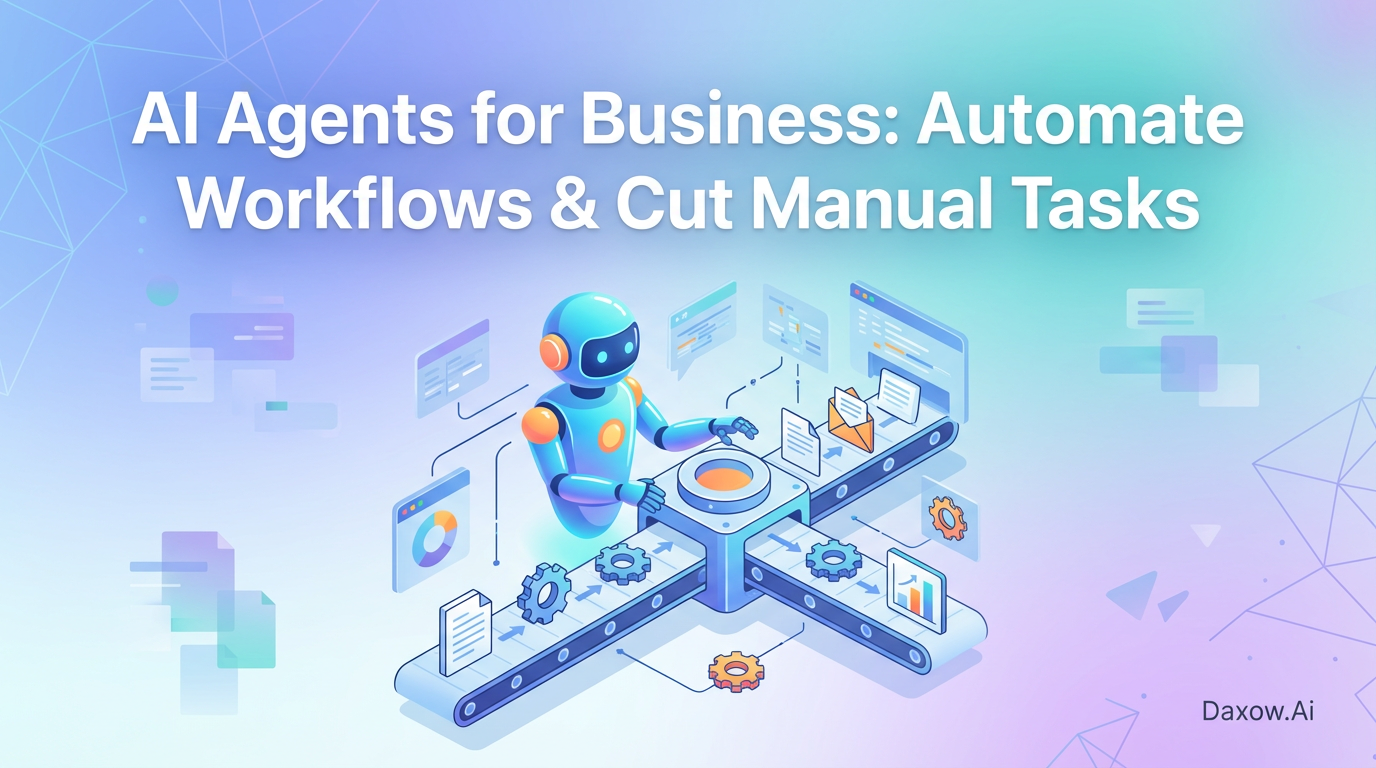
AI agents automate workflows to reduce manual tasks, boost productivity, and deliver measurable ROI. Includes use cases, roadmap, and Daxow.ai solutions.
AI Agents for Business: Driving Workflow Automation to Reduce Manual Tasks and Boost Productivity
Estimated reading time: 15 minutes
Key Takeaways
- AI agents combine AI, RPA, and decision models to automate complex, multi-step workflows.
- They reduce manual tasks, improve responsiveness, and scale expert workflows across business operations.
- Practical use cases span customer support, sales, finance, HR, healthcare, and real estate industries.
- A structured implementation roadmap ensures successful deployment from discovery to continuous improvement.
- Daxow.ai specializes in designing and integrating custom AI systems that deliver measurable ROI.
Table of Contents
- AI Agents for Business: What they are and why they matter
- How AI Agents Drive Workflow Automation and Reduce Manual Tasks
- Practical Use Cases Across Industries
- Implementation Roadmap: From Process Discovery to Autonomous AI Agents
- Common Challenges and How to Overcome Them
- How Daxow.ai Helps Design and Deploy Custom AI Systems
- Getting Started: Practical Steps for Decision-Makers
- Frequently Asked Questions
AI Agents for Business: What they are and why they matter
AI agents are autonomous or semi-autonomous software entities that perform tasks, make decisions, and interact with systems and people on behalf of users. Unlike simple rule-based automation, AI agents combine modern AI components — natural language understanding, document extraction, decision models, and robotic process automation (RPA) — to handle unstructured inputs, adapt to exceptions, and learn over time.
Why they matter:
- Handle complexity: They interpret emails, extract data from documents, and make multi-step decisions that span systems.
- Reduce manual tasks: They automate routine work that previously required human oversight.
- Improve responsiveness: They power 24/7 customer support automation and fast internal processing.
- Scale expertise: They encode expert workflows and apply them consistently across operations.
How AI agents differ from traditional automation
- Rule-based automation (traditional RPA) follows explicit scripts and fails when inputs vary.
- AI agents use machine learning and generative capabilities to interpret variability and escalate only when needed.
- The result is higher automation rates, fewer exceptions, and improved long-term cost efficiency.
How AI Agents Drive Workflow Automation and Reduce Manual Tasks
AI agents power workflow automation by orchestrating tasks across systems, extracting and validating data, generating outputs (emails, reports, responses), and triggering follow-up actions. They act as active workflow participants rather than passive tools.
Core capabilities that enable business value:
- Data extraction & document automation: Parse invoices, contracts, and claims from varied formats.
- Intelligent routing & lead qualification: Triage inquiries and pass qualified leads to sales.
- Customer support automation: Resolve common queries, escalate complex cases, and provide agents with decision support.
- Task orchestration: Coordinate multi-step processes across CRM, ERP, ticketing, and communication platforms.
- Autonomous decisioning: Apply business rules and ML models to approve, reject, or flag items.
Technical building blocks
- Natural Language Understanding (NLU) for text and conversation.
- Optical Character Recognition (OCR) with post-processing for documents.
- Workflow engines and orchestration layers.
- Connectors to CRMs, ERPs, help desks, and databases.
- Monitoring, logging, and feedback loops for continuous learning.
Governance and reliability
- Human-in-the-loop checkpoints for high-risk decisions.
- Audit trails and explainability features.
- Role-based access and secure data handling to meet compliance needs.
Practical Use Cases Across Industries
Customer Support Automation (SaaS & Enterprise)
Problem: High volumes of repetitive inquiries, long response times, and agent burnout.
AI solution: Deploy AI agents that interpret incoming tickets, provide instant responses for common issues, and auto-create or update tickets in the helpdesk for complex cases.
Business impact:
- Reduce manual tasks by up to 60% in first-line support.
- Increase first response times from hours to seconds.
- Improve CSAT through faster, consistent answers.
Daxow role: Design conversational AI, integrate with Zendesk/ServiceNow/HubSpot, set escalation rules, and build analytics dashboards.
Sales Automation & Lead Qualification (B2B)
Problem: Sales teams waste time on low-quality leads and manual qualification.
AI solution: AI agents scan inbound forms, emails, and social signals to score leads, schedule demos, and enrich CRM records automatically.
Business impact:
- Increase qualified lead throughput by 30–50%.
- Shorten sales cycle via instant scheduling and pre-filled call briefs.
- Reduce manual data entry by 70% for sales reps.
Daxow role: Build lead-scoring models, integrate with CRMs, and create automated outreach sequences that improve conversion.
Finance & Accounting (Invoicing and AP Automation)
Problem: Manual invoice processing is slow, error-prone, and costly.
AI solution: Agents extract invoice data, match to purchase orders, route exceptions, and post payments or hold flags in ERP.
Business impact:
- Cut invoice processing time from days to hours.
- Lower cost per invoice by 60–80%.
- Reduce late payment penalties and improve vendor relationships.
Daxow role: Deliver intelligent document processing pipelines that connect OCR, validation rules, and ERP posting.
HR & Administration (Employee Onboarding)
Problem: Onboarding requires coordination across IT, payroll, and facilities — often manual and inconsistent.
AI solution: An onboarding AI agent orchestrates account creation, equipment orders, training enrollments, and compliance checks while notifying stakeholders.
Business impact:
- Reduce manual touchpoints by 50–70%.
- Accelerate time-to-productivity for new hires.
- Improve compliance and auditability.
Daxow role: Map workflows, integrate HRIS systems, and automate role-based provisioning processes.
Healthcare (Claims & Patient Intake)
Problem: Healthcare providers face high administrative load in claims processing and intake forms.
AI solution: AI agents extract clinical and billing information, validate claims, flag inconsistencies, and route to specialist teams.
Business impact:
- Reduce manual claims handling and denials.
- Speed up patient intake and reduce waiting times.
- Free administrative staff for higher-value care coordination.
Daxow role: Implement HIPAA-compliant workflows, integrate clinical systems, and tune extraction models for medical language.
Real Estate & Property Management
Problem: Lease processing, maintenance requests, and tenant communications are manual and inconsistent.
AI solution: Agents handle rental applications, screen tenants, schedule viewings, and manage maintenance ticket triage.
Business impact:
- Reduce workload for property managers.
- Improve tenant satisfaction with faster responses.
- Automate repetitive admin tasks that consume staff time.
Daxow role: Connect property management platforms and automate end-to-end tenant lifecycle tasks.
Implementation Roadmap: From Process Discovery to Autonomous AI Agents
1 — Process discovery and prioritization
- Map existing workflows and measure manual effort and cycle time.
- Identify high-frequency, low-complexity tasks for early automation.
- Prioritize based on ROI, risk, and data availability.
2 — Data readiness and model selection
- Audit data sources, formats, and quality.
- Select AI components (NLU, OCR, decision models) and define training data needs.
- Establish data governance and privacy controls.
3 — Prototype and pilot
- Build a focused pilot for one process to validate accuracy and user acceptance.
- Use A/B testing to measure outcomes versus human baseline.
- Target automation thresholds (e.g., >70% automated resolution) before scaling.
4 — Scale and integrate
- Expand the agent’s scope, add connectors to enterprise systems, and automate additional steps.
- Implement monitoring, fallback procedures, and continuous model retraining.
5 — Operate and improve
- Define KPIs, scheduled audits, and feedback loops.
- Maintain a roadmap for new capabilities and optimization.
KPIs & ROI modeling
Key metrics to track:
- Percentage of tasks automated.
- Hours saved per week or FTEs redeployed.
- Cost per transaction before vs after automation.
- Customer satisfaction (CSAT/NPS) and response time improvements.
Example ROI snapshot:
A mid-sized company automates invoice processing: automates 70% of invoices, reducing 4 FTEs in AP, saving $200k/year, and lowering invoice cycle time by 80%.
Common Challenges and How to Overcome Them
Data silos and poor quality
Solution: Start with high-value, high-quality data sources; create data pipelines and validation rules.
Legacy systems and integrations
Solution: Use middleware and APIs; design agents that can operate with both modern and legacy endpoints.
Change management and adoption
Solution: Involve end-users early, provide clear benefits and training, and retain human oversight where needed.
Model drift and maintenance
Solution: Monitor performance, schedule retraining, and maintain annotated feedback loops.
Compliance and security
Solution: Embed privacy by design, encryption, role-based access, and audit logging.
How Daxow.ai Helps Design and Deploy Custom AI Systems
Daxow.ai specializes in turning process knowledge into automated AI systems that deliver measurable business value. Our approach combines consulting, engineering, and change management to ensure end-to-end success.
What Daxow delivers:
- Process analysis and automation strategy: We map workflows, quantify manual tasks, and prioritize automation opportunities based on ROI.
- Custom AI agent design: We build agents that can read documents, converse with customers, act in CRMs, and execute orchestrated workflows.
- System integrations and connectors: We connect agents to popular business tools and legacy systems, ensuring data consistency and real-time actions.
- Operationalization and governance: We provide monitoring, logging, explainability, and human-in-the-loop controls for robust production operations.
- Continuous improvement: We establish feedback loops and retraining pipelines so AI agents improve over time.
Typical engagement phases:
- Discovery & process analysis
- Pilot & rapid prototyping
- Production deployment & integration
- Managed operations & continuous optimization
Business outcomes we focus on:
- Reduce manual tasks and redeploy staff to strategic work.
- Lower operational costs and improve throughput.
- Increase productivity with faster cycle times and higher automation rates.
- Improve customer experience with faster, consistent interactions.
- Deliver measurable ROI within months, not years.
Getting Started: Practical Steps for Decision-Makers
- Inventory high-volume, manual processes and estimate time spent.
- Choose a low-risk pilot with clear metrics and achievable accuracy goals.
- Ensure data access and map necessary integrations.
- Define governance, escalation rules, and compliance requirements.
- Engage a partner experienced in both AI and systems integration to shorten the path to value.
Frequently Asked Questions
What distinguishes AI agents from traditional automation tools?
AI agents use machine learning, natural language understanding, and generative AI to handle variable inputs and complex workflows, whereas traditional automation tools rely on rigid, rule-based scripts that require precise inputs.
How do AI agents improve customer support?
They provide instant responses to common queries, automatically route complex issues to agents, and enable 24/7 support, reducing manual workload and improving response times and customer satisfaction.
What are common challenges in deploying AI agents, and how does Daxow.ai address them?
Challenges include data silos, legacy integrations, change management, model drift, and compliance. Daxow.ai offers expertise in process analysis, robust integration design, user engagement, monitoring frameworks, and security best practices to overcome these obstacles.
How quickly can a company see ROI from AI agent automation?
ROI can often be realized within months by targeting high-volume manual tasks for automation, such as invoice processing or customer support, which yield measurable cost savings and productivity gains.