
AI Agents for Workflow Automation: Practical Implementation Guide
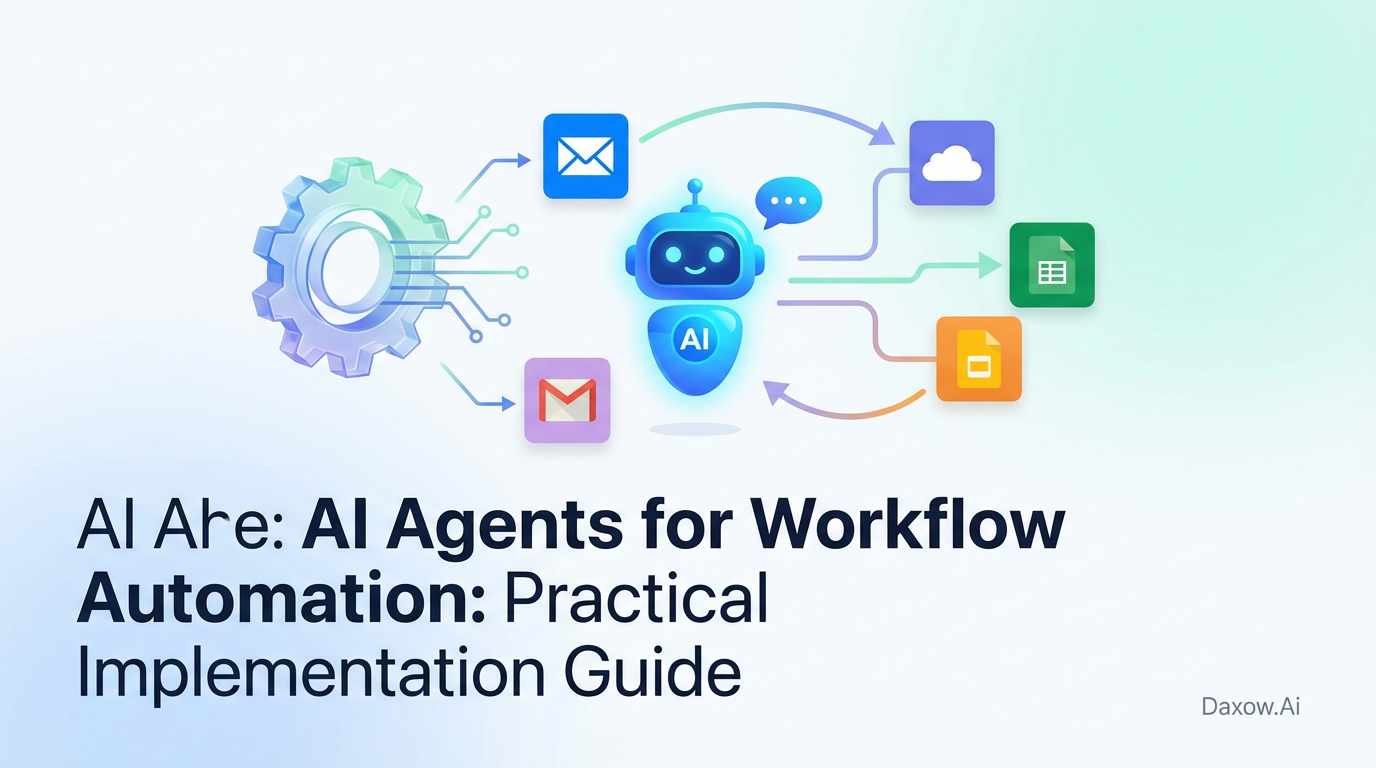
Guide to AI agents for workflow automation: step-by-step implementation, industry use cases, and measurable ROI to reduce manual tasks and boost productivity.
AI Agents for Workflow Automation: Practical Strategies to Reduce Manual Tasks and Boost Productivity
Estimated reading time: 15 minutes
Key Takeaways
- AI agents automate complex workflows using advanced machine learning and integrations, reducing manual tasks and operational costs.
- Implementing AI automation follows a strategic, phased framework from assessment to continuous optimization.
- Industry-specific use cases show measurable productivity gains and customer satisfaction improvements.
- Daxow.ai offers custom AI automation solutions tailored to enterprise requirements, enabling sustained ROI.
- Careful governance, data quality, and change management are essential to successful AI deployment.
Table of Contents
- AI Agents for Workflow Automation — What They Are and Why They Matter
- Strategic Framework for Implementing AI Automation
- Practical Use Cases Across Industries
- How AI Agents Drive Measurable ROI
- Common Risks and How to Avoid Them
- How Daxow.ai Designs and Delivers Custom AI Automation
- Implementation Checklist — From Concept to Production
- Realistic Timeline and Budget Considerations
- Closing: Take the Next Step Toward Business Automation
- Frequently Asked Questions
AI Agents for Workflow Automation — What They Are and Why They Matter
AI agents are autonomous software entities that perform tasks, make decisions, and communicate across systems with minimal human oversight. Unlike static scripts or rule-based bots, modern AI agents use machine learning, natural language understanding, and integrations to execute complex workflows and improve over time.
Core capabilities
- Data ingestion and extraction from documents, emails, and APIs.
- Decision-making using business rules and predictive models.
- Multi-channel communication (chat, email, SMS, voice).
- System integrations with CRMs, ERPs, and ticketing platforms.
- Continuous learning through feedback loops and retraining.
Business outcomes you can expect
- Reduced manual tasks: Routine processing like data entry, invoice triage, and first-line support can be automated, freeing staff for strategic work.
- Improved productivity: Teams handle more volume with fewer delays; AI automation drives faster response times and shortened cycle times.
- Lower operational costs: Labor-intensive processes become inexpensive to scale.
- Higher customer satisfaction: Customer support automation provides faster, consistent responses and intelligent escalation.
- Better compliance and auditability: Embedded rules and logs support regulatory requirements and reduce risk.
Strategic Framework for Implementing AI Automation
Phase 1 — Assessment and goal setting (4–8 weeks)
- Map current workflows and identify high-volume, repetitive tasks that are high ROI candidates for automation.
- Define measurable KPIs (e.g., reduce handling time by 40%, achieve 80% self-service resolution).
- Conduct a data audit: availability, quality, formats, and access controls.
- Establish governance: ownership, escalation paths, and compliance requirements.
Phase 2 — Technology and team selection (6–12 weeks)
- Select stack components: conversational models, RPA, document extraction tools, and integration middleware.
- Build a cross-functional team: business owners, data engineers, IT integrators, and change managers.
- Design security and privacy controls to meet GDPR, HIPAA, or industry-specific standards.
Phase 3 — Preparation and data readiness (4–8 weeks)
- Clean and normalize data; create canonical schemas for records that agents will use.
- Build knowledge bases and decision trees for automated responses.
- Develop integration blueprints to connect CRMs, ERPs, and ticketing systems.
Phase 4 — Pilot and deploy (4–20 weeks)
- Launch a scoped pilot on one process or channel to validate models and flows.
- Measure early KPIs: accuracy, resolution rate, time-to-first-response, and customer satisfaction.
- Iterate quickly and expand to adjacent processes once targets are met.
Phase 5 — Operate and optimize (ongoing)
- Monitor performance dashboards and define retraining cadences.
- Implement feedback loops where human operators correct agent outputs and the system learns.
- Expand scope by adding new channels, use cases, and decision layers.
Practical Use Cases Across Industries
E-commerce — Inventory, fulfilment, and customer support
- Use case: An AI agent monitors stock levels by integrating with inventory management and marketplace APIs. It predicts out-of-stock events and triggers automated reorder workflows.
- Impact: Reduce stockouts, decrease emergency shipping costs, and improve on-time fulfillment rates.
- Support automation: Conversational agents handle order status inquiries, process returns, and escalate exceptions to human agents with context. This reduces contact center volume and improves NPS.
Healthcare — Scheduling, billing, and secure triage
- Use case: An AI agent automates patient scheduling and appointment reminders across channels, integrating with EMR systems while respecting privacy rules.
- Impact: Reduce no-shows, speed bill processing, and free administrative staff to focus on patient care.
- Compliance: Agents enforce consent flows, maintain audit trails, and flag anomalies for clinical review.
Finance — Invoice processing, fraud detection, and reporting
- Use case: Document automation extracts line items and validation rules from invoices, posts them to the ERP, and initiates payment approvals with exception handling.
- Impact: Decrease invoice processing time, reduce late payment penalties, and lower reconciliation overhead.
- Risk detection: Real-time models screen transactions for fraud patterns and raise alerts for high-risk events.
Real Estate — Lead qualification and contract automation
- Use case: AI agents qualify leads from MLS listings and website inquiries, schedule viewings, and prepare draft contracts by pulling data from templates and property records.
- Impact: Shorten sales cycles, increase conversion rates, and reduce administrative delays in closing.
HR and People Operations — Recruitment and onboarding
- Use case: Screening agents parse resumes, score candidates against role profiles, and schedule interviews. Onboarding agents provision accounts, distribute policies, and track completion.
- Impact: Cut hiring time, reduce early attrition with faster, consistent onboarding, and scale recruitment for rapid growth.
How AI Agents Drive Measurable ROI
Quantifiable benefits
- Labor cost reduction: Routine tasks automated can reduce full-time equivalent (FTE) workload by up to 50% in targeted teams (support, back-office).
- Speed and throughput: Many organizations report 3–5x faster cycle times for automated processes.
- Accuracy and compliance: Automation reduces human error and creates audit trails that simplify regulatory reporting.
- Revenue impact: Faster lead qualification and reduced friction in order processing increases conversion rates and lifetime value.
Typical KPIs to track
- Resolution rate / First-contact resolution
- Average handling time
- Automation rate (percentage of tasks fully automated)
- Cost per transaction
- Customer satisfaction and NPS
- Model accuracy, precision/recall, and F1 score
Common Risks and How to Avoid Them
Pitfall: Poor data quality
Mitigation: Invest in data cleaning and canonicalization during Phase 3. Use validation gates and synthetic test data for critical paths.
Pitfall: Scope creep and trying to do too much at once
Mitigation: Start with high-volume, low-complexity tasks. Expand modularly after meeting pilot KPIs.
Pitfall: Lack of change management
Mitigation: Assign change leads, train staff, and provide clear escalation processes. Ensure humans remain in the loop for exceptions.
Pitfall: Compliance gaps
Mitigation: Embed privacy and regulatory controls in design. Maintain audit logs and periodic reviews.
How Daxow.ai Designs and Delivers Custom AI Automation
Discovery and process analysis
We start by mapping workflows with stakeholders to identify automation candidates and define measurable outcomes. This includes data audits and risk assessments.
Custom architecture and integrations
We design modular AI agents that integrate with your CRM, ERP, and other systems using secure connectors. Our solutions include:
- Document automation for invoices, contracts, and claims.
- Conversational AI for multi-channel customer support automation.
- Workflow automation that orchestrates tasks across systems and teams.
Rapid pilots and iterative scaling
We deploy pilots that target quick wins, measure impact against agreed KPIs, then scale gradually. Pilots reduce risk, control costs, and create momentum.
Governance, monitoring, and continuous optimization
Daxow.ai implements monitoring dashboards, feedback loops, and retraining pipelines to ensure sustained performance. We supply both operational support and transferred knowledge so teams can evolve the system independently.
Delivered value
- Faster resolution times in support teams.
- Lower operational costs in finance and admin functions.
- Higher conversion rates in sales and marketing through automated lead qualification.
- Improved compliance and traceability across regulated workflows.
Implementation Checklist — From Concept to Production
- Define 3–5 measurable goals aligned to business outcomes.
- Prioritize processes by volume, repetitiveness, and impact.
- Perform a data readiness assessment and secure necessary access.
- Build a cross-functional team with clear ownership.
- Choose scalable technology and integration platforms.
- Pilot with a constrained scope and predefined success metrics.
- Implement monitoring and retraining cadences.
- Document processes and train operational teams for handoff.
Realistic Timeline and Budget Considerations
Typical small-to-medium pilots run 3–6 months from discovery to live operation. Larger enterprise transformations span 6–18 months depending on integrations, compliance complexity, and global rollout. Budget depends on scope, but focusing on one or two high-impact processes keeps initial costs controllable and accelerates ROI.
Closing: Take the Next Step Toward Business Automation
AI Agents for Workflow Automation are no longer experimental — they are a practical lever for organizations seeking to reduce manual tasks, increase productivity, and modernize operations. With disciplined planning, data hygiene, and staged delivery, AI automation converts repetitive work into scalable, low-cost, auditable processes that free your team for strategic work.
Daxow.ai partners with companies to design custom AI systems, implement end-to-end process automation, and integrate solutions into existing IT landscapes. If you want to see real results — faster cycles, lower costs, and consistent customer experiences — take the next step.
Book a free consultation with Daxow.ai or request a process analysis for your company to discover which workflows to automate first and how to measure success. Contact us to build a custom AI system that delivers measurable ROI.
Frequently Asked Questions
What distinguishes AI agents from traditional workflow automation?
AI agents leverage machine learning and natural language processing, enabling autonomous decision-making and adaptive workflow execution beyond rule-based scripts.
How does Daxow.ai ensure compliance in AI automation projects?
We embed privacy and regulatory controls from design through deployment, maintain audit logs, and conduct periodic compliance reviews aligned with GDPR, HIPAA, and industry-specific standards.
What industries benefit most from AI agents for workflow automation?
Industries such as e-commerce, healthcare, finance, real estate, and HR have demonstrated clear value, but AI automation is broadly applicable across sectors with repetitive and data-intensive processes.
How quickly can organizations expect ROI from AI automation?
With focused pilots and disciplined execution, many clients see measurable ROI within 3 to 6 months, particularly through labor cost savings and productivity improvements.