
AI Agents for Workflow Automation: Reduce Manual Work
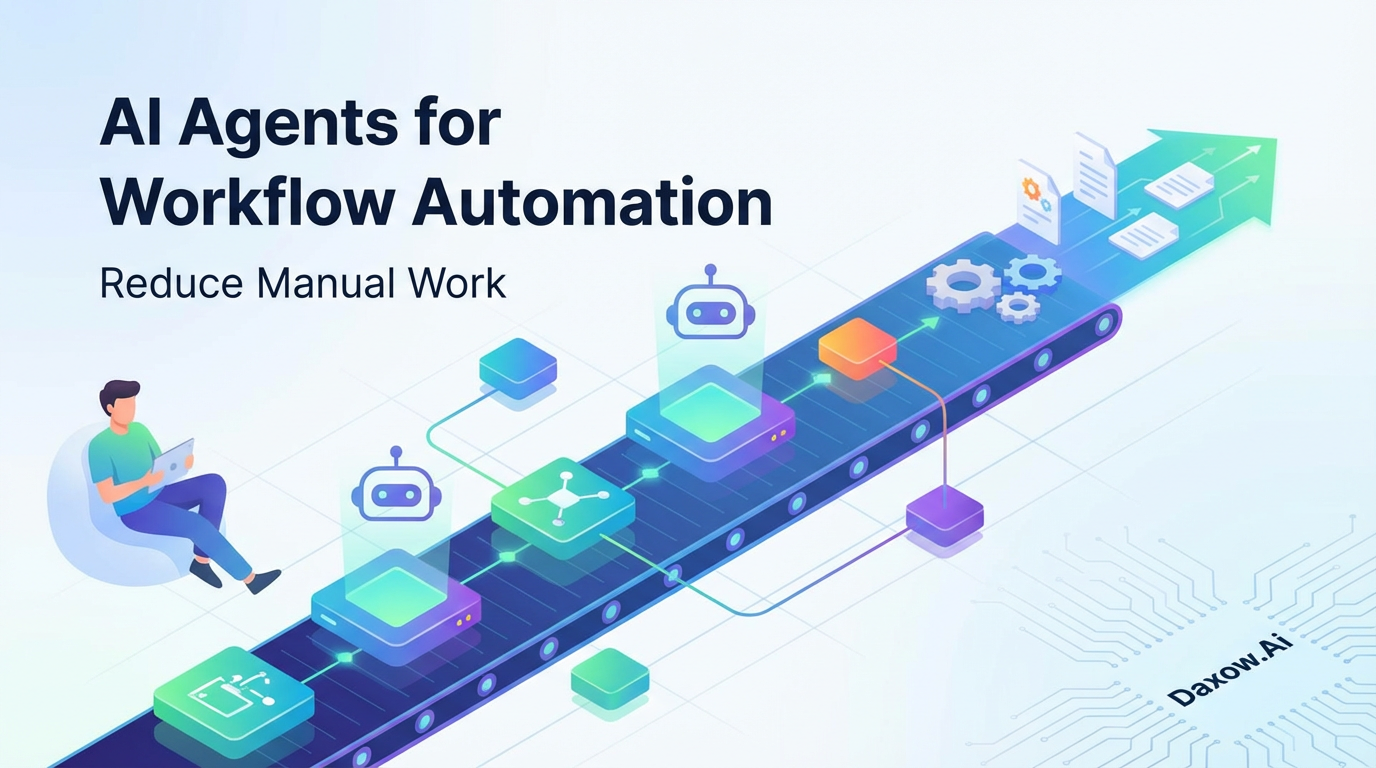
Learn how AI agents automate enterprise workflows to cut manual tasks, lower costs, and boost productivity. Use cases, roadmap, and Daxow.ai solutions.
AI Agents for Workflow Automation: How Enterprises Reduce Manual Tasks and Boost Productivity
Estimated reading time: 15 minutes
Key Takeaways
- AI agents enable autonomous, end-to-end workflow automation that reduces manual tasks and improves accuracy.
- Enterprises benefit from faster outcomes, scalability without proportional headcount growth, and enhanced compliance.
- Industry use cases span e-commerce, healthcare, finance, real estate, HR, and customer support.
- A structured implementation roadmap helps minimize risks and accelerate ROI.
- Daxow.ai specializes in custom AI agent solutions that integrate with existing enterprise systems.
Table of Contents
- AI Agents for Workflow Automation: What It Means for Your Business
- Practical Use Cases: AI Agents for Workflow Automation Across Industries
- How AI Agents and Workflow Automation Deliver Value
- Implementation Steps and Best Practices for AI Agents for Workflow Automation
- ROI and Business Value of AI Agents for Workflow Automation
- How Daxow.ai Designs and Delivers AI Agents for Workflow Automation
- Getting Started: Quick Wins and Pilot Projects
- Conclusion and Next Steps
- Frequently Asked Questions
AI Agents for Workflow Automation: What It Means for Your Business
AI agents are autonomous software entities that interpret inputs, make decisions, and execute actions across systems. Unlike traditional RPA, which follows explicit scripts, AI agents use natural language processing, predictive analytics, and adaptive models to handle exceptions and learn from interaction data.
Key capability: end-to-end execution — from data ingestion and decision-making to taking actions in CRMs, ERPs, and communication channels.
Why enterprises should prioritize AI agents for workflow automation
- Reduce manual tasks: Automate repetitive, high-volume work such as data entry, ticket triage, invoice processing, and lead qualification.
- Improve productivity: Free skilled staff from routine work so they can focus on strategic priorities.
- Enhance accuracy and compliance: Machine learning models reduce human error and create auditable workflows for regulatory needs.
- Scale without linear headcount growth: Handle growth in transaction volumes with marginal increases in operating cost.
- Deliver faster outcomes: Organizations following phased, structured implementations achieve results 3–5x faster than ad-hoc projects.
Practical Use Cases: AI Agents for Workflow Automation Across Industries
AI automation delivers measurable impact where processes are rule-based and high-volume. Below are industry-specific use cases and expected business outcomes.
E-commerce
- Automated order processing and returns handling.
- Inventory forecasting and dynamic pricing.
- Personalized recommendations and post‑purchase support via chatbots.
Business impact:
- Reduced fulfillment errors and operational friction, often improving accuracy by up to 30%.
- Faster time-to-resolution on returns and refunds, improving customer satisfaction.
Healthcare
- Patient scheduling and automated reminders.
- Prior authorization automation and claims triage.
- Clinical documentation assistance and anomaly detection in records.
Business impact:
- Lower administrative burden on clinicians and billing teams.
- Improved compliance and reduced delays for authorizations and reimbursements.
Finance and Insurance
- Invoice processing, transaction reconciliation, and KYC verifications.
- Fraud detection and suspicious activity triage.
- Regulatory reporting automation and audit trails.
Business impact:
- Processing times reduced from days to minutes, with consistent auditability.
- Lower cost per transaction and reduced compliance overhead.
Real Estate and Property Management
- Lead qualification, automated scheduling of viewings, and contract reviews.
- Valuation reports generated from market data and lease renewal automation.
Business impact:
- Accelerated deal cycles and improved conversion rates by focusing human agents on hot leads.
HR and Talent Operations
- Resume screening, automated interview scheduling, and onboarding workflows.
- Benefits administration and payroll exception handling.
Business impact:
- Hiring efficiency improvements of 40–50% for screening and scheduling tasks.
- Faster, more consistent onboarding with fewer manual touchpoints.
Customer Support and Sales Automation
- AI chatbots that resolve routine support tickets and escalate complex issues.
- Lead qualification and routing to appropriate account executives.
- Automated follow-ups and personalized outreach sequences.
Business impact:
- Higher first-contact resolution and reduced average handling times.
- Better lead-to-opportunity conversion through consistent qualification logic.
How AI Agents and Workflow Automation Deliver Value
- Integration-first execution: Agents connect to CRMs, ERPs, ticketing systems, and databases to complete tasks end-to-end.
- Continuous learning: They incorporate feedback loops and retraining to prevent model drift and improve accuracy over time.
- Decision support and escalation: Agents take routine actions and escalate exceptions to humans with summarized context and suggested next steps.
- Real-time monitoring: Dashboards and alerts show throughput, error rates, and process bottlenecks so teams can optimize continuously.
Implementation Steps and Best Practices for AI Agents for Workflow Automation
-
Define goals and assess readiness (4–8 weeks)
- Identify high-impact workflows using process audits.
- Set measurable objectives (e.g., 20% cost reduction, 50% faster response).
- Conduct a data quality and compliance assessment.
- Best practice: Prioritize high-volume, low-complexity processes for initial pilots.
-
Select technology and build cross-functional teams (6–12 weeks)
- Evaluate platforms for integration capabilities, scalability, and vendor support.
- Form a team with IT, business owners, data engineers, and change leads.
- Best practice: Involve IT early to ensure secure, maintainable integrations.
-
Prepare data and systems (4–8 weeks)
- Clean and normalize data sources; build knowledge bases and ontologies.
- Document workflows, decision points, and escalation paths.
- Ensure compliance (GDPR, HIPAA, financial regulations) is embedded in design.
-
Pilot, deploy, and optimize (4–20 weeks)
- Launch focused pilots on a single use case and channel.
- Measure key metrics: resolution rate, processing time, error rate, user adoption.
- Iterate using real user feedback; expand gradually after performance validation.
-
Operate and continuously improve
- Monitor models for drift and retrain as needed.
- Maintain governance for ethical AI and bias detection.
- Scale successful agents across departments and geographies.
Measures of success and KPIs
- Cost per transaction or ticket.
- Time to resolution and throughput.
- Error rate and compliance incidents.
- Adoption and satisfaction among employees and customers.
- Revenue uplift from faster sales cycles or higher retention.
ROI and Business Value of AI Agents for Workflow Automation
AI automation provides rapid and measurable returns when deployed pragmatically:
- Typical outcomes:
- 30–50% reductions in operational costs for targeted processes.
- 40% faster process times, improving customer response and throughput.
- Payback periods of 6–12 months for well-scoped pilots.
- Long-term benefits:
- Scalability: handle growth without linear increases in headcount.
- Continuous improvement: optimization compounds value as agents learn and integrate new data.
- How to quantify ROI:
- Baseline current manual effort (FTE hours), error cost, and response times.
- Estimate effort automated and resulting FTE savings.
- Factor in implementation and ongoing maintenance to compute payback and total cost of ownership.
Practical Example: Invoice Automation ROI
- Baseline: Accounts payable team processes 5,000 invoices/month; average time per invoice = 10 minutes.
- Automation: AI agents perform OCR, validation, and ERP posting; human review only for exceptions (5%).
- Result:
- Process time per invoice drops to 2 minutes average.
- FTE-equivalent savings of ~70% on routine processing.
- Compliance and exception handling improve with audit trails, reducing late payment fines.
- Typical payback: 6–9 months including integration and training costs.
How Daxow.ai Designs and Delivers AI Agents for Workflow Automation
Daxow.ai builds custom AI systems tailored to your processes, data environment, and business objectives. Our approach delivers practical value quickly and scales across the enterprise.
Our end-to-end process
-
Discovery and process analysis
- We map current workflows, quantify manual tasks, and prioritize use cases with the highest ROI.
- Deliverable: A prioritized automation roadmap and business case.
-
Solution design and prototyping
- We design AI agents that integrate with your CRM, ERP, support tools, and databases.
- Prototypes validate feasibility and data readiness before full development.
-
Development and integrations
- We build robust connectors and API integrations to ensure agents execute real tasks across systems.
- Core capabilities include NLP for support automation, document automation for invoices and contracts, and lead qualification flows for sales automation.
-
Pilot deployment and change management
- We run controlled pilots, train staff, and refine agent behavior using real-world data.
- We provide training and adoption programs to ensure user trust and measurable adoption.
-
Monitoring and continuous improvement
- We deliver monitoring dashboards and retraining pipelines to maintain performance and prevent model drift.
- Ongoing support ensures agents evolve with business needs and compliance changes.
What Daxow.ai delivers in practice
- Custom AI agents that perform tasks like ticket triage, automated billing, and lead qualification end-to-end.
- Workflow automation that reduces manual work and improves throughput.
- System integrations with CRMs, ERPs, and communication platforms to execute tasks where work happens.
- Data extraction and document automation to turn unstructured content into structured workflows.
- Sales automation and customer support automation that drive faster revenue cycles and better retention.
Learn more about our tailored AI solutions on our Solutions and Services pages.
Getting Started: Quick Wins and Pilot Projects
To start realizing value quickly, focus on:
- Quick-win pilots (6–12 weeks)
- Invoice and purchase order processing.
- Customer support triage and knowledge-base responses.
- Lead qualification and routing for sales teams.
- Success criteria
- Clear baseline metrics and target KPIs.
- Stakeholder alignment and a committed pilot sponsor.
- Plan for scale: integration patterns and governance for rollout.
- Common pitfalls to avoid
- Starting with overly complex workflows.
- Neglecting data quality and IT integration requirements.
- Under-investing in change management and training.
Conclusion and Next Steps
AI Agents for Workflow Automation are no longer optional for forward-thinking organizations — they are essential for scaling operations, reducing manual tasks, and improving productivity. When implemented with a structured roadmap and strong integration strategy, AI automation delivers measurable ROI within months and compounds value over time.
If you want to evaluate where AI automation can create the most impact in your organization, Daxow.ai can help. Our team specializes in designing and deploying custom AI agents, end-to-end workflow automation, and system integrations that reduce operational costs and improve ROI.
Book a free consultation with Daxow.ai or request a process analysis for your company to discover quick wins and a tailored automation roadmap. Contact us to build a custom AI system that automates your most critical workflows and unlocks measurable business value.
Frequently Asked Questions
What are AI agents in workflow automation?
AI agents are autonomous software entities that handle data ingestion, decision-making, and task execution across enterprise systems using AI technologies like NLP and predictive analytics.
How do AI agents differ from traditional RPA?
Unlike traditional RPA that follows predefined scripts, AI agents learn from data, adapt to exceptions, and use advanced analytics to deliver more flexible and scalable automation.
Which industries benefit most from AI workflow automation?
Industries with high-volume, rule-based processes such as e-commerce, healthcare, finance, real estate, HR, and customer support see the greatest impact.
What is the typical ROI timeframe for AI automation?
Many enterprises experience payback within 6–12 months after pilot deployment, with ongoing cost savings and productivity gains over time.
How can I get started with AI agents for my business?
Begin with process audits to identify high-impact workflows, plan quick-win pilots, and partner with experts like Daxow.ai for solution design and implementation.