
AI Agents for Workflow Automation: Use Cases & Roadmap
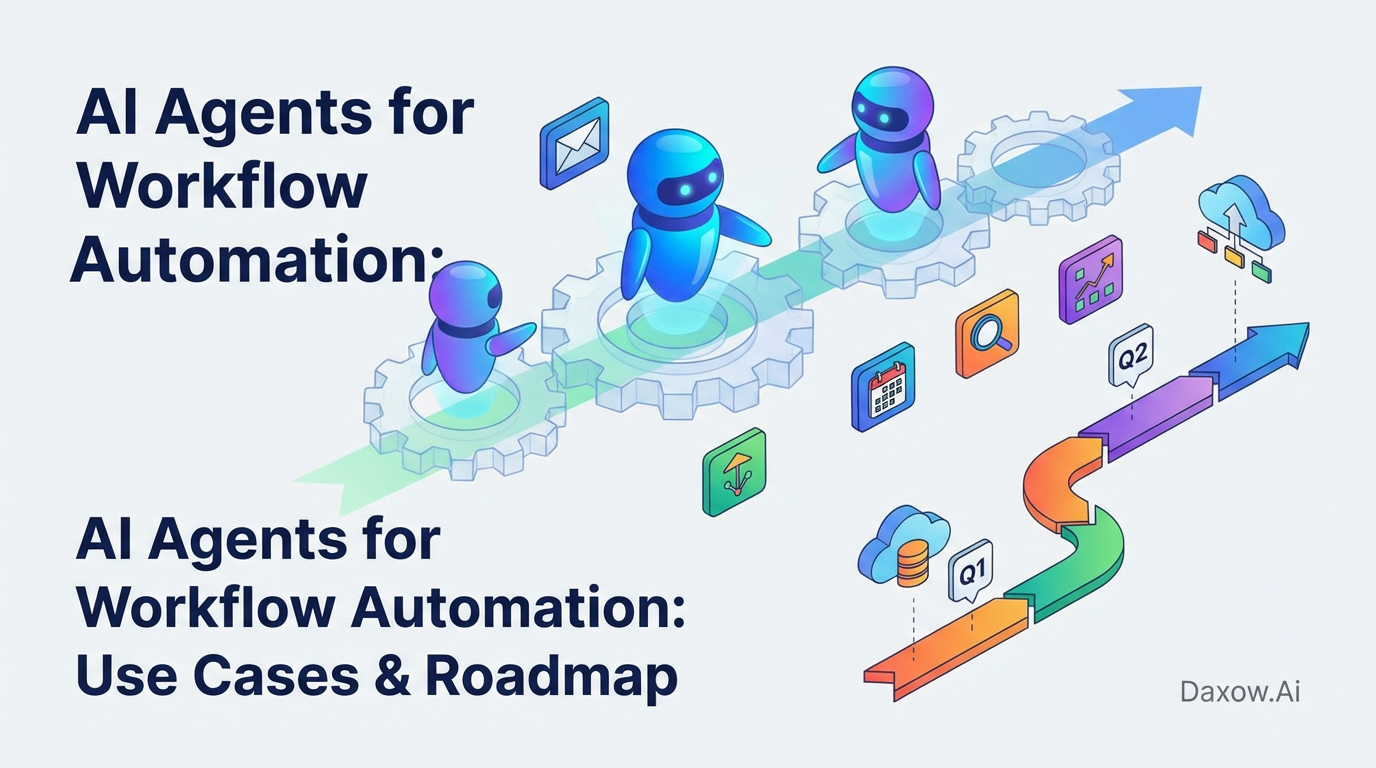
AI agents for workflow automation: use cases, KPIs, integrations, and a practical roadmap to cut manual work, reduce costs, and boost productivity with Daxow.ai.
AI Agents for Workflow Automation: Transforming Business Productivity and Customer Support
Estimated reading time: 15 minutes
Key Takeaways
- AI agents enable autonomous execution of multi-step workflows by leveraging natural language understanding and system integrations.
- Adopting AI automation reduces manual tasks, speeds decision-making, and improves customer support consistency.
- Practical use cases span industries including e-commerce, finance, healthcare, real estate, HR, and sales & marketing.
- A clear implementation roadmap from process analysis to scaling and governance ensures measurable automation success.
- Daxow.ai offers tailored AI agents and integration expertise that deliver ROI and operational excellence.
Table of Contents
- What Are AI Agents?
- Research-based Business Benefits
- Practical Use Cases Across Industries
- Implementation Roadmap
- Technical Considerations and System Integrations
- Measuring Success: KPIs and ROI
- Common Pitfalls and How to Avoid Them
- Why Partner with Daxow.ai for AI Automation
- Conclusion and Next Steps
- Frequently Asked Questions
What Are AI Agents?
AI agents are software entities that perceive context, make decisions, and execute tasks autonomously or semi-autonomously across systems. Unlike static automation scripts, agents combine natural language understanding, business rules, API integrations, and orchestration to complete multi-step workflows.
Key capability: agents can reason with unstructured data such as emails, contracts, and tickets, interact with human staff, and trigger actions in CRMs, ERPs, and support platforms.
How AI Agents Fit into Workflow Automation
- Replace manual, repetitive tasks with configurable decision logic and LLM-powered comprehension.
- Orchestrate cross-system processes: for example, an agent can read an incoming invoice, validate line items against purchase orders, update ERP records, and notify finance if discrepancies occur.
- Provide a consistent customer-facing layer: agents enable faster, personalized responses while escalating complex issues to humans.
Core Technical Components
- Natural language processing and LLMs for understanding and response generation.
- Connectors and APIs to integrate with CRMs, ticketing systems, databases, and document repositories.
- Business rules engine and orchestration layer for multi-step workflows.
- Monitoring and observability for tracking performance, error rates, and compliance.
Research-based Business Benefits
Organizations adopting AI agents and automation reduce manual workload, accelerate customer interactions, and improve throughput with fewer resources. Key benefits include:
Productivity and Cost Reduction
- Reduced manual workload: AI agents eliminate routine data entry, triage, and verification tasks, freeing staff for higher-value work.
- Faster processing: Automated workflows shorten cycle times for invoicing, claims, and onboarding.
- Lower operating costs: Automation minimizes temporary headcount spikes and reduces error-related rework.
Customer Support Automation Outcomes
- Improved response times and resolution rates: AI-enabled triage and knowledge retrieval improve first-contact resolution.
- Consistent quality: Agents provide uniform answers based on policy, boosting CSAT and lowering escalations.
- Scalable service: AI agents handle surges without proportional cost increases.
Sales Automation Improvements
- Faster lead qualification: AI agents analyze and enrich inbound leads, assigning scores per company criteria.
- Higher conversion efficiency: Sales reps focus on qualified opportunities rather than data gathering.
- Shorter sales cycles: Automated task generation nudges prospects through the funnel faster.
Practical Use Cases Across Industries
E-commerce
Use case: Returns processing and refund automation.
Agent role: Process return requests, validate purchase history, inspect images with vision models, trigger refunds or replacements in order management, and update inventory.
Benefits: Faster refunds, reduced manual review, improved customer satisfaction, lower return handling costs.
Finance and Banking
Use case: Loan application triage and document verification.
Agent role: Extract data from documents, cross-check identity and credit databases, generate preliminary decisions, route high-risk files to underwriters.
Benefits: Shorter application turnaround, fewer manual checks, improved compliance traceability.
Healthcare
Use case: Insurance claim intake and coding.
Agent role: Extract clinical codes from medical records and invoices, validate policy rules, flag anomalies, queue complex claims for review.
Benefits: Reduced claim cycle time, fewer coding errors, improved payer-provider reconciliation.
Real Estate and Property Management
Use case: Tenant onboarding and maintenance triage.
Agent role: Collect tenant documents, verify identity, create lease records, prioritize maintenance requests by urgency.
Benefits: Faster move-ins, lower administrative load, improved tenant experience.
Human Resources
Use case: Candidate screening and interview scheduling.
Agent role: Parse resumes, score candidates, handle scheduling with calendar integrations, send standardized communications.
Benefits: Reduced time-to-hire, consistent screening, less recruiter administrative work.
Sales & Marketing
Use case: Lead qualification and enrichment.
Agent role: Scrape profiles, enrich leads with firmographic data, score leads, create follow-up tasks for sales.
Benefits: Higher-quality pipeline, improved conversion rates, scaled outreach.
Implementation Roadmap
Deploying AI agents effectively requires a step-by-step approach. Daxow.ai follows this roadmap to ensure measurable outcomes:
- Discovery and process mapping: Identify high-volume processes; map workflows, decision points, and data sources.
Deliverable: Prioritized automation backlog and baseline KPIs. - Design and prototype: Define agent behaviors, build lightweight integration prototypes.
Deliverable: Working prototype and ROI projection. - Build and integrate: Develop connectors, orchestration, logging, error handling.
Deliverable: Production-ready AI agent with security controls. - Pilot and measure: Run limited-scope pilots, measure KPIs, refine agent logic.
Deliverable: Measured results and refined SLAs. - Scale and govern: Apply access controls, audits, standardize templates.
Deliverable: Scaled deployment with governance framework. - Continuous improvement: Monitor performance, retrain models, expand agents.
Deliverable: Ongoing dashboards and improvement plans.
Technical Considerations and System Integrations
Data Connectivity
- Secure APIs and connectors integrate with CRMs (Salesforce, HubSpot), ERPs (SAP, NetSuite), support platforms (Zendesk, Freshdesk), and document repositories.
- Data normalization and enrichment ensure consistent decisioning.
Model Selection and Orchestration
- Combine LLMs for comprehension with deterministic rules engines for policy enforcement.
- Orchestration layers manage workflows, retries, and compensating actions.
Security, Privacy, and Compliance
- Encrypt data in transit and at rest.
- Role-based access and audit logs for every agent action.
- Ensure compliance with regulations such as GDPR and HIPAA.
Human-in-the-Loop and Escalation
- Set thresholds and decision boundaries for escalation to humans.
- Provide agents with contextual summaries and suggested actions for faster decisions.
Monitoring and Observability
- Track performance metrics: error rates, task completion, human overrides, user satisfaction.
- Implement alerts for drift or increased exceptions.
Measuring Success: KPIs and ROI
Measuring tangible outcomes is vital to justify AI automation investments.
Key KPIs
- Reduction in manual hours spent per process.
- Improvements in average handling time (AHT) and cycle time.
- Customer satisfaction (CSAT) or Net Promoter Score (NPS) gains.
- Conversion rate improvements in sales workflows.
- Reduced error rates and compliance exceptions.
Example ROI Calculation (Illustrative)
- Process: Invoice processing.
- Baseline: 1,000 invoices/month; 15 minutes/manual; $25/hr cost.
- Manual cost: 1,000 x 0.25 hrs x $25 = $6,250/month.
- Post-automation: 70% automated; human review 30% at 5 minutes each.
- New cost: (300 x 0.0833 hrs x $25) = $625 + $500 automation maintenance = $1,125/month.
- Monthly savings: ~$5,125; annualized > $60,000 with faster payments and fewer errors.
Common Pitfalls and How to Avoid Them
- Over-automation: Fix process inefficiencies before automating to avoid magnified issues.
- Ignoring data quality: Invest in data pipelines and normalization for agent effectiveness.
- Lack of governance: Implement audits and controls to manage compliance risks.
- Not involving end-users: Ensure buy-in from staff who interact with agents for success.
- Failure to measure: Define success metrics and monitor continuously to optimize outcomes.
Why Partner with Daxow.ai for AI Automation
Daxow.ai specializes in designing and deploying AI agents and workflow automation tailored to your unique business processes, delivering measurable ROI and operational improvements.
What Daxow.ai Provides
- End-to-end process analysis: Mapping current workflows to identify high-impact automation opportunities.
- Custom AI agents: Design agents that understand your data, enforce policies, and execute tasks across tools.
- System integrations: Secure connectors and orchestration layers linking your CRM, ERP, ticketing, and document systems.
- Operational readiness: Monitoring, governance, and human-in-the-loop controls ensure reliability and compliance.
- Continuous improvement: Post-deployment tuning, analytics, and scaling of AI automation solutions.
Business Value You Can Expect
- Reduced manual tasks and lower operational costs.
- Improved productivity with faster processes and better prioritization.
- Enhanced customer support automation driving higher satisfaction.
- Accelerated sales automation improving conversion rates and pipeline efficiency.
- Transparent ROI and measurable impact across departments through detailed analytics.
Learn more about our approach on our Services and Case Studies pages.
Conclusion and Next Steps
AI Agents for Workflow Automation have become a critical strategic lever to reduce manual workloads, boost productivity, and enhance customer experience. Success depends on combining thorough process analysis, targeted AI agent design, secure system integration, and rigorous performance measurement.
Book a free consultation with Daxow.ai to evaluate your processes and discover your highest-impact automation opportunities. Request a process analysis or connect with us to develop a custom AI system that reduces costs, integrates with your existing tools, and scales your team’s productivity.
Frequently Asked Questions
What distinguishes AI agents from traditional automation?
AI agents leverage natural language understanding, reasoning over unstructured data, and multi-system integrations to autonomously execute complex workflows, whereas traditional automation typically performs predefined, rule-based tasks within single systems.
Which industries benefit most from AI agents?
Industries including e-commerce, finance, healthcare, real estate, human resources, and sales & marketing benefit significantly from AI agents by automating routine tasks, improving decision speed, and enhancing customer interactions.
How does Daxow.ai ensure compliance in AI automation?
Daxow.ai implements encryption, role-based access, audit logs, and governance frameworks aligned with regulations such as GDPR and HIPAA to ensure secure and compliant AI automation deployments.
What is involved in partnering with Daxow.ai?
Partnership involves detailed process analysis, custom AI agent design, system integration, operational readiness support, and continuous improvement to ensure measurable business value and sustained success.