
AI Agents and Workflow Automation: Transform Operations, Cut Costs
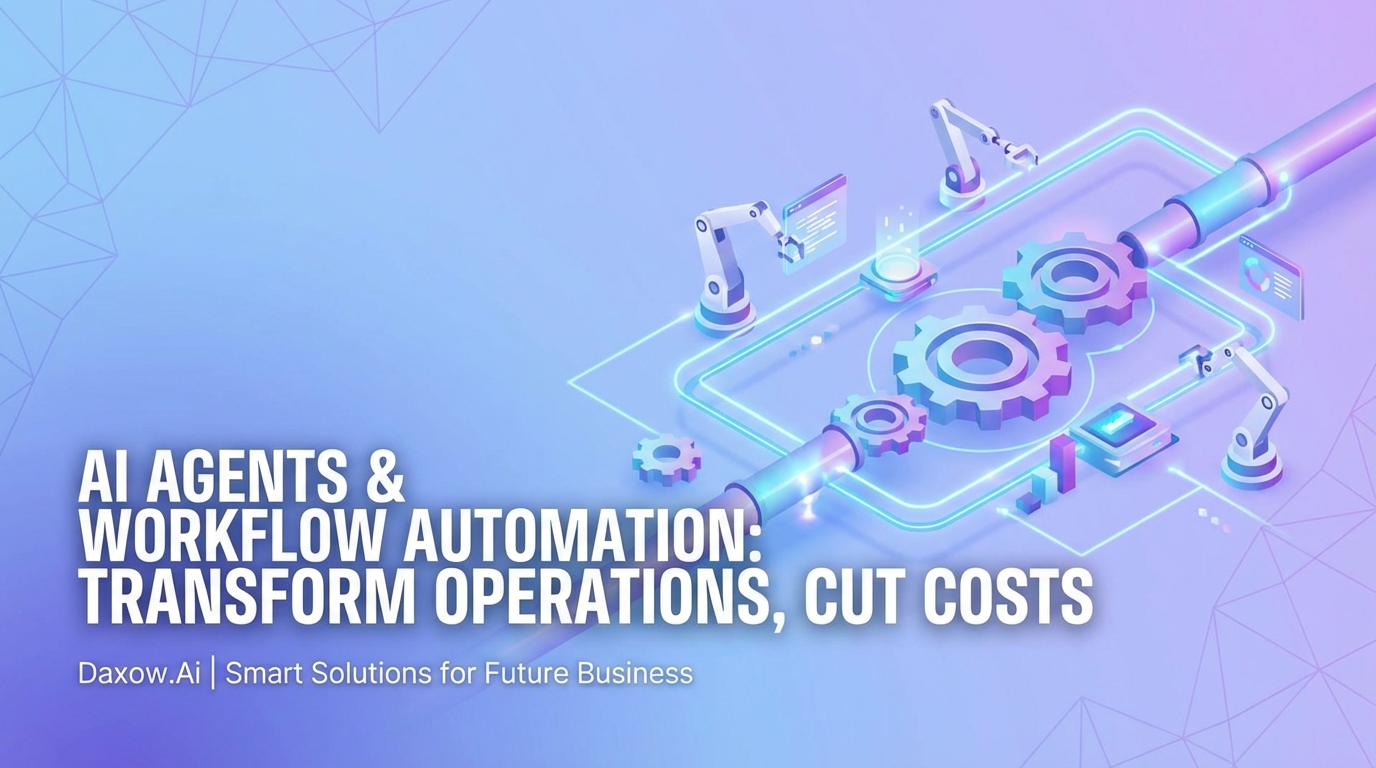
Learn how AI agents and workflow automation streamline operations, cut costs, and boost productivity across industries with implementation steps and Daxow.ai solutions.
AI Agents and Workflow Automation: How to Transform Operations, Cut Costs, and Boost Productivity
Estimated reading time: 15 minutes
Key Takeaways
- AI agents combined with workflow automation enhance operational efficiency by automating complex decision-making tasks.
- Industries like e-commerce, healthcare, finance, real estate, HR, and customer support benefit significantly from targeted AI automation.
- A structured, step-by-step implementation approach ensures successful deployment and measurable ROI.
- Monitoring, governance, and continual optimization are critical to scaling AI-driven automation effectively.
- Daxow.ai delivers end-to-end automation solutions that integrate seamlessly with enterprise systems for lasting business impact.
Table of Contents
- AI Agents and Workflow Automation — The Strategic Imperative
- Use Cases and Practical Examples Across Industries
- How to Implement AI Agents and Workflow Automation
- Measuring ROI and Avoiding Common Pitfalls
- How Daxow.ai Delivers End-to-End Business Automation
- Building Autonomous AI Agents that Execute Real Tasks
- Conclusion and Next Steps
- Frequently Asked Questions
AI Agents and Workflow Automation — The Strategic Imperative
AI agents and workflow automation are reshaping how organizations operate. By combining autonomous, learning-driven agents with automated process orchestration, businesses can eliminate repetitive work, accelerate decision-making, and deliver superior customer experiences.
Why this matters now:
- Business leaders face pressure to reduce operating costs, increase speed, and deliver consistent customer experiences. Traditional automation handles simple rules; AI agents add decision-making, natural language understanding, and adaptive behavior to execute complex workflows end-to-end.
- Organizations implementing AI agents report substantial improvements: cost reductions of 20–50% in targeted processes, processing time cuts of 40–70%, and lower error rates that reduce compliance and financial risks.
- The strategic value is not only efficiency. AI-driven automation enables scalability and frees human talent for higher-value work, turning operational teams into strategic engines for growth.
Core capabilities of AI agents and workflow automation:
- Autonomous task execution: agents execute multi-step processes across systems (CRM, ERP, ticketing).
- Natural language processing: chat and email handling for support, lead qualification, and triage.
- Predictive analytics: demand forecasting, fraud detection, and proactive service.
- Integration and orchestration: connectivity across tools for seamless end-to-end workflows.
How this drives business outcomes:
- Reduce manual tasks and operational costs.
- Improve productivity and throughput without proportional headcount increases.
- Enhance customer support automation to improve response times and satisfaction.
- Accelerate sales automation through faster lead qualification and follow-up.
Use Cases and Practical Examples Across Industries
E-commerce
Challenge: Inventory mismatches, delayed order processing, high return volumes.
AI agent solution: An agent ingests sales and returns data, predicts demand, reorders stock, and coordinates fulfillment systems. A separate conversational agent handles return requests, issues refunds, and updates inventory automatically.
Impact: Reduced stockouts by 20–40%, faster order resolution, and lower manual ticket volumes.
How Daxow helps: We build AI agents that integrate with e-commerce platforms and ERPs, deploy dynamic pricing and inventory forecasting models, and automate order-to-refund workflows.
Healthcare
Challenge: Administrative burden for scheduling, intake, billing and compliance reporting.
AI agent solution: Patient intake agents triage symptoms through secure chat, schedule appointments, pre-fill forms, and validate insurance information. Back-office agents reconcile billing codes and compile compliance reports from disparate systems.
Impact: Administrative time reduced by up to 50%, improved accuracy and regulatory adherence, and better patient experience.
How Daxow helps: We design HIPAA-conscious automation, integrate agents with EHR systems, and implement audit trails and human-in-the-loop oversight for high-stakes decisions.
Finance and Banking
Challenge: High-volume transaction monitoring, manual reconciliation, slow loan approvals, and compliance burdens.
AI agent solution: Agents scan invoices and transaction logs to reconcile accounts, flag anomalies, and escalate potential fraud. Loan processing agents perform risk scoring, verify documentation, and produce audit-ready trails.
Impact: Errors and manual reconciliation time fall significantly; approval times shorten, and compliance reporting becomes automated.
How Daxow helps: We deploy secure document automation, build risk models integrated with existing core banking systems, and implement governance controls.
Real Estate
Challenge: Slow lead qualification, manual document review, and long sales cycles.
AI agent solution: Lead qualification agents analyze inbound inquiries, match buyers to properties using preference profiles, schedule viewings, and pre-fill contract templates. Contract-extraction agents parse terms and highlight negotiation points.
Impact: Deal cycles speed up by roughly 30%, with higher lead-to-deal conversion.
How Daxow helps: We connect CRM data to AI agents for real-time lead scoring, automate contract extraction and approval workflows, and integrate virtual tour scheduling.
Human Resources
Challenge: Time-consuming recruitment, onboarding, and skills tracking.
AI agent solution: Resume-screening agents shortlist candidates, initial interview bots conduct structured assessments, and onboarding agents automate document collection and training assignments.
Impact: Hiring time reduced from weeks to days; improved candidate experience and retention through tailored development plans.
How Daxow helps: We implement applicant-tracking integrations, build conversational screening agents, and automate learning paths tied to HR systems.
Customer Support and Sales Automation
Challenge: High ticket volumes, inconsistent responses, and inefficient lead follow-up.
AI agent solution: Conversational agents resolve common queries, escalate complex cases, and update CRM records automatically. Sales automation agents qualify leads, schedule demos, and orchestrate follow-up campaigns.
Impact: Faster resolution times, higher NPS, and increased sales conversion rates.
How Daxow helps: We design support automation strategies, build chatbots with escalation logic, and implement sales workflows that feed directly into pipeline forecasting.
How to Implement AI Agents and Workflow Automation
Successful deployment follows a structured, iterative approach. Below are practical steps and guidance.
1. Assess and Plan
- Map existing workflows to identify repetitive, high-volume processes with clear metrics (time spent, error rate, cost).
- Prioritize use cases with quick wins and measurable ROI—think customer support, invoice processing, or lead qualification.
- Run small proof-of-concept pilots to validate assumptions and create baseline metrics.
- Daxow role: We conduct process analysis to identify automation candidates and estimate ROI; we define pilot scope and success criteria.
2. Ensure Data Readiness
- Cleanse and standardize data; address missing values and inconsistent formats.
- Build data pipelines and real-time integrations to ensure agents access current, trusted information.
- Enforce privacy and compliance requirements during data ingestion and storage.
- Daxow role: We prepare data pipelines, implement ETL processes, and set up secure data stores with compliance controls.
3. Select and Integrate Tools
- Choose platforms that support NLP, model retraining, and orchestration across services.
- Prioritize vendors and architectures that offer robust APIs for integration with legacy systems (ERP, CRM, ticketing).
- Design the integration layer to enable agents to read and write across systems securely.
- Daxow role: We evaluate technology stacks, recommend scalable and secure platforms, and perform the integration engineering.
4. Build the Team
- Assemble cross-functional teams: process owners, data engineers, ML engineers, and change managers.
- Invest in upskilling and transparent communication to reduce resistance to automation.
- Define roles for human oversight—especially for high-stakes or subjective decisions.
- Daxow role: We provide program management, train internal teams, and embed change management practices.
5. Deploy and Monitor
- Deploy pilots with monitoring for performance, bias, drift, and errors.
- Use human-in-the-loop checkpoints during rollout to catch edge cases and build trust.
- Implement dashboards that track KPIs: cycle time, error rate, cost per transaction, and customer satisfaction.
- Daxow role: We set up monitoring, alerts, and retraining pipelines; we run iterative improvement cycles.
6. Scale and Optimize
- Expand automation to adjacent processes based on pilot learnings.
- Retrain models with new data; refine orchestration logic to handle exceptions.
- Establish governance for model explainability, security, and continuous improvement.
- Daxow role: We help scale solutions, optimize models, and set governance frameworks that ensure long-term value.
Best practices and governance
- Start small and iterate.
- Focus on user experience and avoid over-engineering.
- Centralize automation tooling to prevent “shadow AI.”
- Define metrics and baselines before deployment.
- Enforce security, privacy, and ethical AI principles.
Measuring ROI and Avoiding Common Pitfalls
Key metrics to track
- Cost savings: labor reduction in targeted workflows (20–50%).
- Efficiency gains: processing time reductions (40–70%).
- Revenue impact: improved conversion and NPS (potential 15–30% uplift).
- Risk reduction: fewer compliance errors and audit issues.
Common pitfalls and mitigation
- Poor data quality: mitigate via pre-deployment cleansing and strict data audits.
- Integration issues: perform thorough end-to-end testing and vendor support evaluation.
- Resistance to change: implement transparent communications, upskilling programs, and involve stakeholders early.
- Lack of metrics: define measurable baselines for cost, speed, and accuracy before starting.
How Daxow.ai Delivers End-to-End Business Automation
Daxow.ai provides comprehensive AI automation services across design, build, integration, and operational phases:
- Design: We begin with a process discovery workshop to map workflows and identify high-impact automation opportunities. Our consultants translate business goals into technical requirements and success metrics.
- Build: Our engineering teams develop custom AI agents—chatbots, document parsers, lead qualifiers, and orchestration bots—tailored to your systems and data. We combine off-the-shelf models with proprietary pipelines to balance speed and control.
- Integrate: We connect AI agents to CRMs, ERPs, ticketing systems, and databases. Our emphasis on robust APIs and secure connectors ensures seamless data flow and real-time execution.
- Operate: Post-deployment, we deliver monitoring, model management, and performance analytics. We set up retraining workflows and governance to prevent drift and maintain compliance.
Value delivery: Our clients typically see measurable returns within the first 6–12 months. With targeted automation and continuous optimization, we aim to deliver 3–5x ROI by reducing manual tasks, improving throughput, and increasing revenue opportunities.
Learn more about how we integrate with your enterprise systems on our services page.
Building Autonomous AI Agents that Execute Real Tasks
What makes an AI agent truly effective:
- Actionability: agents must perform operations (create invoices, update CRM records, schedule appointments), not just suggest actions.
- Context awareness: integration with enterprise data provides context to make correct decisions.
- Safety and oversight: human review for exceptions and transparent logging for audits.
- Continual learning: models update from outcomes to improve accuracy over time.
Real-world agent architecture includes:
- Input layer: connectors for emails, forms, chat, and APIs.
- Processing: NLP, rules engine, and ML models for classification and decisioning.
- Orchestration: workflow engine that sequences tasks across systems.
- Action layer: APIs and robotic process automation for executing changes.
- Monitoring: telemetry, dashboards, and retraining triggers.
Daxow’s approach focuses on building agents that are not just intelligent, but operational—capable of executing transactions, handling exceptions, and integrating securely with your business systems.
Conclusion and Next Steps
AI agents and workflow automation are no longer optional for organizations aiming to compete on speed, cost, and customer experience. By following a disciplined approach—assessing processes, preparing data, selecting the right tools, and prioritizing governance—businesses can realize fast, measurable value.
Daxow.ai partners with companies to design, build, and operate custom AI automation solutions that:
- Reduce manual tasks and operational costs.
- Improve productivity and customer experience.
- Integrate with existing CRMs and enterprise systems to execute real work.
- Deliver measurable ROI through targeted pilots and iterative scaling.
Book a free consultation with Daxow.ai to request a process analysis for your company or contact us to build a custom AI system that automates your most valuable workflows.
Explore our tailored automation solutions on the solutions page to see how we can support your transformation.
Frequently Asked Questions
What are AI agents in workflow automation?
AI agents are autonomous software entities that perform multi-step tasks across systems, incorporating AI capabilities like decision-making and natural language understanding to automate complex business workflows.
How can AI automation reduce operational costs?
By automating repetitive, manual tasks and improving process efficiency, AI-driven workflows can reduce labor costs by 20–50%, minimize errors, and speed up processing times.
What industries benefit most from AI agents?
E-commerce, healthcare, finance, real estate, human resources, and customer support/sales automation are among the sectors with high potential for AI agent integration and measurable ROI.
How does Daxow.ai support AI automation implementation?
Daxow.ai offers end-to-end services including process discovery, AI agent development, system integration, deployment, monitoring, and ongoing optimization to ensure successful automation outcomes.
What governance practices are recommended for AI automation?
Establishing clear metrics, enforcing security and privacy standards, maintaining human-in-the-loop oversight, monitoring model performance, and iterative improvement are key governance best practices.