
AI Agents & Workflow Automation: Boost Productivity, Cut Manual Tasks
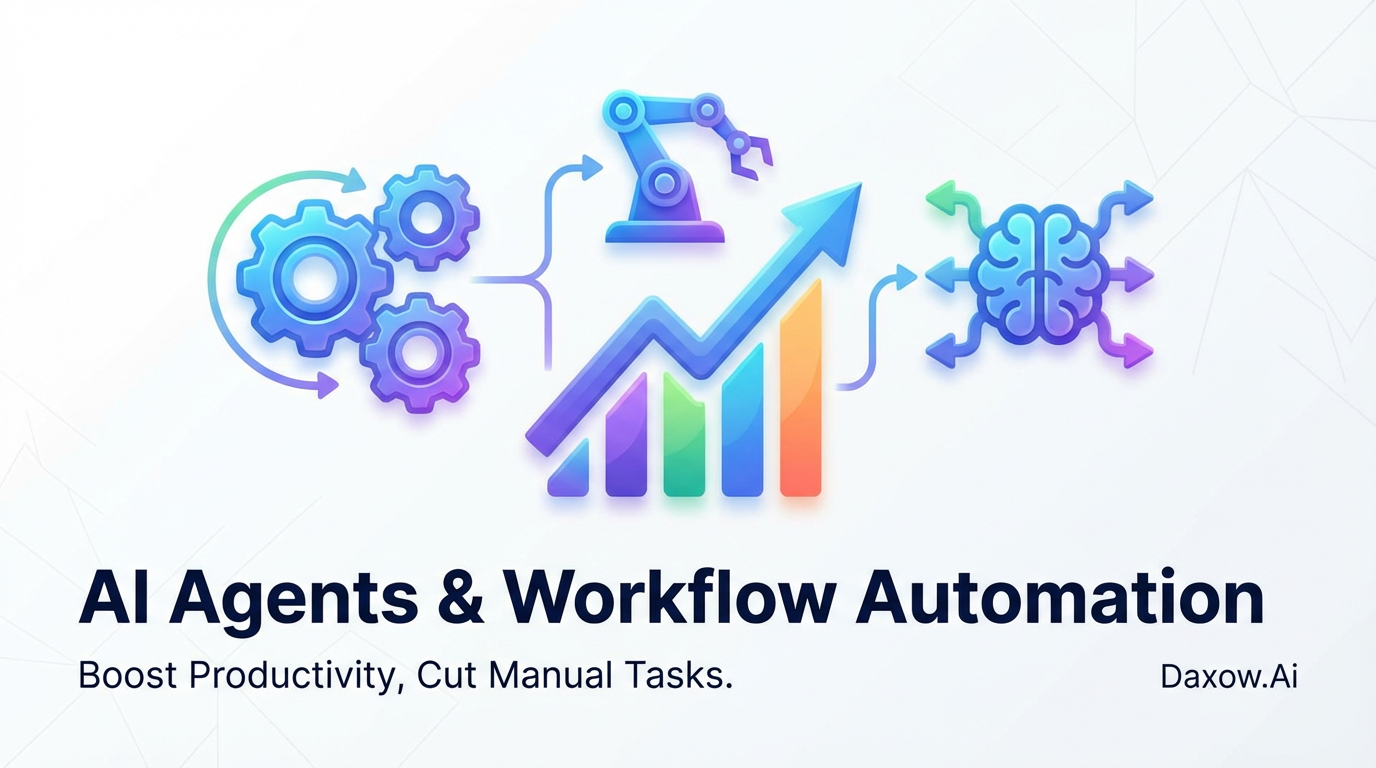
Learn how AI agents and workflow automation eliminate repetitive work, speed decisions, and cut costs—plus an implementation roadmap and KPIs for fast ROI.
How AI Agents and Workflow Automation Boost Productivity and Reduce Manual Tasks
Estimated reading time: 15 minutes
Key Takeaways
- AI agents embedded in workflow automation streamline repetitive tasks, improve decision-making, and enhance customer experience.
- Key benefits include reduced manual workload, faster case resolution, cost savings, and scalable sales automation.
- Industry-specific use cases span e-commerce, finance, healthcare, real estate, HR, and sales, showcasing broad applicability.
- A phased implementation roadmap ensures successful deployment with human-in-the-loop governance and continuous improvement.
- Measurable KPIs like manual task reduction, time-to-resolution, and customer satisfaction demonstrate ROI.
- Daxow.ai partners to design, integrate, and monitor automation systems delivering rapid and sustainable business outcomes.
Table of Contents
- How AI Agents and Workflow Automation Boost Productivity and Reduce Manual Tasks — Business Value Explained
- How AI Agents Work in Workflow Automation
- Use Cases — Practical Examples Across Industries
- Implementation Roadmap — From Process Discovery to Live Automation
- Measuring ROI — KPIs That Matter
- Integration and Data Considerations
- Risks, Security, and Governance
- How Daxow.ai Helps You Build Effective AI Agent Automation
- Case Examples (Hypothetical, Representative)
- Common Challenges and How to Overcome Them
- Getting Started — Practical Checklist
How AI Agents and Workflow Automation Boost Productivity and Reduce Manual Tasks — Business Value Explained
Why now — market and technology drivers
- AI models have matured to handle language, reasoning, and structured data extraction at scale.
- Low-code integration platforms and APIs make system-to-system connectivity simpler.
- Organizations face pressure to cut operating costs while improving service levels — making automation a priority.
Key business outcomes
- Reduce manual tasks by automating data entry, routing, and follow-ups.
- Increase productivity through faster case resolution and fewer handoffs.
- Improve customer experience with timely, consistent responses via customer support automation.
- Lower operational costs and redeploy human talent to higher-impact work.
- Scale sales by automating lead qualification and follow-up with sales automation.
How AI Agents Work in Workflow Automation
Components of an AI agent-based automation system
- Intelligence layer: LLMs and specialized models that interpret intent, extract entities, and generate responses.
- Orchestration layer: Workflow engine that coordinates steps, conditions, approvals, and retries.
- Integration layer: Connectors to CRM, ERP, ticketing, email, calendars, and databases.
- Action layer: Task executors (APIs, RPA bots, email senders) that perform changes in systems.
- Monitoring and governance: Logging, audit trails, performance dashboards, and human-in-the-loop controls.
Typical agent behaviors
- Autonomous information retrieval (from documents, CRM, knowledge base)
- Decision-making based on rules and risk thresholds
- Triggering downstream tasks (create ticket, update records, schedule call)
- Escalation to humans when confidence is low
- Continuous learning from feedback to improve accuracy
Use Cases — Practical Examples Across Industries
E-commerce — Faster fulfillment and better CX
- Automate order exception handling: An AI agent reads inbound orders, validates payment and inventory, and triggers fulfillment or flags exceptions for human review.
- Post-purchase support: Customer support automation answers status queries, starts returns, and updates CRM without human intervention.
- Result: Reduce manual tasks in order management, shorten delivery exceptions, and increase customer satisfaction.
Finance — Compliance and operational efficiency
- Document extraction and reconciliation: AI agents extract data from invoices, statements, and contracts, match transactions, and post to ledgers.
- KYC and onboarding: Automate identity verification steps, run risk checks, and escalate high-risk cases.
- Result: Lower cost per transaction, faster onboarding, and improved auditability.
Healthcare — Administrative burden reduction
- Patient intake automation: Extract structured data from forms, verify insurance, and schedule appointments.
- Prior authorization workflows: AI agents gather clinical documents, populate requests, and track approvals.
- Result: Reduce administrative overhead for clinicians, improve patient access, and reduce claim denials.
Real estate — Faster transactions and higher lead conversion
- Lead qualification and routing: AI agents score leads based on conversations and CRM data, assign to agents, and schedule viewings.
- Document automation: Generate contracts, collect signatures, and track contingencies.
- Result: Improved lead-to-contract conversion and shorter sales cycles.
HR and Administration — Better employee experience
- Onboarding automation: Collect documents, set up accounts, and enroll new hires in benefits.
- HR helpdesk: AI agents answer common inquiries, create tickets for exceptions, and route complex queries to HR specialists.
- Result: Faster onboarding, reduced HR manual workload, and improved employee satisfaction.
Sales and Marketing — Automating pipeline growth
- Lead enrichment and qualification: Agents enrich leads from public data, qualify intent, and book discovery calls.
- Proposal automation: Generate personalized proposals and follow-up sequences.
- Result: More qualified opportunities, higher rep productivity, and consistent follow-up.
Implementation Roadmap — From Process Discovery to Live Automation
Step 1 — Process discovery and prioritization
- Map current workflows and identify manual bottlenecks.
- Score opportunities by volume, cycle time, cost per transaction, and customer impact.
- Focus first on high-volume, rule-based tasks that will yield rapid ROI.
Step 2 — Design AI agent workflows
- Define agent responsibilities, inputs, outputs, success criteria, and escalation rules.
- Identify required integrations (CRM, ERP, ticketing, email, document stores).
- Establish data schemas and privacy requirements.
Step 3 — Build and validate components
- Train or configure models for NER, classification, and document understanding.
- Implement orchestration flows and connectors.
- Validate accuracy using historical data and pilot runs.
Step 4 — Human-in-the-loop and governance
- Implement confidence thresholds for autonomous actions.
- Create review queues for edge cases.
- Define audit trails, access controls, and compliance checks.
Step 5 — Rollout and continuous improvement
- Roll out in controlled phases.
- Monitor KPIs and retrain models on feedback.
- Expand automation scope gradually.
Measuring ROI — KPIs That Matter
Core performance metrics
- Reduction in manual tasks: Percent decrease in human processing steps.
- Time-to-resolution: Reduction in cycle time for common workflows.
- Cost-per-transaction: Decrease in operational cost per case.
- Throughput and capacity: Increased cases handled per employee.
- Customer metrics: Net Promoter Score (NPS), CSAT, response SLAs for support automation.
- Revenue impact: Leads converted, deal velocity improvements from sales automation.
Example ROI calculation
If an operation processes 10,000 cases/year at €5 labor cost per case, automating 60% of cases reduces labor by €30,000/year. Add improved conversion and reduced churn for additional gains.
Integration and Data Considerations
System connectivity
- Business automation depends on clean, reliable integrations.
- Use APIs and event-driven architectures where possible.
- Combine connector libraries with custom adapters for legacy systems.
Data quality and governance
- Establish canonical data models and master records.
- Implement data validation and reconciliation steps in agent workflows.
- Ensure privacy and regulatory compliance in data handling and retention.
Risks, Security, and Governance
Common risks
- Over-automation of ambiguous processes leading to errors.
- Data leakage or insufficient access controls.
- Model drift and accuracy degradation over time.
Mitigation strategies
- Use human-in-the-loop checkpoints and confidence thresholds.
- Apply role-based access control, encryption, and detailed logging.
- Schedule regular model audits and retraining cycles.
How Daxow.ai Helps You Build Effective AI Agent Automation
End-to-end process automation design
- Daxow.ai conducts in-depth process discovery workshops to map workflows and identify automation potential.
- We prioritize automation candidates using business value frameworks to maximize ROI.
Custom AI agent development
- We design AI agents that combine language models, document understanding, and business rules.
- Agents are built to execute real tasks: update CRMs, create tickets, send communications, and coordinate approvals.
System integrations and data connectivity
- Daxow.ai implements secure connectors to your CRM, ERP, ticketing systems, and data stores.
- We create robust orchestration layers so automation works reliably across your existing technology stack.
Governance, monitoring, and optimization
- We provide monitoring dashboards, audit logs, and human-in-the-loop interfaces.
- Daxow.ai supports continuous improvement through A/B testing and model retraining to keep accuracy high.
Outcome-driven delivery
- Our engagement model focuses on delivering measurable outcomes: fewer manual hours, faster SLAs, and reduced costs.
- We support phased rollouts, proving value on initial automations before scaling enterprise-wide.
Case Examples (Hypothetical, Representative)
SaaS company — Support automation leads to 40% faster resolution
- Problem: High volume of repetitive support tickets wasting senior engineers’ time.
- Solution: Daxow.ai deployed an AI agent that triaged tickets, provided self-service resolutions, and escalated complex issues.
- Outcome: Productivity improved, engineers focused on product improvements, and customer satisfaction rose.
Mid-size bank — Document automation reduces processing time by 50%
- Problem: Manual processing of loan applications delayed approvals.
- Solution: An AI agent extracted borrower data from documents, validated fields, and automated eligibility checks.
- Outcome: Faster approvals, lower operational costs, and improved customer retention.
Common Challenges and How to Overcome Them
Challenge — Unclear processes
Start with process discovery and standardized workflows before automating.
Challenge — Poor data quality
Implement data cleaning pipelines and reconciliation steps as part of automation.
Challenge — Resistance to change
Engage stakeholders, highlight time savings, and re-skill staff to higher-value tasks.
Getting Started — Practical Checklist
- Map top 10 repetitive processes with volume and cost metrics.
- Identify quick wins that are rule-based and high-volume.
- Define success metrics and acceptable risk thresholds.
- Secure executive sponsorship and allocate a cross-functional team.
- Start a pilot with clear KPIs, then scale.
Conclusion and Next Step
How AI Agents and Workflow Automation Boost Productivity and Reduce Manual Tasks is proven: businesses that apply targeted AI automation reduce operating costs, accelerate processing, and free people to do higher-value work. The combination of AI agents, robust workflow automation, and integrated systems is the path to sustainable productivity gains.
If you want to evaluate your processes and build tailored AI systems that deliver measurable results, contact Daxow.ai. Our team will perform a process analysis, design custom AI agents, and implement secure, scalable automation to improve your ROI.
Book a free consultation or request a process analysis for your company today — contact us to build a custom AI system that reduces manual tasks and scales productivity.
Frequently Asked Questions
What are AI agents in workflow automation?
AI agents are specialized software components that utilize artificial intelligence models to autonomously execute tasks, interpret data, and make decisions within automated workflows.
How does workflow automation improve productivity?
Workflow automation reduces manual handoffs and repetitive tasks, accelerating process completion, decreasing errors, and enabling employees to focus on higher-value activities.
Can AI automation be integrated with existing enterprise systems?
Yes. AI agents and workflow automation solutions are designed with integration layers that connect to CRM, ERP, ticketing, and data management systems using APIs and connectors.
What industries benefit the most from AI agents and automation?
Industries including e-commerce, finance, healthcare, real estate, HR, and sales & marketing have demonstrated significant gains through AI-driven workflow automation.