
AI Agents & Workflow Automation: Drive Business Growth
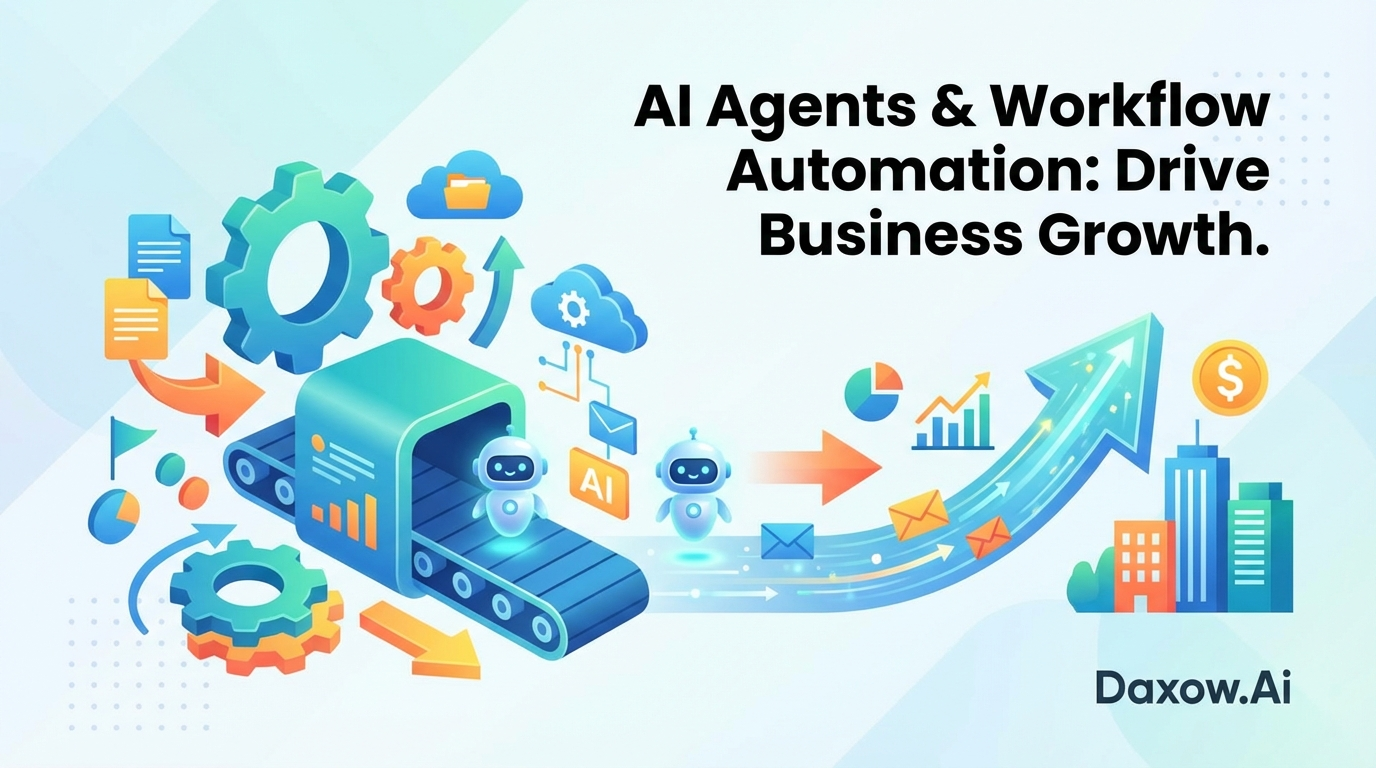
Discover how AI agents and workflow automation reduce manual work, boost productivity, and deliver measurable ROI across industries. Book a Daxow.ai consultation.
Unlocking Business Growth: The Power of AI Agents and Workflow Automation
Estimated reading time: 15 minutes
Key Takeaways
- AI agents and workflow automation reduce manual tasks, accelerate cycles, and scale operations effectively.
- Core business benefits include error reduction, improved productivity, better customer experience, and lower operational costs.
- Practical use cases span e-commerce, healthcare, finance, real estate, and HR with measurable ROI.
- Daxow.ai delivers custom AI automation solutions integrating with existing systems and driving continuous learning.
- Phased implementation and governance best practices minimize risks and maximize value from AI-driven automation.
Table of Contents
- Unlocking Business Growth: The Power of AI Agents and Workflow Automation
- Business benefits and measurable outcomes
- Practical use cases across industries (with examples)
- How AI agents and workflow automation drive transformation
- Implementation roadmap and best practices
- Common pitfalls and how to avoid them
- Measuring ROI and business value
- How Daxow.ai delivers practical AI automation
- Practical checklist for decision-makers
- Frequently Asked Questions
Unlocking Business Growth: The Power of AI Agents and Workflow Automation
What we mean by AI agents and workflow automation
AI agents are autonomous software entities that can perceive inputs, apply logic or machine-learned models, and execute tasks across systems without continuous human supervision. Workflow automation combines these intelligent agents with process orchestration to automate sequences of activities that used to require manual intervention.
- AI agents: Handle cognitive tasks such as natural language understanding, decision-making, classification, and prediction.
- Workflow automation: Orchestrates both rule-based and AI-driven steps across systems (CRMs, ERPs, ticketing systems) to complete end-to-end processes.
Together, they enable businesses to reduce manual tasks, speed decision cycles, and free staff to focus on high-value activities that drive growth.
Business benefits and measurable outcomes
Core benefits
- Reduce manual tasks and error rates: Automating repetitive, high-volume processes reduces human error and cycle times.
- Improve productivity: Teams can focus on strategy and exception handling instead of routine processing.
- Enhance customer experience: Faster responses and 24/7 availability improve CSAT and NPS.
- Lower operational costs: Expect cost reductions in the range of 20–50% on automated activities when implemented correctly.
- Scalable operations: Automation scales query volumes and transactions without linear headcount increases.
Key performance indicators to track
- Average handling time (AHT) for support queries
- First-contact resolution rate
- Time-to-quote or time-to-close for sales processes
- Invoice cycle time and reconciliation accuracy
- Onboarding time for new hires or customers
- Cost per transaction or inquiry
Practical use cases across industries (with examples)
E-commerce — Customer support automation and order processing
Use case: An online retailer automates inbound customer inquiries, returns processing, and inventory alerts.
- AI agents analyze chat and email messages, classify intent (order status, returns, refunds), and either resolve the request or escalate to a human with context.
- Workflow automation ties the agent to order management and warehouse systems to trigger refunds, update tracking, and restock notifications.
Business impact: Faster resolution times, reduced support headcount per ticket, and improved repeat-customer rates due to consistent responses.
Healthcare — Appointment triage and administrative automation
Use case: A clinic uses AI agents to handle appointment scheduling, pre-visit triage, and billing inquiries with HIPAA-aware controls.
- Agents collect symptom information, prioritize urgent cases, and create or modify appointments in the EHR scheduling system.
- Automation routes referrals and insurance verification tasks to back-office systems.
Business impact: Reduced administrative burden, improved patient throughput, and lower no-show rates through automated confirmations and reminders.
Finance — Invoice reconciliation and compliance checks
Use case: A finance team automates supplier invoice capture, validation, and reconciliation.
- Document automation extracts invoice data, an AI agent matches invoices to purchase orders, and a workflow routes exceptions to AP staff.
- Agents run fraud detection models and flag anomalous transactions for human review.
Business impact: Faster close cycles, lower error rates, and stronger audit trails for compliance.
Real estate — Lead qualification and scheduling
Use case: A real estate firm automates lead qualification, property matching, and viewing schedules.
- AI agents score leads based on intent signals, match clients to listings, and automatically schedule viewings in agents’ calendars.
- Workflow automation updates CRM records, triggers follow-up sequences, and logs outcomes.
Business impact: Shorter sales cycles, higher conversion rates, and improved agent productivity.
HR — Recruitment and onboarding
Use case: An enterprise automates resume screening, interview scheduling, and onboarding checklists.
- AI agents screen resumes against job criteria, rank candidates, and coordinate interview times.
- Workflow automation advances candidates through stages and ensures digital paperwork and training deliverables complete on schedule.
Business impact: Faster time-to-hire, better candidate experience, and redeployment of HR resources to strategic initiatives.
How AI agents and workflow automation drive transformation
From point solutions to end-to-end automation
The highest value comes from connecting AI agents to the systems that hold business data and process logic:
- CRMs (customer context)
- ERPs (financial and inventory state)
- Knowledge bases (support content)
- Ticketing systems (workflow state)
Daxow.ai specializes in designing these integrations so AI agents can perform real tasks — updating records, initiating payments, or escalating issues — not just suggest actions.
Intelligent decision-making and continuous learning
AI agents combine NLP, classification, and predictive models to make decisions. Continuous monitoring and retraining prevent model drift and preserve performance over time. Daxow.ai establishes feedback loops so agents learn from human corrections, improving accuracy and reducing supervision.
Hyperautomation for complex workflows
Hyperautomation couples robotic process automation (RPA) with AI capabilities for end-to-end processes. This is essential when workflows include both structured data tasks (RPA-driven) and unstructured inputs (AI-driven). The result is a seamless, automated process that operates 24/7 and scales with demand.
Implementation roadmap and best practices
Phased approach — minimize risk, maximize value
- Assessment & Planning (4–8 weeks)
Define measurable goals (e.g., 30% reduction in handling time).
Map current workflows and identify high-volume, low-complexity opportunities.
Evaluate data quality, systems, and governance needs.
Daxow.ai accelerates this phase with structured process audits and ROI projections. - Technology and Vendor Selection (6–12 weeks)
Prioritize platforms with robust integration capabilities and compliance features.
Consider scalability and total cost of ownership.
Daxow.ai provides vendor-agnostic recommendations and builds bespoke connectors where needed. - Preparation and Data Work (4–8 weeks)
Clean and normalize data.
Build knowledge bases and decision rules.
Document workflows and exception paths. - Pilot Deployment
Start small with a single use case.
Measure KPIs, collect feedback, and refine models and rules. - Gradual Rollout and Continuous Optimization
Expand scope by channels, teams, and regions.
Monitor performance, retrain models, and iterate on workflows.
Maintain governance to avoid shadow automation and ensure compliance.
Best practices to ensure success
- Start with high-impact, low-complexity processes for quick wins and stakeholder buy-in.
- Form a cross-functional team combining business, IT, and compliance stakeholders.
- Prioritize data quality; AI performance depends on clean, representative data.
- Establish governance to manage model updates, access controls, and auditability.
- Design for observability: implement monitoring dashboards for KPIs and errors.
- Plan for change management: train teams, define escalation paths, and communicate the value.
Common pitfalls and how to avoid them
- Over-automating complex decisions without human oversight — mitigate with human-in-the-loop workflows.
- Ignoring integration complexity — Daxow.ai builds robust connectors and API orchestration to ensure data flows reliably.
- Skipping governance — enforce role-based access, logging, and periodic model validation.
- Setting vague success metrics — define specific KPIs aligned to business outcomes before deployment.
Measuring ROI and business value
Typical financial outcomes
- Cost savings through headcount reallocation and faster processing (20–50% on automated processes).
- Revenue upside from faster lead response times, higher conversion rates, and better customer retention.
- Efficiency gains quantified via AHT reductions, increased throughput, and improved first-contact resolution.
Building a business case
- Identify baseline metrics and target improvements.
- Estimate implementation and operating costs (platforms, integrations, maintenance).
- Model payback period using conservative assumptions (many pilots pay back within 6–12 months).
Daxow.ai supports ROI modeling and provides case-based evidence from prior implementations to validate projections.
How Daxow.ai delivers practical AI automation
End-to-end solution design
Daxow.ai combines domain consulting, technical architecture, and implementation. Our capabilities include:
- Process discovery and mapping
- Custom AI agent design and model training
- Workflow orchestration and RPA integration
- System integrations with CRMs, ERPs, ticketing systems, and knowledge bases
- Compliance and security engineering
- Ongoing monitoring, retraining, and managed services
Real-world delivery approach
- We start with a focused process analysis and quick-win pilot.
- We build production-grade agents that execute real actions (update records, create tickets, process invoices).
- We integrate observability and governance so stakeholders retain control and visibility.
- We scale across departments with measurable KPI tracking and continuous optimization.
Practical checklist for decision-makers
- Identify 3–5 high-volume processes that are rule-based or have predictable patterns.
- Define target KPIs and acceptable payback periods.
- Assemble a cross-functional team and appoint an executive sponsor.
- Prioritize data cleanup and knowledge base development.
- Choose an implementation partner that provides both technical and domain expertise.
- Plan for monitoring, retraining, and change management post-launch.
Frequently Asked Questions
What are AI agents and how do they differ from traditional automation?
AI agents are autonomous software that use machine learning and natural language processing to perform cognitive tasks without constant human input. Traditional automation typically follows fixed rules and lacks adaptability or learning capabilities.
How can workflow automation improve customer experience?
Automation enables faster response times, 24/7 availability, and consistent handling of inquiries, leading to higher customer satisfaction (CSAT) and net promoter scores (NPS).
What industries benefit most from AI agents and workflow automation?
E-commerce, healthcare, finance, real estate, and HR are key industries with high-volume processes that benefit greatly. However, any industry with routine, rule-based or predictable tasks can leverage these technologies.
How does Daxow.ai ensure successful AI automation implementation?
Daxow.ai uses a phased approach with strong governance, integration expertise, continuous learning, and KPI tracking to deliver scalable, compliant AI automation tailored to business needs.
Unlocking Business Growth: The Power of AI Agents and Workflow Automation is achievable with a disciplined, outcome-driven approach. Organizations that prioritize high-impact workflows, robust integrations, and continuous learning will realize significant productivity gains, reduced manual tasks, and demonstrable ROI. Daxow.ai helps businesses across industries design, build, and operate custom AI systems that integrate with existing tools, automate end-to-end processes, and deliver measurable value.