
Implement AI Agents and Automation for Business Transformation
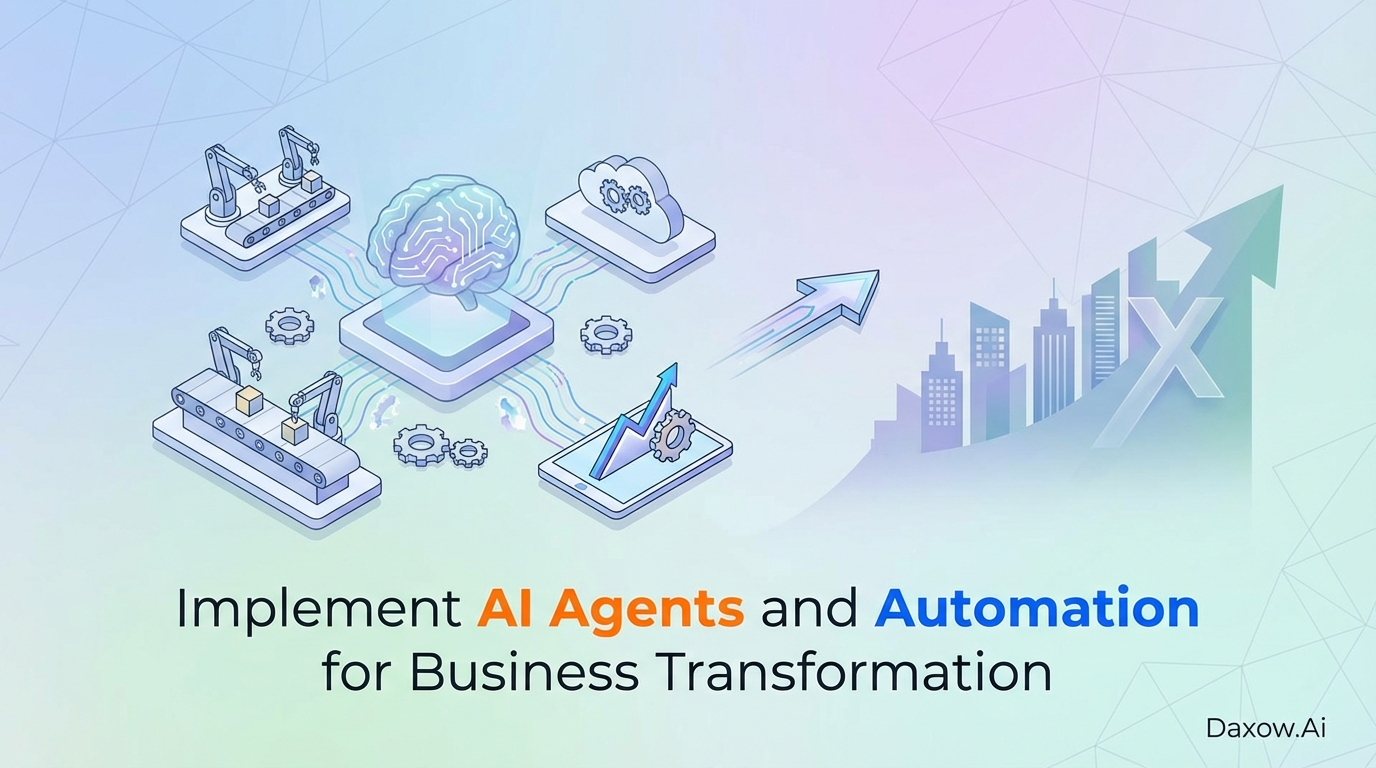
How AI agents plus workflow automation enable hyperautomation, cut costs, and scale operations. Actionable roadmap, use cases, and Daxow.ai implementation services.
Unlocking Business Transformation: Implementing AI Agents and Automation for Competitive Advantage
Estimated reading time: 15 minutes
Key Takeaways
- Combining AI agents with workflow automation drives hyperautomation for operational agility and improved outcomes.
- Businesses can expect 20–50% cost reductions, faster processes, and better customer satisfaction.
- A staged implementation roadmap minimizes risk and maximizes ROI.
- Use cases span industries such as e-commerce, healthcare, finance, real estate, and HR with measurable benefits.
- Effective governance and risk management are critical to sustainable AI automation success.
- Daxow.ai offers end-to-end custom AI automation solutions tailored to business needs.
Table of Contents
- Why This Combination Matters Now
- Business Value and ROI of AI Agents and Automation
- How AI Agents and Automation Drive Results
- Implementation Roadmap: From Idea to Enterprise-Grade Automation
- Use Cases: Practical Examples Across Industries
- Governance, Risk, and Change Management
- Common Pitfalls and How to Avoid Them
- How Daxow.ai Helps You Implement This Transformation
- Practical Checklist for Decision-Makers
- Example Pilot: Lead Qualification for a Mid-Sized Sales Team
- Final Recommendations
- Conclusion and Call to Action
- Frequently Asked Questions
Why This Combination Matters Now
AI agents are autonomous software systems that perceive inputs, reason, decide, and act. They can handle complex decisions, continuous monitoring, and adaptive behaviors.
Workflow automation removes repetitive, rule-based work and stitches processes together across systems.
Together they enable hyperautomation: end-to-end automation of business-critical workflows that previously required human coordination.
The strategic implication is clear: shifting from manual, error-prone processes to data-driven automation creates operational agility, faster response times, and better customer outcomes. Organizations that adopt this approach reduce processing times, lower error rates, and free teams to focus on high-value work.
Business Value and ROI of AI Agents and Automation
What leaders should expect
- Cost reductions of 20–50% in targeted operations by eliminating repetitive tasks and accelerating throughput.
- Short-term pilots often deliver results within 6–12 months, enabling quick validation before scaling.
- Continuous 24/7 operation improves service levels and leads to faster resolution times and higher customer satisfaction.
- Strategic benefits include resilient processes, scalable operations, and the ability to innovate faster than competitors.
Metrics to measure success
- Time saved per process
- Error rate reduction
- Cost per transaction or ticket
- Conversion rate improvements (for sales and e-commerce)
- Net Promoter Score (NPS) and customer satisfaction
- Model accuracy and drift metrics
How AI Agents and Automation Drive Results
What AI agents do that automation alone cannot
- Perceive and interpret unstructured data (emails, documents, chat logs) using NLP.
- Make decisions based on predictive models, not only rules.
- Act autonomously across systems—update CRMs, trigger billing, escalate issues.
- Learn over time, enabling continuous improvement and adaptability.
Where workflow automation adds scale
- Orchestrates processes reliably across tools and teams.
- Eliminates manual handoffs and reduces process latency.
- Enforces governance and audit trails for compliance.
When combined, AI agents handle intelligence tasks (classification, prediction, conversation) and automation platforms execute deterministic steps, creating workflows that are both smart and reliable.
Implementation Roadmap: From Idea to Enterprise-Grade Automation
A staged approach reduces risk and maximizes ROI.
1. Define Clear Objectives and Prioritize Processes
- Identify repetitive, high-volume tasks with clear ROI potential (e.g., invoice processing, lead qualification, support triage).
- Set measurable KPIs: processing time, cost per case, accuracy targets.
- Engage stakeholders early: operations, IT, compliance, and frontline teams.
2. Assess and Prepare Data
- Audit data quality: completeness, consistency, lineage.
- Consolidate or expose data in machine-readable formats.
- Implement privacy and security controls aligned with regulations.
3. Select Tools and Build Cross-Functional Teams
- Choose platforms that offer strong integrations, scalability, and monitoring.
- Assemble teams with business domain experts, data engineers, ML engineers, and process designers.
- Balance off-the-shelf components for speed with custom AI agents where logic or domain knowledge is unique.
4. Prototype and Pilot
- Start with a narrow proof-of-concept that targets a high-value, low-risk process.
- Measure results, refine models, and validate business impact.
- Use pilot learnings to build data pipelines and governance frameworks.
5. Integrate, Govern, and Scale
- Embed automation into production systems with robust error handling and human-in-the-loop where needed.
- Implement governance to manage model drift, bias, and access — prevent shadow AI sprawl.
- Scale across departments once performance and controls are validated.
6. Monitor, Measure, and Iterate
- Track KPIs and retrain models periodically.
- Run quarterly reviews for continuous improvement.
- Use feedback loops from users and customers to enhance decision logic.
Use Cases: Practical Examples Across Industries
E-commerce — Inventory, Pricing, and Support
Use case: AI agents analyze real-time sales and supplier data to predict demand and trigger automated replenishment. Workflow automation executes purchase orders and updates inventory systems.
Business impact: Reduced stockouts, lower overstock, and increased conversion rates through personalized recommendations.
Daxow.ai role: Integrate e-commerce platforms and ERPs, build forecasting agents, deploy dynamic pricing loops, and automate order-to-fulfillment workflows.
Healthcare — Scheduling, Triage, and Claims
Use case: Symptom-checking agents triage patient requests and schedule appropriate appointments. Document automation extracts claims data and automates submissions.
Business impact: Faster access to care, reduced administrative backlog, and improved compliance.
Daxow.ai role: Design HIPAA-aware agents, automate scheduling integrations, and implement document extraction with audit trails.
Finance — Fraud Detection and Compliance
Use case: Autonomous monitoring agents flag suspicious transactions in real time while automation routes suspicious cases for review and attaches enriched evidence.
Business impact: Faster fraud detection, smaller loss exposure, and easier compliance reporting.
Daxow.ai role: Build detection models, integrate with transaction systems, and create end-to-end investigation workflows to accelerate resolution.
Real Estate — Lead Qualification and Valuation
Use case: AI agents score inbound leads using historic transaction data and behavior signals; automation schedules viewings and triggers document prep for listings.
Business impact: Higher lead-to-deal conversion and lower manual follow-up time.
Daxow.ai role: Implement lead-scoring agents, integrate CRM and MLS data, and automate repetitive administrative steps.
HR — Recruitment and Onboarding
Use case: Agents screen resumes, schedule interviews, and automate parts of onboarding (document collection, system access).
Business impact: Reduced time-to-hire and improved candidate experience.
Daxow.ai role: Create screening models, integrate ATS systems, and automate onboarding checklists with compliance controls.
Governance, Risk, and Change Management
- Human-centric design: Keep people in the loop for sensitive decisions and provide clear escalation paths.
- Bias and fairness: Monitor model behavior, test for disparate impact, and maintain transparent decision logs.
- Security and privacy: Encrypt data at rest and in transit, minimize data exposure, and enforce role-based access.
- Change management: Communicate benefits, provide training, and re-skill teams to shift focus from manual tasks to oversight and strategy.
Common Pitfalls and How to Avoid Them
- Poorly defined goals: Ensure measurable KPIs tied to business outcomes.
- Bad data: Invest in data quality and pipelines before building models.
- Over-scoping pilots: Start small to prove value and then scale.
- Lack of governance: Prevent shadow AI by centralizing deployments and enforcing controls.
How Daxow.ai Helps You Implement This Transformation
Daxow.ai delivers end-to-end services to help businesses realize the benefits of AI automation:
- Discovery and Process Analysis: We map current workflows, identify high-impact automation candidates, and define measurable KPIs.
- Custom AI Agents: We design and build agents that execute real tasks — from document extraction and lead qualification to autonomous monitoring and decision-making.
- Workflow Automation and Integrations: We connect systems and automate full workflows across CRMs, ERPs, help desks, and custom databases.
- Data Engineering and Governance: We prepare data pipelines, enforce privacy and security, and implement governance frameworks to minimize risk.
- Pilot-to-Scale Delivery: We run pilots, measure ROI, and execute phased rollouts to scale automation across teams.
- Ongoing Monitoring and Optimization: We monitor model performance, retrain agents, and continuously optimize workflows to protect and improve ROI.
Daxow.ai’s approach emphasizes measurable business outcomes: reduced manual tasks, improved productivity, lower operational costs, and enhanced customer experiences.
Practical Checklist for Decision-Makers
Before you start, confirm these essentials:
- Clear business objective and KPIs.
- Executive sponsor and cross-functional team.
- Data access and quality baseline.
- Choice of integration-friendly platforms.
- Small pilot scope with clear success criteria.
- Governance plan for security, privacy, and model monitoring.
Example Pilot: Lead Qualification for a Mid-Sized Sales Team
- Objective: Reduce time sales reps spend on unqualified leads by 60% within 3 months.
- Approach:
- Build an AI agent to score leads using CRM history and engagement data.
- Automate outreach workflows and calendar scheduling for high-score leads.
- Measure conversion rate of qualified leads, time saved per rep, and sales cycle reduction.
- Expected impact: Faster response to hot leads, higher conversion, and increased rep capacity without headcount growth.
- Daxow.ai delivers the complete pilot: model, integrations, automation, and KPI dashboard.
Final Recommendations
- Start with high-volume, high-impact processes where the business case is clear.
- Combine AI agents with workflow automation to get both intelligence and reliable execution.
- Prioritize governance and human oversight to build trust and control risk.
- Measure results and iterate: pilots should prove value quickly before enterprise scaling.
Conclusion and Call to Action
Unlocking Business Transformation: Implementing AI Agents and Automation for Competitive Advantage is achievable with the right strategy, data readiness, and implementation partner. Daxow.ai specializes in designing custom AI systems that automate end-to-end workflows, integrate with existing tools, reduce manual tasks, and deliver measurable productivity and cost improvements.
Book a free consultation with Daxow.ai to request a process analysis for your company and start building a custom AI system that delivers real business results. Contact us to assess opportunities, run a pilot, and scale automation across your organization.
Frequently Asked Questions
What are AI agents and how do they differ from traditional automation?
AI agents are autonomous systems capable of perception, reasoning, and decision-making beyond rule-based automation. They can interpret unstructured data, make predictive decisions, and adapt over time, whereas traditional automation follows fixed workflows and rules.
How quickly can businesses see ROI from AI automation?
Many short-term pilots deliver measurable results within 6–12 months, allowing businesses to validate impact before scaling more broadly.
Which industries benefit most from implementing AI agents and automation?
Industries like e-commerce, healthcare, finance, real estate, and HR have demonstrated strong benefits, but the approach is broadly applicable to any sector with repetitive workflows and data-driven decision needs.
How does Daxow.ai ensure governance and risk management?
Daxow.ai enforces human-centric design, bias monitoring, data security, and continuous governance to maintain transparency, compliance, and risk mitigation throughout the automation lifecycle.