
Enterprise Transformation with AI Agents and Automation
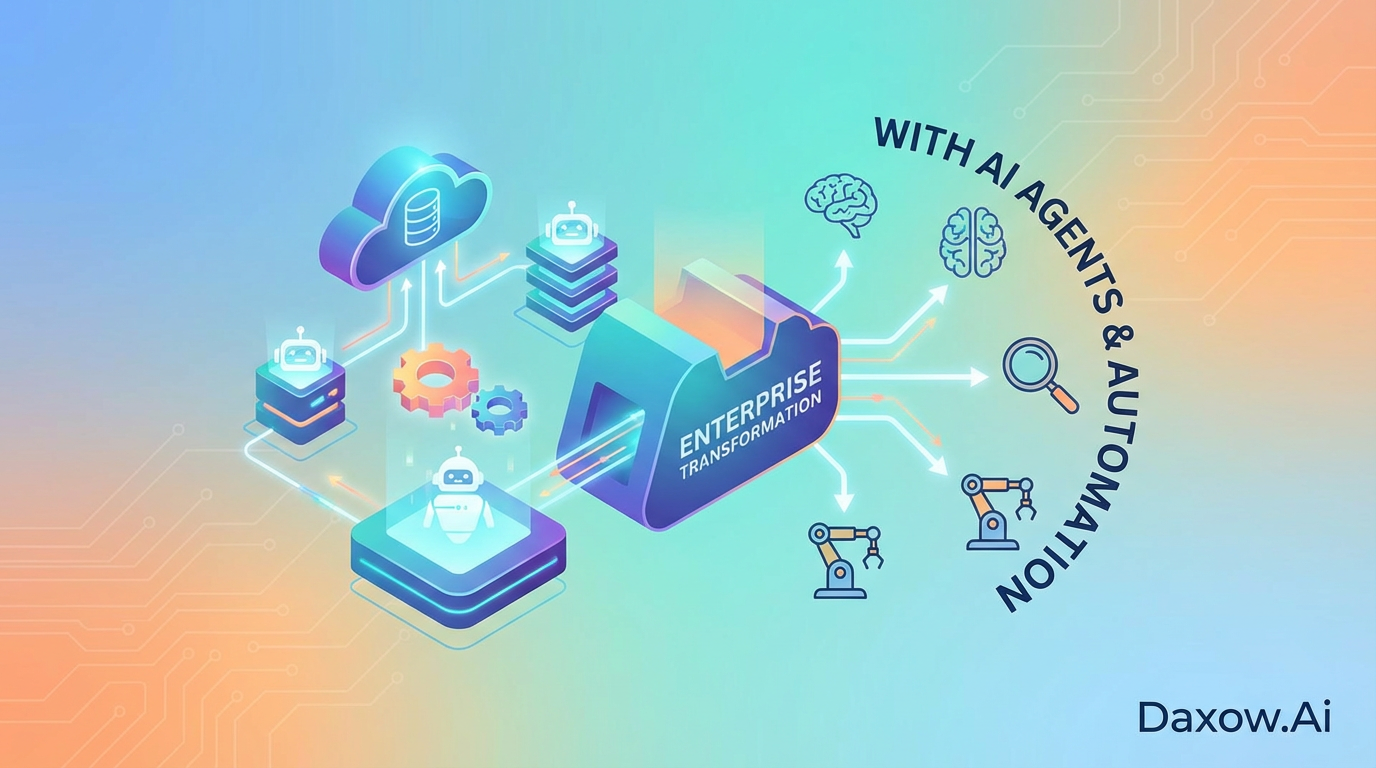
Explore how AI agents and workflow automation streamline enterprise processes, deliver ROI, and practical use cases plus an implementation roadmap from Daxow.ai.
Unlocking Business Transformation: AI Agents and Automation in Enterprise Workflows
Estimated reading time: 12 minutes
Key Takeaways
- AI agents and workflow automation replace manual, error-prone tasks with scalable, data-driven execution.
- Practical use cases span e-commerce, healthcare, finance, real estate, HR, and customer support.
- Daxow.ai delivers tailored AI automation solutions that boost productivity by up to 50% and lower operational costs.
- Successful implementation requires structured steps: goal definition, data quality evaluation, tooling selection, pilot programs, and ongoing governance.
- Measuring KPIs and scaling automation systematically drives enterprise-wide impact and ROI.
Table of Contents
- Unlocking Business Transformation: AI Agents and Automation in Enterprise Workflows
- Key Use Cases for AI Agents and Automation
- How AI Agents and Workflow Automation Drive Business Value
- Implementation Roadmap: From Process Analysis to Scaled Automation
- Measuring Success and Scaling for Enterprise Impact
- Practical Checklist: Is Your Organization Ready for AI Automation?
- Frequently Asked Questions
Unlocking Business Transformation: AI Agents and Automation in Enterprise Workflows
Unlocking Business Transformation: AI Agents and Automation in Enterprise Workflows has moved from theoretical promise to operational imperative. Organizations that adopt AI automation and deploy AI agents to handle repetitive, data-intensive, and decision-driven tasks capture measurable value: reduced manual work, faster response times, and meaningful productivity gains. This article explains what modern automation looks like, presents practical use cases across industries, outlines a proven implementation roadmap, and shows how Daxow.ai designs and delivers custom systems that drive ROI and operational resilience.
What we mean by this phrase is a combined approach where intelligent software agents—powered by machine learning, natural language processing, and rule-based automation—execute tasks autonomously and orchestrate end-to-end workflows across systems. The result is scalable, data-driven operation that replaces error-prone manual processes with consistent, auditable, and fast execution.
- AI agents act like digital employees: they read, reason, and take actions across CRM, ERP, ticketing, and document repositories.
- Workflow automation connects systems and enforces business rules, ensuring that work moves smoothly between teams and tools.
- AI automation marries both: agents resolve unstructured inputs (emails, scanned invoices, chat) and trigger workflow automation to complete transactions.
Strategic implications for decision-makers:
- Reduce manual tasks that consume valuable hours across finance, support, and operations.
- Boost productivity by 20–50% in targeted processes through automation and predictive insights.
- Improve customer experience via faster, more personalized responses with customer support automation.
- Lower operational costs and decrease error rates while unlocking new capacity for value-added work.
Key Use Cases for AI Agents and Automation
E‑commerce — Inventory, Support, and Marketing Automation
- Use case: An AI agent monitors sales velocity and supplier notifications, predicts stockouts, and triggers purchase orders automatically. Simultaneously, a chatbot handles complex customer queries and routes sensitive issues to human agents.
- Business impact: Reduced stockouts, improved conversion rates, lower support cost per ticket.
- Daxow.ai role: Design predictive inventory models, integrate with e-commerce platforms and ERPs, and deploy customer support automation that transitions smoothly from bot to human.
Healthcare — Patient Intake, Document Processing, and Triage
- Use case: Automated extraction of patient data from forms and scanned documents, routing triage inquiries, and flagging anomalies in clinical records for clinician review.
- Business impact: Faster intake, improved compliance, reduced administrative backlog.
- Daxow.ai role: Build secure document automation pipelines, ensure data privacy compliance, and create AI agents that escalate critical findings to clinicians.
Finance — Fraud Detection, Reconciliation, and Document Automation
- Use case: AI agents analyze transaction patterns in real time to detect fraud, reconcile statements automatically, and extract data from invoices to populate accounting systems.
- Business impact: Significant reduction in fraud losses, faster close cycles, and elimination of manual data entry.
- Daxow.ai role: Integrate with core banking, payments, and accounting systems; train detection models; and implement governance for ongoing model tuning.
Real Estate — Lead Qualification and Valuation Reports
- Use case: AI agents qualify incoming leads by researching public records and past interactions, create valuation summaries from market data, and schedule viewings automatically.
- Business impact: Higher-quality leads, faster agent response, better conversion rates.
- Daxow.ai role: Connect CRM, MLS feeds, and marketing systems; build lead-scoring agents; and automate follow-up workflows.
HR and Admin — Recruitment, Onboarding, and Employee Support
- Use case: Automated resume screening, scheduling interviews, generating offer letters, and operating a virtual HR assistant for employee queries.
- Business impact: Reduced time-to-hire, standardized onboarding, and lower HR helpdesk volume.
- Daxow.ai role: Implement document parsing, integrate with HRIS systems, and deliver employee-facing AI agents to reduce repetitive HR tasks.
Customer Support and Sales Automation
- Use case: AI-powered ticket triage, automated responses for common queries, sentiment analysis to prioritize escalations, and sales automation for lead qualification and follow-up.
- Business impact: Faster SLA compliance, improved NPS, and higher-qualified leads for sales teams.
- Daxow.ai role: Deploy customer support automation platforms, integrate with CRMs, and build AI agents that take real actions—updating records, creating tasks, and prompting human intervention when needed.
How AI Agents and Workflow Automation Drive Business Value
Integration and Orchestration
AI agents create value by connecting disparate systems—ERP, CRM, analytics, and third‑party services—executing cross-system logic so processes complete end-to-end without human handoffs.
Handling Unstructured Data
Unlike legacy RPA, AI agents process unstructured inputs: emails, PDFs, images, and free-text conversations. That enables automation for previously intractable tasks like invoice understanding, contract review, and customer sentiment extraction.
Predictive and Proactive Operations
AI agents do more than react; they surface early warnings—fraud alerts, inventory disruptions, or churn signals—allowing teams to act proactively rather than reactively.
Tangible ROI Metrics
- Productivity: 20–50% boost in targeted processes.
- Error reduction: Fewer manual entry mistakes, faster reconciliation.
- Customer satisfaction: Higher NPS through faster, personalized interactions.
- Cost savings: Reduced labor and faster cycle times deliver rapid payback on pilot programs.
Daxow.ai helps organizations capture these benefits by designing custom AI agents, implementing workflow automation, and integrating solutions with existing technology stacks to ensure measurable outcomes and long-term ROI.
Implementation Roadmap: From Process Analysis to Scaled Automation
1. Define Goals and Identify Processes
- Action: Map workflows and prioritize high-impact, repetitive tasks (e.g., invoice processing, first-line support).
- Outcome: Clear, measurable objectives such as “reduce invoice processing time by 60%” or “cut average ticket handling time by 40%.”
- Daxow.ai: Conduct process discovery workshops and create a prioritized automation backlog.
2. Evaluate Data Quality and Accessibility
- Action: Audit data sources, standardize formats, and ensure secure pipelines. Identify compliance requirements.
- Outcome: Reliable training data and operational inputs for AI agents.
- Daxow.ai: Implement data connectors, ETL pipelines, and secure storage tailored to regulatory needs.
3. Select Tools and Build Teams
- Action: Choose platforms with integration capabilities, no-code options for business users, and governance features. Assemble cross-functional teams.
- Outcome: Scalable technology stack and stakeholder alignment.
- Daxow.ai: Recommend tooling, provide engineering and product resources, and train internal teams to manage no-code workflows.
4. Prototype, Pilot, and Validate
- Action: Run time-bound pilots with measurable KPIs and a small cross-functional team.
- Outcome: Proof-of-concept validated against real data and business outcomes.
- Daxow.ai: Deliver rapid prototypes, iterate quickly, and measure pilot results to build the business case for scale.
5. Monitor, Measure, and Iterate
- Action: Implement monitoring, retrain models to address drift, and enforce governance to prevent uncontrolled deployments.
- Outcome: Continuous improvement and long-term stability.
- Daxow.ai: Provide managed services, observability tools, and governance frameworks to scale safely.
Best practices to avoid common pitfalls:
- Start small: Prioritize pilots with clear ROI.
- Enforce governance: Prevent “shadow AI” and maintain compliance.
- Focus on change management: Upskill teams and secure executive sponsorship.
- Mitigate bias: Regularly audit models and datasets for fairness.
Measuring Success and Scaling for Enterprise Impact
Key performance indicators to track:
- Operational metrics: cycle time reduction, tickets handled per agent, time saved per task.
- Financial metrics: cost per process, labor savings, and time-to-value for automation investments.
- Customer metrics: response time, first-contact resolution, and NPS.
- Model metrics: accuracy, precision, recall, and drift indicators.
Scaling approach:
- Convert pilot wins into standardized templates and repeatable playbooks.
- Incrementally expand agent capabilities and integrate additional systems.
- Maintain a feedback loop between business owners and engineering teams for continuous optimization.
Daxow.ai supports measurement and scaling by providing:
- Detailed ROI dashboards and regular performance reviews.
- Ongoing model maintenance and retraining.
- Integration and orchestration expertise to extend automation across the enterprise.
Practical Checklist: Is Your Organization Ready for AI Automation?
- Do you have clearly documented processes and frequent manual bottlenecks?
- Are your data sources accessible and compliant with regulations?
- Do you have executive sponsorship and cross-functional teams ready to collaborate?
- Can you define measurable KPIs for pilots (time saved, cost reduced, NPS improvement)?
- Are you prepared to invest in governance, monitoring, and upskilling?
If you checked more than two boxes, you are ready to begin.
Conclusion and Call to Action
AI agents and workflow automation are proven levers for unlocking business transformation, reducing manual tasks, improving productivity, and delivering measurable ROI. Daxow.ai combines strategic process analysis with technical delivery—designing custom AI agents, integrating systems, and orchestrating end-to-end automation to reduce operational costs and scale impact.
Book a free consultation with Daxow.ai to request a process analysis for your company and start building a custom AI system that automates critical workflows, improves customer experience, and accelerates growth. Contact us today to take the first step toward enterprise-grade AI automation.
Frequently Asked Questions
What are AI agents in enterprise workflows?
AI agents are intelligent software entities that autonomously perform tasks by processing data, making decisions, and interacting with various enterprise systems such as CRM, ERP, and ticketing platforms.
How does workflow automation differ from traditional automation?
Workflow automation orchestrates the flow of work across multiple systems and teams, enforcing business rules, whereas traditional automation typically focuses on automating isolated tasks or processes.
What industries benefit most from AI automation?
Industries like e-commerce, healthcare, finance, real estate, HR, and customer support have shown significant gains by applying AI agents and automation tailored to their specific workflow challenges.
How do I get started with AI automation for my business?
Start by defining clear goals and identifying repetitive, high-impact processes. Collaborate with experts, such as those at Daxow.ai, to audit your data, select platforms, and run pilot projects that demonstrate tangible ROI.
Is there a risk of AI bias in automation systems?
Yes, bias can occur in AI models. It is important to regularly audit and retrain models with diverse, representative data to ensure fairness and compliance throughout automation processes.