
Design, Deploy, and Scale AI Agents for Business Automation
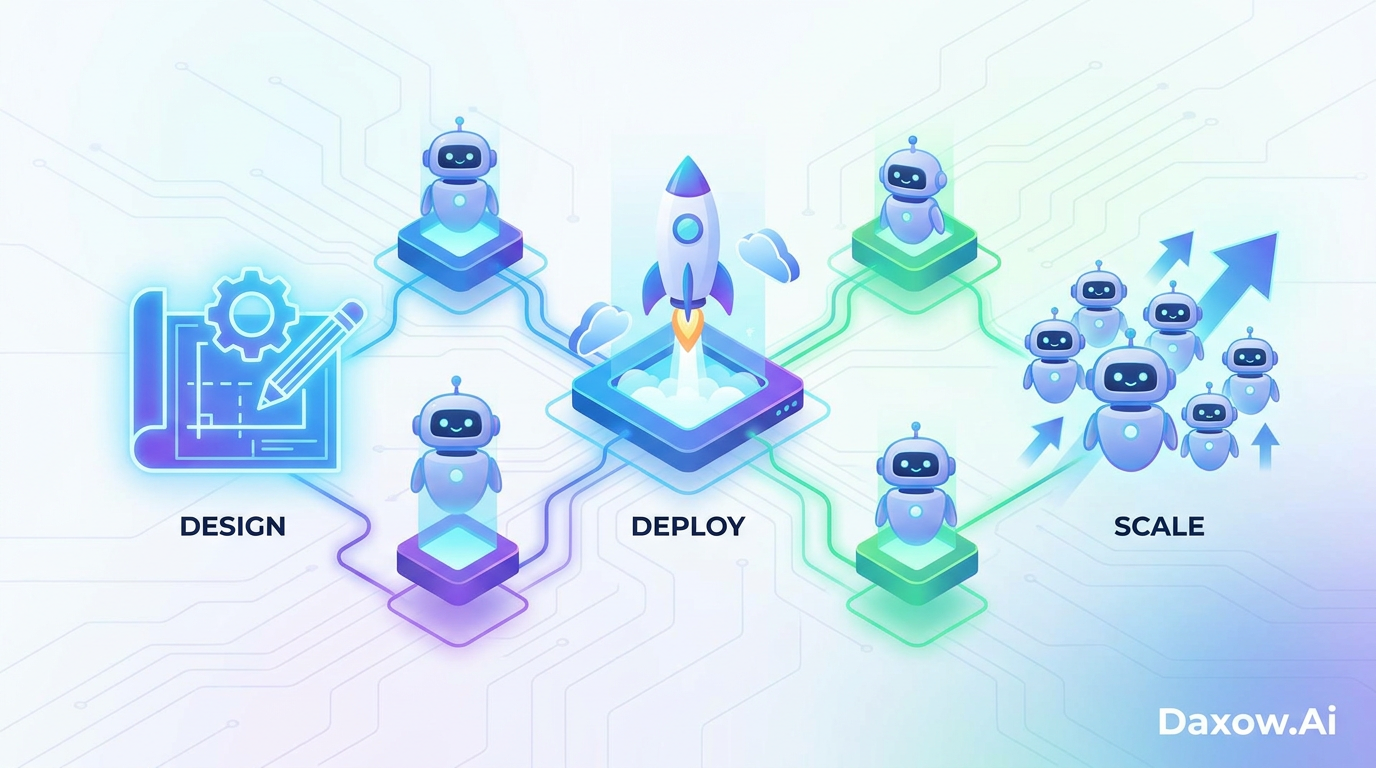
Practical guide to designing, deploying, and scaling AI agents and workflow automation for businesses, with use cases, implementation steps, ROI metrics, and Daxow.ai services.
AI agents and automation for business: How to design, deploy, and scale AI-driven workflows that boost productivity
Estimated reading time: 15 minutes
Key Takeaways
- AI agents combined with workflow automation form a new always-on digital workforce that improves speed, reliability, and scalability.
- Practical AI use cases span e-commerce, healthcare, finance, real estate, and HR with measurable improvements in outcomes.
- Core capabilities like unstructured data understanding, context-aware decisioning, and cross-system orchestration unlock automation value.
- A phased implementation approach ensures successful deployment, governance, and organizational adoption.
- Measuring ROI with direct and strategic metrics secures buy-in and drives continuous improvement.
- Daxow.ai partners with businesses to design, integrate, and scale custom AI agents and automation tailored to their specific needs.
Table of Contents
- AI agents and automation for business — what it means
- Practical use cases and industry examples
- Core capabilities that unlock value
- Implementation steps and best practices
- Measuring ROI and demonstrating business value
- How Daxow.ai helps you design and scale AI agents and workflow automation
- Starting your automation journey — first steps
- Frequently Asked Questions
AI agents and automation for business — what it means
AI agents are autonomous or semi-autonomous software entities that understand context, reason about goals, and execute actions across systems. When combined with workflow automation, they form a new digital workforce that can handle repetitive work, optimize decisions, and trigger processes in real time.
Key implications for business leaders:
- From tasks to outcomes: Move beyond robotic task automation to automating decisions, escalations, and business outcomes.
- Always-on digital workforce: AI agents operate 24/7 and integrate with CRMs, ERPs, ticketing systems, and communication platforms.
- Higher speed and reliability: Complex processes that spanned days can be compressed to minutes, with fewer errors.
- Scalable cost structure: Automation enables revenue and volume growth without linear headcount increases.
- Human leverage: Employees shift from manual execution to supervision, exception handling, and strategic work.
Practical use cases and industry examples
E‑commerce — scale support, personalize sales, and reduce returns
Problem: High volume of repetitive customer inquiries, late responses, and inconsistent product content.
Agent role:
- 24/7 customer support agents for order tracking, returns, and FAQs with multilingual capabilities.
- Pre‑sales agents recommending products based on session behavior and purchase history.
- Content agents that generate and maintain SEO‑optimized product descriptions.
Outcomes:
- Higher conversion and average order value through personalization.
- Reduced support cost and improved CSAT via faster first response and resolution.
- Lower manual work in catalog management and fewer listing errors.
Healthcare — streamline intake, documentation, and claims
Problem: Administrative burden on clinicians and slow revenue cycles.
Agent role:
- Patient intake agents that pre-fill forms, verify insurance, and triage urgency.
- Documentation agents that summarize visits and draft discharge instructions for clinician review.
- Claims agents preparing and validating claims to reduce denials.
Outcomes:
- Faster clinician workflows and higher patient throughput.
- Reduced claim denials and faster payment cycles.
- Improved compliance with clear audit trails.
Finance — speed onboarding and reduce manual reconciliation
Problem: Document-heavy processes, compliance checks, and error-prone invoice handling.
Agent role:
- KYC and onboarding agents extracting and validating identity documents.
- Loan pre-qualification agents summarizing risk factors and drafting memos for underwriters.
- AP/AR agents doing invoice extraction, 3‑way matching, and cash application.
Outcomes:
- Faster customer onboarding and improved conversion.
- Lower operational cost in AP/AR and fewer reconciliation errors.
- More consistent compliance with regulatory screening automated.
Real estate — faster lead qualification and smoother operations
Problem: Slow lead follow-up and fragmented scheduling and document workflows.
Agent role:
- Lead capture agents that qualify inbound inquiries and enrich data with neighborhood insights.
- Scheduling agents that coordinate viewings and manage reschedules and confirmations.
- Document agents that prepare listing copy and contract drafts for review.
Outcomes:
- Improved lead-to-deal conversion and faster response times.
- More efficient agents with less administrative overhead.
- Consistent, professional communications that increase client trust.
HR — automate recruiting, onboarding, and employee support
Problem: Lengthy time-to-fill and heavy admin load on HR teams.
Agent role:
- Screening agents filtering resumes and highlighting top candidates.
- Onboarding orchestration agents provisioning accounts, scheduling training, and tracking tasks.
- Internal HR chat agents answering policy questions and routing complex issues.
Outcomes:
- Shorter time-to-fill and lower cost-per-hire.
- Smoother onboarding with consistent employee experience.
- Reduced HR admin time and higher employee satisfaction.
Core capabilities that unlock value
Successful AI agents and workflow automation projects rely on a set of core capabilities. Designing for these capabilities early reduces risk and accelerates value.
- Unstructured data understanding: Extract meaning from emails, documents, and notes into structured fields.
- Context-aware decisioning: Use rules, historical data, and real-time context to make the next best action.
- Cross-system orchestration: Execute multi-step workflows across CRM, ERP, ticketing, and communication tools.
- Event-driven triggers: Monitor events and trigger workflows in real time (e.g., new lead, overdue invoice).
- Human-in-the-loop workflows: Provide drafts or recommendations with controlled approval gates for sensitive actions.
- Auditability and observability: Maintain logs and dashboards for transparency, compliance, and continuous improvement.
Implementation steps and best practices
Strategic foundations
- Start with outcomes, not tech. Define 2–3 measurable goals (e.g., reduce average response time to 10 minutes; cut invoice cost per item by 40%).
- Identify high‑leverage workflows. Target high-volume, rule-driven, and painful processes with digital data.
- Classify autonomy level. Decide between assisted (recommendations), supervised (limited auto-execution), or autonomous agents.
Technical and operational steps
- Map the process end-to-end. Document systems, inputs, decision points, SLAs, and exceptions.
- Design agent objectives and constraints. Define the agent’s scope, escalation rules, and success metrics.
- Integrate systems securely. Connect CRMs, ERPs, ticketing, and data warehouses with robust auth and audit logs.
- Pilot narrowly. Start in shadow mode where the agent proposes actions while humans approve.
- Iterate and scale. Refine prompts, rules, and exception handling; expand scope as confidence grows.
Governance, security, and human oversight
- Assign ownership. Each agent needs a product owner responsible for performance and changes.
- Protect data and privacy. Apply least-privilege access, masking, and secure logging.
- Include fail-safes. Implement kill switches, manual overrides, and escalation thresholds for sensitive domains.
Organizational change
- Involve frontline users. Design with customer service reps, analysts, and operations staff for adoption.
- Train and communicate. Teach teams how to supervise agents and interpret outputs; share wins to build momentum.
- Productize agents. Treat agents as ongoing products with monitoring, updates, and roadmaps.
Measuring ROI and demonstrating business value
Direct metrics
- Labor efficiency: Percent reduction in time spent on a process; reduced headcount required per volume.
- Cost per transaction: Reduced cost per ticket, invoice, or lead handled.
- Speed metrics: Reduction in average handling time and first response time.
- Error rates: Fewer data-entry mistakes and rework.
Strategic metrics
- Revenue impact: Conversion uplift from faster, personalized sales responses and reduced churn.
- Customer and employee satisfaction: CSAT, NPS, and employee engagement scores.
- Compliance and risk: Fewer compliance incidents and better auditability.
Measurement approach
- Establish baselines before deployment.
- Run pilot vs. control comparisons or A/B tests.
- Combine quantitative KPIs with qualitative feedback from stakeholders.
How Daxow.ai helps you design and scale AI agents and workflow automation
Daxow.ai is an end-to-end AI automation partner that helps organizations move from strategy to production faster and with lower risk. Our approach is tailored to business outcomes and built around integration, security, and measurable value.
What Daxow.ai delivers:
- Discovery and process analysis: We map current workflows, identify high-leverage automation opportunities, and define measurable KPIs to reduce manual tasks and increase productivity.
- Custom AI agents: We design and build AI agents that operate within your systems and business rules—ranging from assisted agents that draft communications to autonomous agents that execute multi-system workflows.
- Workflow automation and orchestration: We implement robust workflow engines and connectors to CRMs, ERPs, ticketing systems, and databases to ensure seamless end-to-end automation.
- Customer support and sales automation: We create customer support automation and sales automation systems that qualify leads, route inquiries, and automate follow-ups to improve conversion and reduce response times.
- Document automation and data extraction: We build extraction pipelines and document processing agents that convert unstructured inputs into structured records for downstream systems.
- Security, governance, and compliance: We design access controls, audit trails, and governance processes so AI-driven actions are transparent, auditable, and compliant.
- Operationalization and scaling: We pilot in shadow mode, optimize based on real performance data, then scale across teams and geographies while measuring ROI.
Why partner with Daxow.ai:
- Outcome-first methodology: We prioritize measurable business results—reduced manual tasks, lower operational costs, and improved productivity.
- Systems integration expertise: We connect AI agents to the tools your teams already use to avoid process fragmentation.
- Continuous improvement: We treat agents as products, monitoring performance and iterating to improve accuracy, automation rate, and business impact.
- Cross-industry experience: We deliver solutions for technology, e‑commerce, finance, healthcare, real estate, and HR, tailoring designs to industry constraints and regulations.
Learn more about our services on the Daxow.ai services page and our solutions page to discover how we customize AI automation for your industry.
Starting your automation journey — first steps
- Identify one high-volume, manual process with clear KPIs.
- Run a quick discovery with stakeholders to map the process and exceptions.
- Pilot an assisted agent to build trust, then graduate to supervised or autonomous modes.
- Measure outcomes and scale to adjacent processes.
Frequently Asked Questions
What are AI agents in business automation?
AI agents are autonomous or semi-autonomous software entities that perform tasks, make contextual decisions, and orchestrate workflows to automate business processes efficiently.
How does workflow automation integrate with existing systems?
Workflow automation connects AI agents with enterprise tools like CRMs, ERPs, ticketing, and data systems using secure integrations and connectors, enabling seamless data flow and process orchestration.
What industries benefit most from AI-driven automation?
Industries such as e-commerce, healthcare, finance, real estate, and HR gain high value from AI automation through improved efficiency, compliance, customer experience, and cost reduction.
How do I measure the ROI of AI automation projects?
ROI can be measured using direct metrics like labor efficiency and cost per transaction, alongside strategic metrics such as revenue impact, customer satisfaction, and compliance improvements.
Why choose Daxow.ai for AI automation?
Daxow.ai offers expert design, integration, and scaling of custom AI agents aligned with business outcomes, supported by secure, compliant implementations and continuous optimization.