
AI Agents & Workflow Automation: Transforming Business in 2026
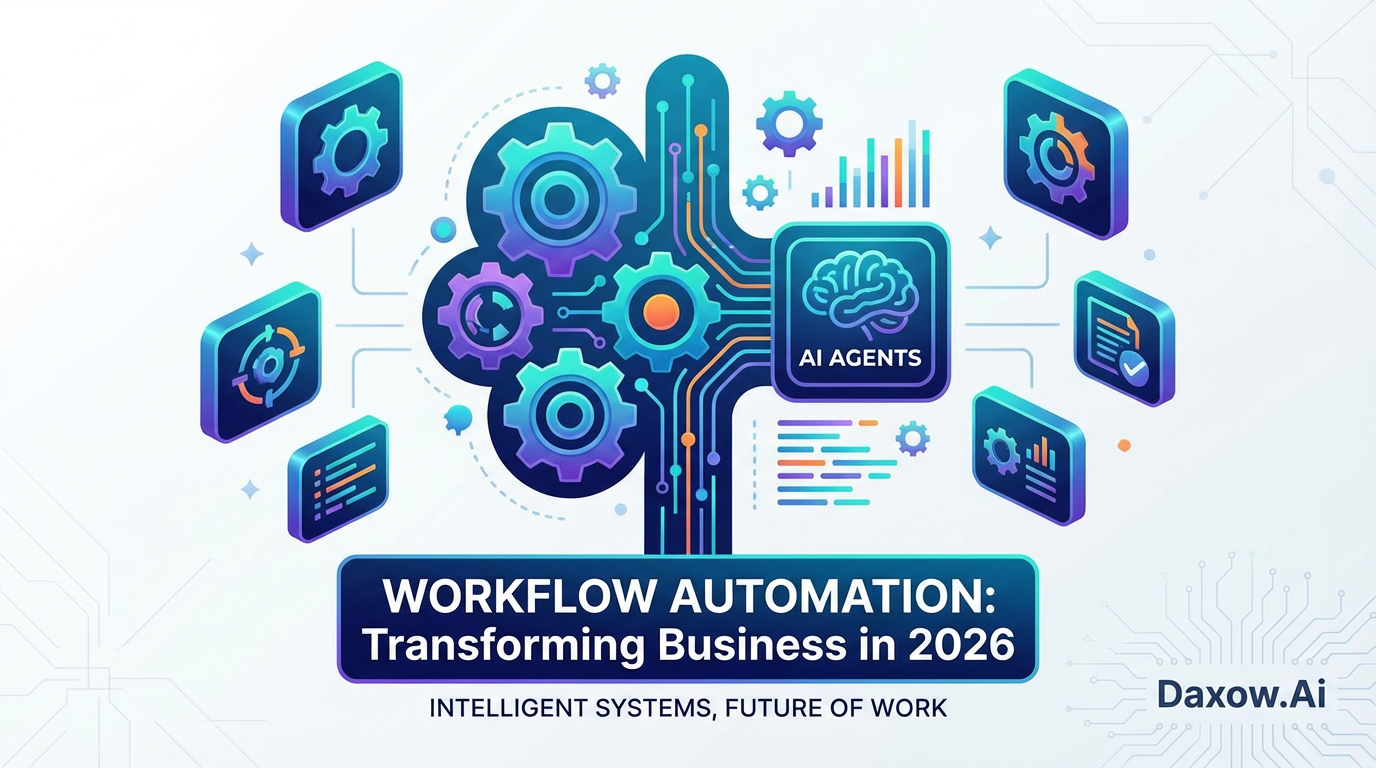
How AI agents and workflow automation cut costs, speed processes, and scale operations - a practical roadmap and Daxow.ai's end-to-end approach for 2026
AI Agents and Workflow Automation: Transforming Business Operations in 2026
Estimated reading time: 15 minutes
Key Takeaways
- AI agents and workflow automation significantly reduce manual tasks and operational costs by 30–50%.
- Businesses experience up to 50% faster workflows with adaptive, context-aware AI systems.
- Daxow.ai provides end-to-end automation solutions focused on ROI, security, and compliance.
- Implementation requires strategic assessment, integration design, human-in-the-loop, and continuous optimization.
- Real-world use cases demonstrate measurable impact across e-commerce, healthcare, finance, real estate, and HR.
Table of Contents
- Introduction
- Why This Matters Now
- AI Agents and Workflow Automation: What it Means for Your Organization
- Proven Use Cases — How AI Agents and Workflow Automation Deliver Value Across Industries
- Implementation Framework — A Practical Roadmap
- Best Practices and Risk Mitigation
- Overcoming Common Challenges — Practical Mitigations
- Measuring ROI and Long-Term Business Value
- Why Work with Daxow.ai
- Getting Started — A Practical First Step
- Conclusion and Call to Action
- Frequently Asked Questions
Introduction
The landscape of digital transformation is accelerating, and the role of AI agents and workflow automation is central to that shift. In 2026, businesses that adopt AI Agents and Workflow Automation: Transforming Business Operations in 2026 will gain measurable advantages in efficiency, cost control, and customer experience. This article synthesizes recent research and practical experience to show decision-makers how to prioritize high-impact automation, design resilient systems, and capture rapid ROI while reducing manual tasks across the enterprise.
Why This Matters Now
- AI automation and AI agents move organizations from rule-based scripting to adaptive, context-aware systems that can execute real tasks across multiple platforms.
- Companies can expect 30–50% reductions in targeted manual processing costs and up to 50% faster workflows in optimized areas.
- Human-AI collaboration becomes the norm: agents handle routine work, freeing teams to focus on higher-value strategy and customer outcomes.
AI Agents and Workflow Automation: Transforming Business Operations in 2026 — What it Means for Your Organization
Core definitions and business impact
- AI agents are autonomous or semi-autonomous systems that perform tasks, make contextual decisions, and interact with enterprise systems through APIs and protocols such as the Model Context Protocol (MCP).
- Workflow automation is the orchestration of end-to-end business processes using software and integrations to reduce handoffs, errors, and latency.
- Combined, these technologies support business automation that improves accuracy, scales operations without proportional headcount increases, and enhances customer experiences through faster, more consistent responses.
Typical business outcomes
- Reduce manual tasks and data entry errors across finance, HR, customer support, and sales.
- Improved customer satisfaction via customer support automation—faster responses, precise routing, and context-aware follow-ups.
- Better sales performance through sales automation: automated lead qualification, prioritized follow-ups, and data enrichment.
- Productivity gains across teams by offloading repetitive work to agents and automating decision workflows.
Proven Use Cases — How AI Agents and Workflow Automation Deliver Value Across Industries
E-commerce
Use case: Order-to-cash automation
- Tasks automated: inventory updates, payment verification, fraud checks, fulfillment orchestration, customer notifications.
- Business impact: 40% faster fulfillment, fewer chargebacks, improved conversion via real-time pricing and personalization.
- How Daxow helps: We design AI agents that integrate with your e-commerce platform and ERP to automate pricing rules, routing to warehouses, and exceptions handling—connected end-to-end to reduce manual intervention.
Healthcare
Use case: Patient intake and administrative automation
- Tasks automated: appointment scheduling, insurance verification, claim pre-processing, triage of inquiries using NLP.
- Business impact: 25% reduction in administrative burden, quicker response times for patients, reduced no-shows through automated reminders.
- How Daxow helps: Daxow.ai builds HIPAA-aware data pipelines and NLP agents that extract structured data from forms and coordinate scheduling across systems, while preserving clinician oversight for clinical decisions.
Finance and Accounting
Use case: Invoice reconciliation and compliance checks
- Tasks automated: invoice ingestion, PO matching, anomaly detection, fraud scoring, regulatory data packaging.
- Business impact: Reduced reconciliation errors, faster month-end close, lower fraud losses, and improved audit readiness.
- How Daxow helps: We implement predictive models and rule engines that reconcile invoices against ERP data, escalate exceptions to human reviewers, and produce traceable audit logs for compliance.
Real Estate
Use case: Lead qualification and listing automation
- Tasks automated: lead scoring, automatic listing creation from forms and images using computer vision, valuation report generation.
- Business impact: Faster lead response, higher qualified lead ratios, reduced time-to-offer.
- How Daxow helps: Daxow.ai integrates MLS feeds, CRM systems, and valuation models to automate lead routing and prepare market-ready listings with minimal manual work.
Human Resources
Use case: Talent screening and onboarding workflows
- Tasks automated: resume parsing, candidate screening, interview scheduling, onboarding document processing.
- Business impact: Reduced time-to-hire, consistent candidate experience, improved employee satisfaction.
- How Daxow helps: Our AI agents automate resume extraction, integrate with ATS systems, and orchestrate onboarding tasks across payroll, IT provisioning, and compliance checks.
Implementation Framework — A Practical Roadmap to Deploy AI Agents and Workflow Automation
1. Strategic assessment and prioritization
- Start with a process audit to identify high-impact, low-risk workflows (rule-based, high volume, error-prone).
- Define clear KPIs: cost reduction targets, cycle-time improvements, error-rate baselines, and customer satisfaction metrics.
- Daxow role: We conduct a rapid process discovery and ROI assessment to prioritize projects that deliver early wins.
2. Architecture and integration design
- Use an API-first architecture and support interoperability standards (e.g., MCP) for agent orchestration.
- Establish robust data pipelines with validation, cleansing, and lineage tracking.
- Daxow role: We design secure, cloud-native architectures that integrate with CRMs, ERPs, support systems, and data warehouses.
3. Development, testing, and human-in-the-loop design
- Build agents that include error detection, escalation rules, and audit trails.
- Pilot in controlled environments; simulate edge cases and measure performance drift.
- Daxow role: We develop agents with explainability, human oversight points, and iterative retraining plans.
4. Deployment and change management
- Start with pilot rollouts to build stakeholder trust; provide training and clear documentation.
- Implement governance: roles, policies, data privacy, and ethical guidelines.
- Daxow role: We lead pilot execution, stakeholder training, and rollout planning to ensure adoption and alignment between business and IT.
5. Monitoring, optimization, and scale
- Continuously track KPIs and retrain models with new data to prevent performance drift.
- Expand successful automations to adjacent workflows and geographies.
- Daxow role: We provide monitoring dashboards, scheduled audits, and ongoing optimization to sustain ROI.
Best Practices and Risk Mitigation
- Start small, deliver measurable wins: Focus on workflows that are high volume and rule-based for predictable outcomes. Use pilots to demonstrate value; successful pilots increase stakeholder buy-in.
- Prioritize data quality and validation: Implement real-time validation and quality checks to prevent pipeline failures. Maintain data lineage for compliance and troubleshooting.
- Design for interoperability and resilience: Adopt API-first design and support emerging standards to reduce integration friction. Include retry logic, circuit breakers, and fallbacks to ensure operational continuity.
- Embed human-in-the-loop where it matters: Keep humans involved in high-stakes decisions and in reviewing edge cases. Design escalation paths and clear SLAs for human review.
- Establish governance and ethical controls: Define ownership, change control, and model governance policies to manage drift, bias, and privacy concerns. Regularly audit model decisions and performance against KPIs.
Overcoming Common Challenges — Practical Mitigations
- Data pipeline failures: Implement automated validation, alerting, and fallback procedures.
- Integration issues: Standardize on API-first and adopt MCP-like protocols for agent interoperability.
- Resistance to adoption: Use pilot programs, provide training, and quantify early wins.
- Performance drift: Monitor KPIs continuously and schedule model retraining with representative data.
Measuring ROI and Long-Term Business Value
Tangible KPIs to track
- Cost reductions in manual processing (target 20–50% in prioritized areas).
- Cycle-time improvements (e.g., order fulfillment or invoice processing speed).
- Error-rate reductions and compliance improvements.
- Customer satisfaction and retention metrics tied to faster, more consistent service.
Example ROI scenarios
- E-commerce automation that reduces fulfillment time by 40% may increase repeat purchases and lifetime value.
- Finance automation that reduces reconciliation errors may lower write-offs and expedite month-end closes.
- A focused HR automation program that shortens hiring cycles can reduce agency fees and vacancy costs.
Long-term strategic value
- Scalability: agents scale without proportional increases in headcount.
- Innovation enablement: freed capacity allows internal teams to focus on product and service innovation.
- Strategic asset: with governance and monitoring, AI agents become compounding assets that improve over time.
Why Work with Daxow.ai to Implement AI Agents and Workflow Automation
- End-to-end automation: Daxow.ai offers strategy, design, development, integration, deployment, and monitoring services to deliver complete business automation solutions.
- Custom AI agents that execute real tasks: We build agents that integrate with your systems, perform contextual decision-making, and escalate appropriately.
- Systems integration and data connectivity: Our engineers connect CRMs, ERPs, communication platforms, and databases to create seamless workflows.
- Focus on ROI and measurable outcomes: Every project begins with KPI definition and an ROI-focused pilot plan.
- Security, compliance, and governance: We design solutions with data privacy, auditability, and ethical controls embedded.
- Post-deployment optimization: Daxow provides continuous monitoring and iterative improvements to maintain agent performance and maximize productivity gains.
Getting Started — A Practical First Step for Decision-Makers
If you are evaluating AI automation initiatives, follow this quick checklist:
- Identify one or two high-volume processes where manual tasks dominate.
- Define clear KPIs and a baseline measurement for those processes.
- Choose a pilot scope that can be implemented within 8–12 weeks.
- Reserve capacity for change management and human-in-the-loop workflows.
- Establish success criteria for expansion after the pilot.
Conclusion and Call to Action
AI Agents and Workflow Automation: Transforming Business Operations in 2026 is not an abstract trend—it is a practical pathway to reducing costs, improving productivity, and delivering superior customer experiences. By prioritizing high-impact workflows, applying rigorous architecture and governance, and working with a partner that delivers end-to-end automation, organizations can achieve measurable returns within months and sustained value over years.
Ready to turn process inefficiencies into competitive advantage? Contact Daxow.ai to book a free consultation, request a process analysis for your company, or contact us to build a custom AI system tailored to your workflows and business goals.
Frequently Asked Questions
What are AI agents in the context of workflow automation?
AI agents are autonomous or semi-autonomous software systems that perform tasks, make contextual decisions, and interact with enterprise systems to execute complex workflows with minimal human intervention.
How can workflow automation reduce operational costs?
Workflow automation reduces operational costs by minimizing manual data entry, decreasing errors, speeding up processes, and enabling scalability without proportional increases in staff.
What industries benefit most from AI agents and workflow automation?
Industries such as e-commerce, healthcare, finance, real estate, and human resources commonly realize significant benefits by automating routine and complex tasks.
How does Daxow.ai support workflow automation projects?
Daxow.ai offers comprehensive services including strategic assessment, architecture design, AI agent development, systems integration, deployment, governance, and ongoing optimization focused on measurable ROI.