
AI Agents and Automation: Unlock Workflow Optimization & Growth
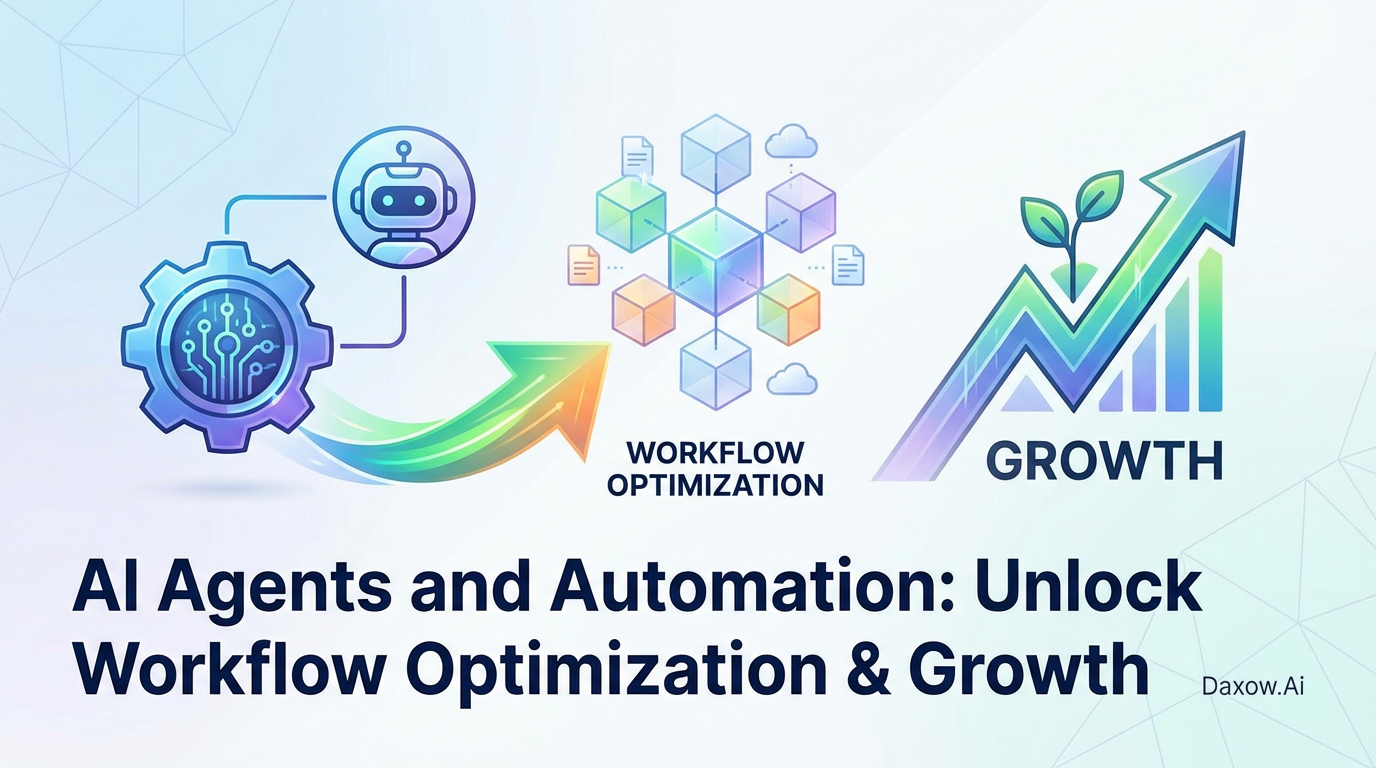
Practical roadmap to use AI agents and workflow automation to cut costs, boost productivity, and scale. Use cases, metrics, and Daxow.ai implementation steps.
Unlocking Business Growth: AI Agents and Automation in Workflow Optimization
Estimated reading time: 15 minutes
Key Takeaways
- AI agents and automation create autonomous workflows that increase productivity and reduce manual work.
- Automating high-volume, rule-based processes delivers 3–5x faster results and reduces costs.
- Use cases span e-commerce, healthcare, finance, real estate, and HR, delivering measurable business value.
- A phased implementation approach minimizes risk and accelerates ROI.
- Daxow.ai offers custom AI automation solutions from discovery to deployment and continuous optimization.
Table of Contents
- Unlocking Business Growth: AI Agents and Automation in Workflow Optimization
- What AI Agents and Automation Mean for Businesses
- Practical Use Cases Across Industries
- How AI Agents and Automation Drive Value
- Implementation Steps and Best Practices
- Measuring ROI and Business Value
- How Daxow.ai Delivers Custom AI Automation
- Next Steps — How to Begin Automating Workflows Today
- Frequently Asked Questions
Unlocking Business Growth: AI Agents and Automation in Workflow Optimization
AI agents and automation combine intelligent decision-making with repeatable process execution to create autonomous workflows that handle data entry, routine decisions, customer interactions, and cross-system orchestration. For decision-makers, the value is straightforward: free employees from repetitive tasks so they can focus on strategy and high-value work, while lowering operating costs and improving service quality.
- Key promise: Automate high-volume, rule-based processes first to realize 3–5x faster results.
- Primary gains: Reduced cost per transaction, faster resolution times, higher accuracy, and better customer satisfaction.
- Where to start: Identify high-frequency workflows with clear inputs/outputs (e.g., invoice processing, returns handling, support triage).
What AI Agents and Automation Mean for Businesses
Definitions and capabilities
- AI agents: Autonomous software entities that perceive context (via APIs, documents, and user inputs), make decisions using models and business rules, and execute tasks across systems.
- Workflow automation: The orchestration layer that sequences tasks, triggers actions, and manages escalations across CRM, ERP, ticketing systems, and document stores.
- Combined outcome: Intelligent workflow optimization that adapts to data and user needs while executing end-to-end processes.
Business impact in practical terms
- Efficiency: Automate data entry and routine inquiries to free 30–50% of staff time on specific functions.
- Scalability: Handle surge volumes without proportional hiring by using agents to triage and process routine cases.
- Accuracy & compliance: Reduce human error in compliance-sensitive tasks like reporting and claims processing.
- Actionable insight: Real-time analytics from automated workflows improve decision-making and process refinement.
Practical Use Cases Across Industries
E-commerce — Customer support and inventory
Use case:
- Deploy AI agents that handle returns, refunds, and pre-sales chat. Agents resolve up to 80% of standard queries, escalating only the complex items.
- Automate inventory alerts and reordering by connecting sales data, warehouse systems, and supplier APIs.
Impact:
- Reduced manual tasks: Faster refunds and fewer agent hand-offs.
- Revenue protection: Prevent stockouts by predictive restocking.
Example outcome:
A retailer reduces average handling time by 40% and prevents 15% of stockout events through predictive alerts.
Healthcare — Scheduling, triage, and documentation
Use case:
- AI agents process intake forms, triage symptoms via conversational flows, schedule appointments, and surface alerts for anomalies or urgent flags.
- Automate routine documentation and coding support to reduce admin burden.
Impact:
- Productivity: Clinicians spend less time on paperwork and more on patient care.
- Compliance: Built-in checks for privacy/security (e.g., HIPAA-aware flows) reduce risk.
Finance — Invoice processing and fraud detection
Use case:
- Automate invoice extraction, validation, matching, and approval routing with document AI and rule-based agents.
- Run real-time transaction analysis with anomaly detection agents to flag potential fraud.
Impact:
- Cost reduction: Lower invoice processing costs by up to 50%.
- Risk reduction: Faster detection of suspicious transactions, improving compliance posture.
Real estate — Lead qualification and contract management
Use case:
- AI agents qualify leads from web forms and chat, schedule viewings, and pre-fill contracts for review.
- Orchestrate multi-party signatures and document storage with automated reminders.
Impact:
- Faster deal cycles: Quicker qualification leads to shorter sales cycles.
- Operational efficiency: Agents reduce manual coordination work for brokers and managers.
HR — Recruitment and onboarding
Use case:
- Screen resumes, run automated pre-screen interviews via chat, and automate benefits enrollment and checklist tracking for new hires.
- Automate payroll data validation and compliance checks.
Impact:
- Hiring speed: Cut time-to-hire by up to 50% for volume roles.
- Reduced manual tasks: HR teams handle fewer routine inquiries and more strategic initiatives.
How AI Agents and Automation Drive Value
Integration and data connectivity
AI agents are only as effective as the data and systems they connect to. Practical deployments rely on:
- CRM and ERP integration to access customer and financial data.
- Document ingestion pipelines for PDFs, emails, and images.
- Event-driven architecture to trigger agents at the right time.
Intelligence + automation = resilient workflows
- Automation handles repeatable steps; agents add reasoning, escalation, and adaptive learning.
- Agents retrain on feedback, improving accuracy over time and reducing manual intervention.
Metrics that matter
To demonstrate value, track:
- Resolution rate and time-to-resolution for support automation.
- Cost per interaction and cost per invoice processed.
- Lead-to-deal conversion and time-to-close for sales automation.
- Employee time reallocated from administrative work to strategic tasks.
Implementation Steps and Best Practices
Phase 1 — Assessment & Planning (4–8 weeks)
Actions:
- Map current workflows and identify bottlenecks.
- Select 1–2 high-frequency, low-complexity use cases for pilot.
- Define measurable KPIs (e.g., 20% cost reduction, 30% faster resolution).
Best practices:
- Prioritize data readiness and access.
- Involve business owners and IT early.
- Create a stakeholder communication plan.
Phase 2 — Technology Selection (6–12 weeks)
Actions:
- Evaluate AI models, orchestration platforms, and integration capabilities.
- Consider compliance and scalability requirements.
Best practices:
- Choose tools that integrate with your CRM, ticketing, and document stores.
- Plan for vendor support and future extensibility.
Phase 3 — Preparation (4–8 weeks)
Actions:
- Clean and label data, build knowledge bases, and design escalation rules.
- Assemble a cross-functional team (product owner, engineers, ops, change lead).
Best practices:
- Focus on data quality and test coverage.
- Create rollback and exception handling strategies.
Phase 4 — Pilot & Deployment (4–20 weeks)
Actions:
- Launch a limited pilot, measure KPIs, iterate rapidly.
- Expand scope gradually across channels and teams.
Best practices:
- Monitor metrics closely and retrain models with real user feedback.
- Provide training and change management for impacted teams.
Ongoing
Actions:
- Continuous monitoring, retraining, and process optimization.
- Report ROI and expand to adjacent workflows.
Pro tips:
- Start small: A single high-volume process yields fast wins.
- Human-centric adoption: Assign change leads to drive acceptance.
- Avoid pitfalls: Neglecting data quality or stakeholder buy-in are common failure points.
Measuring ROI and Business Value
Quantify before you build
Model the expected savings and revenue impact:
- Calculate per-interaction cost savings by automating tickets or invoice tasks.
- Estimate retention/revenue uplift from faster response times and personalized interactions.
Track ongoing business metrics
Use these KPIs:
- Cost per interaction / cost per invoice.
- CSAT and NPS for customer support automation.
- Conversion rates and time-to-close for sales automation.
- Employee hours reallocated from manual tasks to strategic work.
Realistic outcomes
- Expect 20–50% operational cost reductions in targeted areas.
- Anticipate 30–50% time savings on repetitive tasks.
- Plan for compounding returns as systems scale and models improve.
How Daxow.ai Delivers Custom AI Automation
Discovery and process analysis
- We map your workflows and identify high-impact automation opportunities.
- We quantify potential ROI to prioritize pilots that deliver measurable value.
Custom design and development
- Our engineers build AI agents that integrate with your CRM, ERP, and third-party tools.
- We create document automation pipelines, NLP-enabled chatbots, and decision agents tailored to your rules and compliance needs.
Integration and orchestration
- We connect agents to live data sources, event queues, and business systems.
- Our workflow automation layer ensures reliable sequencing, exception handling, and audit trails.
Deployment, monitoring, and optimization
- We run pilots, measure KPIs, and iterate quickly.
- Post-launch, Daxow.ai provides continuous monitoring, model retraining, and feature expansion to maximize ROI.
Security, compliance, and change management
- We design solutions that respect regulatory constraints (e.g., privacy and data residency).
- We implement change management plans and training to ensure adoption and sustained value.
Learn more about our comprehensive services and how we can tailor AI automation to your business.
Next Steps — How to Begin Automating Workflows Today
If your organization is ready to reduce manual tasks, improve productivity, and modernize operations, follow a pragmatic first step:
- Choose one high-volume, rule-based process (customer support ticket triage, invoice processing, or lead qualification).
- Run a process analysis to quantify time and cost savings.
- Pilot an AI agent that automates the majority of routine decisions and integrate it with your existing systems.
Bold action creates momentum. Daxow.ai partners with companies to design and deploy these pilots rapidly and scale successful automations across the business.
Conclusion and Call to Action
Unlocking Business Growth: AI Agents and Automation in Workflow Optimization delivers measurable efficiency, compliance, and customer experience improvements when executed with a disciplined, data-driven approach. Daxow.ai provides the expertise to assess your workflows, build custom AI agents, integrate systems, and operationalize automation so you realize real ROI quickly.
Book a free consultation with Daxow.ai to request a process analysis for your company and start building a custom AI system that reduces manual tasks, boosts productivity, and automates business processes end-to-end. Contact us to begin your automation journey today.
Frequently Asked Questions
What are AI agents in workflow automation?
AI agents are autonomous software entities that perceive context, make decisions using models and business rules, and execute tasks across multiple systems, enabling intelligent automation of workflows.
How quickly can businesses realize benefits from AI automation?
By targeting high-volume, rule-based processes first, businesses can realize 3-5x faster results and measurable cost savings within weeks to a few months of deployment.
What industries benefit most from AI agents and automation?
Industries such as e-commerce, healthcare, finance, real estate, and HR see immediate ROI by automating customer support, scheduling, invoice processing, lead qualification, and recruitment tasks.
How does Daxow.ai support AI automation projects?
Daxow.ai offers end-to-end support including workflow discovery, custom AI design, system integration, pilot deployment, continuous monitoring, and change management to ensure successful automation adoption.