
AI Agents and Workflow Automation: Reduce Manual Tasks, Boost ROI
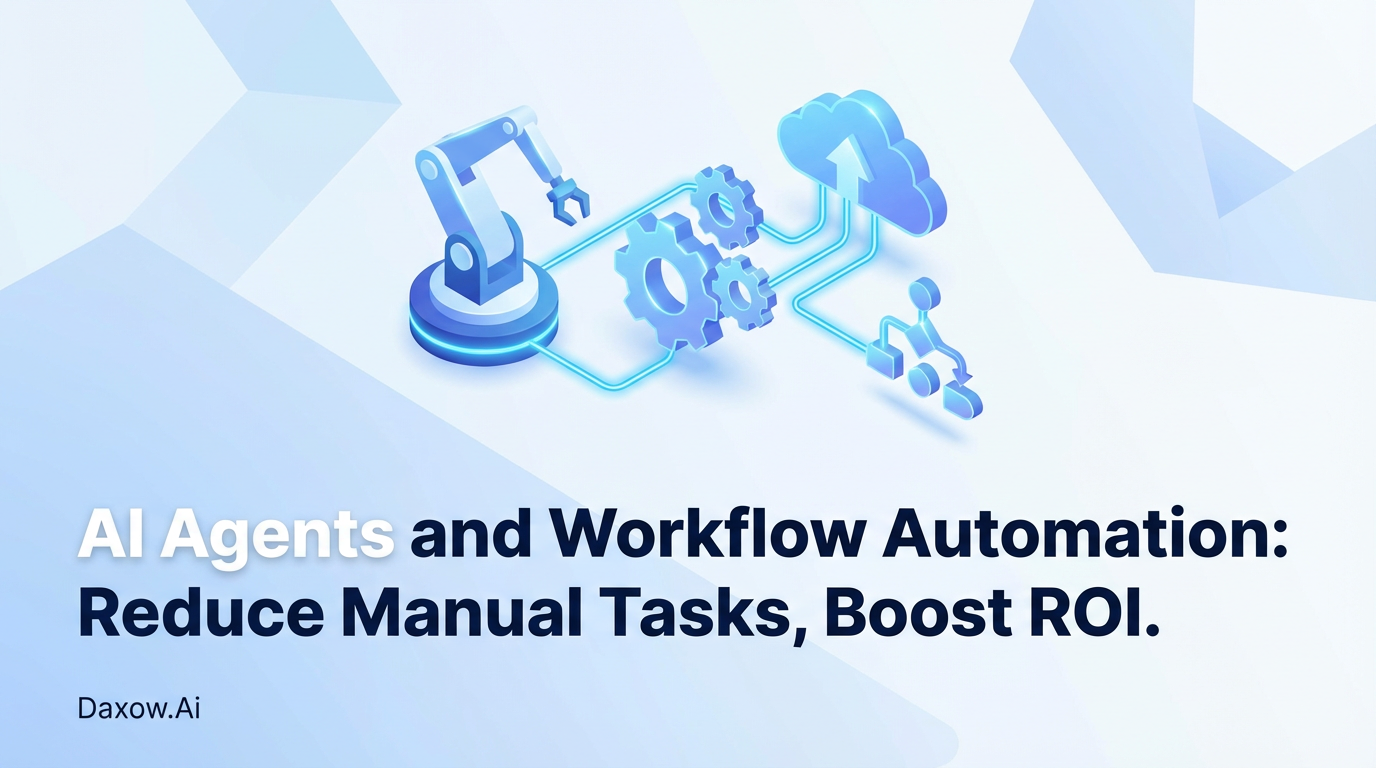
How AI agents automate end-to-end workflows to cut manual work, improve accuracy, and deliver ROI. Roadmap, industry use cases, and Daxow.ai examples.
AI Agents and Workflow Automation: How AI Automation Reduces Manual Tasks and Boosts Productivity
Estimated reading time: 12 minutes
Key Takeaways
- AI agents automate repetitive tasks by integrating ML, NLP, computer vision, and RPA technologies.
- Workflow automation improves productivity, accuracy, scalability, and decision-making for businesses.
- Practical use cases include e-commerce, healthcare, finance, real estate, HR, and customer support sectors.
- A phased implementation roadmap ensures successful deployment and measurable ROI.
- Daxow.ai specializes in designing custom AI systems that deliver end-to-end automation and measurable business value.
Table of Contents
- AI Agents and Workflow Automation: What it Means for Your Business
- Practical Use Cases of AI Agents and Workflow Automation
- How AI Agents Work: From Data to Action
- Implementation Roadmap: Deploying AI Agents for Workflow Automation
- Measuring ROI and Business Value of AI Automation
- Real-world Example: End-to-End Automation Built by Daxow.ai
- Frequently Asked Questions
AI Agents and Workflow Automation: What it Means for Your Business
AI implementation is more than adopting a single tool — it is a strategic shift toward intelligent automation. AI agents are autonomous systems that combine technologies such as machine learning, natural language processing (NLP), computer vision, and robotic process automation (RPA) to execute end-to-end workflows with minimal human intervention.
Key business benefits:
- Reduce manual tasks: Automate repetitive, rule-based work (e.g., data entry, ticket triage).
- Improve productivity: Free skilled employees for high-value work, increasing throughput.
- Enhance accuracy: Lower human error in processes like invoice processing and data extraction.
- Scale without proportional headcount growth: Operate 24/7 with consistent performance.
- Drive faster decisions: Use predictive analytics to anticipate demand, detect anomalies, and optimize operations.
How AI agents fit into business automation:
- Orchestrate multi-step processes by combining NLP for understanding, ML for decisioning, and RPA for system-level actions.
- Integrate with CRMs, ERPs, ticketing systems, and databases to create continuous, closed-loop workflows.
- Provide a practical path to hyperautomation by connecting disparate systems and automating complex, conditional work.
Practical Use Cases of AI Agents and Workflow Automation
E-commerce — Order-to-Cash and Customer Experience
- Automated order validation and exception handling.
- Inventory forecasting with ML to reduce stockouts.
- Personalized product recommendations using behavior models.
- Chatbots and conversational AI for 24/7 customer support automation.
Business impact: Reduced cart abandonment and higher conversion rates, faster order fulfillment and fewer manual interventions, improved customer satisfaction and repeat purchases.
Healthcare — Diagnostics and Administrative Efficiency
- Computer vision for medical image triage and annotation.
- NLP-based intake forms and automated appointment scheduling.
- Predictive models for patient risk stratification and resource planning.
Business impact: Shorter wait times and faster diagnoses, reduced administrative workload for clinicians and staff, better allocation of clinical resources and improved patient outcomes.
Finance — Fraud Detection and Invoice Automation
- Anomaly detection for transaction fraud using ML.
- Automated invoice capture and validation with NLP and document automation.
- Continuous compliance checks and reconciliation workflows.
Business impact: Faster transaction processing and reduced reconciliation time, lower fraud losses and improved audit readiness, operational cost savings and error reduction.
Real Estate — Lead Qualification and Virtual Engagement
- Virtual agents for instant lead qualification using chat and voice.
- Automated property valuation with data analytics and market signals.
- Virtual tours enhanced by computer vision and metadata extraction.
Business impact: Faster lead response times and higher conversion rates, reduced manual follow-up and improved agent productivity, enhanced buyer engagement and reduced time-to-close.
HR — Hiring and Employee Lifecycle Automation
- Resume screening and candidate matching with NLP.
- Automated onboarding workflows and compliance checks.
- Sentiment analysis on employee feedback and predictive turnover models.
Business impact: Reduced time-to-hire and lower screening costs, more consistent onboarding experiences and faster ramp-up, improved retention via early intervention informed by analytics.
Customer Support and Sales Automation
- Tier-one support automation via conversational AI and knowledge-base retrieval.
- Automated ticket classification and routing.
- Lead scoring and qualification workflows to prioritize sales outreach.
Business impact: Faster resolution times and reduced average handling time, higher sales efficiency and improved pipeline quality, lower support headcount requirements for repetitive tasks.
How AI Agents Work: From Data to Action
Understanding the components of an AI agent clarifies how to design and scale automation responsibly.
Core components:
- Data ingestion and preprocessing: Collect structured and unstructured data from CRMs, email, documents, and logs. Data quality and readiness are essential; poor data undermines model performance.
- Intelligence layer: ML models for predictions and pattern detection; NLP for understanding and generating human language; Computer vision for image or video interpretation.
- Orchestration and decisioning: Business rules and policy engines determine when to escalate to humans. Agent orchestration sequences tasks, invokes microservices, and logs actions.
- Integration and execution: RPA or API calls to execute changes in ERP, CRM, billing, or supply-chain systems. Secure connectors and middleware to maintain data integrity and compliance.
- Monitoring and feedback: Continuous evaluation for model drift, bias, and performance. Human-in-the-loop mechanisms for supervision and corrective training.
Typical operational improvements:
- 24/7 availability, handling large volumes without fatigue.
- Error reduction—examples include up to 90% fewer data-entry mistakes when replacing manual extraction with automated capture.
- Scalable productivity, with teams reallocating time to revenue-driving initiatives.
At Daxow.ai, we design AI agents that combine these components into production-grade systems, connecting your data sources, enforcing governance, and delivering automated actions that map to defined KPIs.
Implementation Roadmap: Deploying AI Agents for Workflow Automation
A disciplined, phased approach mitigates risk and accelerates value. The following roadmap is proven across many implementations.
Step 1 — Assess and Identify Processes
- Audit current workflows to find high-volume, repetitive tasks.
- Prioritize by potential cost savings, error reduction, and speed gains.
- Common target areas: invoice processing, ticket triage, lead qualification.
Step 2 — Set Clear, Measurable Goals
- Define SMART objectives (e.g., reduce invoice-processing time by 40%, cut manual ticket routing by 70%).
- Align KPIs with business outcomes such as cost per transaction and customer satisfaction.
Step 3 — Ensure Data Quality and Readiness
- Cleanse, normalize, and secure datasets.
- Establish data governance and compliance controls.
- Prepare labeled data for supervised models when needed.
Step 4 — Select Tools and Build the Team
- Choose platforms with strong integration capabilities (APIs, connectors to CRM/ERP).
- Assemble cross-functional teams: product owners, data scientists, engineers, and operations.
- Invest in change management and AI literacy to support adoption.
Step 5 — Pilot, Integrate, and Scale
- Launch small, measurable pilots on a controlled scope.
- Integrate tightly with core systems and automate only proven steps initially.
- Iterate based on feedback and scale incrementally.
Step 6 — Measure, Optimize, and Iterate
- Monitor KPIs, model performance, and user feedback.
- Retrain models, tune business rules, and expand automation where the ROI is validated.
- Implement governance to prevent bias and ensure ethical AI use.
Common pitfalls to avoid:
- Overlooking data quality.
- Setting vague goals that lead to scope creep.
- Rushing full deployment without adequate piloting.
- Ignoring change management and employee training.
Daxow.ai delivers end-to-end support across this roadmap—from process audits and proof-of-concept pilots to full-scale deployment and ongoing operations—ensuring your AI automation delivers measurable ROI.
Measuring ROI and Business Value of AI Automation
Quantifying ROI is critical to justify investment and guide expansion.
Key value drivers:
- Labor cost savings from reduced manual tasks.
- Faster cycle times and improved throughput.
- Error reduction and lower rework rates.
- Increased revenue from better lead conversion and customer retention.
- Risk reduction via automated compliance and fraud detection.
Practical ROI approach:
- Identify baseline metrics (current cycle time, error rates, headcount).
- Project improvements from pilot results (e.g., 40% faster processing, 30% fewer errors).
- Calculate TCO: tooling, development, integration, and ongoing operations.
- Estimate payback period: many high-impact pilots report paybacks within 12–18 months.
- Build a phased ROI dashboard to monitor actuals and update forecasts.
Example calculation (simplified):
- Baseline: Invoice processing costs $500K annually with 8 FTEs.
- After automation: 60% reduction in manual processing, 4 FTEs redeployed.
- Annual savings: $300K in labor + $50K in error reduction = $350K.
- Implementation cost: $150K (first year).
- Payback: <6 months; ongoing ROI increases after scale.
Daxow.ai helps define these business cases, running pilots that provide real performance data and designing scalable architectures to maximize long-term ROI.
Real-world Example: End-to-End Automation Built by Daxow.ai
Scenario: Mid-sized finance company wants to automate invoice processing and customer support triage.
Phase 1 — Discovery and Assessment
- Audit identifies manual invoice entry and a high volume of support tickets as top pain points.
- Objectives: reduce invoice processing cost by 50% and first-response time for support by 60%.
Phase 2 — Pilot Design
- Build an AI agent that extracts invoice data using NLP and document automation.
- Integrate with the company’s ERP via API to validate and post invoices.
- Deploy a conversational AI bot for tier-one support with escalation rules to human agents.
Phase 3 — Pilot Execution
- Pilot processes 1,000 invoices and 5,000 support interactions.
- Measured results: 70% reduction in manual invoice handling, 90% accuracy in data extraction, and 65% faster support response.
Phase 4 — Scale and Govern
- Roll out across business units, add fraud-detection models to invoice pipeline, and implement monitoring dashboards.
- Train staff on new workflows and reassign personnel to exception handling and strategic tasks.
Business outcomes:
- Operational cost reduction exceeding target.
- Improved customer satisfaction due to faster support and fewer billing errors.
- Short payback period with recurring savings reinvested in other automation initiatives.
Daxow.ai provided full-stack delivery: process mapping, custom AI agent development, system integrations, and ongoing monitoring—delivering measurable improvements in productivity and cost.
Conclusion and Call to Action
AI agents and workflow automation are no longer optional experiments. They are strategic levers that reduce manual tasks, enhance productivity, and unlock measurable business value across industries. The right approach combines careful process selection, strong data practices, incremental pilots, and scalable integrations.
If your organization is ready to move from isolated automation projects to an enterprise-grade AI strategy, Daxow.ai can help. We specialize in designing custom AI agents, automating end-to-end workflows, integrating systems, and maximizing ROI through proven methodologies.
Book a free consultation with Daxow.ai to request a process analysis for your company and start building a custom AI system that reduces manual work, boosts productivity, and transforms your operations. Contact us today to get started.
Frequently Asked Questions
What are AI agents and how do they differ from traditional automation?
AI agents are autonomous systems that use machine learning, NLP, computer vision, and RPA to perform complex end-to-end workflows with minimal human intervention, whereas traditional automation often relies on rigid rules and scripts that require manual adjustments.
How can I measure the ROI of implementing AI automation in my business?
Measure baseline operational metrics such as cycle time, error rates, and headcount, then track improvements from pilot implementations. Calculate total cost of ownership and estimate payback periods, often achievable within 12-18 months for high-impact automation projects.
What industries benefit most from AI workflow automation?
E-commerce, healthcare, finance, real estate, HR, and customer support are among the top industries benefiting from targeted AI automation due to their high volume of repetitive tasks and clear ROI opportunities.
How does Daxow.ai support companies in deploying AI agents?
Daxow.ai provides end-to-end services including process audits, custom AI agent design, system integration, pilot execution, scaling, and ongoing monitoring to ensure measurable value and successful AI adoption.