
AI Agents & Workflow Automation: Boost Efficiency & ROI
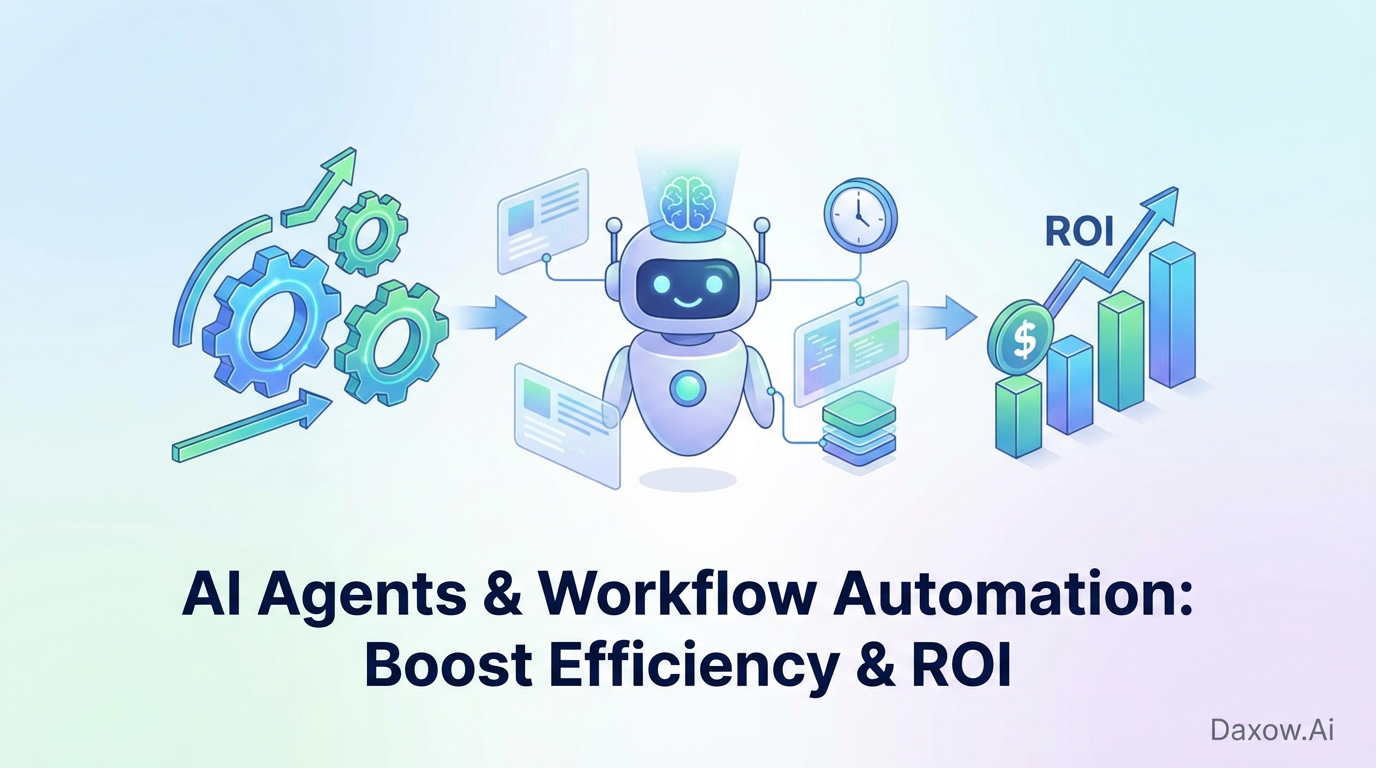
Learn how AI agents and workflow automation streamline processes, reduce costs 20-50%, and boost productivity. Use cases, roadmap, and Daxow.ai services.
AI Agents and Workflow Automation: How AI Automation Transforms Business Operations
Estimated reading time: 15 minutes
Key Takeaways
- AI agents and workflow automation dramatically increase business efficiency by automating repetitive and complex tasks.
- Implementations can reduce costs by 20–50%, improve customer experience, and scale operations without proportional headcount growth.
- Distinct from RPA and standalone AI, AI agents orchestrate end-to-end processes with learning capabilities.
- Industries such as e-commerce, healthcare, finance, real estate, HR, and customer support benefit from tailored AI automation use cases.
- A structured, phased implementation roadmap mitigates risks and ensures measurable ROI.
- Daxow.ai offers end-to-end AI automation solutions including assessment, custom development, integration, compliance, and continuous optimization.
Table of Contents
- AI Agents and Workflow Automation: What it means for your business
- Distinguishing RPA, AI, and AI Agents
- Practical Use Cases Across Industries
- Implementation Roadmap: From assessment to scale
- Best practices to reduce project risk
- Measuring ROI and Business Value
- How Daxow.ai helps you design and deploy AI Agents and Workflow Automation
- Real-world example: From pilot to scale with Daxow.ai
- Practical checklist for decision-makers ready to automate
- Conclusion and next steps
- Frequently Asked Questions
AI Agents and Workflow Automation: What it means for your business
AI automation integrates machine learning, natural language processing, and robotic process automation to handle repetitive, rule-based tasks at scale. When combined with AI agents—autonomous systems that make decisions and learn from interactions—businesses gain the ability to automate complex workflows, not just single tasks.
What AI automation delivers:
- Reduced manual tasks: Automate routine work such as data entry, invoice reconciliation, and ticket triage.
- Higher productivity: Teams focus on high-value work while AI handles volume; organizations can expect measurable productivity gains.
- Cost reduction: Typical implementations report 20–50% cost reductions on processed activities through labor savings and error reduction.
- Faster, consistent decisions: AI agents apply business logic consistently and escalate complex cases to humans when needed.
- Scalable operations: Process thousands of transactions daily without proportional headcount increases.
Distinguishing RPA, AI, and AI Agents
- Robotic Process Automation (RPA) automates rule-based, structured tasks.
- AI adds intelligence—document understanding, predictions, and natural language understanding.
- AI agents orchestrate multiple systems, learn from outcomes, and execute end-to-end processes (for example, ingesting an email, extracting data, updating CRM, and scheduling follow-ups).
Practical Use Cases Across Industries
AI Agents and Workflow Automation are most effective when applied to high-volume, low-complexity processes with clear ROI. Below are practical, actionable use cases for key sectors and how they translate into measurable business outcomes.
E-commerce
- Automated order processing and returns management.
AI agents validate orders, check inventory across warehouses, and trigger fulfillment workflows. Automated returns handling can parse return reasons, authorize refunds, and update inventory without manual review.
Impact: Fulfillment times reduced by up to 40%, and customer support load for returns drops substantially. - Dynamic pricing and inventory prediction.
AI predicts stockouts, recommends price adjustments, and triggers replenishment orders.
Result: Reduced stockouts, improved margins, and better conversion rates.
Healthcare
- Patient scheduling and triage automation.
AI agents manage appointment bookings, triage patient inquiries using symptom checkers, and route urgent cases to clinicians.
Benefit: Faster response times, fewer no-shows, and improved utilization of provider time. - Medical records and billing automation.
Intelligent document processing extracts coding and billing information from records for claims submission.
Outcome: Reduced billing errors and faster reimbursement cycles while maintaining compliance.
Finance
- Invoice reconciliation and accounts payable automation.
AI extracts invoice data, matches it to purchase orders, and routes exceptions to finance teams.
Result: Reduced processing costs and fewer late payment penalties. - Fraud detection and compliance reporting.
AI agents analyze transaction patterns for anomalies, escalate suspicious cases, and generate audit trails.
Impact: Lower fraud losses and simplified compliance reporting.
Real Estate
- Lead qualification and property valuation.
AI agents qualify inbound leads through chatbots, schedule viewings, and feed qualified prospects to agents. Valuation models analyze market data to recommend pricing adjustments.
Result: Faster time-to-contract and higher lead-to-deal conversion rates. - Contract review automation.
AI extracts clauses, flags unusual terms, and summarizes key dates and obligations.
Human Resources
- Candidate screening and onboarding.
AI automates resume screening, matches candidates to roles, schedules interviews, and handles routine onboarding steps.
Outcome: Reduced time-to-hire and lower administrative overhead. - Payroll and benefits automation.
Routine payroll exceptions are flagged and resolved automatically, reducing manual checks.
Customer Support and Sales
- Customer support automation (chatbots & support automation).
Chatbots resolve 70–80% of common inquiries without human intervention. AI agents escalate complex tickets, append suggested responses, and update CRM records automatically.
Result: Improved CSAT, faster resolution times, and reduced cost per resolution. - Sales automation and lead qualification.
AI scores leads, prioritizes outreach, and drafts personalized sequences based on CRM data.
Effect: Higher sales productivity and faster pipeline progression.
Implementation Roadmap: From assessment to scale
Successful AI automation follows a phased, risk-managed approach. Typical projects run 4–6 months for initial deployment with ongoing optimization.
- Assessment and Planning (4–8 weeks)
- Define measurable goals: Set KPIs such as “reduce invoice processing time by 30%” or “automate 50% of support tickets.”
- Audit processes: Map workflows and identify high-impact, repeatable tasks suited for automation.
- Assess data readiness: Evaluate data quality, integration points (CRM, ERP, databases), and compliance constraints (GDPR, HIPAA).
- Deliverable: Prioritized list of use cases and target KPIs.
- Technology Selection (6–12 weeks)
- Choose platforms for AI, RPA, and orchestration based on integration capabilities, vendor support, and scalability.
- Evaluate model needs: Off-the-shelf vs. custom models for NLP, vision, or predictive analytics.
- Deliverable: Solution architecture and vendor shortlist.
- Preparation and Build (4–8 weeks)
- Cross-functional teams: Include IT, business owners, compliance, and change managers.
- Data preparation: Cleanse data, build knowledge bases, and codify decision rules and escalation paths.
- Prototype design: Create minimal viable automations for quick wins.
- Deliverable: Working prototype and integration plan.
- Pilot and Deployment (4–20 weeks)
- Pilot one channel or team: Monitor resolution rates, accuracy, and user feedback.
- Iterate rapidly: Refine models, adjust rules, and improve routing logic based on real-world data.
- Scale gradually: Add languages, channels, and additional workflows.
- Deliverable: Production deployment and scaling playbook.
- Ongoing Optimization
- Continuous retraining: Monitor for model drift, retrain on new examples, and validate fairness/bias.
- Operational metrics: Track throughput, cost per resolution, error rates, and CSAT.
- Deliverable: Continuous improvement plan and governance model.
Best practices to reduce project risk
- Start with high-ROI, low-complexity workflows to build momentum.
- Involve IT early to address integrations and security.
- Invest in change management and training to drive adoption among staff.
- Plan for data gaps and design mitigation strategies like human-in-the-loop checks.
Measuring ROI and Business Value
AI automation delivers both short-term and long-term value. Track these metrics to validate investments:
- Efficiency metrics:
- Throughput (transactions processed per hour)
- Average handling time (AHT) reduction
- Cost per resolution (or cost per processed invoice)
- Quality metrics:
- Error rate and exception rate
- CSAT and NPS changes
- Financial metrics:
- Labor cost reduction (20–50% potential savings)
- Time to payback (often within months for high-volume workflows)
- Revenue impact from faster sales cycles or improved conversion
- Strategic metrics:
- Scalability (volume handled without proportional cost increases)
- Time-to-insight improvements through predictive analytics
Use the metrics above to build a business case and to prioritize the next set of automations.
How Daxow.ai helps you design and deploy AI Agents and Workflow Automation
Daxow.ai builds tailored AI systems that align with your business goals and existing technology stack. Our approach is practical, end-to-end, and focused on measurable outcomes.
- Assessment and process discovery
- We map your current workflows, identify bottlenecks, and prioritize high-ROI automation candidates.
- Deliverable: A targeted automation roadmap with estimated ROI and timelines.
- Custom AI agents and automation design
- We design AI agents that perform real tasks: data extraction, lead qualification, ticket routing, and decision-making.
- We combine RPA for structured tasks with ML/NLP for unstructured data and conversational automation.
- Deliverable: Prototype AI agents integrated with your CRM, ERP, or support stack.
- End-to-end process automation and integration
- Our engineers implement integrations across common systems (Salesforce, internal databases, ticketing systems, ERP) to ensure data consistency and closed-loop automation.
- We build orchestration layers to manage multi-step workflows and human-in-the-loop approvals.
- Deliverable: Production-ready automation pipelines with monitoring dashboards.
- Compliance, security, and governance
- We implement data protection controls, audit trails, and explainability features where required (e.g., GDPR, HIPAA).
- Deliverable: Secure, auditable automation with role-based access and reporting.
- Continuous optimization and support
- Post-deployment, we provide monitoring, model retraining, and feature iterations to prevent drift and maximize long-term value.
- Deliverable: Ongoing SLA-backed support and a roadmap for scaling additional automations.
Learn more about how Daxow.ai services can help transform your business with AI automation.
Real-world example: From pilot to scale with Daxow.ai
- A mid-sized e-commerce company faced rising support costs and slow returns processing.
- Daxow.ai implemented an AI agent to handle returns triage, automate refunds for standard cases, and route complex disputes to human agents.
- Results within three months:
- 40% reduction in returns handling time.
- 60% of return requests resolved without human intervention.
- Reduced operational cost per return and improved customer satisfaction.
Explore detailed case studies in our Daxow.ai case studies section.
Practical checklist for decision-makers ready to automate
- Identify 2–3 high-volume processes with clear KPIs.
- Validate data availability and integration endpoints.
- Set realistic performance targets and timelines (4–6 months for a pilot).
- Secure executive sponsorship and budget for pilot and scaling.
- Establish monitoring and governance for continuous improvement.
Conclusion and next steps
AI Agents and Workflow Automation are not theoretical—companies that adopt them gain measurable efficiency, error reduction, and the ability to scale operations without proportional headcount increases. Whether you want to reduce manual tasks in finance, automate customer support, or build AI agents that close sales faster, a focused, phased implementation delivers rapid payback and long-term strategic advantage.
Contact Daxow.ai today to begin crafting your custom AI automation roadmap and start realizing ROI within months.
Frequently Asked Questions
What are AI agents in workflow automation?
AI agents are autonomous systems that can make decisions, learn from interactions, and manage end-to-end business workflows by integrating multiple systems and applying machine learning techniques.
How is AI automation different from traditional RPA?
Unlike RPA, which automates repetitive rule-based tasks, AI automation incorporates machine learning and natural language processing to handle unstructured data, learn from outcomes, and automate complex workflows.
Which industries benefit most from AI workflow automation?
Industries such as e-commerce, healthcare, finance, real estate, human resources, and customer support see significant benefits, especially in automating high-volume, repeatable, and rule-based processes.
How long does it take to implement AI automation?
Typical initial deployments range from 4 to 6 months, covering assessment, prototype development, pilot, and full deployment phases, with ongoing optimization afterwards.
How does Daxow.ai ensure compliance and security?
Daxow.ai implements data protection controls, audit trails, explainability, and role-based access aligned with regulations such as GDPR and HIPAA to ensure secure and compliant AI automation solutions.