
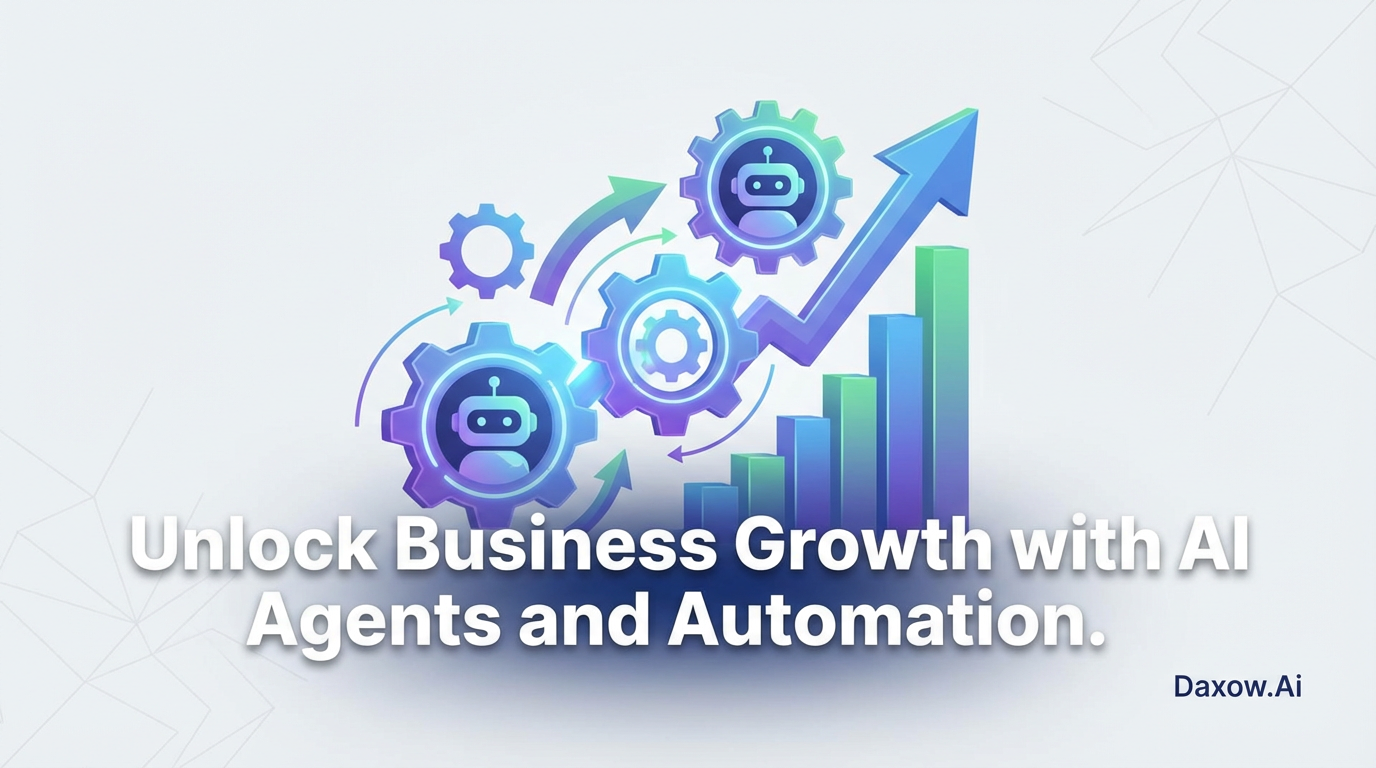
Unlock Business Growth with AI Agents and Automation
How AI agents and workflow automation deliver cost savings, faster execution, and measurable ROI — plus a Daxow.ai roadmap for enterprise deployment.
Unlocking Business Growth: The Strategic Imperative of AI Agents and Automation
Estimated reading time: 15 minutes
Key Takeaways
- AI agents and workflow automation enable scalable, cost-effective business operations with measurable ROI.
- These technologies enhance operational resilience, speed, and customer satisfaction across industries.
- Successful deployment involves phased implementation, data quality focus, and continuous optimization.
- Daxow.ai delivers end-to-end AI automation solutions tailored to strategic objectives and compliant with governance needs.
Table of Contents
- Unlocking Business Growth: The Strategic Imperative of AI Agents and Automation
- What AI Agents and Workflow Automation Do for Your Business
- Practical Use Cases — Actionable Examples by Industry
- How AI Agents and Automation Drive Business Transformation
- Implementation Steps and Best Practices
- ROI and Business Value — Quantifying Impact
- How Daxow.ai Delivers End-to-End Business Automation
- Checklist to Start Your Automation Journey Today
- Conclusion and Call to Action
- Frequently Asked Questions
Unlocking Business Growth: The Strategic Imperative of AI Agents and Automation
AI agents and workflow automation combine machine learning, natural language processing, rule-based orchestration, and systems integration to execute complex, data-driven tasks automatically. Unlike simple scripted bots, modern AI agents reason, escalate, learn from interactions, and coordinate across multiple systems (CRMs, ERPs, knowledge bases) to complete end-to-end workflows.
Why this matters today
- Operational resilience and agility. Automated agents provide 24/7 coverage and consistent results, reducing human error and response variability.
- Higher throughput with lower cost. Targeted automation can reduce process costs by 30–50% in prioritized areas and cut task completion times by up to 50%.
- Faster achievement of strategic objectives. Organizations with structured AI programs reach goals 3–5x faster than those without.
- Measurable customer and employee impact. Automation increases customer satisfaction via faster service and frees staff for higher-value work, improving morale and retention.
What AI Agents and Workflow Automation Do for Your Business
AI agents are autonomous or semi-autonomous software entities that execute tasks across digital systems. Workflow automation coordinates and enforces business rules to move work through processes reliably. Together they deliver a hybrid solution that handles both predictable rule-based work and context-sensitive decisioning.
Core capabilities
- Natural language understanding for chat, email, and voice.
- Document processing and data extraction (invoices, contracts, forms).
- Event-driven orchestration across enterprise systems.
- Continuous learning and improvement through monitored feedback loops.
- Compliance enforcement and audit-ready activity logs.
Practical Use Cases — Actionable Examples by Industry
E-commerce
- Automated inventory and order management agents reconcile stock levels, predict reorder needs, and trigger purchase orders.
- AI chat agents handle order tracking, returns, and personalized recommendations, reducing response times from hours to seconds.
- Business outcomes: higher conversion rates, lower fulfillment errors, and reduced support headcount for standard inquiries.
Healthcare
- Patient intake and scheduling agents triage routine queries, pre-fill forms, and optimize appointment allocation.
- Document automation extracts clinical data from forms and flags anomalies for clinician review.
- Business outcomes: reduced administrative burden (up to 40%), faster care delivery, and improved compliance handling.
Finance and Accounting
- Invoice processing agents extract line items, validate against purchase orders, and route for approval.
- Fraud detection agents analyze transaction patterns in real time to flag anomalies.
- Business outcomes: faster close cycles, improved fraud detection accuracy, and reduced compliance risk.
Real Estate
- Lead qualification agents respond to inquiries, book viewings, and pre-qualify prospects using scripted checks.
- Contract automation extracts clauses, highlights risks, and drafts standardized documents for lawyer review.
- Business outcomes: shorter sales cycles, higher lead conversion, and lower legal bottlenecks.
HR and Administration
- Resume parsing and candidate screening agents match skills to role requirements and rank applicants.
- Onboarding automation coordinates tasks across IT, payroll, and facilities to accelerate new-hire readiness.
- Business outcomes: reduced time-to-hire by up to 50%, improved candidate experience, and consistent onboarding compliance.
How AI Agents and Automation Drive Business Transformation
AI agents act as proactive orchestrators. They integrate with existing business systems and execute cross-functional workflows reliably. Automation complements agents by codifying rules and exceptions and enforcing process discipline. The combined effect is a resilient, scalable operation that reduces manual tasks and supports data-driven decisions.
Key transformational effects
- Resource redeployment. Employees shift from repetitive work to strategic initiatives.
- Scalability without proportional headcount growth. Processes handle increased volume with the same or lower staffing levels.
- Continuous optimization. Analytics and feedback loops enable iterative improvements and model retraining.
- Regulatory readiness. Automated logging and rule enforcement simplify audits and compliance.
Real-world integration patterns
- CRM + AI agents: Automatically log customer interactions, qualify leads, and trigger personalized outreach.
- ERP + workflow automation: Reconcile orders and financial records, triggering downstream fulfillment actions.
- Knowledge base + conversational AI: Deliver consistent self-service across channels and escalate exceptions to humans when needed.
Implementation Steps and Best Practices
A phased, low-risk approach typically spans 4–6 months for initial enterprise deployments. Daxow follows a structured methodology that prioritizes measurable outcomes and rapid value capture.
Phase 1 — Assess and Prioritize (4–8 weeks)
- Map current workflows and measure baseline metrics (cycle times, error rates, volume).
- Identify high-impact, low-risk processes for initial pilots.
- Define clear KPIs (e.g., cost reduction of 20%, 30% faster processing).
- Involve stakeholders from operations, IT, legal, and customer experience.
Phase 2 — Select Technology and Prepare Data (6–12 weeks)
- Choose platforms that support agentic behavior, secure integrations, and scale.
- Clean and consolidate data sources; build or enrich knowledge bases.
- Define compliance requirements (GDPR, HIPAA) and data governance controls.
Phase 3 — Pilot Deployment (4–8 weeks)
- Launch a focused pilot with monitored KPIs and tight feedback loops.
- Use human-in-the-loop for edge cases and continuous learning.
- Iterate on models, decision rules, and integration points.
Phase 4 — Full Rollout & Continuous Optimization (4–20 weeks)
- Scale to additional teams, channels, and geographies.
- Implement monitoring dashboards, automated retraining, and process governance.
- Establish an internal center of excellence to drive ongoing improvements.
Best practices
- Start small. Target high-volume, repetitive tasks first for the quickest ROI.
- Prioritize data quality. AI efficacy depends on clean, representative inputs.
- Design for escalation. Agents should fallback gracefully to human experts.
- Measure continuously. Track resolution rates, cost per transaction, customer satisfaction, and compliance metrics.
- Manage change. Communicate benefits clearly and provide training to affected teams.
ROI and Business Value — Quantifying Impact
Decision-makers need clear financial justification. Typical outcomes from effective AI agent deployments include:
- 40–70% reductions in process costs for targeted functions.
- 50% faster task completion and shorter cycle times.
- 20–30% gains in productivity across affected teams.
- Payback periods of 6–12 months for well-scoped pilots.
How to model ROI
- Define baseline cost per transaction and current volume.
- Estimate automation coverage and error reduction.
- Include savings from reduced escalations, lower rework, and improved customer retention.
- Account for implementation, licensing, and ongoing model maintenance.
Daxow approach to ROI
- We perform upfront ROI modeling to prioritize use cases.
- We set measurable milestones and phased investments to reduce risk.
- We document both direct savings and strategic benefits (customer lifetime value, speed-to-market).
How Daxow.ai Delivers End-to-End Business Automation
Daxow designs and implements custom AI systems that move beyond pilots to operational transformation. Our services include:
Strategic assessment and process mapping
- Deep discovery to identify the best automation opportunities.
- Cross-functional alignment to ensure business relevance.
Custom AI agents and workflow automation
- Agents that handle chat, email, voice, and back-office tasks.
- Hybrid systems that combine rule-based orchestration with machine learning decisioning.
Chatbots and customer support automation
- Multichannel conversational agents that integrate with support platforms.
- Escalation handling and knowledge base connectors to maintain service quality.
Lead qualification and sales automation
- Real-time lead scoring, outreach orchestration, and CRM enrichment.
- Automated scheduling and follow-up workflows to accelerate sales cycles.
Data extraction and document automation
- High-accuracy parsing of invoices, contracts, and forms.
- Audit-ready outputs and integration into financial and operational systems.
Systems integration and platform engineering
- Connectors to CRMs, ERPs, ticketing systems, and proprietary tools.
- Secure data flows and compliance-first architecture.
Monitoring, optimization, and managed services
- Continuous performance tracking, retraining, and process refinement.
- Ongoing support and a clear governance model.
Example engagement — a typical Daxow delivery
- Week 1–4: Discovery, KPI definition, and data readiness assessment.
- Week 5–12: Pilot build — agent configuration, integrations, and launch.
- Week 13–24: Scale and optimization — expand coverage, add channels, automate more workflows.
- Post-launch: Managed analytics, retraining, and governance handover.
Checklist to Start Your Automation Journey Today
Use this practical checklist to evaluate readiness and prepare for an automation program:
- Identify 3 candidate processes with high volume and error rates.
- Gather performance baselines (time per transaction, cost, customer impact).
- Confirm data availability and ownership for each process.
- Allocate a cross-functional sponsor and a small implementation team.
- Define success criteria and an initial 3–6 month pilot scope.
Conclusion and Call to Action
Unlocking Business Growth: The Strategic Imperative of AI Agents and Automation is a pragmatic pathway to sustainable competitive advantage. By starting with prioritized use cases, enforcing strong data practices, and deploying modular AI agents integrated with existing systems, organizations realize rapid cost savings, improved customer experience, and scalable growth.
Daxow.ai builds custom AI systems that automate entire workflows end-to-end — from assessment and pilot to full-scale deployment and ongoing optimization. If you are ready to reduce manual tasks, boost productivity, and transform customer experiences with AI agents and workflow automation:
- Book a free consultation with Daxow.ai
- Request a process analysis for your company
- Contact us to build a custom AI system that delivers measurable ROI
Start the conversation today — let Daxow design an automation roadmap tailored to your business priorities.
Frequently Asked Questions
What distinguishes AI agents from traditional automation bots?
AI agents employ reasoning, learning, and multi-system coordination beyond rule-based scripted bots, enabling handling of complex, dynamic workflows.
How quickly can businesses expect ROI from AI automation?
Many organizations see payback within 6 to 12 months, depending on process scope and scale of deployment.
Is data quality really critical to AI automation success?
Absolutely. Clean, representative data is essential for AI agents to operate effectively and deliver reliable outcomes.
Can Daxow.ai integrate AI agents with our existing CRM and ERP systems?
Yes, Daxow.ai specializes in secure integration across CRMs, ERPs, and other enterprise systems to enable seamless automation.