
AI Agents & Workflow Automation: Unlock Business Growth
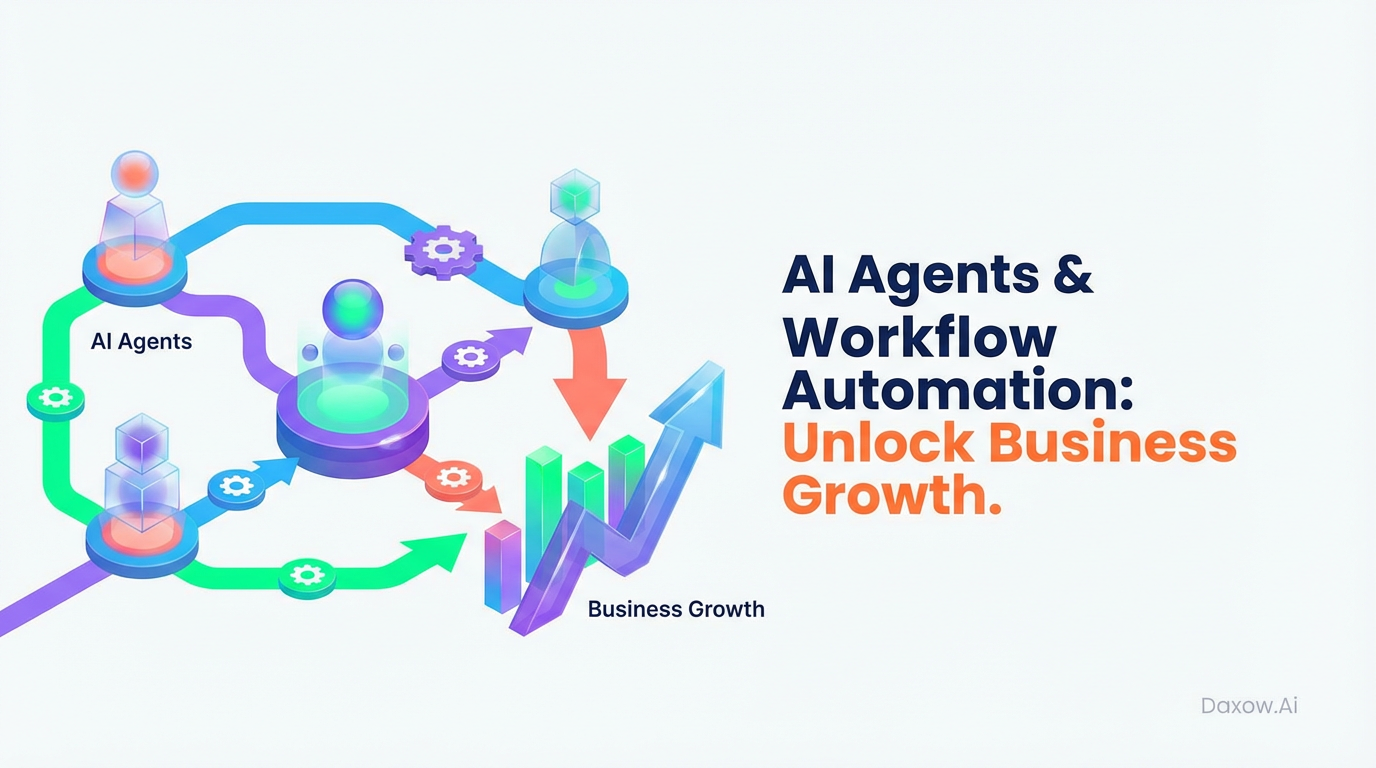
How AI agents and workflow automation boost productivity, cut costs, and scale operations — with practical implementation steps, industry use cases, and Daxow.ai solutions.
Unlocking Business Growth: AI Agents and Workflow Automation for Modern Enterprises
Estimated reading time: 12 minutes
Key Takeaways
- AI agents and workflow automation drastically improve productivity and reduce errors by automating repetitive tasks.
- Businesses gain operational resilience, faster cycle times, cost reductions, and 24/7 business continuity.
- Industry-specific applications show significant ROI in e‑commerce, healthcare, finance, real estate, and HR.
- A phased implementation roadmap ensures scalable, secure, and compliant AI automation deployment.
- Daxow.ai offers end-to-end AI automation solutions tailored to enterprise needs, enabling rapid pilot-to-scale success.
Table of Contents
- Unlocking Business Growth: AI Agents and Workflow Automation for Modern Enterprises
- Why Business Leaders Should Prioritize AI Automation Now
- Core Components — How AI Agents and Workflow Automation Work Together
- Practical Use Cases Across Industries
- Implementation Roadmap — From Assessment to Scale
- Best Practices and Risk Mitigation
- Measuring ROI and Business Value
- How Daxow.ai Delivers End-to-End Automation and AI Agents
- Orchestrating Customer Support Automation and Sales Automation
- Governance, Ethics, and Security
- Frequently Asked Questions
Unlocking Business Growth: AI Agents and Workflow Automation for Modern Enterprises
Unlocking Business Growth: AI Agents and Workflow Automation for Modern Enterprises is no longer an abstract promise — it is a strategic necessity. Organizations that adopt AI automation and workflow automation transform slow, error-prone processes into resilient, scalable operations. For decision-makers and operations leaders, this combination delivers measurable productivity gains, reduces manual tasks, and creates a foundation for sustained competitive advantage.
This article explains what AI agents and workflow automation mean for business, provides actionable implementation steps, presents industry-specific use cases, and shows how Daxow.ai helps companies design and deploy custom AI systems that deliver rapid ROI.
What this means in practice:
- AI agents are intelligent systems that autonomously execute tasks, make data-driven decisions, and interact with systems and people in real time.
- Workflow automation standardizes and automates multi-step processes such as approvals, data routing, and exception handling.
Together, they convert repetitive, manual work into automated, measurable outcomes — reducing errors by up to 80% in rule-based tasks and delivering productivity gains of 30–50% in targeted processes.
Why Business Leaders Should Prioritize AI Automation Now
- Operational resilience: Small teams can scale to enterprise output without proportional headcount increases.
- Faster cycle times: Automated workflows and agents accelerate approvals, customer responses, and reporting.
- Measurable economics: Typical outcomes include 20–40% cost reduction in automated workflows and 3–5x returns when high-impact processes are prioritized.
- 24/7 business continuity: AI agents can run outside business hours and surface exceptions for human review.
Core Components — How AI Agents and Workflow Automation Work Together
Data ingestion and integration
AI agents ingest data from CRMs, ERPs, email, document stores, and APIs. Integration with existing systems is essential for accuracy and speed.
Decision logic and intelligence
Agents combine rule-based logic with machine learning and natural language understanding to route, classify, and decide autonomously.
Execution and orchestration
Agents trigger actions: update records, send notifications, create tickets, or initiate downstream automations. Workflow automation ensures each step is tracked and auditable.
Practical Use Cases Across Industries
E‑commerce — accelerate order-to-cash and increase conversion
Use case:
- Automate order validation, inventory checks, and exception routing.
- Run AI-driven product recommendations and dynamic pricing.
- Deploy chatbots and AI agents to respond to customer queries and process returns.
Business impact:
- Faster customer responses — from hours to seconds.
- Improved conversion rates through personalized recommendations.
- Reduced manual tickets and returns-processing costs.
How Daxow helps:
- Design AI agents that integrate with your e‑commerce platform and ERP.
- Build real-time inventory forecasting models and dynamic pricing workflows.
- Implement customer support automation to qualify leads and escalate complex issues to humans.
Healthcare — reduce administrative burden and improve triage
Use case:
- Automate patient scheduling, pre-visit screening, and documentation extraction from forms.
- Use conversational AI for symptom triage and route urgent cases.
Business impact:
- Administrative workload reduced by 40–60%.
- Improved diagnostic support and patient throughput.
- Audit-ready compliance reporting automated into workflows.
How Daxow helps:
- Integrate AI agents with EHRs and scheduling systems while preserving data privacy.
- Build document automation pipelines and rule-based triage agents.
- Implement governance and audit trails to meet regulatory requirements.
Finance — streamline reconciliations and detect fraud
Use case:
- Automate invoice reconciliation, exceptions handling, and periodic regulatory filings.
- Monitor transactions in real time for anomalous activities using AI models.
Business impact:
- Processing costs cut; faster month-end closes.
- Improved regulatory compliance and reduced fraud risk.
How Daxow helps:
- Connect systems (bank feeds, accounting platforms, CRMs) into a unified automation pipeline.
- Deploy agents that perform reconciliations, auto-post matches, and escalate anomalies.
- Produce audit-ready logs and dashboards for finance and compliance teams.
Real estate — qualify leads and speed closings
Use case:
- Automate property listing creation, lead qualification, and agent assignment.
- Use AI to generate property descriptions and match buyer preferences with listings.
Business impact:
- Faster lead response and higher conversion rates.
- Reduced manual listing work and better agent productivity.
How Daxow helps:
- Implement lead scoring agents that integrate with CRMs.
- Automate listing workflows and virtual tour assets generation.
- Create handoff automations between sales and legal teams for quicker closings.
HR — faster hiring and better retention
Use case:
- Automate resume screening with semantic matching and create bespoke onboarding journeys.
- Monitor employee sentiment and predict turnover risks.
Business impact:
- Hiring time reduced by 50%.
- Proactive retention measures and better employee experience.
How Daxow helps:
- Build candidate screening and scheduling agents integrated with applicant tracking systems.
- Automate onboarding checklists and compliance documentation.
- Provide dashboards that surface retention risks and recommended interventions.
Implementation Roadmap — From Assessment to Scale
1. Define clear objectives
- Map processes and prioritize high-impact workflows.
- Define KPIs: cost-per-transaction, time-to-resolution, error rate, customer satisfaction.
- Use an AI-first scorecard to rank opportunities.
2. Assess and prepare data
- Audit data quality, completeness, and privacy requirements.
- Cleanse and standardize records to avoid model failures; poor data underlies ~70% of AI issues.
3. Select tools and design architecture
- Choose scalable platforms and APIs for integration with CRMs, ERPs, and communication channels.
- Prefer low-code frameworks for rapid prototyping and easier handoff to business users.
4. Build cross-functional teams
- Combine domain experts, data engineers, and operations owners.
- Include governance and compliance oversight to mitigate risk.
5. Pilot rapidly and iterate
- Run a 4–6 week prototype on a single workflow (e.g., invoice processing or ticket triage).
- Measure against KPIs, collect user feedback, and refine models.
6. Scale with monitoring and governance
- Retrain models quarterly and implement bias detection.
- Maintain audit trails, role-based access, and change management processes.
Best Practices and Risk Mitigation
- Focus on scalability and security from day one.
- Prioritize data privacy and compliance across jurisdictions.
- Start small with measurable pilots to build trust and momentum.
- Include non-technical users in design — they drive adoption and 80% of realized value.
Common challenges and mitigations:
- Legacy system integration — use phased APIs and middleware; abstract integrations with a data layer.
- Team resistance — deliver quick wins and provide targeted training.
- Data silos — implement unified pipelines and governance processes.
- Unclear ROI — pilot with defined KPIs and transparent dashboards.
Measuring ROI and Business Value
AI agents and workflow automation deliver both short-term and long-term benefits:
- Typical payback within 3–6 months for well-scoped pilots.
- 20–40% cost reductions in automated processes.
- 25% faster decision-making and 15–30% uplift in revenue from personalized experiences.
- For mid-sized firms automating HR and finance, annual savings of $500K+ are achievable at scale.
Daxow helps clients prioritize high-impact processes to attain 3–5x returns, focusing first on workflows that are rule-based, repetitive, and have direct cost or revenue implications.
How Daxow.ai Delivers End-to-End Automation and AI Agents
Daxow provides a practical path from process mapping to production-grade AI agents:
- Discovery and process analysis: We map your workflows and identify automation potential.
- Custom AI agent design: We design agents aligned to business rules and ML models that execute real tasks.
- System integration: We connect CRMs, ERPs, document stores, and communication tools to enable end-to-end automation.
- Rapid prototyping: Low-code pilots prove value quickly and reduce time-to-market.
- Production roll-out and support: We implement monitoring, governance, and retraining pipelines to sustain performance.
- Continuous optimization: Daxow iterates based on real-world metrics to amplify ROI over time.
Daxow’s approach ensures your automation is not an isolated project but a scalable capability that reduces operational costs, improves customer experience, and increases organizational agility.
Orchestrating Customer Support Automation and Sales Automation
Customer support and sales teams are immediate beneficiaries of AI automation:
- Customer support automation: Deploy conversational AI and routing agents to answer common queries, escalate issues, and update support tickets automatically. This reduces response times and frees agents for complex cases.
- Sales automation: Use lead qualification agents to score inbound interest, schedule demos, and prioritize outreach. Integrate with CRMs to keep pipeline data current and enable faster deal progression.
Daxow builds agents that execute real tasks — not just provide suggestions — ensuring the automation directly affects conversion rates and customer satisfaction.
Governance, Ethics, and Security
- Maintain transparent audit trails for automated decisions.
- Regularly evaluate models for bias and fairness.
- Comply with data protection regulations and secure data in transit and at rest.
Daxow embeds governance and compliance into every project to ensure automation scales without increasing legal or reputational risk.
Frequently Asked Questions
What are AI agents in business automation?
AI agents are intelligent systems that autonomously perform tasks, make decisions using data, and interact with existing systems and users to streamline operations.
How does workflow automation improve productivity?
Workflow automation standardizes repetitive multi-step processes, reduces manual errors, accelerates cycle times, and frees staff to focus on higher-value tasks.
What industries benefit the most from AI and workflow automation?
Industries like e‑commerce, healthcare, finance, real estate, and human resources see strong ROI by automating order processing, administrative tasks, fraud detection, lead qualification, and hiring workflows.
How quickly can businesses see ROI from AI automation?
Well-scoped pilots typically realize payback within 3–6 months, with cost savings and productivity gains increasing over time as automation scales.
How does Daxow.ai support AI automation projects?
Daxow provides end-to-end services including process discovery, custom AI agent design, system integration, rapid prototyping, production rollout, and ongoing optimization to ensure sustained business value.