
Unlock Business Growth with AI Agents and Automation
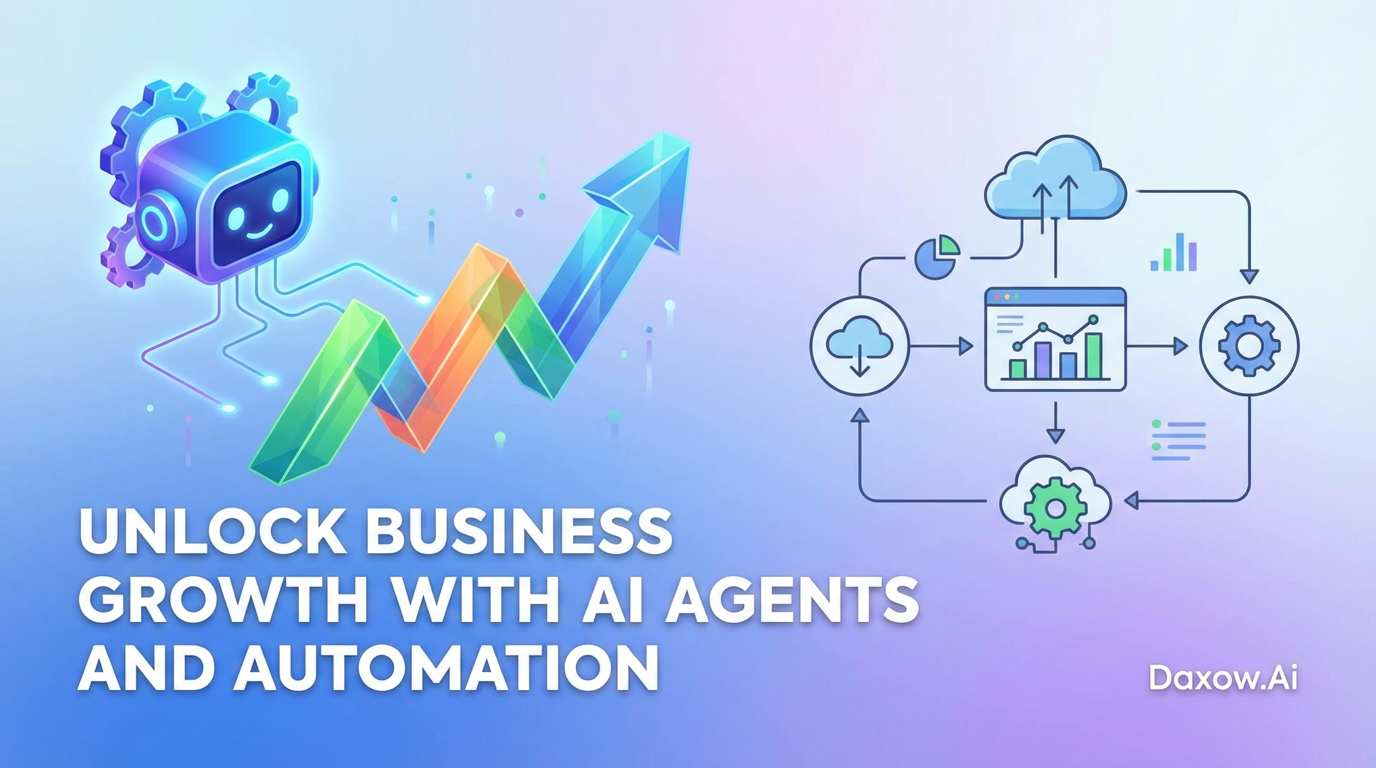
Guide to deploying AI agents and workflow automation to reduce costs, boost productivity, and achieve measurable ROI with practical steps and real use cases.
Unlocking Business Growth: The Strategic Imperative of AI Agents and Automation
Estimated reading time: 18 minutes
Key Takeaways
- AI agents and automation transform manual, siloed processes into scalable, intelligent systems that boost productivity and customer experience.
- Strategic AI deployments yield 3–5x faster progress toward goals and reduce process costs by 30–70% within the first year.
- Practical use cases range across industries including e-commerce, healthcare, finance, and manufacturing, delivering measurable ROI.
- Implementation involves assessment, technology selection, pilot rollout, and continuous optimization with a focus on change management.
- Daxow.ai offers end-to-end AI agent development and integration services that drive rapid payback and scalable business value.
Table of Contents
- Unlocking Business Growth: The Strategic Imperative of AI Agents and Automation
- What AI Agents and Automation Mean for Your Business
- Practical Use Cases and Industry Examples
- Implementation Steps and Best Practices
- Measuring ROI and Business Value
- How Daxow.ai Helps You Unlock Growth with AI Agents and Automation
- Implementation Checklist — Ready to Start
- Final Thoughts
- Frequently Asked Questions
Unlocking Business Growth: The Strategic Imperative of AI Agents and Automation
Why this is a strategic imperative now
- The combination of accessible AI models, mature integrations, and improved tooling has moved AI agents from experiments to production-ready capabilities.
- AI agents and workflow automation enable 24/7 operations, predictable scaling, and faster decision cycles — producing a competitive edge in speed and quality.
- When aligned to concrete business goals, structured AI deployments achieve 3–5x faster progress toward objectives and often yield 30–70% reductions in process costs within the first year.
- The priority is not automation for its own sake but targeted business automation: reducing manual tasks where they are repetitive, error-prone, or high-volume so human talent can focus on strategy and growth.
What AI Agents and Automation Mean for Your Business
Definition and capabilities
- AI agents are autonomous systems that execute complex tasks, orchestrate multi-step workflows, and make bounded decisions with minimal human input.
- Workflow automation coordinates steps across systems (CRM, ERP, ticketing, document stores) so work moves automatically from trigger to resolution.
- Combined, they can process unstructured data (emails, documents, voice), apply business rules, escalate exceptions, and continuously optimize based on feedback.
Core business benefits
- Reduce manual tasks in high-volume areas such as data entry, inquiry routing, and invoice processing.
- Improve productivity by shifting routine work to AI, enabling staff to focus on customer relationships and product innovation.
- Enhance customer experience through faster responses and personalized interactions via customer support automation and sales automation.
- Lower operational cost and shorten time-to-value with predictable, measurable gains.
Practical Use Cases and Industry Examples
E-commerce and retail
- Use case: AI agents handle order inquiries, returns, and live product recommendations across chat and email.
- Business impact: Higher conversion and lower cart abandonment by delivering contextual offers and automating fulfillment exceptions.
- Example automation: When inventory thresholds are detected, an AI agent updates the storefront, notifies procurement, and routes prioritized orders to manual review.
Customer support and contact centers
- Use case: Customer support automation routes tickets, provides 80% of standard answers, and escalates complex cases to human agents with context.
- Business impact: Faster resolution times and improved CSAT, with staffing optimized around high-value interactions.
- Example automation: An AI agent triages incoming messages, extracts intent and sentiment, and populates the CRM with summary notes and recommended next steps.
Healthcare
- Use case: AI agents manage appointment scheduling, triage basic patient queries, and pre-fill intake forms while enforcing HIPAA-compliant handling.
- Business impact: Reduced administrative burden on clinicians and faster patient access to care.
- Example automation: Pre-visit screening is completed by an agent that flags urgent symptoms and prepares a clinician-ready summary in the EHR.
Finance and accounting
- Use case: Invoice matching, automated reconciliation, and fraud detection using anomaly analysis.
- Business impact: Lower error rates and faster closing cycles, with compliance checks integrated into workflows.
- Example automation: AI agents extract invoice data, match it to POs, route exceptions to AP staff, and update the ERP automatically.
Real estate and sales
- Use case: Lead qualification and virtual property tours driven by conversational AI agents and automated follow-ups.
- Business impact: Shorter sales cycles by prioritizing qualified leads and keeping prospects engaged automatically.
- Example automation: An AI agent nurtures leads via SMS and email, schedules showings based on calendar availability, and creates a briefing for the listing agent.
HR and operations
- Use case: Resume screening, onboarding tasks, and employee self-service for common HR questions.
- Business impact: Faster hires and higher employee satisfaction through consistent processes and rapid answers.
- Example automation: New hire onboarding is orchestrated by an AI agent that creates accounts, schedules training, and follows up on required paperwork.
Manufacturing and logistics
- Use case: Predictive maintenance alerts, inventory reordering, and shipment tracking automation.
- Business impact: Reduced downtime and optimized inventory, improving throughput and on-time delivery.
- Example automation: Sensor data triggers an agent to schedule maintenance, order spare parts, and adjust production planning.
Implementation Steps and Best Practices
1. Assessment and planning (4–8 weeks)
- Define business goals with measurable KPIs: cost reduction targets, average handling time, or lead conversion uplift.
- Audit data quality and system integrations: identify CRMs, ERPs, knowledge bases, and APIs.
- Prioritize use cases by impact and complexity using a simple matrix: high-impact/low-complexity first.
2. Technology and vendor selection (6–12 weeks)
- Choose platforms that support secure integrations, data governance, and scalability.
- Prefer solutions that provide audit trails, explainability, and compliance controls relevant to your industry.
- Build a vendor evaluation checklist aligned to business requirements including uptime, support, and extensibility.
3. Preparation and team building
- Clean and label data where necessary; consolidate knowledge bases and document workflows.
- Establish cross-functional teams that include business owners, IT, compliance, and frontline staff.
- Invest in user training and change management to ensure adoption and reduce resistance.
4. Pilot and gradual rollout
- Start with a pilot on a single use case or team to gather feedback and refine the agent’s behavior.
- Monitor KPIs and user experience; iterate quickly to improve accuracy and coverage.
- Scale in waves — add channels, teams, and integrations once the pilot meets success criteria.
5. Ongoing optimization
- Implement continuous monitoring, automated testing, and scheduled reviews.
- Maintain a pipeline of vetted ideas for improvements and new automations.
- Conduct bias checks and ethical reviews, and keep audit logs for governance and compliance.
Best practices distilled
- Start small and deliver quick wins by automating repetitive tasks first.
- Measure continuously and tie improvements to specific KPIs.
- Ensure cross-system integration so AI agents operate with real-time data.
- Plan for people and process change — automation succeeds when users trust and use it.
- Establish governance for ethical AI use and data protection.
Measuring ROI and Business Value
How to measure success
- Primary KPIs: cost per transaction, average handling time, first contact resolution, lead-to-deal conversion, and CSAT/NPS.
- Operational KPIs: process throughput, error rate, and exception volume.
- Financial KPIs: cost savings, incremental revenue from automation-enabled sales, and payback period.
Expected outcomes and timelines
- Quick wins: pilot use cases often show value within 3–6 months.
- Enterprise scale: full rollouts commonly achieve payback in 6–12 months when focused on high-volume, high-impact processes.
- Typical efficiency gains: 30–70% reduction in process costs for automated workflows; 3–5x faster realization of strategic goals when following structured implementation practices.
How Daxow.ai Helps You Unlock Growth with AI Agents and Automation
End-to-end process assessment and design
- Daxow.ai begins with a structured process analysis to identify where AI automation will deliver the most immediate and sustainable value.
- We quantify current baseline metrics and map target KPIs so every automation has a clear business objective.
Custom AI agent development and workflow automation
- We build domain-specific AI agents that execute real tasks: from multi-turn customer conversations to complex, rule-based orchestration across CRMs and ERPs.
- Our solutions integrate with existing systems and data sources so automation works with your live business data—not just in a sandbox.
Integration and data connectivity
- Daxow.ai connects AI agents to your backend systems, knowledge bases, and third-party services with secure APIs and robust error handling.
- We ensure data governance, logging, and compliance are built into every integration to protect sensitive information.
Change management and training
- We provide stakeholder workshops, operator training, and playbooks to accelerate adoption and minimize disruption.
- Our change programs include monitoring frameworks and continuous improvement cycles to sustain benefits.
Measurable ROI and scaling
- Daxow.ai focuses on high-impact, proven use cases for rapid ROI and creates a roadmap for enterprise-wide scaling.
- Clients typically see payback within the first year by concentrating on repetitive, high-volume processes and following best practices.
Implementation Checklist — Ready to Start
- Define 2–3 pilot use cases with clear KPIs.
- Assemble a cross-functional team and sponsor.
- Audit systems and data readiness.
- Select a vendor or partner experienced in AI agents and workflow automation.
- Run a short pilot (6–12 weeks), measure results, and prepare to scale.
Common pitfalls to avoid
- Automating poorly documented processes without first standardizing them.
- Ignoring user experience and failing to include frontline staff in design.
- Overlooking data quality and governance, which reduces accuracy and trust.
- Pursuing large-scale automation before demonstrating value with pilots.
Final Thoughts
AI agents and workflow automation are strategic tools that produce quantifiable business outcomes when applied thoughtfully. They offer a path to reduce manual tasks, improve productivity, and unlock new revenue opportunities through personalized customer interactions and optimized back-office operations. The difference between a pilot and enterprise-grade transformation is deliberate planning: clear KPIs, secure integrations, continuous optimization, and strong adoption practices.
If your organization is ready to move from experimentation to measurable impact, Daxow.ai can help you design, implement, and scale custom AI systems that deliver results. Our approach covers assessment, custom AI agent development, integrations, and change management — all focused on achieving fast payback and sustainable value.
Contact Daxow.ai to request a process analysis for your company or book a free consultation to explore how AI automation can transform your operations and drive business growth.
Frequently Asked Questions
What are AI agents and how do they differ from traditional automation?
AI agents are autonomous systems capable of handling complex, multi-step workflows and decision-making with minimal human input. Unlike traditional automation which often follows fixed rules, AI agents can adapt, learn, and optimize their tasks continuously.
How long does it typically take to see ROI from AI automation?
Pilot projects usually demonstrate value within 3–6 months. Full-scale enterprise rollouts often achieve payback in 6–12 months, especially when focused on high-volume, high-impact processes.
Which business areas benefit most from AI agents and automation?
Industries such as e-commerce, customer support, healthcare, finance, sales, HR, and manufacturing commonly benefit. High-volume, repetitive, or complex processes like inquiry routing, scheduling, invoice processing, and lead nurturing are ideal candidates.
What is important to consider for successful AI automation adoption?
Successful adoption requires clear KPIs, involvement of frontline staff in design, cross-system integration, targeted change management, continuous measurement, and ethical governance of AI tools.