
Mastering AI Agents & Workflow Automation: A Practical Guide
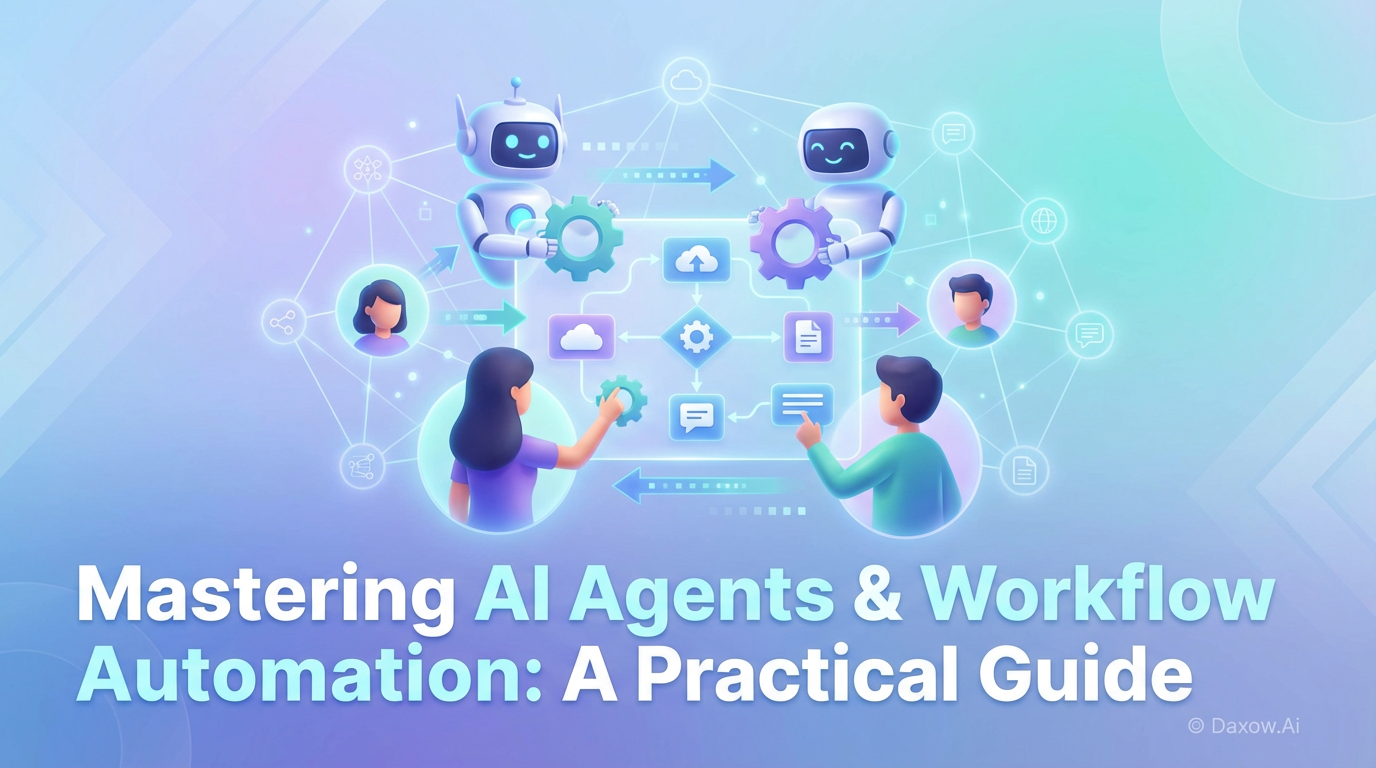
Practical, research-backed guide to deploying AI agents and workflow automation with use cases, a 5-phase implementation plan, ROI benchmarks, and governance tips.
Mastering AI Agents and Workflow Automation: A Practical Guide for Business Leaders
Estimated reading time: 15 minutes
Key Takeaways
- AI agents enable autonomous execution of complex workflows, boosting productivity and operational resilience.
- Workflow automation delivers significant cost savings, faster decision-making, and improved regulatory compliance.
- Industry use cases span e-commerce, healthcare, finance, real estate, and HR, each gaining measurable ROI.
- Daxow.ai offers end-to-end custom AI agent development, integration, and governance for scalable automation.
- Adopting a phased implementation and strong governance ensures sustainable, high-impact AI automation.
Table of Contents
- Mastering AI Agents and Workflow Automation: What It Means for Your Business
- High-Impact Use Cases: Industry Examples and Practical Applications
- Implementation: A Practical 5-Phase Framework
- Best Practices and Governance
- Measuring ROI and Business Value
- Integrations and Technical Considerations
- How Daxow.ai Delivers End-to-End Business Automation
- Practical Next Steps for Decision-Makers
- Final Thoughts
- Frequently Asked Questions
Mastering AI Agents and Workflow Automation: What It Means for Your Business
AI agents are autonomous software entities that combine machine learning, natural language processing, and decision logic to execute multi-step tasks. Workflow automation integrates these agents into operational processes, automating activities such as lead qualification, ticket routing, invoice reconciliation, and compliance checks.
Why this matters now
- Operational resilience: AI agents operate 24/7, maintain consistent performance, and handle peak volume without proportional headcount increases.
- Cost reduction: Organizations implementing structured automation frequently realize 20–50% operational cost savings and faster time-to-value.
- Faster decision-making: Automated workflows deliver 3–5x faster processing for repetitive tasks.
- Regulatory reliability: Built-in governance reduces compliance risk in regulated industries such as healthcare and finance.
Key capabilities of AI agents
- Natural language understanding for customer and employee interactions.
- Decision automation for routing, approvals, and escalation.
- Integration with CRMs, ERPs, ticketing systems, and document stores.
- Continuous learning loops that retrain models from feedback and audit trails.
High-Impact Use Cases: Industry Examples and Practical Applications
E-commerce: Customer support automation and sales automation
Use cases:
- Automate ticket triage, returns processing, and order status queries.
- Personalize product recommendations and re-engagement campaigns using real-time signals.
Practical example: A midsize online retailer deploys an AI agent that handles 70% of routine support queries (order status, returns, tracking) and qualifies high-intent leads for agents. Outcome: response times cut by 60%, CSAT increases, and conversion rates rise due to faster lead follow-up.
Healthcare: Patient triage and document automation
Use cases:
- Automated appointment scheduling, triage bots for symptom collection, and HIPAA-compliant data extraction from forms.
- Automate patient intake, billing codes, and compliance checks.
Practical example: A clinic uses AI agents to pre-screen incoming patient requests and populate electronic health records, reducing administrative hours by 40% and improving appointment utilization.
Finance: Invoice reconciliation and fraud detection
Use cases:
- Automate accounts payable workflows: invoice capture, matching, exception handling, and approvals.
- Real-time anomaly detection across transactions and audit trail generation.
Practical example: An accounting team implements agents that match invoices to purchase orders and flag discrepancies. Outcome: manual reconciliation time reduced by 50%, error rates fall, and audit cycles shorten.
Real Estate: Lead qualification and contract automation
Use cases:
- Automated lead enrichment and scheduling of viewings.
- Contract review bots extract clauses and flag non-standard terms.
Practical example: A brokerage uses AI agents to qualify leads via chat and schedule viewings automatically. Result: faster lead-to-showing times and 10–20% faster deal cycles.
HR and Administration: Onboarding and talent screening
Use cases:
- Resume parsing, pre-screening candidate questionnaires, onboarding task automation, and employee query bots (HR FAQ).
- Continuous monitoring of training completion and engagement.
Practical example: A growing company automates the first screening stage and onboarding checklist, reducing time-to-hire and administrative workload, allowing recruiters to focus on final-stage interviews.
Implementation: A Practical 5-Phase Framework
Phase 1 — Assessment and Planning (4–8 weeks)
- Define clear, measurable objectives: e.g., reduce support cost by 30%, cut invoice processing time by 50%.
- Map current workflows, systems, data sources (CRM, ERP), and stakeholder roles.
- Identify high-volume, low-complexity processes suitable for initial pilots.
- Deliverables: baseline KPIs, process maps, prioritized use-case list.
Phase 2 — Technology Selection (6–12 weeks)
- Choose platforms that provide NLP, supervised/unsupervised learning, integration APIs, and governance features.
- Evaluate scalability for 3–5 year growth and regulatory compliance (GDPR, HIPAA where applicable).
- Daxow helps select and customize the right stack and build connectors to your systems.
Phase 3 — Preparation (4–8 weeks)
- Clean and normalize data; build knowledge bases and decision rules.
- Design integrations to CRMs and business tools, create error-handling flows, and document escalation paths.
- Set up monitoring and logging for audits and performance tracking.
Phase 4 — Pilot and Iteration
- Launch a controlled pilot for a single use case or subset of users.
- Monitor metrics (resolution rate, cycle time, cost per transaction), gather qualitative feedback, and iterate—tune NLP models and decision logic.
- Use A/B testing to compare AI-driven workflows versus manual processes.
Phase 5 — Gradual Rollout and Continuous Improvement
- Scale to additional channels, languages, and business units.
- Establish governance to prevent sprawl and technical debt.
- Implement continuous retraining pipelines based on human feedback and performance drift.
Best Practices and Governance
Start small, demonstrate value, scale deliberately
- Prioritize high-volume, low-complexity tasks to achieve quick wins.
- Use pilots to build stakeholder confidence and gather training data.
Cross-functional teams and change management
- Form teams with business owners, data engineers, AI practitioners, and compliance leads.
- Train staff to supervise AI agents and handle edge cases.
Data quality and monitoring
- Data is the foundation of effective AI. Clean, labeled data accelerates ROI.
- Implement monitoring dashboards, audit trails, and bias checks. Automate alerts for model drift.
Security and compliance
- Embed privacy controls and compliance checks in workflows.
- Maintain role-based access and encryption for sensitive data.
Measuring ROI and Business Value
Typical metrics to track
- Cost per transaction and total operational cost.
- Throughput and cycle time (e.g., tickets processed per hour).
- Resolution rate and escalation rate.
- Customer satisfaction (CSAT) and Net Promoter Score (NPS).
- Compliance adherence and audit findings.
Typical ROI outcomes (benchmarks)
- Cost reduction: 20–50% lower operational costs for automated processes.
- Speed: 3–5x faster processing for high-volume tasks.
- Revenue lift: 10–25% growth via personalization and faster lead follow-up.
- Scalability: Handle growth without equivalent headcount increases.
Example: an automated invoicing workflow that reduces manual reconciliation time by 50% and error rates by 40% immediately saves headcount-hours and reduces late penalties — producing payback within months on the automation investment.
Integrations and Technical Considerations
Common integration targets
- CRMs (lead routing and qualification).
- ERPs and accounting systems (invoice processing).
- Support platforms and knowledge bases (customer support automation).
- Document stores and legal repositories (contract automation).
Data pipelines and retraining
- Establish pipelines for continuous data flow from production systems to retraining environments.
- Automate versioning and testing of models before production rollouts to prevent regressions.
How Daxow.ai Delivers End-to-End Business Automation
Daxow.ai specializes in designing and building tailored AI agents and workflow automation that produce measurable business outcomes.
What Daxow does for clients
- Process discovery and analysis: We map your workflows, quantify waste, and identify high-ROI automation opportunities.
- Custom AI agent development: We build AI agents that perform real tasks — from lead qualification to invoice automation — with tight integrations into your tech stack.
- End-to-end automation delivery: From data cleanup to deployment, monitoring, and continuous improvement, Daxow delivers full lifecycle automation.
- Compliance and governance: We design systems with audit trails, role-based access, and compliance checks baked into processes.
- Integration and connectivity: We connect AI agents to CRMs, ERPs, ticketing systems, and document repositories for seamless operation.
Why partner with Daxow
- Business-first approach: We prioritize measurable outcomes and ROI over technology for technology’s sake.
- Operational experience: Our teams combine domain expertise with engineering discipline to deploy production-ready systems.
- Scalability and sustainability: Daxow focuses on governance, monitoring, and retraining to ensure automation continues to deliver value as conditions change.
Practical Next Steps for Decision-Makers
Quick-start checklist
- Identify 2–3 high-volume processes with repetitive manual work.
- Capture baseline metrics (time per transaction, cost, error rate).
- Run a 4–8 week discovery with a cross-functional team to scope a pilot.
- Build success criteria (ROI threshold, throughput targets, CSAT improvement).
- Select a partner that can deliver integrations, governance, and continuous improvement.
Final Thoughts
Mastering AI agents and workflow automation is a strategic move that converts repetitive work into measurable business advantage. When implemented correctly — starting small, integrating deeply, and governing continuously — automation delivers rapid ROI, frees employees for higher-value projects, and elevates customer experiences. The organizations that win are those that treat AI as a business transformation program, not a point technology.
Ready to transform operations, reduce manual tasks, and boost productivity? Book a free consultation with Daxow.ai. Request a process analysis for your company and get a tailored roadmap to design, build, and scale AI automation that delivers predictable ROI. Contact us to build a custom AI system and begin your automation journey.
Frequently Asked Questions
What industries benefit most from AI agents and workflow automation?
Industries such as e-commerce, healthcare, finance, real estate, and HR see significant benefits through increased efficiency, cost savings, and enhanced customer and employee experiences.
How does Daxow.ai support integration with existing systems?
Daxow.ai designs AI agents with seamless integration into CRMs, ERPs, ticketing platforms, and document repositories, ensuring smooth data flow and workflow automation that aligns with your current technology stack.
What is the recommended approach for implementing AI automation?
A phased, pragmatic approach starting with assessment and planning, followed by technology selection, preparation, pilot testing, and gradual rollout ensures reduced risk and measurable business wins.
How do organizations measure the ROI of AI agents?
Key metrics include cost per transaction, throughput, resolution and escalation rates, customer satisfaction (CSAT), and compliance adherence. Typical ROI benchmarks show 20-50% cost reduction and 3-5x faster processing times.