
Mastering AI Agents and Workflow Automation: A Business Guide
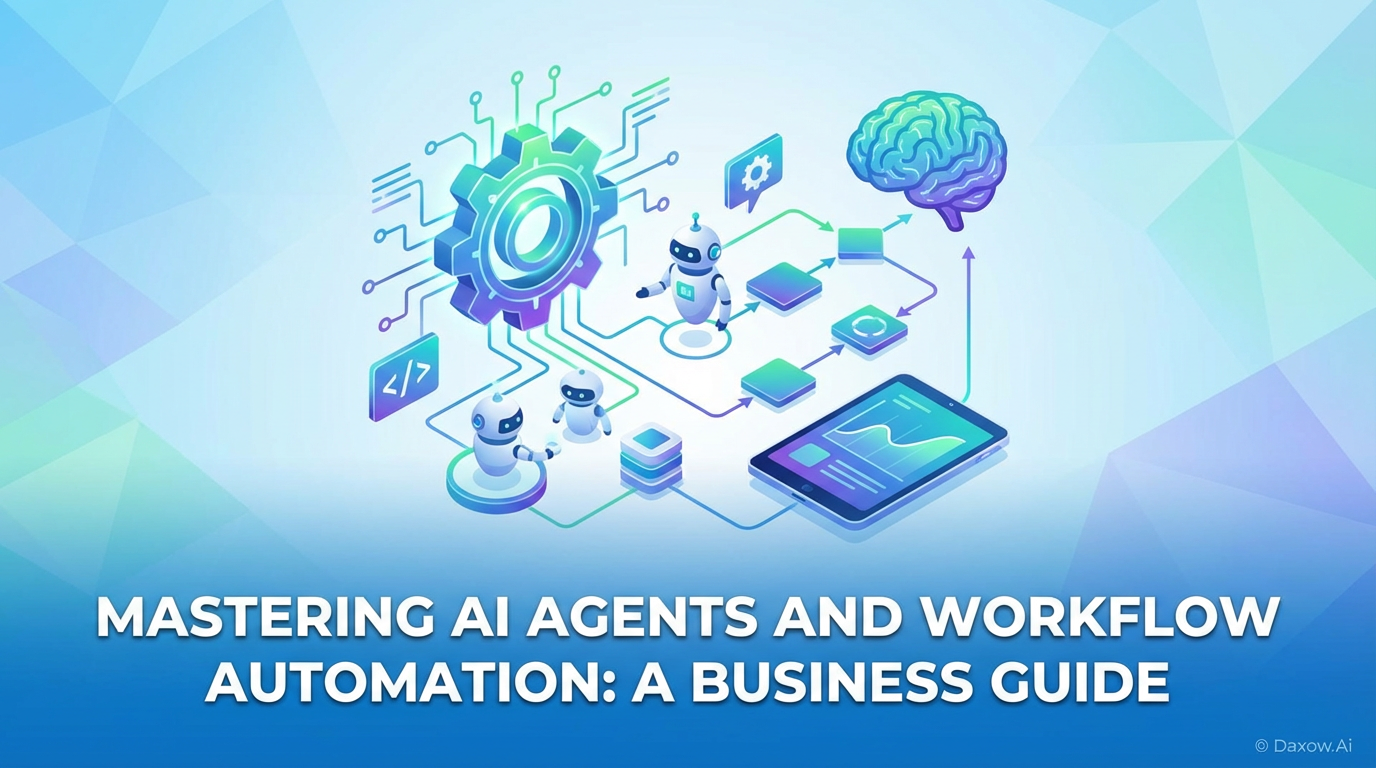
Guide to planning, implementing, and scaling AI agents and workflow automation — use cases, ROI, roadmap, and Daxow.ai's end-to-end support.
Mastering AI Agents and Workflow Automation: A Strategic Imperative for Modern Businesses
Estimated reading time: 15 minutes
Key Takeaways
- AI agents and workflow automation transform manual tasks into scalable, cost-saving processes.
- Organizations see 20–50% cost reductions and accelerated service delivery after adoption.
- Specific use cases span e-commerce, healthcare, finance, real estate, HR, and customer support.
- A phased implementation roadmap ensures practical, measurable automation success.
- Daxow.ai offers end-to-end AI automation services tailored to industry needs and compliance.
Table of Contents
- Mastering AI Agents and Workflow Automation: A Strategic Imperative for Modern Businesses
- Concrete Use Cases and Industry Examples
- Implementation Roadmap: From Assessment to Scale
- Technical Considerations: Integrations, Security, and Governance
- Measuring ROI and Business Value
- Risks, Pitfalls, and How to Avoid Them
- How Daxow.ai Helps You Master AI Agents and Workflow Automation
Mastering AI Agents and Workflow Automation: A Strategic Imperative for Modern Businesses
Mastering AI Agents and Workflow Automation: A Strategic Imperative for Modern Businesses is no longer optional for competitive organizations — it is a strategic necessity. AI agents and workflow automation convert manual, repetitive work into reliable, scalable processes that reduce cost, accelerate service delivery, and free teams to focus on high-value activities. Organizations that adopt these technologies systematically report 20–50% cost reductions on targeted processes, faster resolution times, and the ability to scale operations without proportional headcount increases. This article lays out a practical, actionable guide for decision-makers on how to plan, implement, and scale AI automation — with concrete use cases, implementation steps, technical considerations, ROI calculations, and how Daxow.ai supports end-to-end business automation.
What we mean by AI agents and workflow automation
- AI agents are autonomous systems that perform tasks, make decisions, and execute workflows with minimal human intervention. They combine natural language processing, rule-based logic, and predictive models to act on data and systems.
- Workflow automation connects processes, systems, and people so that work flows reliably and efficiently across teams and tools. When combined with AI, workflows become adaptive and continuously optimized.
Why this matters now
- Operational efficiency: Automating high-volume, rule-based tasks (invoice processing, ticket triage, lead qualification) yields immediate cost and time savings.
- Scalability: AI agents can handle thousands of concurrent interactions, enabling growth without proportional increases in staff.
- Compliance and risk management: Properly designed agents enforce compliance workflows and audit trails for regulated industries.
- Competitive advantage: Companies implementing these solutions achieve business objectives 3–5x faster than peers who lack structured AI initiatives.
Concrete Use Cases and Industry Examples
E-commerce — Faster service and higher conversion
Use case
Automate customer support ticket sorting, returns processing, product recommendation, and order status updates.
How it works
An AI agent ingests incoming messages, classifies intent, retrieves order data via CRM/API, and either resolves the query or escalates to an agent with a pre-filled case.
Business impact
- Reduced response times, lower cart abandonment, and fewer manual touchpoints in order fulfillment.
- Typical KPI improvements: 30–40% reduction in first-response time and 20–30% lower cost per ticket.
Healthcare — Patient triage and administrative automation
Use case
Patient intake automation, appointment scheduling, clinical documentation extraction, and triage escalation.
How it works
Agents extract structured data from intake forms, check available slots in scheduling systems, validate insurance requirements, and escalate urgent requests to clinical staff.
Business impact
- Improved patient satisfaction, reduced no-shows, and streamlined billing cycles.
- Compliance: workflows built to maintain HIPAA-level controls and audit logs.
Finance — Reconciliation, compliance, and fraud detection
Use case
Invoice reconciliation, automated bookkeeping entries, anomaly detection in transactions, and compliance reporting.
How it works
Agents pull transaction data from ERP/CRM, reconcile entries using rules and ML, flag anomalies for review, and generate audit-ready reports.
Business impact
- 20–50% reduction in processing costs, faster month-close, and improved fraud detection rates.
Real estate — Lead qualification and quicker closings
Use case
Automate lead routing, property-matching, appointment scheduling, and automated follow-ups.
How it works
AI agents qualify leads based on predefined criteria, update CRM fields, send personalized proposals, and schedule virtual tours.
Business impact
- Accelerated sales cycles, higher conversion rates, and better lead-to-client matching.
HR — Recruitment and onboarding efficiency
Use case
Resume screening, candidate pre-qualification, interview scheduling, and onboarding checklist automation.
How it works
Agents parse resumes, score candidates against job criteria, handle initial outreach, and orchestrate document collection for onboarding.
Business impact
- Reduced time-to-hire, better candidate experience, and fewer administrative errors.
Customer Support Automation — 24/7 resolution and cost control
Use case
Omni-channel support agents that answer FAQs, process simple requests, and escalate complex cases.
How it works
Natural language understanding routes queries, knowledge-base retrieval answers questions, and workflow automation completes tasks like refunds or subscription changes.
Business impact
- Higher CSAT, faster resolution rates, and significant reductions in support headcount for routine tasks.
Implementation Roadmap: From Assessment to Scale
Phase 1 — Assess and Plan (4–8 weeks)
Activities
- Map current workflows and data sources.
- Identify high-volume, low-complexity processes for quick wins.
- Define objectives (e.g., 20% reduction in handling time) and baseline metrics.
Deliverables
- Prioritized process list, success metrics, governance framework, and a project timeline.
Why it matters
Starting with the right use cases creates momentum and measurable credibility.
Phase 2 — Select Technology and Build Team (6–12 weeks)
Activities
- Choose platforms and tools emphasizing integration, security, and scalability.
- Assemble cross-functional team: product owner, AI engineer, integration specialist, compliance lead, and business SMEs.
Deliverables
- Technology stack, integration plan, staffing matrix, and training schedule.
Why it matters
Vendor selection and team composition determine long-term maintainability.
Phase 3 — Prepare Data and Systems (4–8 weeks)
Activities
- Clean and harmonize data, build knowledge bases, and design decision trees.
- Set up secure connections to CRMs, ERPs, and document stores.
Deliverables
- Clean datasets, documented APIs, annotated examples for model training, and compliance controls.
Why it matters
High-quality data is the foundation of reliable AI agents.
Phase 4 — Pilot and Rollout
Activities
- Launch a controlled pilot targeting a single use case or customer segment.
- Monitor KPIs daily, collect qualitative feedback, and iterate.
Deliverables
- Pilot performance dashboard, issue log, and updated model/flow logic.
Why it matters
Pilots minimize risk and create a blueprint for scaling.
Phase 5 — Monitor and Improve (Continuous)
Activities
- Implement monitoring, retraining pipelines, and bias detection.
- Formalize escalation paths and periodic governance reviews.
Deliverables
- Operational playbooks, continuous improvement backlog, and SLA reports.
Why it matters
Ongoing optimization keeps automation aligned with business goals.
Technical Considerations: Integrations, Security, and Governance
Integrations and data connectivity
- Integrate with CRMs, ERPs, ticketing systems, and databases via APIs or middleware.
- Build event-driven workflows to avoid batch delays.
- Ensure agents can read/write authoritative data to preserve single source of truth.
Security, privacy, and compliance
- Encrypt data in transit and at rest.
- Enforce role-based access controls and audit logging.
- Build compliance checks into workflows for HIPAA, GDPR, SOC 2, or industry-specific requirements.
Model governance and bias mitigation
- Use explainable models where possible and log decision rationale.
- Maintain a testing dataset for drift detection and scheduled retraining.
- Implement human-in-the-loop controls for high-risk decisions.
Observability and error handling
- Instrument workflows with metrics: latency, success rate, escalation rate, and user satisfaction.
- Implement graceful failure modes and clear escalation channels for unresolved cases.
Measuring ROI and Business Value
Measuring impact is essential to justify investment and guide expansion. Use clear baselines, KPIs, and forecast scenarios.
Key KPIs to track
- Cost per transaction or ticket.
- Average handling time (AHT).
- First contact resolution (FCR) rate.
- Time-to-hire for HR processes.
- Revenue uplift attributable to faster lead response.
Sample ROI scenario
Company: Mid-size e-commerce support center.
Baseline: 10 support agents handling 2,000 tickets/week. Average salary cost per agent (fully loaded) $70,000/year.
Automation target: Automate 40% of routine tickets with AI agents, reducing live-handled tickets proportionally.
Savings: Equivalent of 4 FTEs * $70k = $280k annual labor savings.
Additional benefits: Faster responses improve conversion and retention, conservatively adding $50k in incremental revenue.
Net benefit: ~$330k annual value plus improved CSAT and scalability.
Why pilots compound value
- Early pilots show quick wins and create data for retraining.
- Scaling successful pilots across other processes delivers exponential returns due to shared integrations and reused components.
Risks, Pitfalls, and How to Avoid Them
Common pitfalls
- Rushing into complex use cases without data readiness.
- Poor integration leading to inconsistent data states.
- Ignoring change management and undertraining users.
How to avoid them
- Start small: high-volume, low-complexity workflows first.
- Invest in data quality and governance before scaling.
- Embed change management: training, clear communication, and stakeholder buy-in.
- Define rollback and monitoring plans before full rollout.
How Daxow.ai Helps You Master AI Agents and Workflow Automation
At Daxow.ai we design, build, and operate custom AI systems that convert manual work into measurable business outcomes. Our approach is pragmatic and tailored to your needs.
What we deliver
- Discovery & process analysis: Map workflows and identify automation candidates.
- Custom AI agents: Build agents that execute real tasks — from lead qualification to invoice reconciliation.
- Workflow automation: Orchestrate cross-system processes, ensuring reliable data flow across CRM, ERP, and ticketing systems.
- Chatbots & support automation: Deploy omni-channel bots integrated with knowledge bases and escalation paths.
- Data extraction & document automation: Automate parsing of invoices, contracts, and medical records with accuracy and compliance controls.
- Systems integrations: Connect to the tools you already use, preserving single sources of truth.
- Continuous improvement: Operational support, monitoring, retraining, and governance.
Why Daxow.ai
- End-to-end delivery: From assessment to pilot to scale, we handle technical and operational implementation.
- Industry expertise: Experience in technology, e-commerce, healthcare, finance, real estate, and HR automation.
- Business-focused metrics: We define KPIs up front and align automation to measurable outcomes like cost reduction, faster time-to-resolution, and revenue uplift.
- Compliance-first design: Security and regulatory controls baked into workflows.
Example engagement flow
- Rapid process analysis to identify pilot use case.
- Prototype AI agent and integration adapters within 6–8 weeks.
- Pilot with live traffic, monitored by Daxow.ai engineers and your SMEs.
- Iterate based on real performance data and scale across processes.
Explore our services and case studies to learn more about how Daxow.ai can transform your business automation journey.
Frequently Asked Questions
What are AI agents and how do they differ from traditional automation?
AI agents are autonomous systems that combine natural language processing, predictive modeling, and rule-based logic to perform complex tasks with minimal human intervention, whereas traditional automation typically follows fixed scripts without adaptive capabilities.
How quickly can companies expect ROI from AI automation?
With proper planning and piloting, companies often see measurable ROI within 6 to 12 months, including cost reduction, faster handling times, and improved customer satisfaction.
Is workflow automation suitable for highly regulated industries?
Yes. Workflow automation with AI agents can enforce compliance checkpoints, maintain audit logs, and support privacy regulations such as HIPAA and GDPR, making it highly suitable for regulated sectors like healthcare and finance.