
AI Agents & Workflow Automation: From Manual to Autonomous
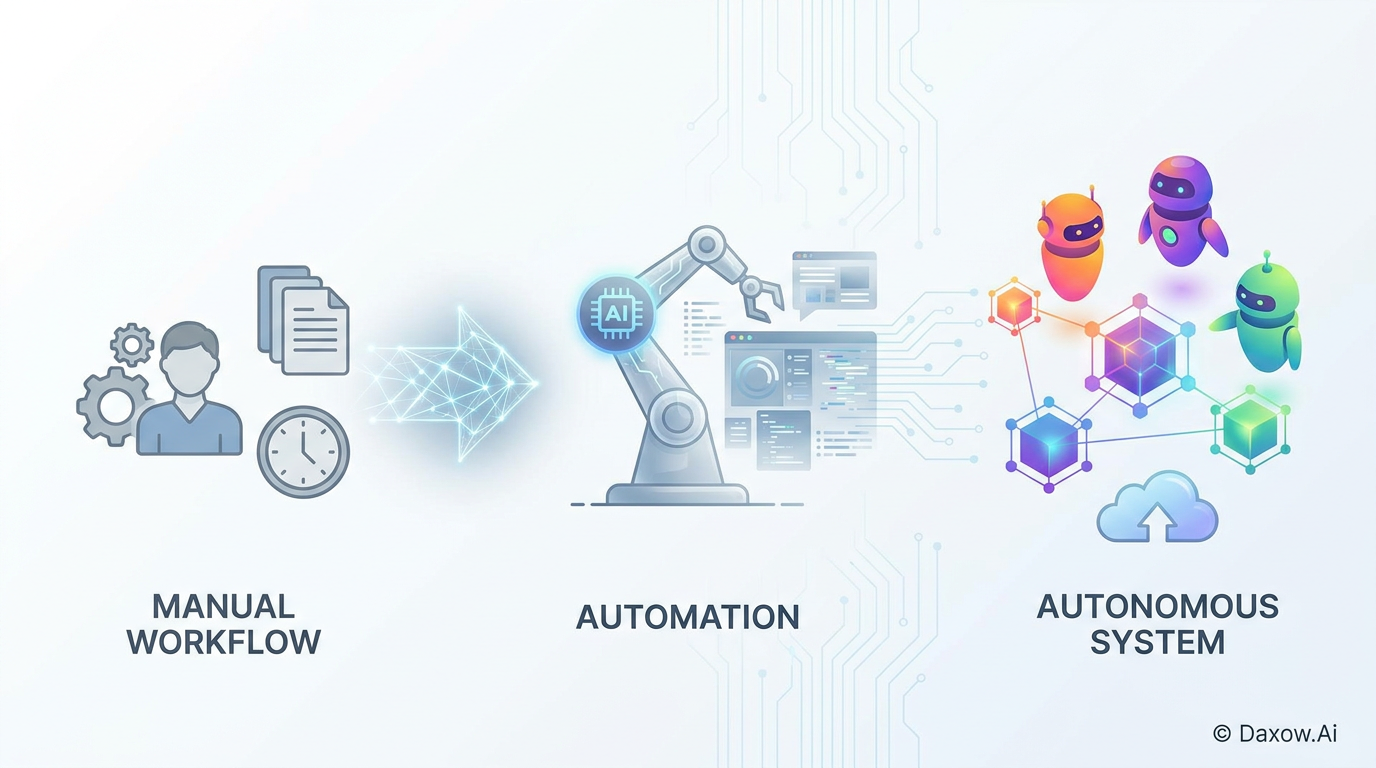
How AI agents and workflow automation turn manual operations into autonomous workflows—includes use cases, ROI guidance, governance, and a Daxow.ai implementation roadmap.
AI Agents and Workflow Automation: How to Move from Manual Operations to Autonomous, AI-Driven Workflows
Estimated reading time: 15 minutes
Key Takeaways
- AI agents plus workflow automation are strategic capabilities, not point tools.
- Start with high-impact, narrow use cases, validate with metrics, then scale.
- Governance, measurement, and integrations are as important as AI models.
- Design agents as roles with clear scope, authority, and KPIs.
- Continuous improvement turns early wins into sustained advantage.
Table of Contents
- AI Agents and Workflow Automation — What This Shift Means for Business
- Practical Use Cases Across Industries: Where AI Agents and Workflow Automation Deliver Most
- How Daxow.ai Designs and Delivers AI Agents and Workflow Automation
- Implementation Roadmap: From Pilot to Enterprise-Scale Automation
- Measuring ROI: How to Quantify the Value of AI Agents and Workflow Automation
- Best Practices and Governance: Safeguarding Performance and Compliance
- Real-World Example: From Manual Invoice Processing to Autonomous AP
- Key Takeaways for Decision-Makers
- Frequently Asked Questions
AI Agents and Workflow Automation — What This Shift Means for Business
At its core, AI agents combined with workflow automation convert manual, repetitive processes into autonomous capabilities. This is not merely replacing a human with a script. It is about:
- Turning processes into productized, repeatable workflows that encode best practices.
- Shifting from human-managed handoffs to AI-orchestrated execution, with humans handling exceptions and judgment.
- Creating a compounding productivity advantage where each automated workflow continues to deliver value as volume grows.
What AI agents bring to the stack
- Contextual understanding: Agents read emails, documents, tickets, and chat to extract intent and required actions.
- Decision-making: They evaluate policies and rules, make decisions within guardrails, and escalate when needed.
- Execution across systems: Agents perform actions in CRM, ERP, ticketing, and communication platforms via integrations.
- Continuous improvement: Feedback loops enable agents to become more accurate and efficient over time.
For business leaders, the outcome is tangible: lower operational costs, faster cycle times, higher consistency, and improved customer and employee experiences. Daxow.ai specializes in mapping this transformation end-to-end — from discovery to scaled deployment — ensuring the technology ties directly to your KPIs.
Practical Use Cases Across Industries: Where AI Agents and Workflow Automation Deliver Most
E-commerce — Increase conversion and reduce support overhead
Use cases:
- AI product advisor & sales agent: Conversational agents on-site or on messaging channels that understand intent, recommend products, create bundles, and apply discounts within rules.
- Automated post-purchase operations: Agents update ERP/fulfillment, flag risky orders, and trigger personalized shipping notifications.
- Customer support automation: Agents handle WISMO, returns, and warranty queries end-to-end, escalating only complex exceptions.
Business impact:
- Higher conversion and average order value
- Lower ticket volume per order and reduced support headcount growth
- Faster fulfillment and higher lifetime value
Healthcare — Reduce administrative burden and improve patient experience
Use cases:
- AI front-desk & triage assistant: Appointment scheduling, reminders, intake collection, and urgency triage.
- Clinical documentation automation: Draft structured notes, populate EHR fields, and generate referral and discharge summaries.
- Care coordination agents: Orchestrate follow-ups, test results, and prescriptions across providers.
Business impact:
- More clinician time for patient care
- Reduced clinician burnout and admin errors
- Improved throughput and patient satisfaction
Finance — Speed operations while tightening risk controls
Use cases:
- Intelligent accounts payable/receivable: Invoice extraction, PO matching, anomaly detection, and ERP posting.
- KYC/AML automation: Document validation, risk scoring, and monitoring with human-in-the-loop escalation.
- Treasury forecasting agents: Consolidate data, generate cash forecasts, and highlight covenant or liquidity risks.
Business impact:
- Shorter cycle times and fewer manual interventions
- Lower back-office costs and improved compliance
- Faster, data-driven decisions
Real Estate — Improve lead conversion and streamline transactions
Use cases:
- Lead qualification and follow-up agents: Real-time responses, qualification, calendar booking, and personalized nurture flows.
- Transaction coordination: Track documents, signatures, and conditions between parties and service providers.
- Asset management automation: Monitor lease expiries, maintenance tickets, and performance benchmarks.
Business impact:
- Higher lead-to-deal conversion
- Smoother transactions and fewer delays
- Proactive asset performance management
Human Resources — Hire faster and improve employee experience
Use cases:
- AI recruiting copilot: Screen resumes, rank candidates, and draft personalized outreach.
- Onboarding automation: Guide new hires through paperwork, IT setup, and training with tailored paths.
- HR helpdesk automation: Handle policy FAQs, routing sensitive issues to HR partners.
Business impact:
- Shorter hiring cycles and improved candidate experience
- Lower HR ticket volume and faster new-hire ramp
- Consistent application of policies
How Daxow.ai Designs and Delivers AI Agents and Workflow Automation
Discovery and process analysis
- We map current workflows, identify high-volume manual handoffs, and quantify potential benefits.
- Deliverable: Prioritized use-case backlog tied to clear KPIs (cost, speed, quality).
Tailored design and agent specification
- We design agent roles with explicit inputs, outputs, permissions, and guardrails.
- Deliverable: Agent playbooks that define when agents act autonomously and when humans intervene.
Integrations and technical build
- We implement secure integrations with CRMs, ERPs, EHRs, ticketing systems, and communication platforms.
- We build connectors, orchestration flows, and the AI “brain” that reasons across data sources.
- Deliverable: Production-grade agents connected to your systems with robust monitoring and logging.
Pilot, measure, and scale
- Run controlled pilots in shadow mode, measure automation rate, resolution time, and quality.
- Iterate prompts, rules, and escalation paths based on real-world data.
- Standardize reusable components and scale horizontally across teams and regions.
Governance and continuous improvement
- Establish role-based access, approval thresholds, and audit trails.
- Provide dashboards and feedback channels for continuous tuning.
- Deliverable: A living operational model for AI automation that reduces manual tasks while managing risk.
By combining business process expertise with deep technical implementation capabilities, Daxow.ai ensures automation delivers measurable ROI and sustainable operational change.
Implementation Roadmap: From Pilot to Enterprise-Scale Automation
Step 1 — Align objectives and constraints
- Define what you optimize (cost, speed, quality, growth).
- Capture compliance boundaries, data sensitivity, and acceptable risk.
- Output: Business case with owners and KPIs.
Step 2 — Discover and prioritize
- Identify high-volume, rule-based processes with frequent exceptions.
- Prioritize by expected ROI and strategic importance.
- Output: Shortlist of 3–5 pilot use cases.
Step 3 — Design target workflows and agent roles
- Map current state and future state.
- Define agent responsibilities, guardrails, and human-in-the-loop points.
- Output: Workflow blueprints and agent specifications.
Step 4 — Build integrations and AI capabilities
- Connect to systems securely and provision data retrieval mechanisms.
- Implement LLMs and extraction models where needed.
- Output: Working agent prototypes integrated with live data.
Step 5 — Pilot and validate
- Run pilots with shadow mode and human comparisons.
- Track automation rates, error rates, and business KPIs.
- Output: Validated models and deployment plan.
Step 6 — Govern and scale
- Define ownership, approval logic, and monitoring.
- Create reusable templates and industrialize improvement cycles.
- Output: Enterprise-scale automation with continuous improvement.
Measuring ROI: How to Quantify the Value of AI Agents and Workflow Automation
To secure executive buy-in, present a clear and measurable ROI model:
- Annual benefit:
- Hours saved × fully loaded hourly rate.
- Incremental revenue from conversion uplift or retention.
- Reduced error and rework costs.
- Annual cost:
- Implementation amortized.
- Tooling, integrations, and ongoing maintenance.
- ROI = (Annual benefit – Annual cost) ÷ Annual cost.
- Payback period = Implementation cost ÷ Monthly net benefit.
Focus on direct financial impact (labor efficiency, revenue uplift, cost avoidance), operational metrics (cycle time, automation rate, quality), and strategic benefits (employee experience, customer satisfaction, scalability).
Best Practices and Governance: Safeguarding Performance and Compliance
- Tie agents to clear KPIs and owners: Each agent should have a business owner and a technical owner.
- Start conservative with approvals: Use thresholds for autonomous actions and human approvals for high-risk activities.
- Limit permissions: Agents get only the data and system access they need.
- Monitor and log: Maintain detailed logs of decisions and actions for audits and continuous improvement.
- Iterate fast: Use feedback to refine prompts, decision logic, and workflows.
Daxow.ai embeds governance into every deployment so automation scales safely and transparently.
Real-World Example: From Manual Invoice Processing to Autonomous AP
A manufacturing company processed thousands of supplier invoices monthly. Manual validation created a backlog and frequent payment delays.
- Problem: Duplicate invoices, PO mismatches, and slow approvals.
- Daxow.ai solution:
- Built an AI agent to extract invoice data, match against PO and GRN, detect anomalies, and route exceptions.
- Integrated the agent with the ERP and approval workflows.
- Implemented dashboards and approval thresholds for payments above material amounts.
- Results:
- Automation rate: 78% of invoices processed end-to-end without human intervention.
- Cycle time: Reduced average processing time from 4 days to 6 hours.
- Cost: Equivalent of 3 FTE hours saved monthly and fewer late-payment penalties.
This example demonstrates the combination of data extraction, decision logic, and cross-system action that defines successful business automation.
Key Takeaways for Decision-Makers
- AI agents plus workflow automation are strategic capabilities, not point tools.
- Start with high-impact, narrow use cases, validate with metrics, then scale.
- Governance, measurement, and integrations are as important as AI models.
- Design agents as roles with clear scope, authority, and KPIs.
- Continuous improvement turns early wins into sustained advantage.
Daxow.ai helps companies accelerate this journey with end-to-end services: process discovery, agent design, secure integrations, deployment, and operational governance. We focus on delivering measurable reductions in manual tasks, improved productivity, and clear ROI.
Frequently Asked Questions
What are AI agents in the context of workflow automation?
AI agents are autonomous software entities that understand context, make decisions within defined rules, and execute tasks across integrated systems to automate workflows.
How does workflow automation benefit businesses?
Workflow automation reduces manual workload, accelerates cycle times, lowers operational costs, and improves consistency, allowing teams to focus on strategic decisions.
Can AI agents handle exceptions in automated workflows?
Yes, AI agents are designed to escalate complex exceptions to humans while managing routine cases autonomously, ensuring proper oversight where needed.
How can my organization start implementing AI-driven workflows?
Begin by aligning business objectives, discovering high-impact processes, designing agent roles and workflows, and partnering with experts like Daxow.ai for secure integration and scaling.