
AI Agents & Workflow Automation: Drive Measurable Enterprise ROI
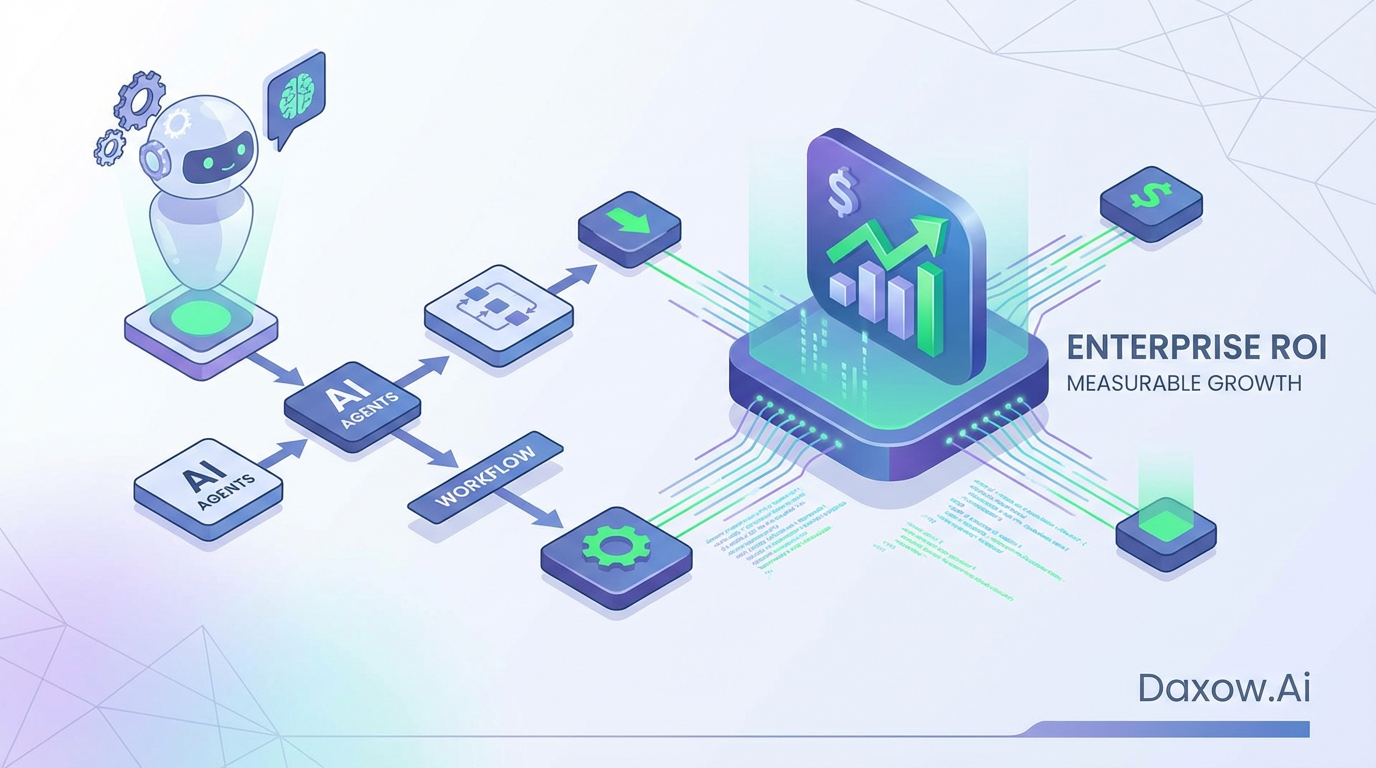
How AI agents and workflow automation cut manual work, speed processes, and deliver measurable ROI across e-commerce, support, finance, HR and more.
AI Agents and Workflow Automation: Transforming Enterprise Operations for Measurable ROI
Estimated reading time: 15 minutes
Key Takeaways
- AI agents and workflow automation reduce manual tasks and accelerate enterprise operations.
- Practical use cases span e-commerce, customer support, sales, finance, healthcare, real estate, and HR.
- A structured implementation framework ensures scalable and compliant automation delivery.
- Daxow.ai specializes in building custom AI automation platforms with measurable ROI.
- Tracking core KPIs like cycle time and error rate quantifies automation impact.
Table of Contents
- Introduction — AI agents and workflow automation for business transformation
- Why AI agents and workflow automation matter now
- What an AI agent is (and is not)
- How Daxow.ai approaches business automation
- Core benefits for decision-makers
- AI agents and workflow automation — Practical use cases by industry
- How to quantify ROI from AI agents and workflow automation
- Implementation framework — From process mapping to autonomous agents
- Technical considerations and integrations
- Best practices for adoption and long-term success
- How Daxow.ai helps you build AI agents and workflow automation systems
- Conclusion — Move from experimentation to enterprise-grade automation
- Frequently Asked Questions
Introduction — AI agents and workflow automation for business transformation
AI agents and workflow automation are rapidly becoming core components of modern digital transformation strategies. Organizations that adopt these technologies systematically reduce manual tasks, accelerate decision cycles, and scale customer-facing operations without proportionally increasing headcount. This article explains how AI agents and workflow automation deliver business value, offers practical industry use cases, outlines an implementation framework, and describes how Daxow.ai builds custom AI systems that integrate, automate, and optimize end-to-end processes.
Why AI agents and workflow automation matter now
- Competitive pressure: Customers expect faster responses and personalized experiences. Companies that automate repetitive work gain agility.
- Operational cost control: Automating routine tasks reduces labor costs and error rates, improving margins.
- Data-driven processes: AI agents can ingest unstructured data, make decisions, and trigger workflows that previously required human interpretation.
- Scalability: Workflow automation enables predictable scale across sales, support, finance, and HR without linear headcount increases.
What an AI agent is (and is not)
- AI agents are software entities that can perceive their environment (via data and integrations), make decisions (using ML models and rules), and perform actions (trigger workflows, update systems, communicate).
- They are not generic chatbots; instead, they are task-oriented systems that can execute business logic and connect to enterprise tools.
How Daxow.ai approaches business automation
- Understand: Map current workflows and quantify manual tasks.
- Design: Define AI agent goals, decision points, and success metrics.
- Integrate: Connect to CRMs, ERPs, ticketing systems, and document repositories.
- Build: Develop models, rules engines, and orchestrations.
- Deploy & Operate: Monitor performance, retrain models, and iterate.
Core benefits for decision-makers
- Reduce manual tasks: Free employees from routine work so they focus on high-value activities.
- Improve productivity: Faster throughput and fewer handoffs shorten cycle times.
- Enhance customer experience: Faster, accurate responses increase retention and lifetime value.
- Lower operational costs: Automation reduces rework and staffing pressures.
- Measureable ROI: Track metrics such as reduction in response time, decrease in manual FTE hours, and uplift in conversion rates.
AI agents and workflow automation — Practical use cases by industry
E-commerce — Order, returns, and personalization automation
- Use case: An AI agent monitors incoming orders, validates address and payment, flags high-risk transactions, and routes suspicious orders to a fraud review queue.
- Workflow automation: Trigger shipping label creation, inventory adjustments, and customer notifications automatically.
- Business value: Reduce manual review time, reduce chargebacks, and improve fulfillment speed.
- Daxow.ai role: Build an AI agent that integrates with your e-commerce platform, payment gateway, and logistics provider to execute these tasks automatically and surface exceptions for human intervention.
Customer support automation — 24/7 resolution and escalations
- Use case: AI agents classify incoming tickets (email, chat, voice), extract intent and entities, and match queries to knowledge base articles or workflows.
- Workflow automation: Auto-resolve standard issues, create troubleshooting steps, or escalate complex ones to human agents with context-rich summaries.
- Business value: Faster SLA compliance, improved first-contact resolution, and reduced support headcount pressure.
- Daxow.ai role: Implement customer support automation that ties into your helpdesk, CRM, and knowledge management systems, with continuous learning from agent feedback.
Sales automation — Lead qualification and pipeline acceleration
- Use case: An AI agent scores inbound leads using firmographic, behavioral, and historical win-rate data; it then schedules qualified leads for sales outreach and personalizes initial contact.
- Workflow automation: Trigger nurture sequences for unqualified leads and populate CRM fields automatically.
- Business value: Higher conversion rates, shorter sales cycles, and more effective use of sales rep time.
- Daxow.ai role: Create sales automation agents that integrate with marketing automation platforms, CRM systems, and calendar tools to automate qualification and follow-up.
Finance & accounting — Invoice processing and reconciliations
- Use case: AI agents extract data from invoices and receipts, validate against purchase orders, and route discrepancies for approval.
- Workflow automation: Post validated transactions to ERP, schedule payments, and reconcile bank statements.
- Business value: Significant reduction in manual data entry, faster month-end close, and fewer payment errors.
- Daxow.ai role: Deploy document automation pipelines that integrate OCR, NLP extraction, and ERP connectors, delivering compliance and audit trails.
Healthcare — Patient intake and prior authorization
- Use case: AI agents extract clinical and administrative data from referral documents, check insurance eligibility, and generate prior authorization requests.
- Workflow automation: Route approvals to providers, schedule appointments, and update EHRs.
- Business value: Reduced administrative burden, faster care delivery, and fewer denied claims.
- Daxow.ai role: Build privacy-compliant automation that connects to EHRs, payer systems, and scheduling platforms while enforcing data governance.
Real estate — Document automation and client matching
- Use case: AI agents parse lease agreements, extract key dates and clauses, and trigger reminders or renewals.
- Workflow automation: Match client preferences with listings and automatically send curated proposals.
- Business value: Faster transaction cycles, improved tenant retention, and reduced legal risk.
- Daxow.ai role: Design agents that integrate with property management systems and CRM platforms, automating routine workflows and surfacing exceptions.
HR & administrative — Candidate screening and onboarding
- Use case: AI agents screen resumes for required skills, schedule interviews, and collect onboarding documents.
- Workflow automation: Provision accounts, assign training, and trigger payroll entries when employment is confirmed.
- Business value: Reduced time-to-hire, better candidate experience, and lower administrative overhead.
- Daxow.ai role: Implement HR automation pipelines that integrate with ATS, directory services, and payroll systems.
How to quantify ROI from AI agents and workflow automation
Core metrics to track
- Reduction in manual hours: Hours saved per week by automation.
- Process cycle time: Time from initiation to completion before and after automation.
- Error rate: Decrease in manual processing errors.
- Customer metrics: NPS, response time, first-response resolution.
- Financial metrics: Cost per transaction, reduction in overtime, and annualized savings.
- Conversion metrics: Lead-to-opportunity and opportunity-to-win rate improvements.
Calculating ROI — a simple approach
- Identify baseline costs (manual labor hours × fully loaded hourly rate).
- Estimate automation implementation and operating costs (development, integrations, hosting, monitoring).
- Project annual savings from reduced labor, fewer errors, and revenue uplift.
- ROI = (Annual Savings − Annual Costs) / Annual Costs.
- Include soft benefits (improved customer retention, faster time-to-market) as upside potential.
Implementation framework — From process mapping to autonomous agents
1. Discovery and process mapping
- Conduct stakeholder interviews.
- Map end-to-end workflows and identify repetitive, rule-based tasks.
- Quantify volumes and current manual effort.
2. Prioritization and ROI estimation
- Score processes by automation potential, cost, and strategic value.
- Pilot quick wins that deliver measurable savings.
3. Design and architecture
- Define AI agent responsibilities: perception, decision, and action layers.
- Choose integration points: CRM, ERP, ticketing, databases, and document stores.
- Define data requirements, privacy constraints, and compliance needs.
4. Development and testing
- Build extraction models (NLP, OCR) and decision models (rules, ML).
- Create orchestrations that connect agents to systems of record.
- Test with representative data and run shadow pilots.
5. Deployment and change management
- Roll out incrementally with human-in-the-loop controls.
- Train staff on new workflows and exception handling.
- Monitor KPIs and tune models.
6. Operate and scale
- Set up monitoring, alerting, and observability.
- Establish feedback loops for continuous learning.
- Expand agents to adjacent processes using the same data backbone.
Technical considerations and integrations
Data quality and governance
- Data accuracy is essential for reliable decisions.
- Implement validation layers and reconciliation processes.
- Enforce access controls and audit logs for compliance.
Integration patterns
- API-first integrations with CRM, ERP, and ticketing systems.
- Event-driven orchestration for real-time workflows.
- Batch processing for high-volume document automation.
Security and compliance
- Protect PHI and PII with encryption and role-based access.
- Maintain audit trails for regulated industries.
- Ensure model explainability where required for governance.
Best practices for adoption and long-term success
- Start with high-impact, low-complexity processes to build momentum.
- Keep humans in the loop for exception handling and trust-building.
- Measure outcomes continuously and iterate on models and workflows.
- Use modular, reusable components to accelerate new automations.
- Align automation goals with business KPIs and executive sponsorship.
How Daxow.ai helps you build AI agents and workflow automation systems
Daxow.ai delivers end-to-end automation programs tailored to enterprise needs:
- Process discovery and ROI analysis: We quantify manual tasks and prioritize automation opportunities.
- Custom AI agent development: We design agents that perceive, decide, and act — integrating ML models, rules engines, and orchestration.
- Systems integration and data connectivity: We connect to CRMs, ERPs, support platforms, and document stores to create seamless end-to-end workflows.
- Operationalization and governance: We deploy monitoring, retraining pipelines, and governance to keep agents reliable and compliant.
- Iterative scaling: Starting with pilots, we replicate success across teams, reducing operational costs and improving ROI.
Example Daxow.ai engagement model
- Week 1–3: Process analysis, stakeholder alignment, and pilot scoping.
- Week 4–8: Build extraction models and integrate core systems.
- Week 9–12: Pilot deployment with human-in-the-loop and KPI measurement.
- Month 4+: Scale to additional processes, add agent capabilities, and optimize performance.
Conclusion — Move from experimentation to enterprise-grade automation
AI agents and workflow automation are no longer experimental — they are strategic enablers that reduce manual tasks, boost productivity, and deliver measurable business automation outcomes. Organizations that adopt a structured approach see faster customer support resolution, more efficient sales pipelines, lower operational costs, and improved compliance.
If your organization is ready to reduce manual work, improve productivity, and scale with intelligent automation, Daxow.ai can help design and build a custom AI system tailored to your business needs. Book a free consultation or request a process analysis for your company to begin automating high-impact workflows and unlocking measurable ROI.
Frequently Asked Questions
What is the difference between an AI agent and a chatbot?
An AI agent is a task-oriented system that perceives data, makes decisions, and triggers automated workflows within enterprise systems, whereas a chatbot primarily focuses on conversational interactions without executing integrated business logic.
How do AI agents reduce operational costs?
AI agents automate routine and repetitive tasks, reducing the need for manual labor, minimizing errors, and accelerating process cycle times, all of which contribute to lower operational expenses.
Can existing systems integrate with AI workflow automation?
Yes, integration is a core part of workflow automation. AI agents connect to CRM, ERP, ticketing, and document management systems via APIs and other integration patterns to enable seamless end-to-end automation.
How does Daxow.ai ensure compliance and data security?
Daxow.ai enforces strict data governance, secure access controls, audit trails, and privacy-compliant architectures tailored to regulated industries, ensuring your automation systems meet compliance requirements.