
How AI Agents and Workflow Automation Transform Customer Support
Learn how AI agents and workflow automation speed responses, reduce manual work, and boost ROI in customer support — with use cases, a roadmap, and Daxow.ai services.
How AI Agents and Workflow Automation are Transforming Customer Support
Estimated reading time: 18 minutes
Key Takeaways
- AI agents and workflow automation streamline customer support, delivering faster resolutions and higher customer satisfaction.
- Core capabilities include natural language understanding, document extraction, system integrations, and autonomous task execution.
- Multiple industries benefit from AI automation, including e-commerce, SaaS, finance, healthcare, real estate, and HR.
- Implementing AI agents requires clear task definition, integration strategies, security, and continuous learning.
- Daxow.ai offers tailored AI automation solutions to increase productivity, reduce costs, and improve customer experience.
Table of Contents
- Why This Matters Now
- Key Benefits
- Core Capabilities of AI-Driven Customer Support
- Practical Architecture
- Real-World Use Cases
- Building Effective AI Agents for Customer Support
- How to Implement Customer Support Automation with Minimal Disruption
- Estimating Impact — Productivity, Cost, and Customer Experience
- Risks and Mitigations in Customer Support Automation
- Partnering with Daxow.ai to Build Custom AI Automation
- Start Automating Customer Support Today
- Frequently Asked Questions
Why This Matters Now
Customers expect near-instant resolution across multiple channels. Manual ticket routing, repetitive responses, and siloed data are no longer acceptable in a competitive business landscape.
AI automation combined with workflow automation enables companies to handle higher volumes of inquiries, reduce manual tasks, and scale support operations without a proportional increase in headcount.
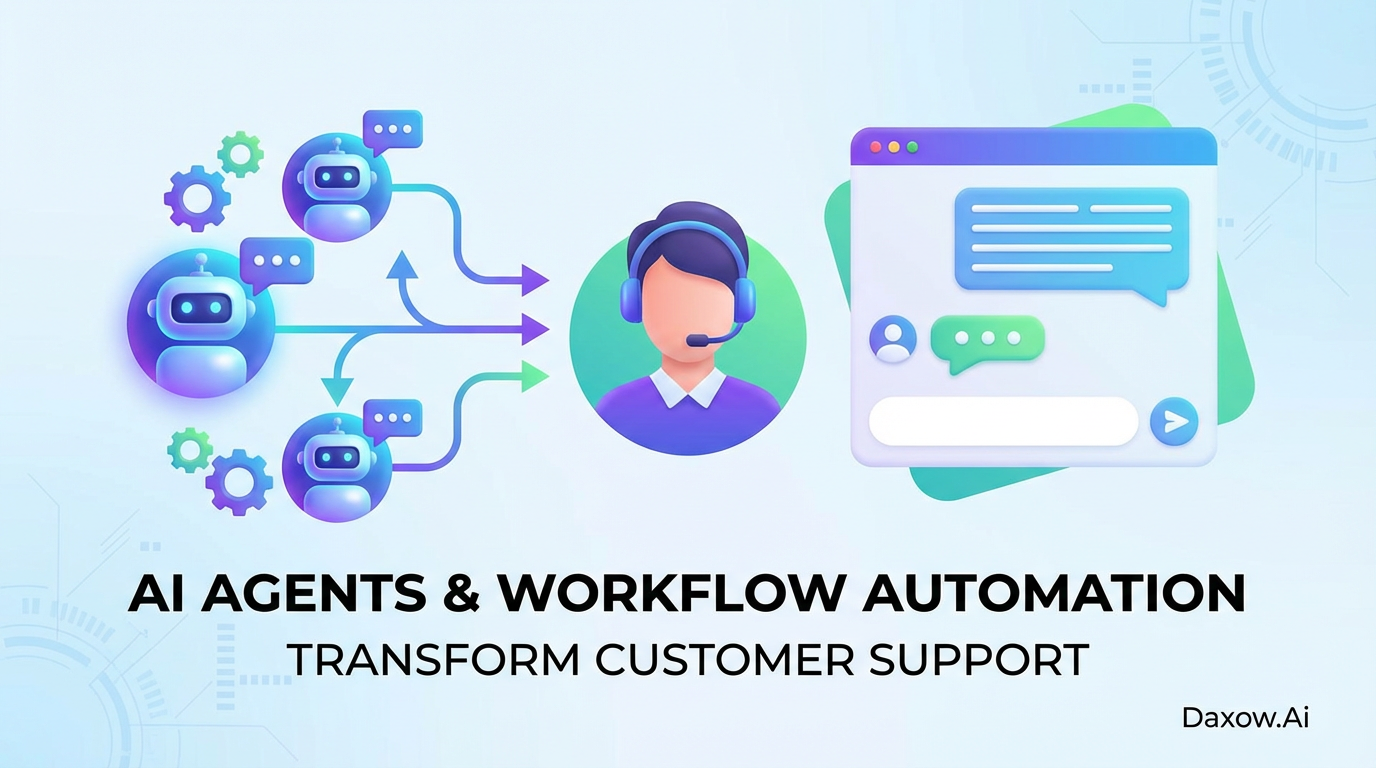
AI agents, autonomous systems capable of performing multi-step actions, go beyond traditional chatbots by triaging requests, completing transactions, updating systems, and escalating complex issues when necessary.
Key Benefits
- Faster response times through automated triage and instant answers.
- Reduced manual tasks by automating repetitive activities like data entry and status updates.
- Improved productivity as AI-assisted agents empower human staff to focus on higher-value interactions.
- Better customer outcomes with consistent responses, fewer transfers, and proactive issue resolution.
- Lower operational costs by intelligent work routing and minimizing unnecessary human effort.
Core Capabilities of AI-Driven Customer Support
- Natural language understanding for multi-channel intake, including chat, email, and voice.
- Document and data extraction that pulls structured info from invoices, contracts, and screenshots.
- Integration with CRMs, ticketing, billing, and fulfillment systems to provide end-to-end automation.
- Autonomous AI agents execute tasks via APIs, Robotic Process Automation (RPA), or connector platforms.
- Analytics and continuous learning mechanisms optimize workflows and measure business impact.
Practical Architecture
- Input layer: omnichannel capture including chat, email, voice, forms.
- Intelligence layer: AI agents performing intent classification, entity extraction, and decision making.
- Orchestration: workflow automation engine coordinates tasks, escalates issues, and enforces SLAs.
- Integration layer: connectors link to CRM, ERP, payment, and fulfillment systems.
- Monitoring and governance: dashboards track KPIs, maintain audit trails, and manage model governance.
Real-World Use Cases
E-commerce — Faster refunds, fewer escalations
Problem: High volumes of refund requests and order status inquiries overwhelm agents.
Automation solution:
- AI agents triage incoming messages, verify orders and policy eligibility, and propose refund amounts.
- Workflow automation triggers refunds via payment APIs or creates cases for manual reviews on exceptions.
- Post-resolution surveys are automatically collected; feedback is routed to quality teams for training.
Business impact:
- Reduces manual lookups and data entry by 60–80% for routine cases.
- Faster refunds improve customer retention and reduce chargebacks.
SaaS / Technology — Intelligent incident routing and escalation
Problem: Technical issues are often misrouted, causing delays and low Net Promoter Scores (NPS).
Automation solution:
- AI agents parse logs and customer descriptions to assess severity and root causes.
- Workflow automation enriches tickets with diagnostics, reproduces steps where possible, and routes to correct teams.
- Automated follow-ups and status updates reduce back-and-forth communication.
Business impact:
- Support team productivity improves by filtering tickets to high-skill engineers with actionable data.
- Mean time to resolution (MTTR) decreases and customer satisfaction increases.
Financial services — Compliance-aware support and document automation
Problem: Support requests require documents and compliance with regulations.
Automation solution:
- AI-powered document extraction and validation pull required fields from PDF uploads.
- AI agents enforce compliance, either approving straightforward cases or escalating with annotated dossiers.
- Integration with CRM updates account records and triggers audit logs.
Business impact:
- Reduces manual data collection and verification tasks.
- Decreases compliance risk and accelerates customer onboarding.
Healthcare — Patient inquiries and records handling
Problem: High volumes of appointment scheduling, billing questions, and records access requests.
Automation solution:
- AI agents manage bookings across calendars, verify insurance, and extract billing codes.
- Hybrid workflows require clinician/admin approval for sensitive actions, ensuring compliance.
Business impact:
- Improves patient experience via faster scheduling and fewer errors.
- Reduces operational costs while maintaining privacy and compliance.
Real estate — Lead qualification and transaction support
Problem: Agents spend excessive time qualifying leads and preparing paperwork.
Automation solution:
- AI agents qualify leads through conversational intake, flag high-intent prospects, and schedule viewings.
- Workflows auto-generate documents, autofill details, and route contracts for signature.
Business impact:
- Increase conversion rates with faster follow-up.
- Reduce administrative burden on brokers and agents.
HR and Internal Operations — Employee support automation
Problem: HR teams handle repetitive inquiries around benefits, time-offs, and policies.
Automation solution:
- AI agents answer FAQs, file requests, and update HRIS records.
- Escalations and approvals are orchestrated automatically with reminders and SLAs.
Business impact:
- Business automation frees HR teams for strategic initiatives.
- Improves internal employee satisfaction and streamlines onboarding.
Building Effective AI Agents for Customer Support
Define the task scope and success metrics
- Map clear processes including inputs, decision points, actions, and outputs.
- Define KPIs such as response time, resolution time, automation coverage, customer satisfaction (CSAT), and cost per ticket.
Choose the right autonomy level
- Tier 1: Assistive agents suggest responses and actions to human agents.
- Tier 2: Semi-autonomous agents perform low-risk tasks, requiring approval for exceptions.
- Tier 3: Fully autonomous agents execute end-to-end actions for well-defined, low-risk processes.
Integration and data connectivity
- Connect AI agents to CRMs, ticketing, billing, and knowledge bases using APIs and secure connectors.
- Maintain a single source of truth for customer context to prevent conflicting actions.
Knowledge management and continuous learning
- Incorporate knowledge bases and feedback loops to update agent responses dynamically.
- Use conversation analytics to detect new intents and automate training cycles.
Security, compliance, and governance
- Implement access controls, logging, and explainability for AI agent decisions.
- Embed consent and data retention policies, especially in regulated industries.
How to Implement Customer Support Automation with Minimal Disruption
Phase 1 — Process discovery and prioritization
- Map workflows to identify high-volume, repetitive tasks.
- Use value vs. effort matrices to select quick wins with clear ROI.
- Deliver a prioritized automation backlog with estimated business impact.
Phase 2 — Prototype and pilot
- Build pilots around one or two high-impact workflows (e.g. returns, password resets).
- Deploy AI agents in assistive mode to collect performance data and human feedback.
- Measure baseline KPIs and compare post-pilot performance.
Phase 3 — Integration and scaling
- Expand integrations with CRM, billing, and fulfillment systems.
- Elevate AI agents to higher autonomy levels after validation of performance and governance.
- Standardize monitoring and incident response processes for automated tasks.
Phase 4 — Continuous improvement
- Form governance teams to review performance, retrain models, and manage exceptions.
- Automate retraining and run A/B tests for new workflows.
- Regularly track ROI and reprioritize the automation backlog.
Estimating Impact — Productivity, Cost, and Customer Experience
Key Levers:
- Labor savings: reduction in time spent on repetitive tasks lowers full-time equivalent (FTE) costs.
- Volume handling: automation enables increased ticket volume support without additional hires.
- Revenue impact: faster lead qualification and improved CX drive higher conversions and retention.
- Error reduction: fewer manual mistakes reduce downstream costs such as refunds and rework.
Simple ROI Framework:
- Identify an automation target (e.g., refund processing).
- Measure average handling time per case and monthly volume.
- Estimate automation coverage and FTE time reduction.
- Consider implementation and operational costs.
- Calculate payback period and annual savings.
Example:
Assuming 10,000 monthly refund inquiries each requiring 20 minutes manual handling equals 3,333 hours/month. Automating 60% end-to-end results in 2,000 hours saved monthly. At $30/hour fully loaded, savings are $60,000/month or $720,000 annually before costs.
Risks and Mitigations in Customer Support Automation
Pitfall: Over-automating complex interactions
Mitigation: Maintain human-in-the-loop oversight for nuanced and high-risk actions.
Pitfall: Poor integration causing inconsistent customer data
Mitigation: Invest in robust connectors and adopt a consistent data model to ensure integrity.
Pitfall: Neglecting change management
Mitigation: Provide staff training, communicate benefits clearly, and involve frontline teams in design.
Pitfall: Ignoring governance and compliance
Mitigation: Implement logging, audit trails, and data retention policies from day one.
Partnering with Daxow.ai to Build Custom AI Automation
Daxow.ai provides a comprehensive end-to-end approach tailored to your business needs:
- Discovery and process analysis: Mapping existing workflows to identify key automation opportunities.
- Custom AI agent design: Building agents that understand your language, access your systems, and execute real tasks from triage to transactions.
- Workflow automation and integrations: Connecting CRM, ticketing, billing, and fulfillment systems for seamless orchestration.
- Data extraction and document automation: Extracting structured data from unstructured documents and automating feeds into workflows.
- Governance and monitoring: Providing dashboards, audit trails, and retraining pipelines for ongoing performance and compliance.
- Managed scaling: Guiding you from pilot implementations to enterprise-wide automation with measurable ROI.
Why choose Daxow.ai:
- Industry experience across technology, e-commerce, finance, healthcare, and real estate sectors.
- Focus on business outcomes — prioritizing reduced manual workload, increased productivity, and cost savings.
- Practical deployment with secure integrations and full operational support for production environments.
Learn more about our solutions on the Daxow.ai services page and how we approach enterprise-grade AI on our solutions page.
Start Automating Customer Support Today
If your organization aims to reduce manual work, boost productivity, and deliver superior customer experiences, building AI agents paired with workflow automation offers the fastest path forward.
Daxow.ai can help you evaluate opportunities, run pilots, and scale reliable AI systems that connect directly with your business tools and execute real actions.
Book a free consultation with Daxow.ai to request a process analysis tailored to your company and start building a custom AI automation system designed specifically for your customer support operations.
Frequently Asked Questions
What is the difference between AI agents and chatbots?
AI agents are autonomous systems capable of multi-step actions such as triage, transactions, system updates, and escalation, whereas chatbots generally provide conversational responses limited to scripted interactions.
How do AI agents improve productivity in customer support?
They automate routine tasks and data entry, filter and classify requests, and assist human agents to focus on high-value interactions, enabling teams to handle higher inquiry volumes efficiently.
Is AI automation suitable for all industries?
Many industries such as e-commerce, technology, finance, healthcare, real estate, and HR can benefit from AI customer support automation, but solutions must be customized to meet specific regulatory and operational needs.
What measures ensure compliance and security with AI agents?
Implementing access controls, logging, audit trails, explainability features, consent management, and data retention policies help maintain compliance and security, especially in regulated industries.