

Select Topic & Preferences for AI Automation Article
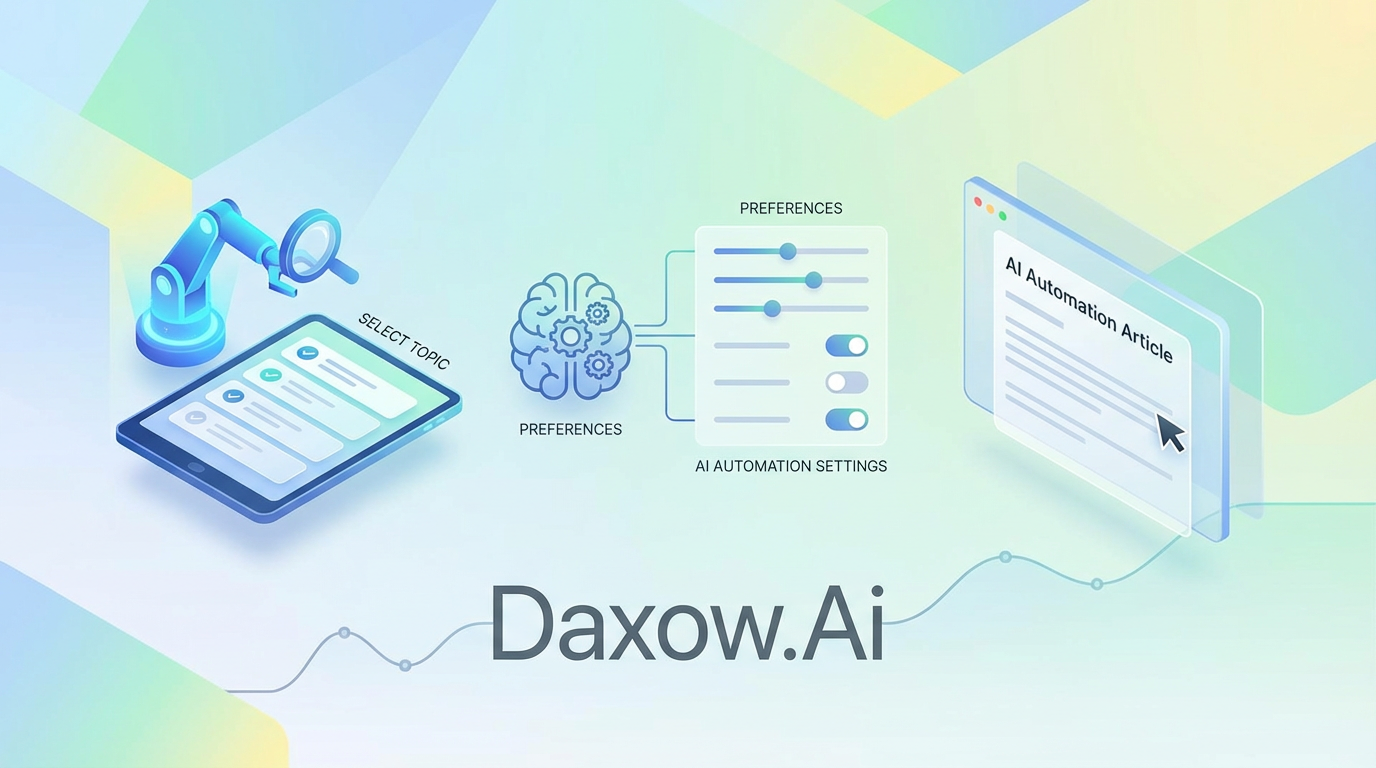
Ready to draft a 1,500–2,000 word AI automation article. Pick a topic, industries, research, links, and preferred CTA to include.
AI Workflow Automation: How to Map and Automate Core Business Processes
Estimated reading time: 10 minutes
Key Takeaways
- Understanding the fundamentals of mapping workflows for AI automation.
- Step-by-step guidance to automate core business processes effectively.
- Real-world use cases in finance, healthcare, and e-commerce industries.
- How Daxow.ai can accelerate your AI workflow automation journey.
- Best practices to ensure seamless integration and maximize ROI.
Understanding AI Workflow Automation
AI workflow automation revolutionizes how businesses optimize repetitive tasks by integrating artificial intelligence with existing processes. It enables organizations to streamline operations, reduce manual errors, and boost efficiency across departments. By combining AI’s adaptability with automated workflows, companies can ensure faster decision making and improved accuracy.
The core objective is to design workflows that leverage AI for data processing, decision support, and interaction, thus freeing human resources from mundane, repetitive tasks and focusing them on higher-value activities.
Mapping Core Business Processes
Accurate workflow mapping is critical to successful automation. It involves documenting each step of a business process, identifying inputs, outputs, decision points, and stakeholders involved. This comprehensive overview serves as a blueprint for automation implementation.
Start by:
- Identifying high-value repetitive processes that impact efficiency or customer satisfaction.
- Engaging process owners and frontline employees to gather insights into daily operations.
- Using tools like flowcharts, BPMN diagrams, or process mapping software to visualize workflows.
- Analyzing bottlenecks, redundancies, and decision rules within the workflow.
At this stage, consider where AI can add value – for example, intelligent document processing, predictive analytics, or natural language understanding – as well as integration points with existing systems such as CRM, ERP, or customer support platforms.
Steps to Automate Business Processes
- Define clear objectives: Establish automation goals including cost reduction, cycle time improvement, or error minimization.
- Select appropriate AI technologies: Choose from machine learning models, robotic process automation (RPA), natural language processing (NLP), or computer vision suited to the workflow.
- Develop and test automation scripts: Use iterative development techniques to configure automation components and test them rigorously within controlled environments.
- Integrate with enterprise systems: Connect your AI workflows with databases, cloud platforms, and third-party software ensuring smooth data exchange.
- Deploy gradually: Start with pilot projects to obtain feedback, measure impact, and refine workflows before full-scale deployment.
- Monitor performance and optimize: Use analytics and dashboards to evaluate KPIs, and optimize AI models and workflows continuously.
Following these steps reduces risks while maximizing the potential of AI-driven automation.
Industry Use Cases
AI workflow automation is transforming several key industries. Here are examples focused on finance, healthcare, and e-commerce:
- Finance: Automating loan approvals using AI algorithms to assess credit risk rapidly, fraud detection through pattern recognition, and streamlined compliance reporting.
- Healthcare: Streamlining patient data processing, automating appointment scheduling, and leveraging AI for diagnostic support and claims management.
- E-commerce: Enhancing order fulfillment workflows with AI-driven inventory management, customer queries resolved via intelligent chatbots, and personalized marketing automation.
Each of these industries benefits from reduced manual intervention, faster response times, and improved service consistency, thanks to well-mapped and automated AI workflows.
Leveraging Daxow.ai for Automation Success
Daxow.ai specializes in helping enterprises map and automate their core business processes through AI-powered solutions. Their expertise lies in:
- End-to-end workflow assessment and mapping to identify automation potential.
- Custom AI model development tailored to specific business needs and data sets.
- Seamless integration with existing enterprise software and cloud environments.
- Providing scalable, secure, enterprise-grade automation platforms.
- Continuous monitoring and iteration to optimize automation impact.
By partnering with Daxow.ai’s AI workflow automation solutions, businesses gain a competitive edge, unlocking productivity and operational excellence.
Best Practices and Metrics
To ensure the success of AI workflow automation, consider these best practices:
- Maintain transparency: Clearly communicate automation goals and changes with internal teams to promote adoption.
- Ensure data quality: High-quality input data drives accurate AI outputs and reliable automation outcomes.
- Implement robust security: Protect sensitive data and comply with industry regulations.
- Set measurable KPIs: Track metrics such as process cycle time, error rates, cost savings, and user satisfaction.
- Plan for scalability: Design workflows that can evolve with business growth and new automation opportunities.
Key performance indicators reinforce continuous improvement and demonstrate return on investment (ROI) for stakeholders.
Frequently Asked Questions
What is AI workflow automation?
AI workflow automation refers to the use of artificial intelligence technologies to automate and enhance the execution of business processes, enabling faster, more accurate, and scalable operations.
How do I identify which processes to automate first?
Focus on processes that are repetitive, rule-based, and have a high volume or frequent bottlenecks. Prioritize those with significant impact on customer experience or operational costs.
Can AI workflow automation integrate with my existing software?
Yes, modern AI automation platforms, including those offered by Daxow.ai, support integration with various enterprise systems such as CRM, ERP, and cloud-based services to enable seamless data exchange and workflow orchestration.
What industries benefit most from AI workflow automation?
Finance, healthcare, e-commerce, manufacturing, real estate, and many others gain significant benefits through increased efficiency, accuracy, and compliance.