
AI Automation: Transform Business Operations for ROI
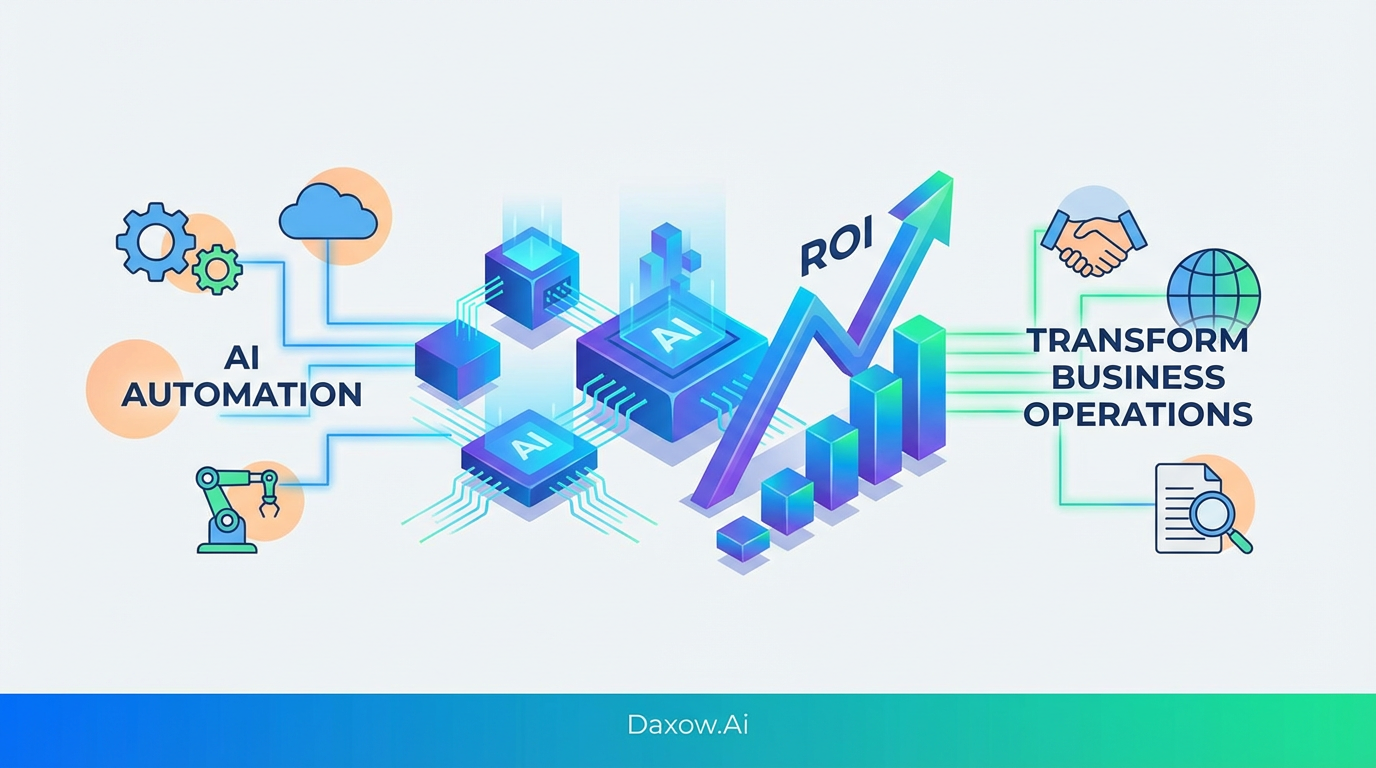
Practical guide to AI automation for business operations—steps, industry use cases, KPIs, and how Daxow.ai builds custom AI agents to boost productivity and ROI.
AI Automation: Transforming Business Operations for Competitive Advantage
Estimated reading time: 12 minutes
Key Takeaways
- AI automation reduces manual tasks and boosts productivity by integrating AI with workflow automation.
- Following structured implementation steps minimizes risks and accelerates value realization.
- Industry-specific use cases demonstrate measurable impacts across e-commerce, healthcare, finance, real estate, and HR.
- Daxow.ai provides custom AI agents and end-to-end automation solutions with a strong focus on ROI and compliance.
- Continuous monitoring, retraining, and user feedback are critical to sustaining AI automation success.
Table of Contents
- AI Automation: Transforming Business Operations for Competitive Advantage — What it Means for Your Business
- Implementation Steps and Best Practices for AI Automation
- Use Cases — How AI Automation Delivers Value Across Industries
- How AI Agents and Workflow Automation Work Together
- Measuring ROI and Business Value from AI Automation
- Common Challenges and How to Overcome Them
- Getting Started — How Daxow.ai Designs Custom AI Systems for Your Business
- Frequently Asked Questions
AI Automation: Transforming Business Operations for Competitive Advantage — What it Means for Your Business
AI automation integrates artificial intelligence with workflow tools to handle repetitive, data-intensive tasks, allowing teams to focus on higher-value work. By combining AI agents with rule-based automation, organizations can achieve faster execution, improved accuracy, and scalable operations.
Key outcomes:
- Reduced manual work: Automate routine tasks like invoice processing, lead qualification, and ticket triage.
- Improved productivity: Reallocate human effort to strategy and customer-facing activities.
- Faster decisions: Use predictive models to anticipate demand, detect fraud, or prioritize cases.
- Scalable operations: Handle increased volume without proportional increases in headcount.
Why now?
- Companies report potential cost savings of 20–50% in targeted workflows when AI and automation are applied strategically.
- Quick pilots on high-volume, low-variability tasks deliver fast wins and fund broader transformation.
Implementation Steps and Best Practices for AI Automation
1. Define clear, measurable goals
- Identify specific pain points with process audits and stakeholder interviews.
- Set measurable KPIs (e.g., reduce invoice processing cost by 30%, cut average ticket response time by 50%).
- Build an AI-first scorecard to prioritize high-ROI workflows.
Common pitfall: Vague objectives that cause scope creep and stalled projects.
2. Assess and prepare your data
- Audit for quality, completeness, and accessibility.
- Standardize formats and centralize data sources for reliable model inputs.
- Build compliance checks for GDPR and industry regulations before production.
Common pitfall: Poor data leading to inaccurate models and lost trust.
3. Choose tools and form the right team
- Select platforms that support integrations with CRMs, ERPs, and ticketing systems.
- Assemble cross-functional teams: product owners, data engineers, ML engineers, domain experts, and change managers.
- Invest in training and adoption planning to ensure employees understand new workflows.
Common pitfall: Tool fragmentation and missing subject-matter expertise.
4. Prototype, validate, and iterate
- Start small with pilot workflows (e.g., invoice OCR plus automated approval routing).
- Use validation datasets and track metrics like precision/recall, error rates, and time saved.
- Keep human-in-the-loop controls where necessary to maintain accuracy and compliance.
Common pitfall: Skipping validation or launching enterprise-wide before proving value.
5. Deploy, monitor, and scale
- Roll out in phases with dashboards, automated alerts, and retraining schedules.
- Monitor for model drift, bias, and performance degradation.
- Embed feedback loops from users to refine rules and models continuously.
Common pitfall: Treating deployment as “done” instead of a continuous lifecycle.
Use Cases — How AI Automation Delivers Value Across Industries
E-commerce — Faster fulfillment and smarter merchandising
- Business problem: Manual order reconciliation, delayed responses to customer queries, and reactive stock management.
- Automated solution: AI agents that process orders, reconcile invoices, and trigger replenishment based on predictive inventory forecasts. Chatbots handle routine customer inquiries and route complex issues to agents.
- Expected impact: Reduced fulfillment time by up to 40%, fewer stockouts through predictive analytics, and improved customer NPS via faster responses.
- How Daxow.ai helps: We build end-to-end integrations connecting e-commerce platforms, warehouse management systems, and CRMs. We design AI agents that automate order-to-cash workflows and implement personalized recommendation engines to lift conversion rates.
Healthcare — Streamlined admin and faster triage
- Business problem: High administrative burden for scheduling, paperwork, and preliminary triage.
- Automated solution: Patient-facing chatbots for appointment booking, AI-driven document extraction for medical records, and triage agents that prioritize cases for clinicians.
- Expected impact: Reduced administrative time, faster patient routing, and improved compliance through standardized data capture.
- How Daxow.ai helps: We create privacy-first automation architectures, implement secure integrations with EHR systems, and deliver AI agents that maintain audit trails for compliance.
Finance — Accelerated reconciliation and stronger compliance
- Business problem: Manual transaction reconciliation, slow fraud detection, and labor-intensive compliance checks.
- Automated solution: AI-driven transaction matching, anomaly detection models for fraud, and automated compliance workflows for KYC and reporting.
- Expected impact: Reduced error rates, faster audits, and potential fraud loss reductions upward of 50% in targeted workflows.
- How Daxow.ai helps: We connect AI models to banking systems and accounting platforms, automate reconciliation processes, and implement monitoring dashboards that alert teams to anomalies in real time.
Real Estate — Faster deals and better lead conversion
- Business problem: Slow lead qualification, time-consuming contract review, and lack of instant client matching.
- Automated solution: AI agents that qualify leads via NLP, auto-populate listings, and flag contract clauses that require legal review.
- Expected impact: Faster response to leads, higher conversion rates, and reduced legal review time.
- How Daxow.ai helps: We integrate with property CRMs, build intelligent lead-scoring models, and automate document workflows to accelerate closings.
HR — Efficient hiring and reliable onboarding
- Business problem: Time-consuming resume screening, inconsistent onboarding, and heavy administrative workload.
- Automated solution: Automated resume parsing and candidate ranking, onboarding bots that collect documents and schedule training, and workflow automation for approvals.
- Expected impact: Reduced screening time by 30–50%, faster time-to-hire, and more consistent employee experiences.
- How Daxow.ai helps: We design candidate qualification agents, set up secure HR integrations, and build dashboards that track hiring KPIs.
How AI Agents and Workflow Automation Work Together
AI agents are autonomous software entities that reason, adapt, and execute tasks across systems. When combined with workflow automation, they deliver continuous, end-to-end process orchestration.
Key capabilities:
- Orchestration: Route work across systems (CRM, ERP, ticketing) and people.
- Reasoning: Use models to prioritize, predict, and recommend actions.
- Learning: Improve performance via retraining and feedback loops.
- Integration: Connect with enterprise systems to read/write data and trigger downstream processes.
Typical architecture components:
- Data ingestion and normalization layer.
- Model inference and decision layer (AI agents).
- Orchestration and workflow engine.
- Monitoring and retraining pipeline.
- User interfaces (dashboards, chatbots) and integrations (APIs, webhooks).
How Daxow.ai executes this:
- We design modular architectures so AI agents can execute real tasks — from triaging tickets to creating invoices.
- We integrate systems to eliminate manual handoffs.
- We implement monitoring and governance to ensure reliability and compliance.
Measuring ROI and Business Value from AI Automation
Decision-makers need clear metrics to evaluate success. Focus on both direct financial gains and indirect strategic benefits.
Primary KPIs:
- Cost per transaction or case.
- Time to resolution (customer service, claims, approvals).
- Error rate or exception rate.
- Throughput (cases processed per hour/day).
- Customer satisfaction (NPS) and employee productivity metrics.
Projected returns:
- Labor cost reductions of 20–50% on repetitive tasks.
- Productivity improvements of 20–40% in targeted teams.
- Short payback periods: many pilots are recouped in 6–12 months.
- Long-term scalability: handle 10x volume without equivalent headcount increases.
Example calculation (simple):
- Current cost: $100k/year to process invoices manually.
- Target automation impact: 40% cost reduction.
- Savings: $40k/year.
- Implementation cost recouped within 6–12 months for typical mid-sized processes.
How Daxow.ai helps quantify ROI:
- We run a process analysis to identify high-value pilots.
- We model expected savings and create a phased roadmap to achieve payback.
- We establish dashboards to track KPIs and tune models for continuous improvement.
Common Challenges and How to Overcome Them
Challenge: Data quality and fragmented systems.
- Solution: Start with a targeted data audit and implement connectors to unify sources.
Challenge: Resistance to change.
- Solution: Engage stakeholders early, run small pilots, and demonstrate quick wins.
Challenge: Regulatory and privacy concerns.
- Solution: Build privacy-first architectures and maintain auditable processes.
Challenge: Model drift and maintenance.
- Solution: Put retraining schedules and monitoring in place before deployment.
Daxow.ai approach:
- We conduct discovery sessions to map processes and risks.
- We design governance frameworks and implement secure, monitored deployments.
- We provide training and change management to maximize adoption.
Getting Started — How Daxow.ai Designs Custom AI Systems for Your Business
Daxow.ai provides end-to-end business automation services from Estonia with a practical, ROI-focused approach.
Our typical engagement:
- Discovery and process analysis: We map workflows, quantify pain points, and prioritize high-impact automation candidates.
- Proof of value (PoV): We build a focused pilot (e.g., invoice automation, lead qualification, customer support automation) to validate assumptions and measure results.
- Integration and scaling: We connect systems, operationalize AI agents, and extend automation across departments.
- Operations and continuous improvement: We monitor performance, retrain models, and iterate to capture additional value.
Why partner with Daxow.ai:
- Custom solutions: We design AI agents tailored to your processes and systems.
- End-to-end delivery: From data pipelines to integrations and UX, we handle the full stack.
- Business-first focus: We prioritize workflows that reduce manual tasks and deliver measurable ROI.
- Security and compliance: We implement enterprise-grade controls and maintain auditability.
- Cross-industry experience: We bring proven patterns from e-commerce, finance, healthcare, real estate, and HR.
AI automation is the most practical lever companies have to reduce manual work, boost productivity, and gain a competitive edge. By focusing on targeted pilots, robust data practices, and tight integrations, organizations can realize rapid ROI and scale intelligently. AI agents and workflow automation transform processes so teams can deliver better customer experiences and strategic outcomes.
Ready to turn repetitive tasks into continuous value? Book a free consultation with Daxow.ai or request a process analysis for your company today. Contact us to build a custom AI system that reduces operational costs, improves ROI, and automates the workflows that matter most.
Frequently Asked Questions
What types of tasks are best suited for AI automation?
Repetitive, rule-based, and data-intensive tasks such as invoice processing, lead qualification, and customer service ticket triage are ideal candidates for AI automation.
How do AI agents improve workflow automation?
AI agents add autonomous reasoning, decision-making, and learning capabilities to automated workflows, enabling smarter orchestration and continuous improvement over time.
What industries benefit most from AI automation?
Industries such as e-commerce, healthcare, finance, real estate, and HR have demonstrated significant value from AI automation with measurable productivity and compliance benefits.
How does Daxow.ai ensure compliance and data privacy?
Daxow.ai builds privacy-first architectures, integrates securely with enterprise systems, and maintains auditable processes to comply with GDPR and industry regulations.
What is the typical ROI timeline for AI automation projects?
Many pilots achieve payback within 6 to 12 months by reducing labor costs and improving operational efficiency.