
AI Automation: Transforming Business Operations
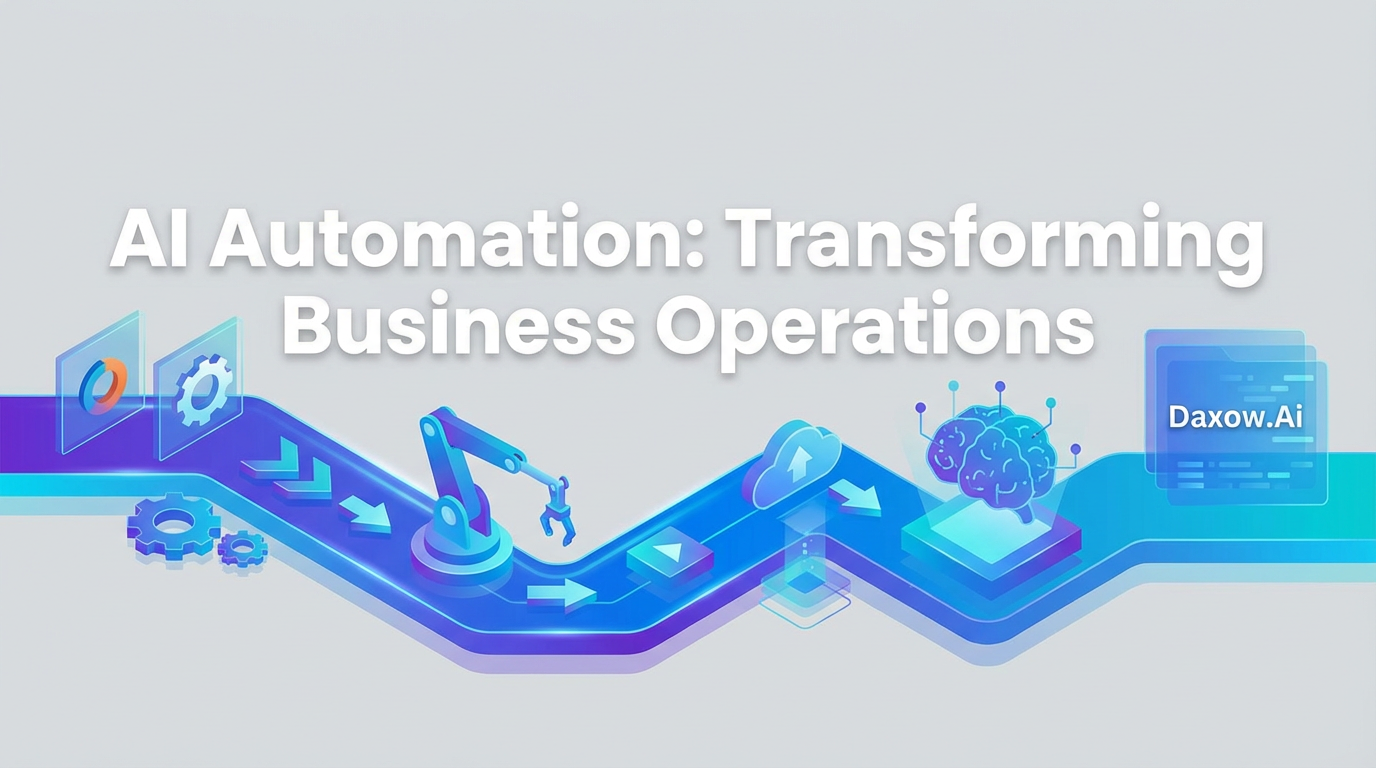
Guide to AI automation and agents that streamline workflows, reduce costs, and boost productivity across industries, with use cases and ROI from Daxow.ai.
AI Automation: Transforming Business Operations for the Modern Enterprise
Estimated reading time: 15 minutes
Key Takeaways
- AI automation reduces manual tasks and operational costs while increasing productivity and customer satisfaction.
- AI agents and workflow automation enable scalable, compliant, and agile business operations across multiple industries.
- Practical use cases include e-commerce, healthcare, finance, real estate, and HR with measurable outcomes.
- Daxow.ai offers end-to-end AI automation solutions from process analysis to deployment and continuous improvement.
- A structured implementation approach and focus on KPIs ensure rapid ROI and sustainable business transformation.
Table of Contents
- AI Automation: Transforming Business Operations for the Modern Enterprise
- What AI Automation Means for Your Business
- Practical Use Cases Across Industries
- How AI Agents and Automation Drive Business Success
- Implementation Steps and Best Practices
- Measuring ROI and Business Value
- How Daxow.ai Helps You Implement AI Automation
- Getting Started — A Practical Roadmap
- Frequently Asked Questions
AI Automation: Transforming Business Operations for the Modern Enterprise
AI automation combines artificial intelligence with workflow automation and integration technologies to handle repetitive, data-intensive, and decision-driven work at scale. Rather than replacing human judgment, effective AI automation augments it by taking on routine tasks, surfacing insights, and executing actions across systems.
Key outcomes organizations should expect:
- Lower operational costs through automation of rule-based tasks.
- Higher productivity as employees shift from manual processing to value-added activities.
- Faster customer responses via customer support automation and AI-driven chatbots.
- Improved compliance and tracing with structured data pipelines and audit trails.
- Scalable operations that handle volume spikes without proportional headcount increases.
Research and practice show organizations can achieve 20–40% cost reductions on repetitive processes and 30–50% productivity gains in targeted workflows. High-impact pilots often show payback within 12 months when the right processes are prioritized.
What AI Automation Means for Your Business
From rule-based tasks to intelligent decision-making
AI automation covers a spectrum:
- RPA-style automation for predictable, rule-based steps (e.g., invoice processing).
- Machine learning and NLP for unstructured data tasks (e.g., extracting data from documents).
- AI agents that combine APIs, knowledge bases, and conversational interfaces to take end-to-end actions (e.g., qualify leads, update CRM, schedule follow-ups).
Business benefits in practice
- Reduce manual tasks like data entry, reconciliation, and routine customer emails.
- Increase productivity by automating high-volume, repetitive work and enabling staff to focus on strategy.
- Improve accuracy and compliance by reducing human error and enforcing process rules.
- Drive better decisions with predictive analytics (e.g., demand forecasting, fraud detection).
Practical Use Cases Across Industries
E-commerce — Order-to-cash and customer experience
Use case:
- Automate order validation, inventory checks, and exceptions handling.
- Deploy AI agents in customer support to answer complex queries, process returns, and recommend alternatives.
Impact:
- Reduce fulfillment errors, shorten resolution time, and increase conversion with personalized recommendations.
- Outcome: inventory optimization reduces waste; customer support automation improves NPS with faster replies.
Daxow.ai approach:
- Integrate storefront, ERP, and shipping APIs.
- Build AI agents that process orders, trigger warehouses, and update CRMs for sales automation.
Healthcare — Document automation and triage
Use case:
- Extract information from patient forms, insurance documents, and clinical notes using document automation.
- Use AI agents to triage inquiries, route them to clinicians, and prepare summarized patient histories.
Impact:
- Reduce administrative burden, accelerate diagnostics, and maintain data security through compliant pipelines.
- Outcome: faster patient intake and lower billing errors.
Daxow.ai approach:
- Implement secure data ingestion and extraction, link EHRs, and create privacy-preserving workflows.
Finance — Fraud detection and compliance reporting
Use case:
- Automate transaction surveillance, flag anomalies, and prepare compliance reports.
- Use AI agents to gather contextual evidence, file alerts, and assist audit teams.
Impact:
- Detect fraud patterns faster and reduce manual review time.
- Outcome: lower losses and shorter audit cycles.
Daxow.ai approach:
- Combine ML models for anomaly detection with workflow automation for case management and reporting.
Real Estate — Lead qualification and valuation
Use case:
- Automatically parse lead submissions, qualify prospects via conversational AI, and update listings based on market signals.
- Run valuation models that pull public market data and internal comparables.
Impact:
- Shorten sales cycles, improve lead-to-conversion rates, and keep listings current across channels.
Daxow.ai approach:
- Build AI agents that integrate MLS feeds, CRM systems, and marketing automation for continuous lead nurturing and sales automation.
HR — Resume screening and candidate engagement
Use case:
- Screen resumes, rank candidates, and conduct initial conversational interviews with chatbots.
- Predict employee churn with HR analytics and recommend retention actions.
Impact:
- Reduce time-to-hire, improve candidate experience, and focus recruiters on top-fit applicants.
Daxow.ai approach:
- Deploy AI models for skills matching, integrate with ATS, and automate interview scheduling and follow-ups.
How AI Agents and Automation Drive Business Success
What makes an AI agent effective
- Maintain conversational context across interactions.
- Access and act on external systems through integrations.
- Apply guardrails to stay aligned with policies and objectives.
- Learn iteratively via monitored retraining to avoid drift.
Hyperautomation — the next step
Hyperautomation is the strategic combination of AI agents, RPA, analytics, and process orchestration to automate complex, cross-system workflows. It enables:
- Dynamic decisioning for exceptions.
- Continuous process improvement through feedback loops.
- Greater adaptability to changing business conditions.
The result is organizations that can scale operations without linear increases in headcount while preserving control and compliance.
Implementation Steps and Best Practices
1. Define goals and identify high-impact processes
- Start with business objectives (cost reduction, NPS improvement, faster processing).
- Map workflows and prioritize repetitive, high-volume tasks using an impact-versus-effort matrix.
- Set clear KPIs: processing time, error rate, customer response time, and ROI targets.
2. Conduct a data audit and ensure quality
- Inventory data sources, assess accessibility, and standardize formats for pipelines.
- Address data gaps and privacy/compliance requirements before model training.
3. Select tools and build the right team
- Choose scalable platforms that support integrations, security, and enterprise deployment.
- Form cross-functional teams: business owners, data engineers, ML engineers, and change managers.
- Provide training and change management to avoid shadow automation.
4. Develop and test AI agents
- Define agent goals, knowledge bases, actions, and error handling.
- Test with real scenarios and edge cases; add guardrails and fallback procedures.
- Use phased pilots on non-critical processes to validate performance.
5. Integrate, deploy, and monitor
- Integrate with CRMs, ERPs, and collaboration tools to enable end-to-end automation.
- Track KPIs continuously and set alerts for model drift or workflow failures.
6. Foster continuous improvement
- Collect user feedback, retrain models, and expand scope iteratively.
- Create an AI governance framework to manage ethics, compliance, and security.
Best practices summary:
- Start small and prove value with focused pilots.
- Measure rigorously against business KPIs.
- Build integrations for end-to-end automation rather than point solutions.
- Plan for change management to secure adoption across teams.
Measuring ROI and Business Value
Quantifying ROI is essential for executive buy-in.
Key metrics to track:
- Time saved per process and reallocation of productive hours.
- Reduction in error rates and associated cost savings.
- Cost savings as a percentage of process cost (expect 20–40% for many repetitive workflows).
- Productivity gains in targeted teams (30–50% improvements are common).
- Customer metrics: average response time, NPS, and resolution rate.
Pilot-driven validation:
- Run small pilots with clear success criteria.
- Extrapolate pilot results to scale, factoring in integration complexity and change management.
- Typical payback: under 12 months for high-impact pilots; longer for complex, enterprise-wide programs.
How Daxow.ai Helps You Implement AI Automation
Daxow.ai is an end-to-end partner for businesses seeking to harness AI automation and AI agents. Our services are tailored to embed intelligence into your operations while protecting data and delivering measurable outcomes.
What we do:
- Process discovery and analysis: We map existing workflows, quantify manual tasks, and identify high-return automation opportunities.
- Custom AI agents: We design agents that execute real tasks — from lead qualification and sales automation to customer support automation and document processing.
- Workflow automation and orchestration: We build robust pipelines that connect your CRM, ERP, support tools, and data stores for seamless end-to-end automation.
- Data extraction and document automation: We extract structured data from invoices, forms, and contracts to remove manual data entry.
- Integrations and connectivity: We implement secure integrations across business tools to ensure real-time data flow and traceability.
- Change management and training: We support adoption through training, governance frameworks, and continuous improvement plans.
Why partner with Daxow.ai:
- Business-first approach: We prioritize opportunities that deliver measurable ROI and alignment with strategic goals.
- Technical depth: We combine AI agents, ML models, and workflow automation expertise to build scalable solutions.
- End-to-end delivery: From discovery to deployment and monitoring, we handle the full lifecycle and integrate with your tech stack.
- Focus on outcomes: We measure success through the KPIs that matter — productivity, cost reduction, and customer experience.
Explore more about our AI automation services and our AI agents solutions to see how we can tailor technology to your business needs.
Getting Started — A Practical Roadmap
Actionable first steps to begin your AI automation journey:
- Conduct a rapid process analysis to identify 3–5 pilot processes.
- Define KPIs and success criteria with stakeholders.
- Commission a pilot with clear timelines and deliverables.
- Measure results and plan phased scaling based on validated ROI.
Daxow.ai can run a targeted process analysis to identify the fastest path to value and construct a pilot tailored to your systems and priorities.
Frequently Asked Questions
What is AI automation and how does it differ from traditional automation?
AI automation leverages artificial intelligence technologies like machine learning, natural language processing, and AI agents to automate not only rule-based tasks but also data-driven decision-making processes. Traditional automation typically involves fixed, rule-based workflows without adaptive intelligence.
How quickly can businesses expect ROI from AI automation?
Many organizations see measurable ROI within 6 to 12 months of deploying AI automation on prioritized processes. High-impact pilots focused on repetitive workflows often pay back investments rapidly by reducing costs and improving throughput.
Is AI automation suitable for small businesses?
Yes, AI automation can benefit small businesses by automating routine tasks, improving customer responsiveness, and enabling employees to focus on growth and strategy. Scalable solutions can be tailored to the size and complexity of the organization.
How does Daxow.ai ensure the security and compliance of AI automation solutions?
Daxow.ai designs AI systems with secure data ingestion, privacy-preserving workflows, and compliance frameworks integrated from the start. We maintain audit trails and implement governance policies to protect sensitive information and meet regulatory requirements.