
Mastering AI Automation: Transform Business Operations
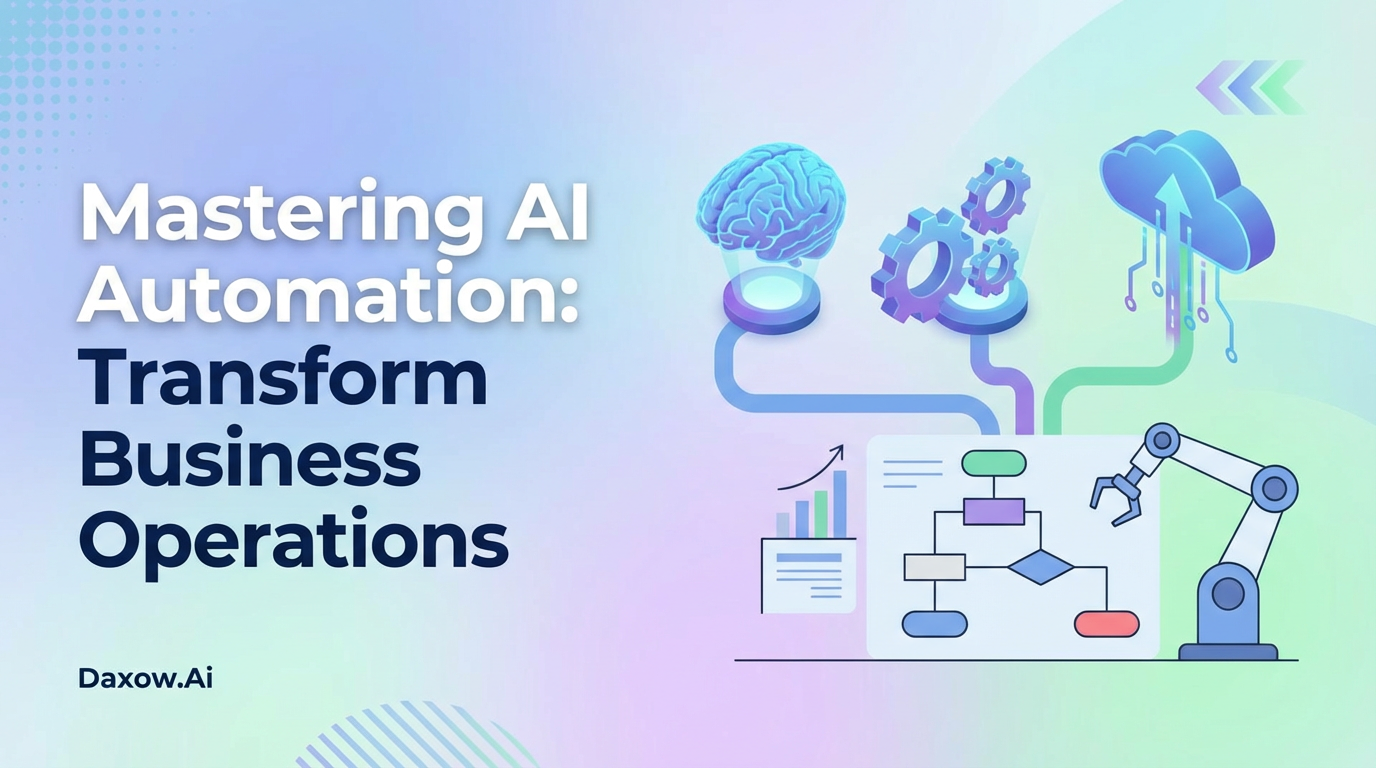
How AI automation and agents cut costs, boost productivity, and scale operations - with use cases, ROI targets and an 8-week pilot roadmap.
Mastering AI Automation: Transforming Business Operations in the AI Era
Estimated reading time: 18 minutes
Key Takeaways
- AI automation drives 40–50% productivity gains and breaks even within 6–12 months.
- Integrating AI agents with workflow automation transforms manual workflows into scalable, intelligent processes.
- Key benefits include cost reduction, faster customer support, scalable operations, and proactive decision-making.
- Daxow.ai specializes in designing custom AI agents, integrations, and secure automation pipelines tailored by industry.
- A clear implementation roadmap and governance strategy ensures rapid, measurable ROI and ethical AI use.
Table of Contents
- Why This Matters Now
- Why AI Automation Delivers Business Value
- Practical Use Cases: How AI Automation Works Across Industries
- How AI Agents and Workflow Automation Work Together
- Implementation Roadmap: From Pilot to Enterprise Rollout
- Implementation Best Practices and Governance
- Measuring ROI and Business Impact
- How Daxow.ai Delivers Custom AI Automation
- Practical Roadmap: A Sample Pilot in 8 Weeks
- Readiness Checklist for Decision-Makers
- Conclusion and Next Steps
- Frequently Asked Questions
Why This Matters Now
Businesses today face rising costs, talent shortages, and increasing customer expectations. AI automation combined with workflow automation transforms high-volume manual work into reliable, scalable services. Companies adopting these approaches report up to 40–50% productivity gains in targeted processes and typically break even within 6–12 months.
AI automation integrates AI with workflow automation tools and systems to handle routine tasks while extracting strategic insights from data. The impact is not merely fewer human steps but a reallocation of talent toward innovation and customer-facing work.
Why AI Automation Delivers Business Value
The strategic implications
- Reduce operational costs: Automating invoice processing, data entry, and repeatable support tasks cuts processing time and error rates.
- Improve speed and responsiveness: Customer support automation and AI agents provide 24/7 handling of common inquiries, raising satisfaction and NPS.
- Scale without proportional headcount: AI systems handle volume surges without linear staffing increases.
- Turn data into decisions: Automated pipelines and analytics identify trends earlier, enabling proactive actions such as inventory restocking or fraud prevention.
Measurable outcomes executives care about
- Productivity improvements: 3–5x productivity in automated processes.
- Cost savings: 20–50% cost reductions on automated processes.
- Risk reduction: Fraud detection and compliance automation reduce losses and shorten audit cycles.
- Faster time-to-value: Pilot projects frequently deliver measurable improvements within weeks.
Practical Use Cases: How AI Automation Works Across Industries
E-commerce — Order-to-cash, inventory, and customer experience
- Use case: AI agents monitor incoming orders, verify payments, trigger warehouse fulfillment, and send automated customer updates.
- Benefit: Reduced order errors, fewer support tickets, and fewer stockouts via predictive inventory alerts.
- Example outcome: Automated order handling reduces processing time by 70% and lowers cart abandonment through timely personalized follow-ups.
Healthcare — Scheduling, document automation, and compliance
- Use case: Workflow automation extracts structured data from medical forms and EHR notes, routes billing, and manages patient scheduling conflicts with AI prioritization.
- Benefit: Faster claim handling, improved appointment utilization, and reduced billing errors.
- Compliance: Daxow.ai designs privacy-first, secure pipelines meeting regulatory requirements.
Finance — Real-time monitoring and compliance
- Use case: AI agents analyze transaction streams for anomalies, flag suspicious activity, and auto-generate compliance reports.
- Benefit: Fraud losses drop 30–40% in piloted systems, audit cycles shrink.
- Integration: Systems connect with core banking platforms for closed-loop workflows.
Real estate — Lead qualification and market intelligence
- Use case: AI agents qualify leads from inquiries, summarize needs for sales, and predict demand fluctuations from aggregated listing data.
- Benefit: Faster lead response, higher conversion rates, and improved forecasting for investment decisions.
HR — Recruitment and employee lifecycle automation
- Use case: Resume screening, interview scheduling, offer generation, and churn prediction automated with ML scoring.
- Benefit: Faster hiring cycles, improved candidate experience, data-driven retention strategies.
Sales automation — Lead scoring and follow-ups
- Use case: AI agents score leads from multiple channels and trigger personalized outreach workflows in CRMs.
- Benefit: Higher-quality pipelines, less manual qualification, consistent follow-ups increasing conversion rates.
How AI Agents and Workflow Automation Work Together
AI agents are autonomous components that perceive context, make decisions, and take actions within business workflows. When combined with workflow automation platforms:
- Agents ingest data from disparate sources such as CRM, ERP, email, and documents.
- They run models for classification, prediction, or data extraction.
- They execute actions like creating tickets, updating records, or sending communications.
- Closed-loop feedback enables retraining as outcomes feed the models, improving accuracy over time.
For instance, a customer support AI agent can read support emails using NLP, classify urgency, pull account data, create a ticket, draft an initial response, and then learn from feedback to enhance future replies.
Daxow.ai specializes in building integrated systems by designing agent decision logic, connecting APIs, and implementing secure governance for reliable automation.
Implementation Roadmap: From Pilot to Enterprise Rollout
1 — Define clear objectives
- Set measurable goals such as reducing manual invoice processing by 30% or cutting response time to under 2 hours.
- Conduct process audits to identify high-volume, low-variation tasks ideal for automation.
2 — Assess and prepare data
- Inventory and assess data sources and quality.
- Establish secure pipelines and standardize formats.
- Build compliance checks for sensitive information.
3 — Select tools and build the team
- Choose platforms that support integrations, enterprise security, and model governance.
- Assemble a cross-functional pilot team — business owner, operations lead, and engineer — recommended by Daxow.ai for speed and clarity.
4 — Prototype and integrate
- Start with small, high-impact pilots.
- Validate integrations with core systems such as CRM and ERP.
- Define escalation paths and human-in-the-loop checkpoints.
5 — Monitor, measure, iterate
- Track KPIs including productivity, error rates, cost per transaction, and customer satisfaction.
- Retrain models regularly and refine automation logic.
- Scale gradually with governance to avoid shadow automation risks.
Daxow.ai supports every step, from discovery workshops through data engineering, model development, integration, and ongoing monitoring—ensuring measurable improvements and controlled scaling.
Implementation Best Practices and Governance
- Prioritize quick wins: Focus on rule-based, high-volume tasks first to demonstrate ROI fast.
- Foster cross-functional ownership: Collaboration among business, IT, and compliance is essential.
- Build ethical safeguards: Implement bias monitoring and privacy controls as mandatory.
- Avoid technical debt: Use modular, well-documented integrations to minimize maintenance burden.
- Plan for change management: Train staff to collaborate with AI agents; position automation as augmentation, not replacement.
Measuring ROI and Business Impact
Decision-makers require concrete metrics to justify investments. Typical measurable outcomes include:
- Cost reductions: 20–50% decrease in operational costs from automated processes.
- Productivity gains: 3–5x throughput improvements in targeted workflows.
- Risk and loss mitigation: Fraud detection often reduces losses by 30–40%.
- Faster scaling: Ability to handle 10x volume without a 10x increase in staff.
- Payback period: Most pilot projects break even within 6–12 months.
Beyond financials, strategic ROI includes freed-up talent focusing on innovation, improved customer loyalty, and accelerated decision cycles.
How Daxow.ai Delivers Custom AI Automation
Daxow.ai provides comprehensive services to translate your AI automation strategy into production-ready systems:
- Process discovery and analysis: Mapping workflows, quantifying manual tasks, identifying automation opportunities.
- Custom AI agent design: Building agents with clear decision logic and human-in-the-loop controls for real tasks like lead qualification or claims processing.
- Workflow automation and integrations: Connecting agents to CRMs, ERPs, ticketing systems, and databases for seamless, auditable workflows.
- Data engineering and model training: Preparing datasets, training models, and setting up retraining pipelines.
- Governance and security: Role-based access control, logging, and compliance mechanisms.
- Operational support and continuous improvement: Monitoring live systems, refining models, and scaling automation across departments.
Each solution is tailored to industry needs — whether for real estate lead routing, real-time bank fraud detection, or e-commerce order orchestration.
Practical Roadmap: A Sample Pilot in 8 Weeks
- Week 1–2: Process discovery and KPI setting.
- Week 3–4: Data preparation and prototype development.
- Week 5: Integration with core systems and human-in-the-loop testing.
- Week 6: Pilot launch and initial monitoring.
- Week 7–8: Iteration, performance measurement, and scaling plan.
This focused timeline enables measurable results in weeks rather than months.
Readiness Checklist for Decision-Makers
- Do you have defined KPIs for the processes you want to automate?
- Are your data sources accessible and auditable?
- Is there cross-functional sponsorship across business, IT, and compliance?
- Can you start with a three-person pilot team?
- Do you have a prioritized list of high-volume, low-variation tasks?
If you answered yes to most items, your organization is well-positioned to move from pilot to rollout.
Conclusion and Next Steps
Mastering AI Automation: Transforming Business Operations in the AI Era is essential for every growth-focused organization. Combining AI agents, workflow automation, and robust integrations delivers tangible reductions in manual labor, measurable productivity gains, and better customer outcomes.
Daxow.ai partners with clients to design, build, and operate custom AI systems that automate end-to-end processes, reduce costs, and enable rapid ROI.
Book a free consultation with Daxow.ai today to request a process analysis and start transforming your operations with enterprise-grade AI automation.
Frequently Asked Questions
What is AI automation and how does it differ from traditional automation?
AI automation combines artificial intelligence techniques with workflow automation to handle complex tasks requiring understanding, decision-making, and adaptation, rather than just rule-based repetitive processes.
How quickly can businesses expect to see ROI from AI automation projects?
Many pilot projects achieve measurable improvements within weeks and typically break even within 6 to 12 months depending on scale and complexity.
How does Daxow.ai ensure compliance and data privacy?
Daxow.ai builds secure, privacy-first pipelines that adhere to regulatory standards, employs role-based access control, and integrates auditing and logging mechanisms to maintain compliance.
What industries does Daxow.ai serve?
Daxow.ai serves multiple industries including e-commerce, healthcare, finance, real estate, HR, and sales automation with tailored AI automation solutions.