
AI Automation: Transforming Business Operations
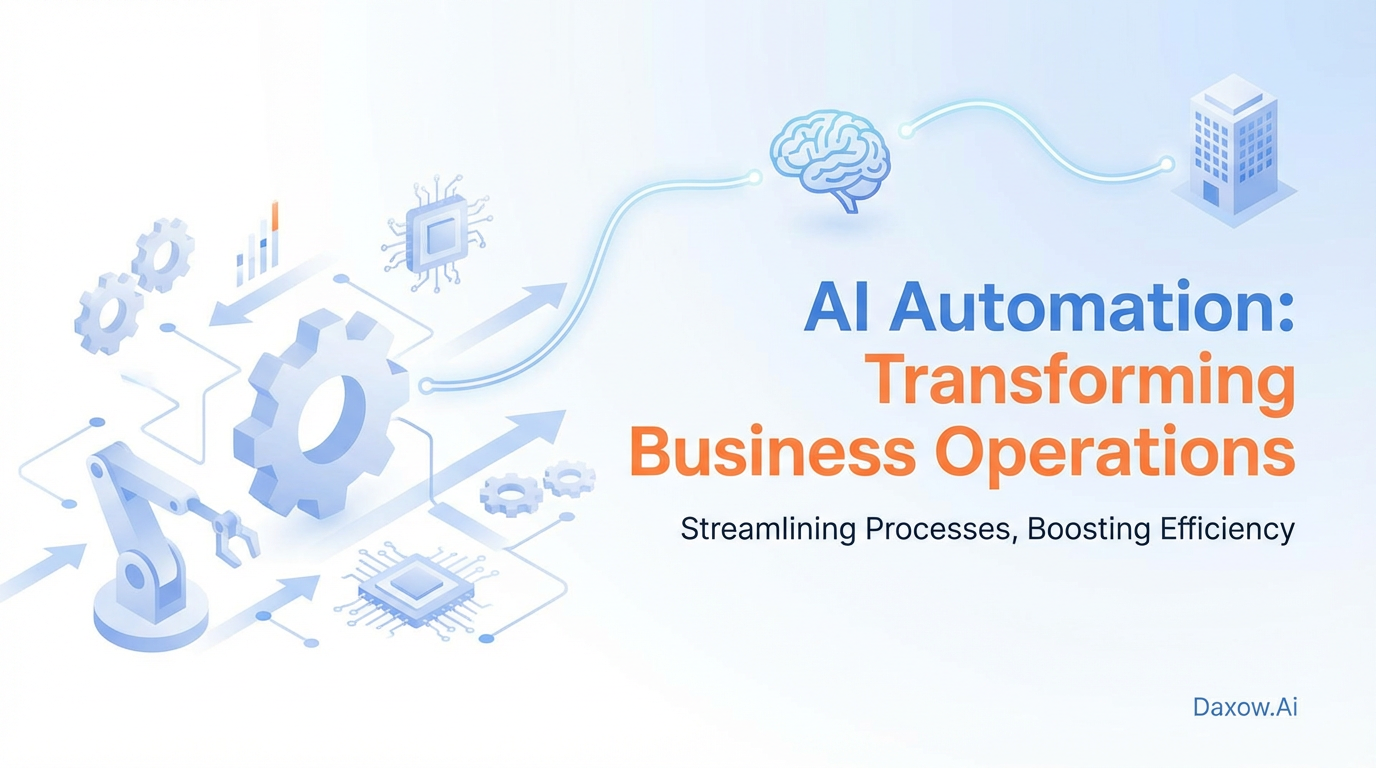
Practical roadmap to AI automation for enterprises - use cases, implementation steps, ROI, and how Daxow.ai builds AI agents to scale operations.
AI Automation: Transforming Business Operations for the Modern Enterprise
Estimated reading time: 12 minutes
Key Takeaways
- AI automation enhances operational efficiency by reducing manual work that consumes up to 30% of employee time.
- Companies can achieve 30–50% cost reductions in targeted processes through automation.
- Workflow automation and AI agents accelerate processing speeds by 20–40% while improving accuracy.
- Industry-specific use cases illustrate measurable impacts across e-commerce, healthcare, finance, real estate, HR, and customer support.
- Successful AI adoption requires a clear roadmap—from defining objectives to data readiness, piloting, scaling, and governance.
- Daxow.ai provides end-to-end AI solutions, combining advanced technology with business-first strategies to maximize ROI.
Table of Contents
- Why This Matters Now
- Where AI Automation Delivers Value — Use Cases Across Industries
- How AI Agents and Workflow Automation Work Together
- Implementation Roadmap — Practical Steps and Best Practices
- Measuring ROI and Business Value
- Security, Compliance, and Responsible Automation
- How Daxow.ai Helps — From Audit to Autonomous Operations
- Actionable Next Steps — How to Start Today
- Frequently Asked Questions
Why This Matters Now
AI Automation: Transforming Business Operations for the Modern Enterprise is not a slogan — it is a practical roadmap for companies that want to reduce manual work, increase productivity, and scale without proportional headcount growth. For business leaders, operations managers, and technology teams, adopting AI automation and workflow automation means moving from reactive processes to proactive, intelligent systems that deliver measurable business value: faster processing, lower costs, fewer errors, and better customer experiences.
- Operational efficiency: Studies show manual data entry and siloed workflows consume 20–30% of employee time. AI automation and business automation target these inefficiencies to unlock immediate capacity.
- Cost reduction: Targeted processes can see 30–50% cost reduction after automation through labor savings and error reduction.
- Speed and accuracy: Workflow automation combined with predictive analytics delivers 20–40% faster processing times and significant accuracy improvements.
- Scalability and resilience: In volatile markets, automated systems enable rapid adaptation without matching increases in headcount.
These strategic gains convert automation from a technical initiative into a business advantage. Below we break down how to prioritize, implement, and scale AI automation across different functions and industries.
Where AI Automation Delivers Value — Use Cases Across Industries
E-commerce
- Use cases: order processing automation, inventory forecasting, dynamic pricing, personalized recommendations, chatbot-driven support, returns handling.
- Typical outcomes: 40% reduction in fulfillment time; improved conversion through personalized offers; reduced stockouts with predictive inventory.
- Example: An e-commerce retailer using AI agents to qualify customer requests, auto-route urgent issues, and trigger replenishment orders reduces customer wait time and inventory carrying costs.
Healthcare
- Use cases: patient scheduling and reminders, claims processing automation, clinical documentation extraction, predictive diagnostics triage.
- Typical outcomes: reduced administrative costs, improved compliance, faster claims cycle times, and better care coordination.
- Example: Automated intake forms using NLP and document extraction reduce manual data entry and accelerate patient throughput while preserving audit trails for compliance.
Finance
- Use cases: fraud detection, compliance reporting automation, automated loan decisioning, anomaly detection in transaction streams.
- Typical outcomes: faster audits, reduced false positives in fraud detection, and streamlined regulatory reporting.
- Example: An AI agent that monitors transaction patterns and auto-escalates suspicious events reduces manual review hours and shortens investigation cycles.
Real Estate
- Use cases: automated property valuations, lead qualification, contract review and redlining, automated listing enrichment with computer vision.
- Typical outcomes: faster time-to-listing, higher-quality leads passed to agents, and reduced legal review bottlenecks.
- Example: A brokerage using lead-qualification agents that score and route prospects to the right agent increases conversion rates while reducing lead-handling costs.
HR and Administration
- Use cases: resume parsing, candidate screening, onboarding automation, payroll reconciliation, sentiment analysis on engagement surveys.
- Typical outcomes: hiring time reduced by up to 50%, improved retention through better onboarding, and faster payroll reconciliation.
- Example: Automating interview scheduling and resume shortlisting frees recruiters to focus on final-stage interviews and candidate experience.
Customer Support and Sales
- Use cases: chatbots for tier-1 support, automated ticket triaging, knowledge base automation, lead qualification and CRM enrichment.
- Typical outcomes: reduced first-response times, improved agent productivity, and better-qualified lead flow to sales teams.
- Example: A support automation stack using AI agents and integrated chat reduces ticket backlog and improves CSAT by handling routine inquiries automatically.
How AI Agents and Workflow Automation Work Together
AI agents are the next evolution beyond traditional RPA. They combine machine learning, natural language processing (NLP), computer vision, and decision logic to handle unstructured inputs and learn from feedback.
Key capabilities:
- Process unstructured data: Extract information from emails, PDFs, and images using NLP and computer vision.
- Predictive decisioning: Forecast outcomes and detect anomalies with supervised and unsupervised models.
- Hyperautomation: Orchestrate RPA, APIs, and AI models to deliver end-to-end automation (for example, invoice-to-payment).
- Adaptive behavior: Learn from new data and refine actions, reducing human intervention over time.
When integrated into workflow automation platforms and existing systems (CRMs, ERPs, ticketing tools), AI agents execute tasks autonomously, escalate as needed, and feed analytics back into continuous improvement loops.
Implementation Roadmap — Practical Steps and Best Practices
1. Define clear objectives
- Action: Conduct a process audit or process mining exercise to identify bottlenecks and handoffs.
- Outcome: Prioritize use cases with measurable targets (e.g., reduce invoice processing time by 30%).
- Best practice: Align automation goals to business KPIs rather than technology metrics.
2. Assess data readiness
- Action: Inventory data sources, cleanse records, and establish tagging for compliance-sensitive data (healthcare, finance).
- Outcome: Reliable training data and defensible audit trails.
- Best practice: Build data pipelines that enforce quality checks and lineage tracking.
3. Select tools and assemble the team
- Action: Choose platforms that support AI integrations, scalability, and secure APIs. Create cross-functional teams (operations, IT, compliance).
- Outcome: Faster development cycles and smoother integrations.
- Best practice: Combine internal domain experts with external AI specialists when needed.
4. Prioritize and pilot
- Action: Use an impact-effort matrix to select high-value, low-complexity pilots.
- Outcome: Quick wins that justify further investment.
- Best practice: Keep pilots time-boxed and measurable.
5. Train, deploy, and monitor
- Action: Apply transfer learning where possible; split data into training/validation/test sets; implement performance monitoring dashboards.
- Outcome: Reliable production models and actionable insights.
- Best practice: Establish review cycles and responsible owners for model performance and drift.
6. Scale and govern
- Action: Integrate automated processes into enterprise workflows, enforce security and compliance controls, and invest in infrastructure.
- Outcome: Sustainable, governed automation across the organization.
- Best practice: Implement an automation center of excellence to manage standards, reuse, and governance.
Common pitfalls to avoid:
- Automating poor processes. Fix process design before adding automation.
- Ignoring end users. Engage staff early to uncover hidden steps and ensure adoption.
- Skipping data quality and compliance checks. These are essential for reliable outcomes and auditability.
- Scope creep. Define clear success metrics and expansion criteria before scaling.
Measuring ROI and Business Value
Quantifying the impact of AI automation is essential to secure executive buy-in and prioritize expansion. Typical financial and operational outcomes include:
- Payback period: 3–6 months on optimized processes.
- Return on investment: 200–400% over 2–3 years for mature programs.
- Cost reduction: 30–50% in targeted processes through labor and error savings.
- Throughput improvements: 20–40% faster processing times.
- Revenue uplift: 15–25% from improved sales conversion and better customer experiences.
Key KPIs to track:
- Time-to-completion for core processes (e.g., invoice processing, claims resolution).
- Error rates and rework volumes.
- Employee time reallocated from routine tasks to strategic work.
- Customer satisfaction scores and first-contact resolution.
- Lead conversion rates and sales cycle time.
Use a combination of short-term operational indicators (speed, errors) and longer-term business metrics (cost to serve, revenue lift) to build the business case for scaling.
Security, Compliance, and Responsible Automation
- Data protection: Encrypt data in transit and at rest; implement role-based access controls.
- Compliance: Tag and segregate regulated data. Maintain auditable logs for decisions and model outputs.
- Model governance: Monitor for drift, bias, and unexpected behavior. Maintain documentation on datasets, training, and model versions.
- Change management: Prepare staff for role changes; provide training and clear escalation pathways.
How Daxow.ai Helps — From Audit to Autonomous Operations
Daxow.ai designs and delivers end-to-end AI automation solutions tailored to your business objectives. Our approach:
- Discovery and process analysis
- We map your workflows, identify bottlenecks, and prioritize use cases using impact-effort frameworks.
- Deliverable: A targeted automation roadmap with expected ROI and timelines.
- Data readiness and platform selection
- We audit data quality, design pipelines for cleansing and governance, and select scalable platforms and integrations.
- Deliverable: Data architecture and integration plan for CRMs, ERPs, and document stores.
- Custom AI agents and workflow automation
- We build AI agents that combine NLP, computer vision, and decision logic to automate real tasks: document extraction, lead qualification, automated support, and more.
- Deliverable: Production-ready AI agents and orchestrated workflows that connect to your business systems.
- Pilot, measure, and iterate
- We run controlled pilots, measure outcomes against KPIs, and refine models and processes with user feedback.
- Deliverable: Pilot report with validated metrics and scale recommendations.
- Scale and govern
- We help you operationalize automation with monitoring dashboards, governance controls, and knowledge transfer to your teams.
- Deliverable: Scaled deployment plan and governance playbook.
Why partner with Daxow.ai?
- Business-first approach: We focus on measurable outcomes — reduced manual tasks, lower operational costs, and improved productivity.
- Cross-functional expertise: Our team combines domain knowledge, AI engineering, and integration experience to deliver end-to-end automation.
- Integration-first design: We connect AI agents to your CRM, ERP, and other systems for seamless automation and accurate data flows.
- Practical speed: We prioritize pilots that deliver quick wins and clear ROI before scaling.
Learn more about our approach and success stories on the Daxow.ai Solutions and Case Studies pages.
Actionable Next Steps — How to Start Today
- Run a focused process audit
- Choose one high-volume, error-prone process (e.g., invoice processing, lead qualification, claims handling).
- Measure baseline performance to quantify opportunity.
- Scope a rapid pilot
- Define clear success metrics and a 90-day pilot plan.
- Include integration needs and data access in the scope.
- Design for scale
- Document APIs, data lineage, and governance requirements from the pilot stage.
- Plan for transfer learning and continuous monitoring to keep models performant.
AI automation is a strategic lever to reduce manual tasks, increase productivity, and transform core operations. When applied with clear objectives, good data practices, and strong governance, AI agents and workflow automation deliver measurable ROI and sustainable competitive advantage.
Frequently Asked Questions
What industries benefit most from AI automation?
AI automation benefits a wide range of industries including e-commerce, healthcare, finance, real estate, HR, and customer support by automating routine tasks and improving operational efficiency.
How long does it take to see ROI from AI automation?
Typical payback periods range from 3 to 6 months for optimized processes, with mature programs achieving 200–400% return on investment over 2–3 years.
What are common challenges in implementing AI automation?
Common challenges include automating poorly designed processes, insufficient data quality, lack of user adoption, and scope creep. A structured roadmap and stakeholder engagement help mitigate these risks.
How does Daxow.ai integrate AI automation with existing systems?
Daxow.ai connects AI agents with CRMs, ERPs, and other platforms using scalable, secure APIs to ensure seamless data flows and automated workflows tailored to your existing technology stack.