
AI Automation for Modern Enterprises: Daxow.ai Roadmap
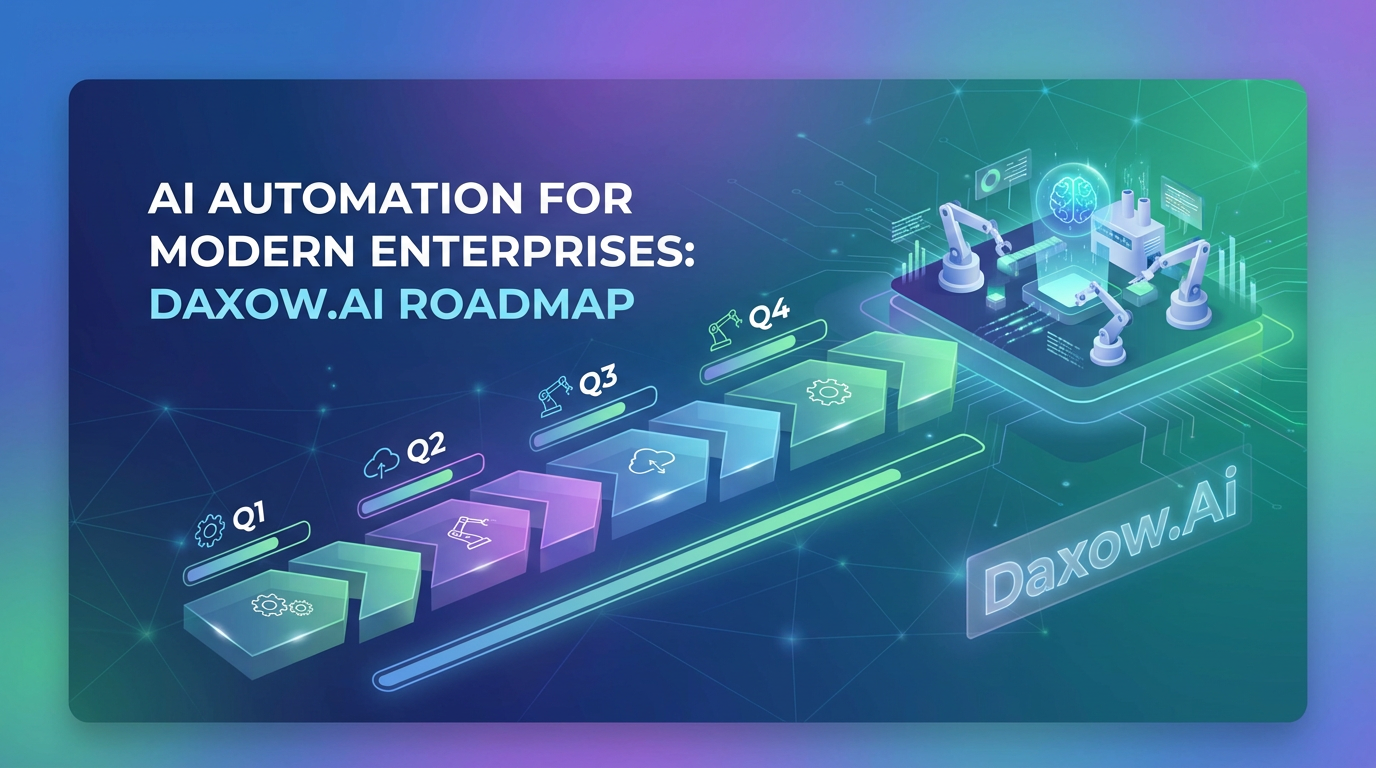
How AI agents and workflow automation help enterprises cut costs, boost productivity, and scale — a practical roadmap and use cases from Daxow.ai.
AI Automation: Transforming Business Operations for the Modern Enterprise
Estimated reading time: 15 minutes
Key Takeaways
- AI automation is a strategic imperative for scaling, cost reduction, and improving customer outcomes.
- AI agents intelligently automate multi-step workflows, improving productivity and accuracy.
- Industry-specific use cases demonstrate measurable benefits across e-commerce, healthcare, finance, real estate, HR, and support.
- A phased implementation roadmap ensures risk reduction and sustainable scaling of AI automation.
- Daxow.ai offers end-to-end AI agent design, integration, and monitoring to deliver rapid ROI.
- Security, governance, and ethics are fundamental to responsible AI automation adoption.
Table of Contents
- AI Automation: Transforming Business Operations for the Modern Enterprise
- How AI agents and workflow automation deliver measurable results
- Practical use cases across industries
- Implementation roadmap: From process discovery to enterprise scale
- Metrics, ROI, and scaling
- Security, governance, and ethical considerations
- Real-world pilot: An example workflow
- Why partner with Daxow.ai
- Frequently Asked Questions
AI Automation: Transforming Business Operations for the Modern Enterprise
AI Automation: Transforming Business Operations for the Modern Enterprise is no longer a speculative advantage — it is a strategic imperative for organizations that want to scale efficiently, reduce manual work, and improve customer outcomes. This article explains how businesses can harness AI automation, workflow automation, and AI agents to increase productivity, reduce operational costs, and unlock measurable ROI. Drawing on proven research and practical examples, we outline an actionable roadmap and show how Daxow.ai partners with companies to design and deploy custom AI systems that execute real tasks end-to-end.
Why this matters now
- Competitive pressure: Markets demand faster response times and personalized experiences.
- Cost efficiency: Targeted processes can see operational cost reductions of up to 40% with AI-driven automation.
- Workforce leverage: Automating repetitive tasks frees teams to focus on high-value strategic work.
AI automation integrates machine learning, intelligent agents, and workflow automation to execute repetitive tasks, make data-driven decisions, and scale operations with minimal human intervention. For decision-makers, the result is measurable: faster processing, fewer errors, and improved customer satisfaction.
Strategic implications for leaders
- Business owners can reallocate resources from low-value tasks to product, growth, and customer retention.
- CTOs can modernize stacks incrementally by integrating AI agents with existing systems rather than full platform rewrites.
- Operations leaders improve compliance and reduce human error in mission-critical workflows.
How AI agents and workflow automation deliver measurable results
What AI agents do
- Perceive: Ingest and structure data from emails, documents, CRMs, and support systems.
- Reason: Apply rules and predictive models to decide next steps.
- Act: Execute tasks end-to-end, such as routing tickets, updating records, or initiating payments.
AI agents extend traditional automation by handling dynamic, multi-step workflows that require context and adaptive decision-making. When connected to workflow automation, these agents can complete complete business processes without human handoffs, improving throughput and accuracy.
Key capabilities
- Intelligent document extraction and data validation.
- Automated lead qualification and routing.
- Customer support automation with context-aware responses and ticket resolution.
- Predictive forecasting tied to inventory and demand planning.
Business impact highlights
- Productivity gains: Organizations report 20–50% improvements in productivity for automated functions.
- Cost savings: Targeted implementations reduce process costs by 30–40%.
- Time recovery: Automation can free 20–30% of employee time for creative and strategic work.
Practical use cases across industries
E‑commerce: Faster order-to-cash, fewer stockouts
Problem: Manual order processing, inaccurate forecasts, slow returns handling.
Solution:
- AI agents automate order verification, fraud checks, and invoice reconciliation.
- Predictive models forecast demand to adjust replenishment automatically.
- Workflow automation routes exceptions to human operators only when required.
Outcomes:
- Reduced stockouts by up to 30% and faster fulfillment cycles.
- Lower order processing errors and accelerated refunds.
How Daxow helps:
- We build end-to-end order-to-cash automations integrating your e-commerce platform, ERP, and fulfillment partners.
- We deploy forecasting models and monitor inventory KPIs to continually improve accuracy.
Healthcare: Efficient triage and compliant operations
Problem: Overloaded call centers, appointment scheduling bottlenecks, and administrative load on clinicians.
Solution:
- AI-powered triage chatbots screen patient inquiries, prioritize urgent cases, and schedule appointments.
- Intelligent extraction tools pull structured data from referral letters and lab reports.
Outcomes:
- Lower administrative wait times and higher patient satisfaction.
- Improved compliance through audit-ready logs and secure data handling.
How Daxow helps:
- Daxow designs HIPAA-conscious workflows and integrates AI agents with EHRs, appointment systems, and secure messaging platforms.
Finance: Faster reconciliation and real-time fraud detection
Problem: High-volume transaction processing with brittle manual reconciliation and slow fraud detection.
Solution:
- AI models reconcile invoices, identify anomalies, and trigger automated compliance reporting.
- Real-time monitoring agents flag suspicious patterns and escalate for review.
Outcomes:
- Up to 99% transactional accuracy in reconciled flows.
- Reduced time to detect fraud and faster compliance reporting.
How Daxow helps:
- We create secure, auditable automations that integrate with core accounting systems and deploy continuous monitoring.
Real estate: Lead qualification and accelerated deal cycles
Problem: High lead volume with slow qualification and repetitive outreach.
Solution:
- AI agents score leads based on behavior and property criteria, then automate follow-up sequences.
- Automation schedules tours, sends contracts for signature, and updates CRM records.
Outcomes:
- Faster qualification and shorter sales cycles.
- Increased conversion rates through timely, personalized outreach.
How Daxow helps:
- We connect listing platforms, CRMs, and calendar systems to build agentic workflows that manage leads from first contact through close.
HR: Faster hiring and better retention forecasting
Problem: Time-consuming resume screening and inconsistent onboarding.
Solution:
- Automated resume parsing, candidate screening bots, and onboarding checklists driven by workflow automation.
- Predictive models flag retention risk and suggest interventions.
Outcomes:
- Hiring time cut by up to 50%, more consistent candidate experience, and reduced early turnover.
How Daxow helps:
- We implement bias-mitigating screening workflows, integrate ATS systems, and create onboarding automations that ensure compliance and speed.
Customer support and sales automation: From triage to resolution
Problem: Slow ticket routing, inconsistent responses, and missed upsell opportunities.
Solution:
- AI chatbots handle common queries and escalate complex issues with context.
- Sales automation agents identify upsell opportunities and schedule outreach.
Outcomes:
- Faster first response times and improved CSAT.
- Increased revenue through timely, automated sales motions.
How Daxow helps:
- We design conversational AI agents integrated with ticketing systems and CRMs to automate support and sales workflows end-to-end.
Implementation roadmap: From process discovery to enterprise scale
A structured approach reduces risk and produces measurable outcomes. Daxow follows a phased method grounded in best practices.
1. Define goals and audit processes
- Conduct discovery workshops and process audits to identify high-impact workflows.
- Set measurable objectives (e.g., 25% cost reduction, 40% faster processing).
- Prioritize quick wins to build momentum.
What Daxow does: We run a process analysis to map tasks, owners, and error points and recommend immediate automation candidates.
2. Assess data quality and accessibility
- Evaluate sources for accuracy, completeness, and compliance.
- Clean and standardize data; establish pipelines for continuous ingestion.
What Daxow does: We design secure data architectures and ETL pipelines that feed AI models and maintain auditability.
3. Select tools and build the team
- Choose platforms that integrate seamlessly with your stack and meet security requirements.
- Assemble cross-functional teams with technical and domain expertise.
What Daxow does: We recommend and implement toolchains, from AI agent frameworks to workflow orchestration platforms, and provide the engineering and project leadership resources.
4. Prototype and test
- Start with non-critical pilots using validation metrics like precision and recall.
- Integrate with existing systems to minimize disruption.
What Daxow does: We deliver rapid prototypes, run A/B tests, and present clear KPIs to stakeholders.
5. Deploy, monitor, and iterate
- Roll out with dashboards, alerts, and governance controls.
- Retrain models, prevent drift, and ensure ethical compliance.
What Daxow does: We operate monitoring and continuous improvement programs to optimize models and workflows over time.
Best practices to follow
- Prioritize high-ROI workflows first.
- Embed governance and security from day one.
- Foster cross-functional collaboration between business and tech teams.
- Measure success with clear KPIs: throughput, error rates, cost per transaction, and customer satisfaction.
Metrics, ROI, and scaling
Measuring success is essential. Typical KPIs include:
- Throughput and cycle time reductions.
- Error rate reductions and compliance incidents avoided.
- Employee time recovered (hours saved).
- Customer satisfaction and NPS improvements.
- Financial metrics: cost per transaction, cost savings, and payback period.
What the research shows
- Organizations report 20–50% productivity gains and 30–40% cost reductions in targeted processes.
- Daxow clients often realize 3–5x ROI with payback periods under six months for focused implementations.
- Long-term benefits include better data-driven decisions and reduced employee churn by removing repetitive tasks.
How to scale
- Standardize reusable components (document parsers, intent classifiers, data connectors).
- Maintain a central automation catalog to prioritize and manage automations.
- Ensure security and governance scale alongside feature growth.
Security, governance, and ethical considerations
Implementing AI automation responsibly requires:
- Data minimization and encryption for sensitive information.
- Access controls, logging, and audit trails for regulated processes.
- Regular bias and fairness assessments for decisioning models.
- Clear escalation paths for exceptions and human-in-the-loop checkpoints.
Daxow’s approach
- We integrate security and compliance into solution design.
- We implement monitoring that detects drift, maintains model explainability, and ensures regulatory alignment.
Real-world pilot: An example workflow
Pilot scenario: Order exceptions in an e-commerce operation
- Baseline: 1,200 order exceptions per month, handled manually.
- Automation:
- AI agent extracts order data and identifies exception type (payment, inventory, address).
- Workflow automation routes straightforward fixes (e.g., address normalization) automatically.
- Complex exceptions are routed with context-rich summaries to specialists.
- Results:
- Manual handling reduced by 70%.
- Average resolution time cut from 48 hours to under 8 hours.
- Customer satisfaction improved through faster updates.
Daxow role: End-to-end implementation: data extraction, model training, workflow orchestration, and system integration with ERP and CRM.
Why partner with Daxow.ai
Daxow.ai builds custom AI systems that align to business outcomes. Our differentiators:
- End-to-end delivery: From discovery and data engineering to production AI agents and monitoring.
- Custom AI agents: We design agentic systems that execute multi-step workflows and integrate with existing tools.
- Cross-industry expertise: Proven use cases in e-commerce, healthcare, finance, real estate, HR, and support operations.
- Integration-first approach: We connect CRMs, ERPs, ticketing systems, and productivity tools to ensure seamless data flow.
- Focus on ROI: We prioritize high-impact automations and provide measurable KPIs and short payback periods.
- Security and governance: Built-in compliance, audit trails, and ethical model practices.
If your organization needs to reduce manual tasks, improve productivity, and scale reliably, Daxow helps design and deliver the right mix of AI agents, workflow automation, and integrations.
Frequently Asked Questions
What is AI automation and how does it differ from traditional automation?
AI automation uses intelligent agents and machine learning to handle dynamic, multi-step tasks with context and adaptive decision-making, unlike traditional automation that typically follows fixed rules and scripts.
Which industries benefit the most from AI automation?
Industries including e-commerce, healthcare, finance, real estate, HR, and customer support see significant productivity and cost benefits from AI automation deployments.
How do I start implementing AI automation in my business?
A phased approach starting with process discovery and goal setting, followed by data assessment, tool selection, prototyping, and deployment helps ensure success. Partnering with experts like Daxow.ai can accelerate your path to ROI.
What security measures are important when adopting AI automation?
Key measures include data encryption, access controls, audit trails, bias assessments, and human-in-the-loop checkpoints to maintain compliance and ethical standards.