
AI Automation: Transform Business Processes for Competitive Advantage
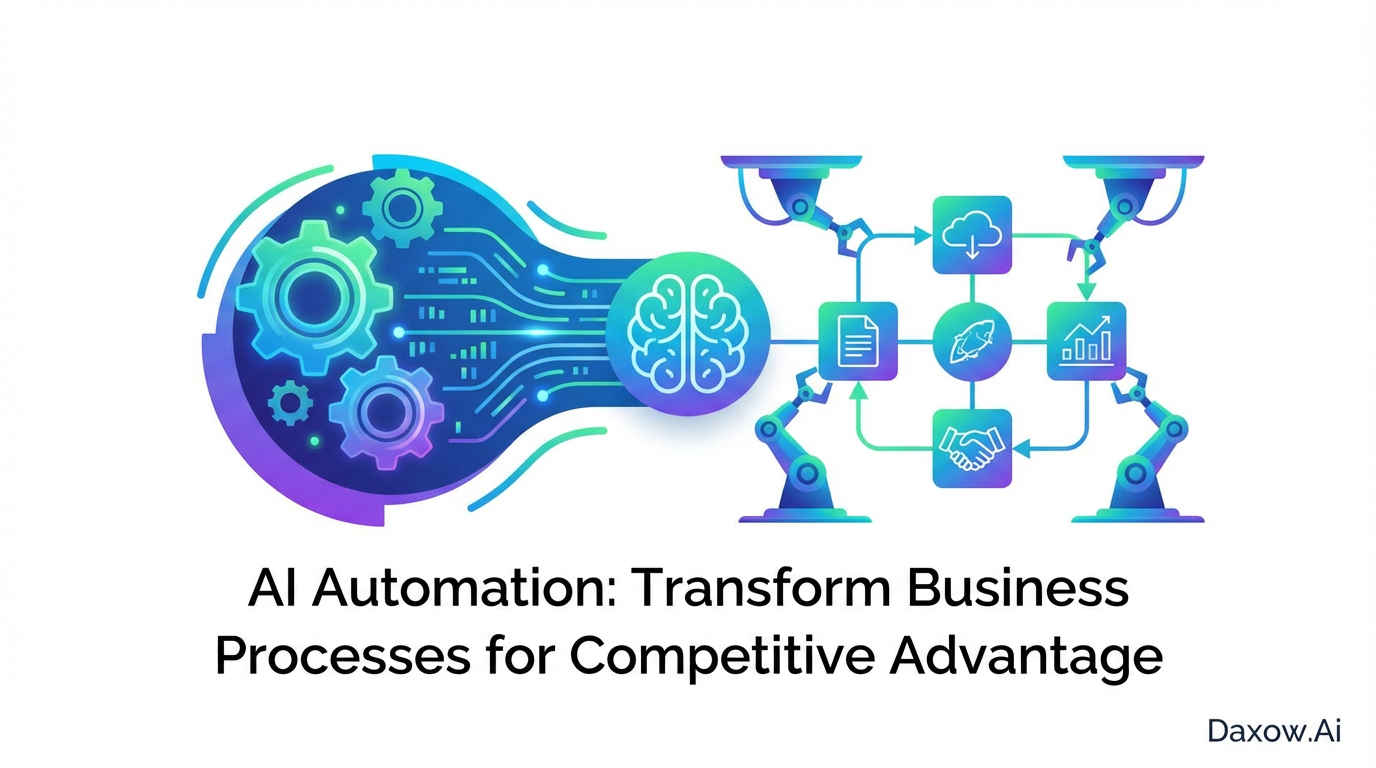
Practical guide to AI automation and AI agents: industry use cases, ROI figures, and a step-by-step roadmap to cut costs, boost productivity, and scale operations.
AI Automation: Transforming Business Processes for Competitive Advantage
Estimated reading time: 12 minutes
Key Takeaways
- AI automation integrates intelligent systems to dramatically reduce manual work and improve operational agility.
- AI agents enable autonomous decision-making across complex workflows, enhancing productivity and reducing error rates.
- Industry-specific applications in e-commerce, healthcare, finance, real estate, and HR show measurable ROI and business impact.
- A structured, phased implementation roadmap is critical to maximize value and ensure compliance and scalability.
- Daxow.ai offers end-to-end AI automation solutions tailored to business objectives with proven outcomes.
Table of Contents
AI Automation: Transforming Business Processes for Competitive Advantage
Strategic meaning for businesses
AI automation integrates artificial intelligence with traditional robotic process automation to handle both rule-based and cognitive tasks. For leaders, this represents a shift from manual execution toward intelligent, unattended systems that:
- Free human talent for high-value work, such as strategy and customer engagement.
- Address labor shortages and compliance risks by standardizing repeatable processes.
- Deliver predictive insights that improve operational planning and customer outcomes.
Research-backed outcomes include productivity gains of 20–50%, cost reductions in targeted processes of up to 30%, and reduced error rates approaching 90% in automated tasks. These results translate to competitive agility: faster product cycles, better customer retention, and the capacity to scale without linear increases in headcount.
How AI agents and workflow automation deliver value
AI agents — autonomous systems that perceive, decide, and act — extend automation beyond scripted RPA. They process unstructured data, interpret natural language, and execute multi-step workflows across systems. Key capabilities include:
- Natural language understanding for customer support automation and document summarization.
- Computer vision and anomaly detection for quality control and fraud surveillance.
- Generative tasks such as automated content drafting or responses in support channels.
- Integration and orchestration across CRMs, ERPs, ticketing systems, and cloud storage.
At Daxow.ai, our AI agents reduce human intervention by 60–80% in targeted workflows while maintaining detailed audit trails for accountability and compliance. That reduction in manual tasks converts directly into improved productivity and reduced operational costs.
Practical Use Cases of AI Automation and AI Agents
E-commerce
Use cases:
- Automate order-to-cash workflows: from payment reconciliation to shipment confirmation.
- Personalized product recommendations using purchase and browsing history.
- Predictive inventory management to prevent stockouts.
- 24/7 customer support automation using conversational AI agents.
Business impact:
- Faster fulfillment, lower cart abandonment, and 15–25% revenue uplift from targeted upsells.
- Reduced manual order exceptions and shorter cash cycle times.
Example: A mid-market retailer implemented AI agents to reconcile payments and route exceptions automatically. Manual reconciliation time fell by 75%, while inventory forecasting cut stockouts by 30%.
Healthcare
Use cases:
- AI triage for patient intake and appointment scheduling.
- Summarization and categorization of medical records.
- Predictive models for readmission risk and resource allocation.
Business impact:
- 40% faster administrative processing, improved patient throughput, and stronger regulatory compliance.
- Clinicians spend more time on patient care rather than paperwork.
Example: A regional clinic automated patient query triage and appointment routing; administrative staff redirected effort to care coordination, improving patient satisfaction scores.
Finance
Use cases:
- Transaction surveillance for fraud detection with real-time alerts.
- Automated compliance reporting and audit trail generation.
- Invoice capture and accounts payable automation.
Business impact:
- 50–70% reduction in fraud losses for firms that deploy continuous monitoring.
- Faster close cycles and fewer manual reconciliations.
Example: A financial services firm deployed AI agents to screen transactions and trigger investigations. Fraud case throughput increased while false positives declined.
Real Estate
Use cases:
- Automated lead qualification and prioritization.
- Property valuation using multi-source market data.
- Contract extraction and clause verification.
Business impact:
- Accelerated deal cycles and ~20% higher conversion rates.
- Reduced time-to-offer and improved pricing consistency.
Example: A brokerage used AI agents to pre-qualify leads and summarize property comparables, increasing agent productivity and deal velocity.
HR and Talent Management
Use cases:
- Resume screening and candidate shortlisting.
- Onboarding task orchestration and documentation automation.
- Employee sentiment analysis and predictive turnover modeling.
Business impact:
- 30% faster hiring processes and reduced administrative overhead by ~25%.
- Better retention through early warning signals and targeted interventions.
Example: A global HR team automated screening and onboarding reminders, reducing time-to-productivity for new hires.
Cross-industry customer support automation
Use cases:
- Omnichannel chatbots that escalate complex cases to humans with context.
- Automated knowledge base updates from resolved tickets.
- SLA monitoring and automatic escalation workflows.
Business impact:
- Faster response times, lower first-response costs, and improved NPS.
- Reassignment of support staff to higher-value escalations.
Example: A SaaS provider implemented an AI agent that resolves tier-1 queries and drafts knowledge articles from resolved tickets, reducing support costs while increasing customer satisfaction.
Implementing AI Automation: A Practical Roadmap
1. Define clear objectives
- Align automation with business outcomes: cost reduction, revenue uplift, NPS, or compliance.
- Create an AI-first scorecard with measurable KPIs (accuracy, throughput, time saved).
How Daxow helps: We facilitate stakeholder workshops to set objectives, define KPIs, and prioritize processes that deliver rapid return.
2. Identify high-impact processes
- Use task mining and stakeholder interviews to find repetitive, high-volume tasks suitable for automation.
- Prioritize small, non-critical pilots to validate assumptions.
How Daxow helps: Our process analysis identifies quick wins and long-term transformation opportunities across departments like sales, finance, and support.
3. Assess and prepare data
- Ensure data quality, accessibility, and privacy compliance from the start.
- Establish pipelines and data governance to feed models and agents.
How Daxow helps: We design secure data pipelines, anonymization processes, and compliance controls to meet industry standards and regulatory requirements.
4. Select tools and build the team
- Choose scalable platforms with strong integration capabilities and enterprise security.
- Create cross-functional teams and provide training for adoption.
How Daxow helps: We recommend and implement toolsets aligned with your architecture, and we embed change management to minimize shadow AI and maximize adoption.
5. Prototype and integrate
- Pilot a single process, validate performance, and scale gradually.
- Ensure compatibility with legacy systems using APIs and connectors.
How Daxow helps: Our engineering teams build lightweight pilots, validate ROI, and manage phased rollouts to prevent infrastructure bottlenecks.
6. Monitor, measure, and iterate
- Continuously track metrics, retrain models, and implement governance to prevent sprawl.
- Use feedback to refine decision rules and expand automation.
How Daxow helps: We provide monitoring dashboards, scheduled retraining, and governance frameworks to sustain improvements and ensure auditability.
Best practices to follow
- Enterprise-grade security and ethical AI guidelines.
- Involve IT early to secure integrations and scale.
- Organization-wide training for end-user buy-in.
- Continuous improvement with built-in feedback loops.
Measuring ROI and Business Impact
Quantifying ROI starts with a baseline of current costs, error rates, and lead times. Typical business outcomes from research and client results include:
- 25–40% cost savings on automated processes.
- 3–5x productivity gains in targeted teams.
- Faster fraud detection and compliance reporting leading to measurable risk reduction.
- Long-term reductions in error rates up to 90%.
Daxow clients report a range of 200–400% ROI within 12–18 months on optimized workflows. To replicate these results:
- Establish baseline metrics pre-implementation.
- Define short-term and long-term KPIs (time saved, cost per transaction, NPS).
- Use pilot outcomes to model enterprise-wide impact before scaling.
How Daxow.ai Builds Custom AI Systems and AI Agents
Daxow.ai delivers end-to-end business automation services designed to reduce manual tasks, boost productivity, and improve customer outcomes. Core offerings include:
- AI Agents: Autonomous agents that execute workflows, handle support interactions, qualify leads, and update systems with minimal human intervention.
- Workflow Automation: Process orchestration that ties together CRM, ERP, ticketing, and document systems for seamless operations.
- Customer Support Automation: Omnichannel chatbots and escalation workflows that reduce response times and improve CSAT.
- Sales Automation: Lead scoring, outreach automation, and pipeline enrichment to accelerate revenue.
- Data Extraction & Document Automation: OCR, NLP, and structured data extraction to convert documents into actionable data.
- Integrations & System Connectivity: Robust connectors and custom APIs to unify disparate tools and enable real-time data flow.
How we deliver value:
- We begin with a process analysis to identify high-impact automation opportunities.
- We design custom AI agents that reflect your business rules and compliance needs.
- We integrate systems to ensure end-to-end process visibility and reliable data flow.
- We deploy governance, monitoring, and retraining regimes to maintain performance and compliance.
Why choose Daxow:
- Practical focus on measurable ROI rather than proof-of-concept for its own sake.
- Domain expertise across technology, e-commerce, finance, real estate, healthcare, and HR.
- Full-stack delivery from discovery and prototyping to production, monitoring, and scaling.
Frequently Asked Questions
What is AI automation and how is it different from traditional automation?
AI automation combines artificial intelligence with robotic process automation (RPA) to handle both rule-based and cognitive tasks, enabling intelligent decision-making beyond scripted workflows.
Which industries benefit most from AI agents?
Industries such as e-commerce, healthcare, finance, real estate, and HR have seen significant benefits through improved efficiency, accuracy, and customer experience using AI agents.
How does Daxow.ai support implementation and scaling?
Daxow.ai provides end-to-end services including process analysis, custom AI design, system integration, phased rollout, governance, and continuous monitoring to ensure seamless scaling and measurable ROI.
What are best practices for ensuring AI automation success?
Establish clear objectives, prioritize compliance and data governance, involve IT early, and invest in organizational training and change management to drive adoption and continuous improvement.