
AI Automation in Business: ROI, Implementation & Roadmap
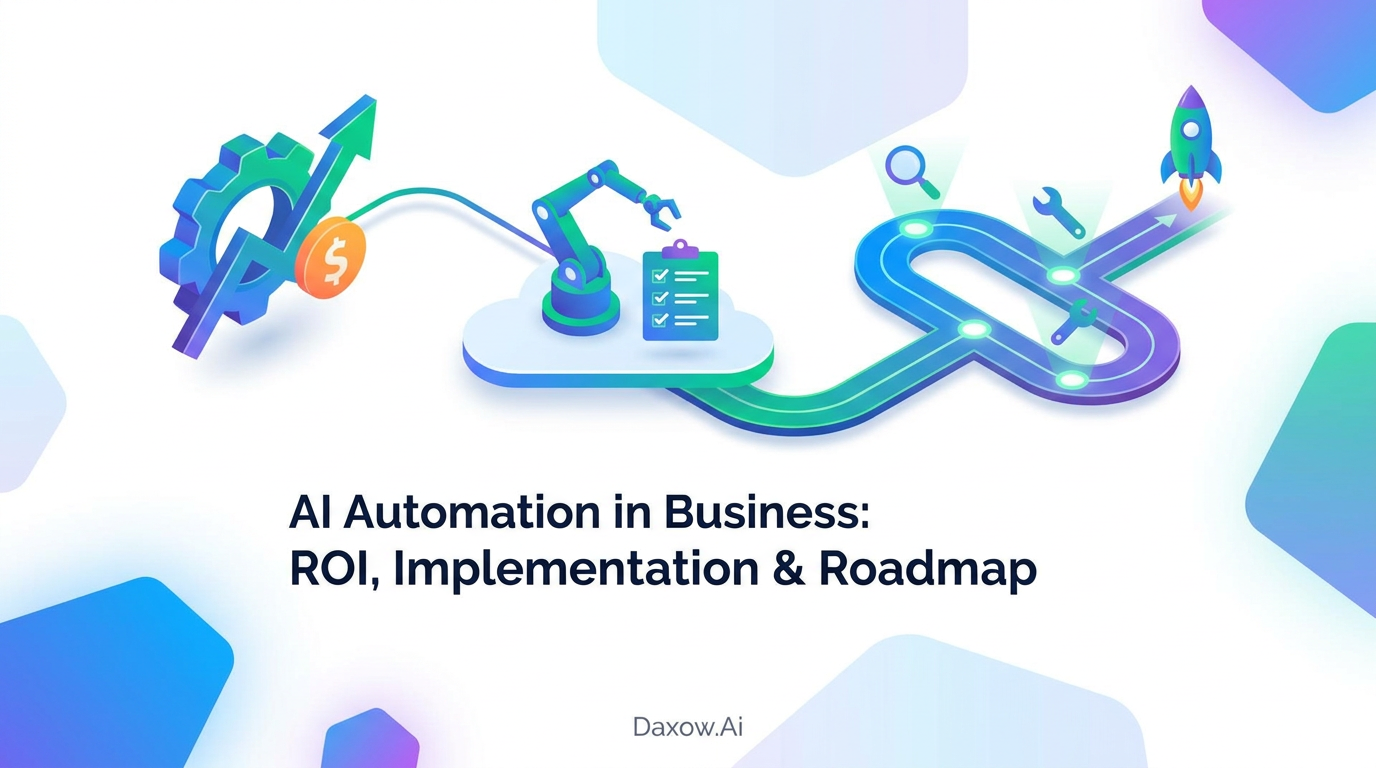
Comprehensive guide to AI automation in business: tech, industry use cases, implementation roadmap, and ROI to plan, pilot, and scale AI agents.
AI Automation in Business: A Comprehensive Guide to Transformation, ROI, and Implementation
Estimated reading time: 15 minutes
Key Takeaways
- AI automation merges machine learning, NLP, RPA, and orchestration to improve productivity and customer experience.
- Core AI technologies enable businesses to automate complex, repetitive tasks and make data-driven decisions quicker.
- Industry-specific use cases demonstrate measurable cost savings, efficiency gains, and enhanced customer engagement.
- Successful implementation follows a phased roadmap from assessment to scaling and ongoing evolution.
- Measuring ROI is critical for securing executive buy-in and prioritizing automation initiatives effectively.
- Daxow.ai specializes in building custom AI agents and workflows tailored to your business needs with fast, measurable ROI.
Table of Contents
- AI Automation in Business: A Comprehensive Guide to Transformation, ROI, and Implementation — What It Means for Your Organization
- Core Technologies Behind AI Automation
- Practical AI Automation Use Cases Across Industries
- From Opportunity to Outcome — Implementation Roadmap
- Measuring ROI and Business Value
- Best Practices and Common Pitfalls
- Why Build AI Agents and Workflow Automation with Daxow.ai
- Example Implementation — AI-Powered Invoice Processing (How Daxow Delivers)
- Getting Started — A Practical Checklist
- Frequently Asked Questions
AI Automation in Business: A Comprehensive Guide to Transformation, ROI, and Implementation — What It Means for Your Organization
AI automation combines machine learning, natural language processing, robotic process automation, and intelligent workflow orchestration to perform tasks that previously required human effort. Unlike classical automation, AI-driven systems learn from data, handle unstructured inputs, adapt to exceptions, and make contextual decisions. For businesses, this translates into measurable improvements in productivity, speed, and compliance.
- Reduce manual tasks across finance, HR, support, and operations.
- Boost productivity by freeing staff for higher-value work.
- Improve accuracy and compliance through automated validation and audit trails.
- Scale operations without proportional headcount growth.
- Deliver better customer experiences via responsive AI agents and personalized workflows.
Core Technologies Behind AI Automation
Machine Learning and Predictive Models
Machine learning powers demand forecasting, credit underwriting, fraud detection, and churn prediction. These models continuously improve as more data is processed.
Natural Language Processing (NLP)
NLP enables chatbots, document understanding, contract extraction, and email triage—critical for customer support automation and document processing.
Robotic Process Automation (RPA)
RPA automates repetitive UI-based tasks—data entry, form filling, and system-to-system transfers—often combined with AI for decision-making.
Computer Vision
Computer vision extracts data from images and scanned documents—useful for invoice processing, medical imaging, and claims handling.
Intelligent Workflow Orchestration
Orchestration coordinates multi-step processes across systems, enabling end-to-end business automation from initiation to completion.
Practical AI Automation Use Cases Across Industries
E-Commerce & Retail
- Personalized recommendations and dynamic pricing increase conversion and basket size.
- Inventory management and demand forecasting prevent stockouts and reduce carrying costs.
- Chatbots and customer support automation handle routine inquiries 24/7, reducing ticket volume by 40–60%.
- Fraud detection prevents chargebacks by identifying anomalous transactions in real time.
How Daxow helps: We build AI agents that integrate product catalogs, CRM, and payment systems to enable personalized experiences and automated dispute handling, while connecting dynamic pricing models to inventory and competitor feeds.
Finance & Accounting
- Intelligent invoice processing automates data extraction, PO matching, and approvals—cutting AP costs by 30–50% and processing time from hours to minutes.
- Automated reconciliation and financial reporting accelerate close cycles by days.
- Fraud detection and AML monitoring identify suspicious patterns across accounts in real time.
How Daxow helps: We design end-to-end invoice automation pipelines using computer vision, NLP, ML validation, and RPA connectors to ERPs and banking systems—ensuring auditability and fast ROI.
Healthcare
- EHR analysis and disease prediction enable proactive care and reduce emergency interventions.
- Claims fraud detection and automated billing reduce rejected claims and improve revenue capture.
- Appointment optimization and AI-driven patient engagement lower no-show rates and improve utilization.
How Daxow helps: We develop HIPAA-aware AI agents that integrate EHRs, scheduling systems, and billing platforms to automate patient triage, billing validation, and predictive staffing.
Real Estate & Property Management
- Automated property valuation and market analysis accelerate deal evaluation.
- Tenant screening and lease analysis reduce risk and speed approvals.
- Predictive maintenance and maintenance scheduling reduce downtime and cost.
How Daxow helps: We connect listing databases, municipal records, and CRM systems to deliver automated valuations, tenant due diligence workflows, and predictive maintenance alerts for property teams.
Human Resources
- Resume screening and candidate ranking reduce time-to-hire by 60–80% for early-stage screening.
- Predictive attrition models identify flight risk employees for retention interventions.
- Onboarding automation speeds time-to-productivity for new hires.
How Daxow helps: We implement recruitment automation platforms that integrate with ATS, calendar systems, and learning management systems to automate screening, scheduling, and onboarding workflows.
From Opportunity to Outcome — Implementation Roadmap
Phase 1 — Assessment & Strategy (Weeks 1–4)
- Conduct process discovery to map manual steps, decision points, and exceptions.
- Prioritize opportunities by volume, repetition, business impact, and feasibility.
- Develop a business case with baseline metrics and target KPIs: processing time, error rate, cost per transaction.
How Daxow helps: We run a structured process analysis and provide a quantified roadmap identifying quick wins and long-term transformations.
Phase 2 — Pilot & Proof of Concept (Weeks 5–12)
- Select a well-defined process for a pilot — moderate complexity, clear ROI.
- Build a POC integrating required systems and test with real data.
- Run the pilot in parallel with existing processes, monitor accuracy, and refine.
How Daxow helps: Our agile delivery teams build pilot AI agents and automation workflows, manage integrations, and deliver measurable pilots within weeks.
Phase 3 — Scale & Optimize (Weeks 13–26)
- Deploy across the organization, migrate historical data, and establish governance.
- Monitor KPIs continuously and apply iterative improvements.
- Train staff and implement change management practices.
How Daxow helps: We provide production hardening, monitoring dashboards, governance frameworks, and training to ensure durable adoption and continuous improvement.
Phase 4 — Expand & Evolve (Ongoing)
- Extend automation to adjacent processes and integrate more data sources.
- Move from partial automation to end-to-end business automation driven by AI agents.
- Invest in advanced AI capabilities and prescriptive analytics.
How Daxow helps: We roadmap expansion plans, implement cross-process automation, and provide managed services for ongoing optimization.
Measuring ROI and Business Value
Direct Cost Savings
- Labor reduction: Examples include finance teams reducing invoice work by 75%, or chatbots handling 60% of customer queries.
- Error reduction and rework prevention yield savings from fewer manual corrections and rejected claims.
Revenue Impact
- Improved CX and personalization can increase conversion rates by 5–15%.
- Dynamic pricing and better inventory management reduce lost sales and increase margins.
Operational Efficiency
Processing times drop from days to hours or minutes—enabling higher throughput without headcount growth.
Example calculation (Invoice Processing):
- Annual labor savings: $225,000
- Error reduction savings: $150,000
- Compliance value: $50,000
- Total annual benefits: $425,000
- Year-1 investment (software, integration, training): $155,000
- Year-1 ROI: 174%; Payback in ~4–5 months.
Best Practices and Common Pitfalls
Best Practices
- Start with high-impact, standardized processes.
- Prioritize data quality—AI models require clean, consistent data.
- Design for exceptions—automate 80–90% and route the rest to humans.
- Implement change management—involve users early and provide training.
- Measure everything—establish baselines and track KPIs continuously.
- Build for integration—APIs and modern connectors prevent data silos.
Pitfalls to Avoid
- Automating a broken process before fixing it.
- Underestimating integration complexity with legacy systems.
- Neglecting governance, monitoring, and audit trails.
- Over-ambitious scope at project start—begin with pilots.
Why Build AI Agents and Workflow Automation with Daxow.ai
- End-to-end process automation: We map workflows end-to-end, design AI agents that execute tasks, and orchestrate systems so workflows complete without human handoffs where possible.
- Custom AI agents that execute real tasks: From lead qualification and sales automation to accounts payable and claims processing, our agents act on data and systems—not just surface insights.
- System integrations and data connectivity: We connect ERPs, CRMs, EHRs, payment gateways, and third-party APIs to create a unified automation fabric.
- Focus on ROI and operational cost reduction: Our pilots are designed to deliver rapid payback and measurable cost reductions.
- Managed services and continuous optimization: After deployment we monitor performance, retrain models, and optimize rules to maintain and improve value.
Learn more about how we deliver custom AI automation solutions and managed services tailored to your business needs.
Example Implementation — AI-Powered Invoice Processing (How Daxow Delivers)
- Document ingestion using computer vision to extract invoice fields.
- NLP and ML validate vendor, amounts, and line items against historical data.
- Workflow orchestration routes invoices based on thresholds and approval matrices.
- RPA posts approved invoices into accounting systems and triggers payments.
- Exception handling flags anomalies for quick human review.
- Continuous learning improves routing and reduces manual reviews over time.
Result: Reduced invoice processing time from days to minutes, significant labor savings, and a clear audit trail for compliance.
Getting Started — A Practical Checklist
- Identify 1–2 high-volume, repeatable processes with measurable pain points.
- Gather baseline metrics: time per transaction, error rates, and labor costs.
- Secure executive sponsorship and choose a cross-functional sponsor.
- Run a rapid process analysis and develop a pilot plan.
- Choose a partner experienced in AI agents, RPA, NLP, and integrations.
Frequently Asked Questions
What differentiates AI automation from traditional automation?
AI automation uses machine learning and advanced technologies to handle unstructured data, learn from experience, and make contextual decisions, unlike traditional rule-based automation which is limited to fixed, repetitive tasks.
How quickly can my business see ROI from AI automation?
Many organizations experience measurable ROI within 4 to 6 months after deployment, especially when starting with high-volume, repetitive processes with defined KPIs and using proven implementation roadmaps like the one Daxow offers.
What industries benefit most from AI automation?
E-commerce, finance, healthcare, real estate, and human resources are among the industries that see significant improvements, though AI automation has broad applicability across virtually all sectors.
How does Daxow.ai support ongoing optimization after deployment?
We provide managed services including monitoring, model retraining, rule optimization, and governance to ensure AI automation continues to deliver maximum value and adapts to changing business needs.