
Mastering AI Automation: Transforming Business Operations
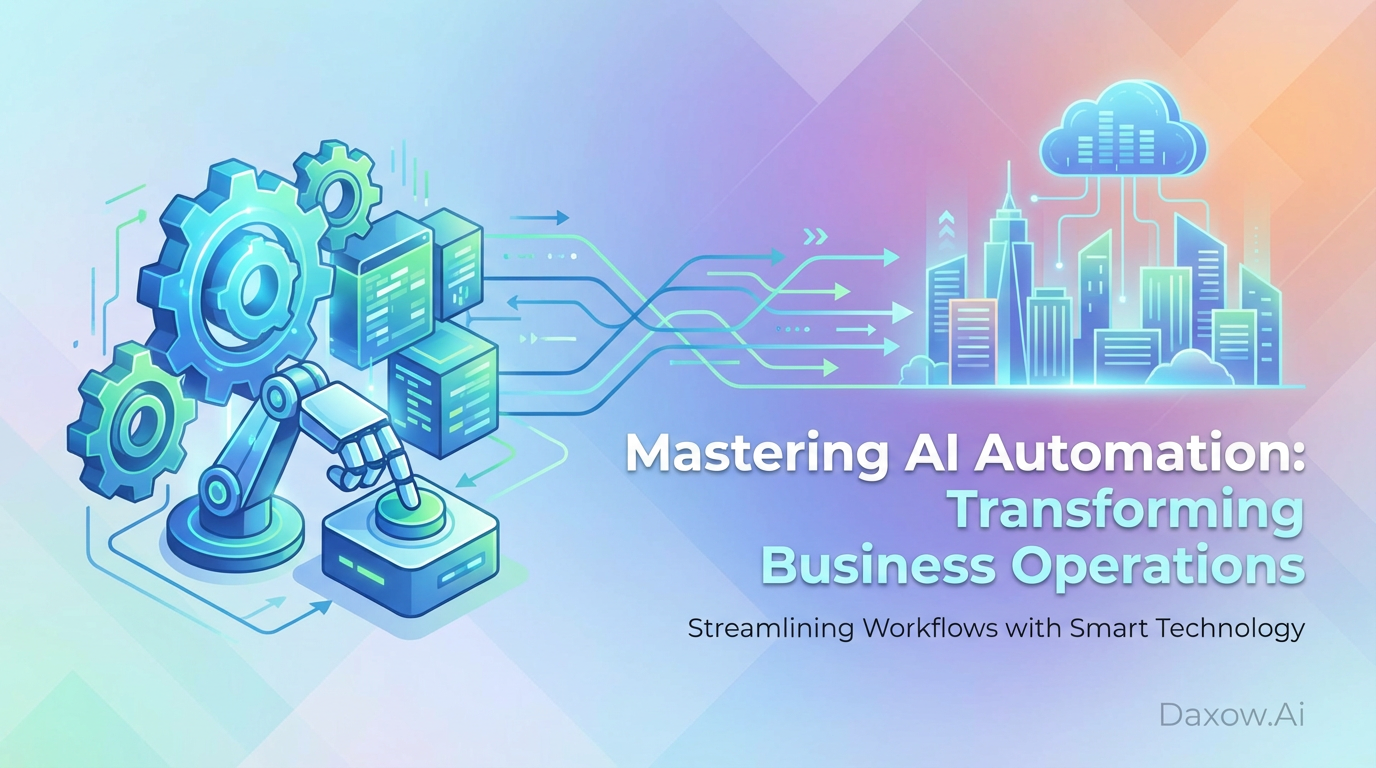
Practical guide to implementing AI automation with use cases, roadmap, KPIs, and how Daxow.ai builds secure, integrated AI agents to boost productivity and ROI.
Mastering AI Automation: Transforming Business Operations for the AI Era
Estimated reading time: 15 minutes
Key Takeaways
- AI automation is a practical necessity to reduce manual tasks, boost productivity, and stay competitive.
- Combines machine learning, generative models, and RPA to automate repetitive and decision-based workflows.
- Delivers measurable ROI across industries including e-commerce, healthcare, finance, real estate, HR, and customer support.
- Effective AI automation requires end-to-end orchestration, security compliance, and continuous monitoring.
- Daxow.ai offers tailored AI automation solutions to accelerate business transformation and operational efficiency.
Table of Contents
- Mastering AI Automation: Transforming Business Operations for the AI Era
- Practical Use Cases — AI automation across industries
- How AI Agents and Workflow Automation Deliver Real Business Outcomes
- Implementation Roadmap and Best Practices
- Measuring ROI and Business Value
- Why partner with Daxow.ai to master AI automation
- Frequently Asked Questions
Mastering AI Automation: Transforming Business Operations for the AI Era
What AI automation actually is
AI automation integrates machine learning, generative models, and rule-based automation (RPA) to perform repetitive, data-intensive, and decision-making work. It goes beyond scripting by enabling systems to interpret unstructured inputs (emails, documents, images), reason about outcomes, and trigger end-to-end workflows. Modern AI agents can execute tasks autonomously — for example, detecting anomalies, drafting responses, or initiating approvals — and then integrate results with CRMs, ERPs, and other business systems.
Why it matters for your organization
- Faster operations: Targeted automation can complete tasks 3–5x faster.
- Reduced costs: Typical cost reductions of 20–30% in automated processes.
- Productivity gains: Focused areas report productivity increases of 40–50%.
- Revenue uplift: Personalization and prediction (e.g., e-commerce) can lift sales by 15–20%.
- Resilience and agility: AI systems detect disruptions and adapt decisions in real time, maintaining continuity across supply chains and customer operations.
Practical Use Cases — AI automation across industries
E-commerce — order-to-cash and personalization
Use case: An AI agent monitors incoming orders, verifies payments, updates inventory, and triggers fulfillment. It combines purchase history with behavioral signals to personalize product recommendations.
Business outcome: Reduced stockouts, faster fulfillment, higher conversion rates, and fewer manual reconciliations.
How Daxow.ai helps: We design AI agents that integrate with your e-commerce platform and ERP, automate order reconciliation, and run predictive inventory models to reduce carrying costs.
Healthcare — document automation and patient flow
Use case: Automate intake forms, extract clinical data from referrals, and flag anomalies or urgent cases for expedited triage.
Business outcome: Reduced administrative burden, faster patient throughput, and improved compliance with audit trails.
How Daxow.ai helps: We build secure data extraction pipelines compliant with healthcare standards and connect AI-driven triage agents to scheduling and electronic health record systems.
Finance — fraud detection and compliance reporting
Use case: Real-time transaction monitoring with automated alerts, case creation, and escalation. Automate periodic compliance reports by extracting and aggregating required fields from multiple data sources.
Business outcome: Faster detection of suspicious activity, reduced false positives, and lower compliance costs.
How Daxow.ai helps: We deploy AI agents that combine anomaly detection with workflow automation to notify teams, create cases, and trigger governance-approved approval flows.
Real estate — valuations and client engagement
Use case: Aggregate market data and property records to produce automated valuations and generate market summaries for agents and clients. Use chatbots to handle initial inquiry and schedule viewings.
Business outcome: Faster lead qualification, better pricing decisions, and higher agent productivity.
How Daxow.ai helps: Our systems connect MLS data, CRM, and analytics to automate valuations and manage leads from first contact to contract.
HR — recruitment and employee lifecycle
Use case: Screen resumes for role fit, automate interview scheduling, and generate onboarding packets. Perform sentiment analysis on employee surveys to predict turnover risk.
Business outcome: Faster hiring cycles, consistent candidate experience, and early intervention to reduce attrition.
How Daxow.ai helps: We create AI-driven screening and onboarding workflows that plug into your ATS and HRIS, reducing manual steps and improving data quality.
Customer support automation
Use case: Chatbots handle tier-1 support queries, escalate complex cases to human agents with context, and run follow-up satisfaction surveys automatically.
Business outcome: Lower first response times, higher resolution rates, and increased NPS.
How Daxow.ai helps: We implement conversational AI with CRM integration, automated ticket routing, and knowledge base management to reduce manual support workloads.
How AI Agents and Workflow Automation Deliver Real Business Outcomes
From rules to reasoning
Traditional automation handles explicit rules and inputs. AI agents add pattern recognition, natural language understanding, and decision-making. They can:
- Interpret customer emails and decide routing and next actions.
- Extract entities from unstructured documents (invoices, contracts).
- Predict outcomes (churn, fraud, demand) and trigger preventative workflows.
End-to-end orchestration
An effective AI automation implementation does more than a single task. It chains steps across systems:
- Detect an event (failed payment).
- Create a remediation task in the CRM.
- Notify the responsible team via the collaboration platform.
- Propose next-best actions using predictive models.
This end-to-end capability reduces handoffs and latency, and ensures the system handles exceptions without manual intervention.
Security, compliance, and enterprise readiness
AI agents must adhere to enterprise security standards: role-based access, audit logs, encryption, and data residency controls. They also need governance frameworks to detect bias and preserve privacy. A secure, auditable automation stack reduces operational risk and supports regulatory reporting.
Implementation Roadmap and Best Practices
Phase 1 — Define goals and audit processes
- Clarify objectives: Reduce cost, accelerate processing time, improve NPS, or increase conversion.
- Process audit: Use process mining and stakeholder interviews to map time-consuming, error-prone tasks.
- Prioritize: Target quick wins (high volume, repetitive tasks) while maintaining strategic long-term goals.
Phase 2 — Assess data and select tools
- Data audit: Check accuracy, completeness, and accessibility.
- Tool selection criteria: Scalability, integration capability, security, vendor support, and compatibility with legacy systems.
- Plan for data pipelines: Standardize formats and create ETL patterns to prevent silos.
Phase 3 — Build a cross-functional team
- Core roles: Business owners, data engineers, ML engineers, product managers, IT, and compliance.
- Training and governance: Establish training programs and a governance board to avoid shadow AI and manage model drift.
Phase 4 — Prototype and integrate
- Start small: Pilot with a non-critical but high-impact workflow (e.g., customer inquiry triage).
- Test and iterate: Validate models with real data and operational metrics.
- Phased integration: Gradually integrate with CRMs, ERPs, and collaboration tools.
Phase 5 — Monitor, measure, and scale
- KPIs: Measure time savings, error rates, cost reductions, throughput, conversion uplift, and customer satisfaction.
- Continuous improvement: Retrain models, incorporate user feedback, and expand automation scope based on validated ROI.
Best practices to mitigate common challenges
- Legacy system integration: Use middleware and phased rollouts; expose APIs rather than replacing core systems immediately.
- Skill gaps: Combine internal training with external expertise from vendors like Daxow.ai to accelerate capability building.
- Data silos: Create standardized pipelines early and enforce data governance.
- Scope creep: Define measurable KPIs and success criteria from day one.
Measuring ROI and Business Value
What to measure
- Operational KPIs: Processing time, throughput, and error rate reductions.
- Financial KPIs: Cost savings as a percentage of process cost, reduction in headcount effort hours, and revenue uplift from improved conversions or upsells.
- Customer KPIs: NPS, first response time, and resolution time.
- Model KPIs: Precision, recall, and drift metrics.
Typical ROI examples
- Cost reduction: Expect 20–30% cost savings in fully automated processes.
- Speed: Tasks often become 3–5x faster, freeing capacity for higher-value work.
- Productivity: Targeted productivity improvements of 40–50% in specific teams.
- Revenue: Personalization and predictive insights can drive 15–20% uplift in relevant channels.
- Payback: Many organizations see payback within 2–3 years when prioritizing high-impact processes.
Sample calculation approach
- Baseline current cost and cycle time for the process.
- Estimate labor and error cost reductions after automation.
- Factor in one-time implementation and recurring operation costs.
- Calculate net savings and simple payback period.
Daxow.ai provides ROI modeling as part of the discovery phase to quantify these outcomes before committing to large-scale projects.
Why partner with Daxow.ai to master AI automation
End-to-end delivery tailored to your business
Daxow.ai is built to help companies discover, design, and deploy custom AI automation solutions. Our services cover:
- Process discovery and audits: Identify high-value processes using process mining and stakeholder workshops.
- Custom AI agents and workflow automation: Build agents that execute real tasks, from data extraction to decisioning and approvals.
- System integrations and data connectivity: Connect CRMs, ERPs, ticketing systems, and data warehouses with secure, scalable pipelines.
- Compliance and governance: Implement enterprise security, audit trails, and ethical AI practices.
- Managed operations and continuous improvement: Monitor models, retrain, and refine workflows to protect long-term ROI.
Typical engagement model
- Discovery and process analysis to prioritize quick wins.
- Prototype and pilot to validate outcomes with live data.
- Full build and integration with production-grade security.
- Ongoing support, monitoring, and iteration to scale automation across the enterprise.
Outcomes you can expect
- Reduced manual tasks across support, finance, HR, and operations.
- Faster decision cycles and fewer errors through automated validation and approvals.
- Improved customer experience with timely, personalized interactions.
- Lower operational costs and a clearer path to measurable ROI.
Conclusion
Mastering AI Automation: Transforming Business Operations for the AI Era requires a pragmatic, measurable approach. By prioritizing high-impact workflows, ensuring data quality, and deploying AI agents that integrate across systems, organizations can reduce manual tasks, boost productivity, and unlock new revenue opportunities. Daxow.ai partners with teams to deliver custom solutions that automate end-to-end processes, integrate legacy systems, and deliver secure, scalable AI that drives measurable business value.
Book a free consultation with Daxow.ai today to request a process analysis for your company and begin building a custom AI system that reduces manual work, improves productivity, and accelerates ROI. Contact us to start your automation journey.
Frequently Asked Questions
What is AI automation and how does it differ from traditional automation?
AI automation integrates machine learning, generative AI, and rule-based processes to handle complex, unstructured data and make decisions, whereas traditional automation typically follows predefined rules and scripts.
Which industries benefit most from AI automation?
Industries such as e-commerce, healthcare, finance, real estate, HR, and customer support see significant ROI from AI automation due to the volume of repetitive tasks and data-driven decision points.
How can Daxow.ai help my business implement AI automation?
Daxow.ai offers tailored end-to-end AI automation solutions including process discovery, custom AI agent design, system integration, compliance, and ongoing support to ensure measurable business outcomes.
What are key factors for a successful AI automation implementation?
Clear goal-setting, thorough process and data audits, phased rollout, cross-functional teams, security and governance frameworks, and continuous monitoring and improvement are essential success factors.