
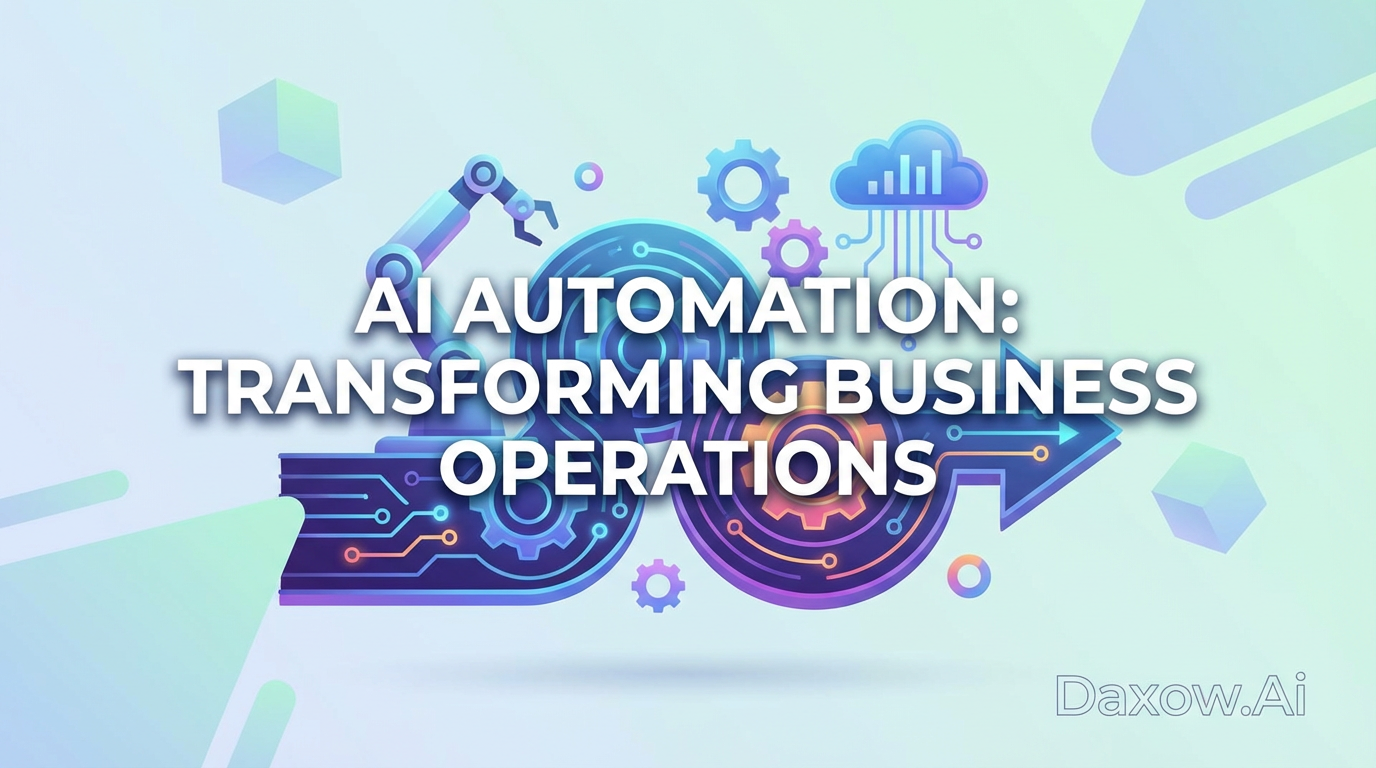
AI Automation: Transforming Business Operations
Practical roadmap for implementing AI agents and workflow automation to reduce costs, boost productivity, and scale operations with Daxow.ai.
AI Automation: Transforming Business Operations for the Modern Enterprise
Estimated reading time: 12 minutes
Key Takeaways
- AI automation is essential now to manage data volume, complexity, and competitive pressure.
- Business outcomes include cost reduction, faster response, and improved customer satisfaction.
- Modern AI agents provide capabilities beyond RPA, including document understanding and conversational automation.
- Real-world use cases span e-commerce, healthcare, finance, real estate, and HR sectors.
- Successful AI automation requires clear goals, data quality, governance, and continuous monitoring.
- Daxow.ai delivers tailored AI automation solutions with proven ROI and scalable integrations.
Table of Contents
- Introduction
- Why AI Automation Matters Now
- How AI Agents and Automation Drive Transformation
- Practical Use Cases Across Industries
- How to Implement AI Automation: A Practical Roadmap
- Measuring ROI and Business Value
- How Daxow.ai Helps Design and Deploy Custom AI Automation
- Practical Examples: Daxow.ai Use Case Scenarios
- Next Steps for Decision-Makers
- Conclusion and Call to Action
- Frequently Asked Questions
Introduction
AI Automation: Transforming Business Operations for the Modern Enterprise is no longer a future scenario — it is a tactical and strategic imperative for companies that want to reduce costs, improve customer experiences, and scale efficiently. Decision-makers from startups to large enterprises are adopting AI-driven workflow automation and AI agents to eliminate repetitive tasks, improve accuracy, and free human talent for higher-value work. This article synthesizes current research and practical guidance into an actionable roadmap for leaders who want measurable business value from AI automation.
Why AI Automation Matters Now
Volume and Complexity of Data
Organizations accumulate more documents, transactions, and interactions than manual teams can reliably manage.
Competitive Pressure
Early adopters convert operational efficiency into better customer experience and faster product cycles.
Mature Enabling Technologies
NLP, supervised learning, and orchestration platforms make AI agents practical and integrable with existing systems.
Business Outcomes to Expect
- Reduced operational costs: Targeted processes can yield up to 20–40% cost reductions.
- Faster, more accurate work: Teams report 30–50% faster response times in automated processes.
- Improved customer metrics: Personalization and automation push higher satisfaction and NPS scores.
Strategic Implications for Leaders
- Move from manual, brittle processes to resilient, monitored automation.
- Shift talent from transactional tasks to strategy, product improvement, and customer success.
- Treat AI-first as an operational capability—embedded in workflows and KPIs, not isolated as an experiment.
How AI Agents and Automation Drive Transformation
AI agents extend traditional RPA by adding reasoning, adaptability, and natural language understanding. They don’t only “click through screens”; they interpret documents, summarize conversations, and trigger decisions across systems.
Capabilities of Modern AI Agents
- Document understanding: Extract structured data from invoices, claims, and contracts.
- Conversational automation: Field customer queries and escalate complex cases appropriately.
- Predictive monitoring: Identify supply chain risks, fraud patterns, or churn signals.
- Action orchestration: Execute multi-step workflows across CRMs, ERPs, and ticketing systems.
Business Benefits
- Reduced manual tasks and errors through reliable data extraction and validation.
- Higher productivity as agents complete repetitive work continuously.
- Scalability: Agents scale with demand without linear increases in headcount.
- Better compliance and auditability: Automated trails and model governance reduce regulatory risk.
Practical Use Cases Across Industries
E-commerce
Use case: Customer support automation + order reconciliation.
What it does: AI agents triage tickets, respond to common queries, create return labels, and flag ambiguous issues for human review.
Impact: 25% higher customer satisfaction, 30–50% reduction in support handle time, fewer stockouts via demand prediction.
Healthcare
Use case: Patient data extraction and triage.
What it does: Automates intake forms, extracts clinical data from records, and flags anomalies for clinician review while preserving privacy.
Impact: Faster triage, lower administrative burden on clinicians, improved compliance through standardized data capture.
Finance
Use case: Automated reconciliation and fraud detection.
What it does: Reconciles invoices and transactions, surfaces anomalies, and generates audit-ready reports.
Impact: Fraud losses reduced significantly; faster close cycles and reduced manual reconciliation time.
Real Estate
Use case: Lead qualification and document population.
What it does: Qualifies leads from web forms and messages, populates contracts and spreadsheets, and schedules viewings automatically.
Impact: Shorter sales cycles, higher conversion rates from prioritized lead follow-up.
HR and Recruitment
Use case: Resume screening and interview scheduling.
What it does: Filters candidates, highlights qualified matches, schedules interviews, and monitors hiring bias.
Impact: Reduced time-to-hire by up to 50%, better candidate experience, and more consistent hiring decisions.
How to Implement AI Automation: A Practical Roadmap
1. Define Clear Goals and Pick High-Impact Processes
- Score candidate processes by volume, error rate, and business value.
- Prioritize quick wins (e.g., invoice reconciliation, ticket triage) to build momentum.
- Set measurable KPIs: cost per transaction, response time, NPS impact.
2. Conduct a Data Audit and Ensure Quality
- Identify required data sources and assess accessibility.
- Standardize formats and create machine-readable pipelines.
- Ensure compliance requirements (privacy, retention, audit logs) are addressed.
3. Choose the Right Tools and Architectures
- Decide between configurable commercial tools and custom models based on scale and complexity.
- Prioritize seamless integration with existing CRMs, ERPs, and ticketing systems for practical workflow automation.
- Select models appropriate to the task: NLP models for queries, supervised models for prediction.
4. Build a Cross-Functional Team and Governance Model
- Include product owners, data engineers, compliance, and end users.
- Embed ethics and bias detection controls from day one.
- Provide training and change-management resources to avoid shadow AI and encourage adoption.
5. Integrate, Deploy, Monitor, and Iterate
- Deploy in phases: pilot, expand, scale.
- Implement monitoring for accuracy, speed, and fairness. Retrain models on fresh data.
- Capture user feedback loops to refine automation and escalate edge cases to humans.
6. Measure Impact and Scale
- Track ROI: cost savings, productivity multipliers, error reduction, and customer metrics.
- Use outcomes to prioritize subsequent automation projects.
Common Pitfalls to Avoid
- Poor data quality or incomplete integration plans.
- Failure to align automation with business KPIs.
- Underinvestment in governance and model retraining.
Measuring ROI and Business Value
AI automation is a measurable investment, not a vague promise. Typical outcomes from targeted deployments include:
- Cost reductions: 20–40% in automated processes.
- Productivity gains: 3–5x improvements in throughput for repetitive tasks.
- Risk reduction: Faster fraud detection and compliance reporting.
- Revenue impact: Shorter sales cycles and improved lead qualification translate to higher conversion rates.
Use a results-driven metric set:
- Process cycle time and throughput
- Error rates and exception volume
- Cost per transaction and headcount redeployment
- Customer satisfaction (CSAT/NPS) and retention
How Daxow.ai Helps Design and Deploy Custom AI Automation
Discovery and Process Analysis
- We map current workflows and identify high-ROI automation targets.
- Deliverable: A prioritized automation roadmap tied to KPIs.
Custom AI Agent and Workflow Design
- We build AI agents that execute real tasks: document extraction, conversational automation, lead qualification, and orchestrated cross-system actions.
- Deliverable: Integrated AI agents connected to your CRM, ERP, and ticketing tools for reliable workflow automation.
Integrations and Data Connectivity
- We create secure, auditable pipelines to consolidate data from your tools into trainable models.
- Deliverable: Scalable integrations with governance controls and logging for compliance.
Deployment, Monitoring, and Continuous Improvement
- We deploy in controlled stages, set monitoring dashboards, and implement retraining cycles to keep models accurate.
- Deliverable: Ongoing performance reports and an iterative improvement plan.
Business-Focused Outcomes
- We emphasize reducing manual tasks, improving productivity, and maximizing ROI.
- Deliverable: Documented cost savings, time-to-value metrics, and business case for expansion.
Explore more about Daxow.ai’s approach in our solutions page and services overview for detailed insights.
Practical Examples: Daxow.ai Use Case Scenarios
Customer Support Automation for a SaaS Company
Challenge: High ticket volumes and slow response times during peak releases.
Solution: Deploy AI agents to auto-triage tickets, provide first-line answers, and route escalations.
Outcome: 40% reduction in first-response time, 30% lower support headcount per ticket volume, improved CSAT.
Invoice Automation for Mid-Market Finance Teams
Challenge: Manual invoice matching and slow month-end reconciliations.
Solution: Document extraction, automated matching rules, and exception workflows integrated with accounting software.
Outcome: 50% faster reconciliations, 35% reduction in late payments, and audit-ready trails.
Lead Qualification for a Real Estate Brokerage
Challenge: High volume of unqualified leads and missed opportunities.
Solution: AI agent analyzes inbound messages and market data to score and route leads to agents automatically.
Outcome: 20% higher conversion rate for qualified leads; faster response increases deal closure speed.
Next Steps for Decision-Makers
- Run a short process analysis to quantify time spent on repetitive tasks.
- Score candidate workflows for automation potential and expected ROI.
- Pilot an AI agent on one high-volume process with measurable KPIs.
Conclusion and Call to Action
AI Automation: Transforming Business Operations for the Modern Enterprise is a practical path to greater productivity, lower costs, and improved customer experience. The technology is mature; the differentiator is execution. Daxow.ai helps businesses map processes, build custom AI agents, integrate systems, and deliver measurable ROI through focused workflow automation.
Book a free consultation with Daxow.ai to request a process analysis for your company and start a pragmatic roadmap toward production-ready business automation. Contact us to build a custom AI system that reduces manual tasks, boosts productivity, and scales with your business.
Frequently Asked Questions
What is AI automation and how does it differ from traditional automation?
AI automation uses artificial intelligence techniques such as natural language processing and machine learning to perform tasks that require reasoning and adaptability, extending beyond traditional rule-based automation that typically involves repetitive mechanical tasks.
Which business processes are best suited for AI automation?
Processes with high volume, repetitive tasks, significant data interaction, and opportunities for accuracy improvements—such as invoice reconciliation, customer support ticket triage, lead qualification, and compliance-related workflows—are ideal candidates.
How do I measure the success of an AI automation project?
Success metrics include cost savings, time reductions, improved throughput, error and risk reduction, customer satisfaction improvements, and headcount redeployment. Setting these KPIs before deployment helps quantify ROI.
How can Daxow.ai help with AI automation implementation?
Daxow.ai offers end-to-end solutions including process analysis, custom AI agent design, secure integration, deployment, monitoring, and continuous improvement to ensure scalable and measurable AI automation tailored to your business needs.