
Mastering AI Automation: Roadmap for Business Transformation
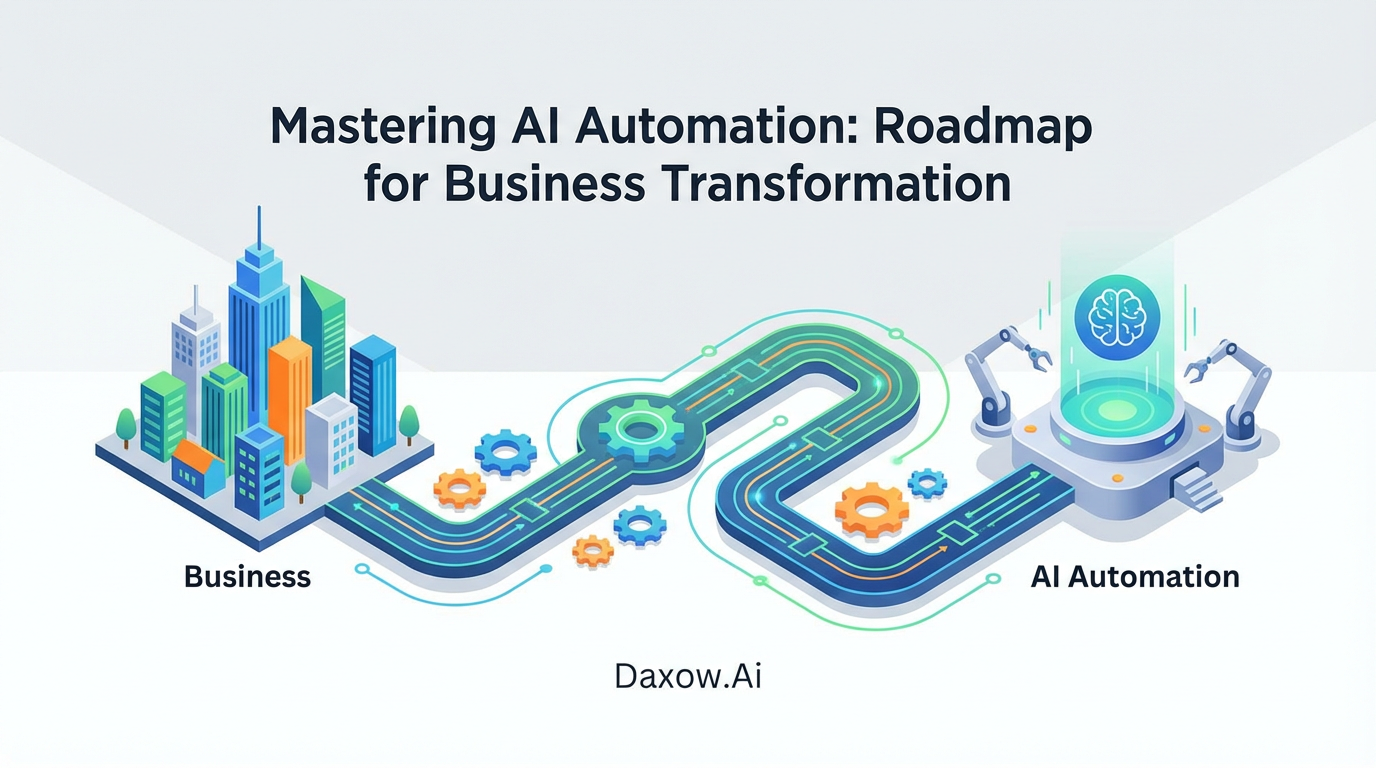
Practical roadmap to implement AI automation and agents: use cases, phased rollout, ROI metrics, governance, and how Daxow.ai delivers secure, fast ROI.
Mastering AI Automation: A Strategic Imperative for Business Transformation
Estimated reading time: 18 minutes
Key Takeaways
- AI automation integrates machine learning, NLP, and robotic process automation to replace repetitive tasks with intelligent workflow systems.
- Significant cost reductions (40–60%) and faster task completion (30–70%) improve customer satisfaction and operational efficiency.
- Industry use cases include e-commerce order processing, healthcare scheduling, finance fraud detection, real estate lead qualification, and HR automation.
- Implementation follows a phased roadmap: assessment, technology selection, preparation, pilot, and scale with continuous monitoring.
- Daxow.ai provides tailored AI agent design, secure integrations, compliance frameworks, and pilot delivery to accelerate ROI.
- Measuring ROI includes tracking cost reduction, time-to-resolution, customer satisfaction, automation rate, and payback period.
- Governance, ethics, and compliance are critical for sustained success with AI automation in regulated industries.
Table of Contents
- Mastering AI Automation: A Strategic Imperative for Business Transformation
- Practical use cases and industry examples
- How AI agents and workflow automation deliver value
- Implementation roadmap — a pragmatic phased approach
- Measuring ROI and business impact
- Governance, ethics, and compliance
- How Daxow.ai partners with you to implement AI automation
- Actionable next steps for decision-makers
- Frequently Asked Questions
Mastering AI Automation: A Strategic Imperative for Business Transformation
Mastering AI Automation: A Strategic Imperative for Business Transformation is not a slogan — it is a practical roadmap for organizations that must reduce manual work, scale operations, and deliver differentiated customer experiences. Business leaders, operations managers, and technology teams face rising expectations: faster responses, 24/7 support, error-free processes, and measurable cost reductions. This article translates current research into an actionable plan for decision-makers, showing how AI automation, workflow automation, and AI agents deliver measurable productivity gains while minimizing implementation risk.
What “AI automation” means for your organization
AI automation integrates machine learning, natural language processing, and robotic process automation into business workflows. The objective is to replace repetitive, rule-based tasks with intelligent systems that:
- Execute tasks consistently and at scale.
- Learn from data to improve outcomes.
- Escalate complex or ambiguous cases to humans.
- Integrate with CRMs, ERPs, and other systems to preserve data consistency.
Business outcomes include up to 40–60% cost reductions in targeted processes, 30–70% faster task completion, and improved customer satisfaction — outcomes validated across multiple industry studies.
Core components of a high-impact AI automation program
- AI agents: Autonomous software that perceives inputs, makes decisions, and triggers actions across systems.
- Workflow automation: Orchestration of multi-step processes, combining rules-based logic with AI decision layers.
- Integrations: Secure connectors to CRM, billing, ERP, ticketing systems, and databases.
- Data and knowledge bases: Clean, structured sources that feed models and decision logic.
- Monitoring and optimization: Continuous measurement and retraining to maintain performance and compliance.
Practical use cases and industry examples
E-commerce — reduce manual tasks in orders and support
Use case: Automating order processing, returns, and support triage.
- What to automate: Order validation, payment reconciliation, shipment tracking updates, returns approvals, and first-line customer queries.
- Example workflow: An AI agent parses incoming emails and chat messages, validates order IDs in the ERP, triggers refunds or exchanges, updates inventory, and creates a follow-up NPS survey.
- Impact: Faster resolution times, reduced cart abandonment, and cost savings in support operations. Typical ROI in 6–12 months for mid-size e-commerce operations.
Healthcare — automate scheduling and compliance-heavy admin tasks
Use case: Patient scheduling, symptom triage, and document classification.
- What to automate: Appointment booking, eligibility checks, insurance pre-authorizations, and intake form extraction.
- Example workflow: An NLP-driven chatbot pre-screens symptoms, schedules patients based on clinician availability, and flags urgent cases to triage nurses. Medical documents are extracted and indexed into the EHR with compliance controls.
- Impact: Reduced administrative workload, lower no-show rates, and better clinician utilization while maintaining HIPAA compliance.
Finance — streamline invoices, fraud detection, and compliance
Use case: Invoice processing and anomaly detection.
- What to automate: Invoice ingestion, PO matching, exception routing, and suspicious-transaction alerts.
- Example workflow: An AI agent extracts line items from invoices, reconciles them against POs in the ERP, routes mismatches for human review, and applies anomaly detection to flag potential fraud.
- Impact: Faster approvals, fewer payment delays, and reduced financial risk.
Real estate — accelerate lead qualification and contract workflows
Use case: Lead qualification, property matching, and automated contract review.
- What to automate: Lead parsing, qualification scoring, matching properties to buyer preferences, and detecting risky contract clauses.
- Example workflow: Leads are ingested from web forms, scored by an AI agent, matched to available listings, and routed to sales reps with suggested next steps and templated contracts.
- Impact: Faster deal velocity, higher conversion rates, and reduced legal bottlenecks.
HR — reduce manual tasks in hiring and employee queries
Use case: Resume screening, onboarding, and benefits FAQs.
- What to automate: Candidate screening based on skills, automated interview scheduling, onboarding checklist automation, and employee self-service bots.
- Example workflow: AI agents shortlist resumes, schedule interviews with hiring panels, trigger background checks, and answer routine benefits questions with escalation to HR for complex cases.
- Impact: Faster time-to-hire, reduced administrative load, and improved candidate experience.
How AI agents and workflow automation deliver value
Why AI agents matter
AI agents combine perception (NLP, vision), reasoning (models, rules), and action (API calls, emails, CRM updates). They:
- Scale support and sales efforts without linear headcount increases.
- Adapt to new inputs, reducing manual tuning over time.
- Orchestrate cross-system processes end-to-end.
Real tasks AI agents perform
- Customer support automation: resolve common queries, process returns, escalate complex issues.
- Sales automation: qualify leads, update CRM records, schedule demos, prepare personalized outreach.
- Document automation: extract, classify, and route contracts, invoices, and forms.
- Monitoring and remediation: detect anomalies and trigger corrective workflows.
Daxow.ai role: We design AI agents that execute real tasks — connecting knowledge bases, automating decision logic, building secure integrations, and deploying monitoring to ensure continuous improvement.
Implementation roadmap — a pragmatic phased approach
Phase 1 — Assessment and planning (4–8 weeks)
Actions:
- Define measurable objectives (e.g., reduce customer service cost by 30%).
- Audit processes to identify high-impact, low-complexity candidates (data entry, FAQs, invoice matching).
- Evaluate data quality and integration points.
Deliverables:
- KPI-based business case.
- Process inventory and prioritization matrix.
Phase 2 — Technology selection and team building (6–12 weeks)
Actions:
- Choose platforms that support NLP, model retraining, and enterprise integrations.
- Form cross-functional teams: IT, business SMEs, security, and change management.
Deliverables:
- Technology stack and integration plan.
- Sourcing and governance model.
Phase 3 — Preparation (4–8 weeks)
Actions:
- Cleanse data and build knowledge bases.
- Document decision trees, SLAs, and escalation paths.
- Prepare security and compliance checklists.
Deliverables:
- Training data sets.
- Deployment and rollback plans.
Phase 4 — Pilot and deployment (4–20 weeks)
Actions:
- Launch a focused pilot (one channel, one business unit).
- Monitor KPIs: resolution rate, handle time, cost per ticket, and customer satisfaction.
- Iterate and expand in waves.
Deliverables:
- Pilot report with ROI analysis.
- Scale plan for enterprise rollout.
Best practices and pitfalls to avoid
Best practices:
- Start small with measurable pilots.
- Invest in data quality and compliance from the outset.
- Involve leadership early for organizational alignment.
- Monitor continuously and iterate based on real metrics.
Pitfalls:
- Over-automating complex tasks without human oversight.
- Ignoring change management and training.
- Underestimating integration complexity.
Measuring ROI and business impact
Key metrics to track
- Cost reduction per process (target 20–50%).
- Time-to-resolution or task completion (30–70% faster).
- Customer satisfaction and NPS changes (15–25% improvement).
- Automation rate (percentage of cases resolved without human intervention).
- Payback period (high-impact pilots often pay back within 6–12 months).
Example ROI scenarios
- A mid-sized e-commerce company automates support triage and returns: 40% reduction in support headcount effort, 20% faster refunds, ROI within 9 months.
- A finance department automates invoice processing and fraud detection: 50% fewer manual reconciliations, 30% faster approvals, and reduced fraud exposure.
- An HR team automates resume screening and onboarding: 60% time reduction in first-stage screening, improved candidate throughput.
Daxow.ai helps quantify expected ROI during Assessment and builds pilot designs that demonstrate payback before scaling. Visit our ROI analysis page to learn more about our data-driven approach.
Governance, ethics, and compliance
Data governance and security
- Ensure encryption at rest and in transit.
- Apply role-based access controls for automation systems.
- Maintain audit trails for decisions made by AI agents.
Ethical and regulatory considerations
- Document model biases and mitigation steps.
- Ensure compliance for regulated industries (e.g., HIPAA in healthcare, financial regulations).
- Provide transparent escalation paths and human-in-the-loop controls.
How Daxow.ai partners with you to implement AI automation
End-to-end service model
Daxow.ai provides:
- Process discovery and readiness assessment.
- Custom AI agent design and workflow automation.
- Integrations with existing CRMs, ERPs, ticketing systems, and databases.
- Security, compliance, and governance frameworks.
- Pilot delivery, monitoring, and scale-up support.
Practical delivery example
- Discovery: We map your current workflows and identify 3 high-impact pilots.
- Build: We design AI agents and integrations, train models on your data, and establish decision logic.
- Pilot: We deploy a controlled pilot, measure KPIs, and refine behavior.
- Scale: We roll out across teams and channels, implement governance, and provide ongoing optimizations.
Why choose Daxow.ai
- Domain-first approach: We prioritize business value and measurable outcomes.
- Integration expertise: We connect AI agents to your stack to ensure data flows securely.
- Operational focus: We automate tasks end-to-end — not just build prototypes.
- Fast ROI: Our clients see accelerated achievement of objectives through targeted pilots and disciplined scaling.
Learn more about our services on our Services page.
Actionable next steps for decision-makers
Immediate checklist
- Identify 2–3 repetitive processes that consume the most time and cost.
- Gather sample data (support transcripts, invoices, resumes).
- Define top-line KPIs and acceptable timelines for pilots.
- Assign an internal sponsor and a cross-functional project team.
What Daxow.ai will deliver in a first engagement
- A process analysis with prioritized automation candidates.
- A pilot blueprint with estimated costs, timelines, and expected ROI.
- A proof-of-concept AI agent that integrates with one chosen system.
Frequently Asked Questions
What types of tasks are best suited for AI automation?
Repetitive, rule-based tasks that require consistency and scale such as order processing, invoice reconciliation, customer support queries, and document classification are ideal for AI automation.
How long does it take to see ROI from AI automation?
Typical ROI is seen within 6 to 12 months depending on the complexity and scale of automation pilots, with many clients experiencing 30-60% cost reduction and increased operational speed.
How does Daxow.ai ensure compliance and security?
Daxow.ai implements encryption, role-based access, audit trails, and follows industry-specific regulations such as HIPAA and financial compliance. Our governance frameworks embed compliance throughout automation lifecycles.
Can AI automation replace human workers?
AI automation complements human work by handling repetitive tasks, allowing employees to focus on higher-value activities. Complex and ambiguous cases are always escalated to human experts to maintain quality and oversight.