
AI Automation: Transforming Enterprise Operations
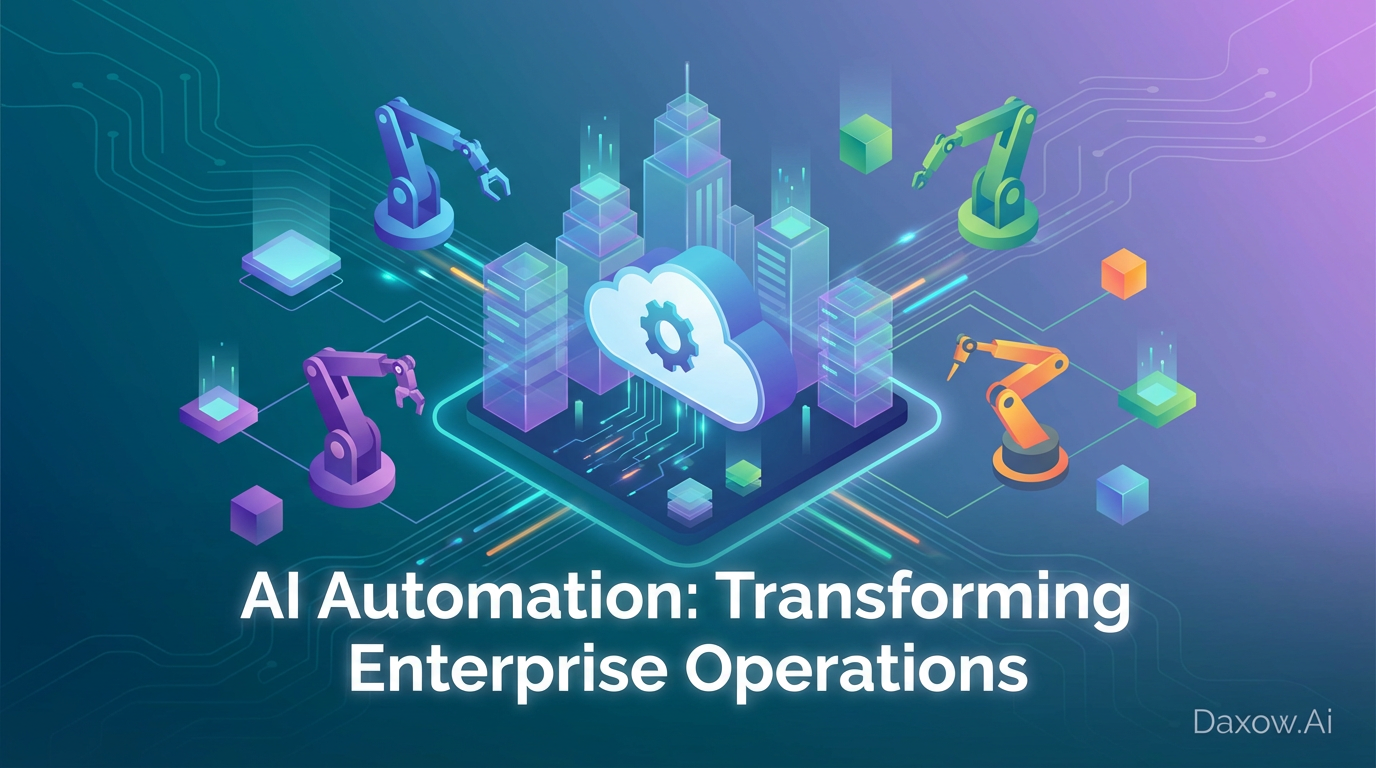
How AI agents and workflow automation cut costs, speed processes, and improve customer experience with industry use cases and a clear implementation roadmap.
AI Automation: Transforming Business Operations for the Modern Enterprise
Estimated reading time: 15 minutes
Key Takeaways
- AI automation reduces manual tasks and human error while improving productivity and customer experience.
- It integrates AI agents with workflow automation to manage complex, data-driven processes end-to-end.
- Industry-specific use cases demonstrate immediate business value in e-commerce, healthcare, finance, real estate, HR, and customer support.
- A clear, structured implementation roadmap accelerates outcomes and mitigates risk.
- Measuring ROI and aligning AI automation with KPIs ensures sustainable business impact.
- Daxow.ai specializes in enterprise-grade AI automation with secure, scalable solutions tailored to client needs.
Table of Contents
- Why AI Automation Matters
- What AI Automation Means for Businesses
- How AI Agents and Automation Deliver Value
- Use Cases and Practical Examples Across Industries
- Implementation Steps and Best Practices
- Measuring ROI and Business Value
- How Daxow.ai Helps Drive AI Automation
- Practical Considerations for Decision-Makers
- Conclusion and Next Steps
- Frequently Asked Questions
Why AI Automation Matters
AI automation combines artificial intelligence with workflow automation to manage data-intensive, repetitive, and decision-driven tasks. Unlike traditional automation that follows rigid rules, AI-driven systems adapt to changing patterns, extract meaning from documents and conversations, and orchestrate multi-step workflows across systems. The priority outcomes for executives are clear:
- Reduce manual tasks and human error.
- Increase productivity and throughput without proportional headcount growth.
- Improve customer experience through faster, personalized responses.
- Lower operational costs and accelerate time-to-value.
These outcomes enable organizations to scale efficiently while maintaining governance and security across enterprise systems.
What AI Automation Means for Businesses
AI automation targets two primary problem classes:
- Rule-based process automation: automating high-volume, deterministic tasks such as invoice posting, order confirmations, and data entry.
- Cognitive automation: using AI agents to interpret documents, summarize content, predict exceptions, and make contextual decisions.
Together, they create an ecosystem where workflows are automated end-to-end — from document ingestion to decision, action, and audit logging. This shift is particularly valuable for businesses operating in regulated or customer-centric sectors where speed and accuracy directly affect revenue and compliance.
How AI Agents and Automation Deliver Value
AI agents are autonomous components that can perceive inputs, reason over context, and take actions. When integrated with workflow automation, they bring several advantages:
- Task mining and process discovery: Agents analyze user activity to find bottlenecks and candidate processes for automation.
- Adaptive decisioning: Machine learning models predict exceptions (e.g., supply chain delays, payment failures) and route workflows for remediation.
- Continuous learning loops: Feedback from users and outcomes is used to retrain models, reducing drift and improving accuracy.
- Governed execution: Centralized controls prevent “shadow AI” by ensuring compliance, logging, and role-based access.
These capabilities scale operations, reduce cycle times, and free teams from repetitive work so they can focus on higher-value tasks.
Use Cases and Practical Examples Across Industries
E-commerce
Use case: Order-to-cash automation and personalization
- Automate order validation, inventory reservation, and invoice generation.
- Use AI agents to predict stockouts based on supplier lead times and past demand.
- Personalize recommendation emails and post-purchase journeys using customer segmentation models.
Business impact:
- Faster fulfillment and reduced late shipments.
- Higher conversion rates through personalized campaigns.
- Lower manual reconciliation between storefronts and ERP systems.
Healthcare
Use case: Document automation and triage
- Automate extraction of patient data from admission forms, insurance documents, and lab reports using OCR + NLP.
- Use AI to summarize clinical notes and flag anomalies for clinician review.
- Orchestrate authorization workflows with payers and notify care teams automatically.
Business impact:
- Shorter administrative times at intake.
- Faster triage and improved patient throughput.
- Better compliance with audit trails for sensitive data handling.
Finance
Use case: Invoice processing and fraud surveillance
- Extract invoice fields automatically and match against purchase orders.
- Automate exception handling with AI agents that route discrepancies to the right owner, suggest probable causes, and recommend resolutions.
- Implement real-time transaction monitoring to detect fraudulent patterns.
Business impact:
- Reduced processing costs and faster vendor payments.
- Higher fraud detection rates and reduced financial exposure.
- Improved auditability for regulators and auditors.
Real Estate
Use case: Lease automation and market analysis
- Auto-populate lease templates with tenant and property data.
- Use AI to summarize market sentiment from listings and social data to support pricing decisions.
- Automate tenant onboarding tasks: background checks, document verification, and billing setup.
Business impact:
- Faster deal cycles and reduced time-to-occupancy.
- Better pricing strategies informed by aggregated market signals.
- Lower administrative overhead in property management.
Human Resources
Use case: Recruitment and employee service automation
- Screen resumes with pattern recognition to shortlist candidates aligned to job requirements.
- Automatically generate job descriptions tailored to role and seniority.
- Implement HR chatbots to answer common policies, schedule interviews, and process leave requests.
Business impact:
- Shorter time-to-hire and better candidate matching.
- Reduced administrative burden for HR teams.
- Higher employee satisfaction with faster responses to queries.
Customer Support and Sales
Use case: Support automation and lead qualification
- Deploy AI agents to respond to common support queries, escalate complex issues, and recommend knowledge base articles.
- Use conversational AI to qualify leads on websites and route high-intent prospects to sales reps with context-rich summaries.
- Integrate with CRM for automated activity logging, follow-ups, and deal stage updates.
Business impact:
- Improved first response times and reduced backlog.
- Higher conversion rates with better lead prioritization.
- Consistent customer experience across channels.
Implementation Steps and Best Practices
A structured approach reduces risk and speeds outcomes. Below is a pragmatic roadmap:
- Define clear objectives
- Set measurable targets (e.g., reduce invoice processing cost by 30%, improve NPS by 10 points).
- Conduct a process audit to identify repetitive, high-volume tasks suitable for automation.
- Assess data quality and accessibility
- Inventory data sources, assess completeness, and standardize formats.
- Address compliance and privacy requirements early, especially in regulated industries.
- Identify processes and select tools
- Prioritize processes that combine high volume with standardized inputs.
- Evaluate platforms for integration capability, scalability, security, and low-code orchestration.
- Build a cross-functional team
- Include business owners, IT, data scientists, security, and change management.
- Define roles for model governance, monitoring, and exception handling.
- Prototype and integrate
- Start with a pilot on a non-critical but visible process.
- Use iterative sprints to integrate with ERPs, CRMs, and collaboration tools.
- Validate outputs with human review and adjust thresholds before full rollout.
- Measure, monitor, and iterate
- Track KPIs: cycle time, processing accuracy, cost per transaction, customer satisfaction.
- Implement continuous feedback loops to retrain models and update rulesets.
Best practices:
- Prioritize data quality to prevent unreliable outcomes.
- Create governance policies to manage bias, access, and model lifecycle.
- Avoid shadow AI by centralizing deployment and monitoring.
- Scale deliberately: prove ROI with one process, then expand.
Measuring ROI and Business Value
AI automation delivers tangible returns when aligned to business KPIs. Typical impacts include:
- Cost savings: 20–40% reduction on repetitive operational tasks through automation and labor reallocation.
- Productivity: 2–5x faster workflows because AI agents handle discovery, extraction, and routing.
- Faster decision-making: reduced latency in approvals and exception handling.
- Improved customer metrics: higher NPS and retention through personalization and faster servicing.
- Risk reduction: better fraud detection and compliance monitoring.
A pragmatic ROI approach:
- Calculate baseline cost and time for a given process.
- Estimate automation-enabled reductions in time and error rate.
- Include deployment and ongoing maintenance costs to compute payback period.
- Expect many pilots to reach payback within 6–12 months when targeted at high-volume processes.
How Daxow.ai Helps Drive AI Automation
Daxow.ai specializes in designing and delivering enterprise-grade AI automation that converts strategy into measurable outcomes. Our end-to-end services include:
- Process discovery and task mining to identify high-impact automation opportunities.
- Custom AI agents that execute real tasks: extract, decide, act, and log.
- Workflow automation that integrates with existing systems: CRMs, ERPs, ticketing systems, and databases.
- Secure data pipelines and model governance to meet compliance and privacy requirements.
- Iterative deployment with clear KPI measurement and continuous optimization.
Typical engagement flow with Daxow.ai:
- Discovery: We map workflows, stakeholders, and success metrics.
- Pilot: Build a focused proof-of-value that automates a core process.
- Scale: Extend automation across systems and teams with robust governance.
- Optimize: Monitor performance and retrain models as data and business needs evolve.
Examples of Daxow.ai deliverables:
- An AI agent that qualifies leads from website chats, enriches profiles from public data, and creates pre-filled CRM opportunities for sales.
- An invoice automation pipeline that ingests PDFs, validates line items against purchase orders, and triggers payments on approval.
- A customer support automation stack combining chatbots, knowledge base retrieval, and escalation workflows to improve SLA compliance.
Practical Considerations for Decision-Makers
- Focus on outcomes, not technology features. Measure impact in time saved, error reductions, and revenue influence.
- Treat AI automation as a program, not a one-off project. Governance and retraining are continuous responsibilities.
- Empower business teams with tooling and training to realize sustained adoption.
- Choose partners that can integrate across systems and deliver turnkey automation, reducing internal engineering burden.
Conclusion and Next Steps
AI Automation: Transforming Business Operations for the Modern Enterprise is an actionable strategy for organizations that want to reduce manual tasks, boost productivity, and improve customer experiences. By combining AI agents with workflow automation and secure integrations, businesses can achieve rapid ROI while positioning themselves for long-term agility.
If you are ready to move from pilot to production, Daxow.ai can help you design and implement a custom AI system tailored to your processes and goals. Book a free consultation with our team to request a process analysis for your company and start automating the workflows that matter most. Contact us to build a custom AI system that reduces costs, improves outcomes, and scales with your business.
Frequently Asked Questions
What is AI automation and how does it differ from traditional automation?
AI automation integrates artificial intelligence with workflow automation, enabling systems to adapt, learn, and make decisions rather than simply following fixed rules. This allows for handling complex, data-driven tasks and continuous improvement through learning loops.
Which industries benefit most from AI automation?
Industries such as e-commerce, healthcare, finance, real estate, human resources, and customer support experience significant benefits due to their reliance on repetitive and data-intensive processes, requiring compliance, personalization, and speed.
How does Daxow.ai support AI automation implementation?
Daxow.ai offers end-to-end services including process discovery, custom AI agent development, workflow integration, secure pipelines, and ongoing optimization to ensure measurable business outcomes and compliance.
What are the key steps to successfully implement AI automation?
Key steps include defining clear objectives, assessing data quality, selecting appropriate tools, building cross-functional teams, prototyping and integrating with existing systems, and continuously measuring and iterating to optimize the process.