
AI-Powered Customer Service: AI Agents & Workflow Automation
How AI agents and workflow automation streamline customer support, reduce costs, and improve FCR/NPS across industries — includes Daxow.ai's implementation roadmap.
AI-powered customer service automation: How AI Agents and Workflow Automation Transform Support Operations
Estimated reading time: 15 minutes
Key Takeaways
- AI automation reduces manual support tasks, improving productivity and lowering operational costs.
- Combining AI agents with workflow automation delivers measurable improvements in response times and customer satisfaction.
- Industry-specific use cases demonstrate versatile benefits from e-commerce to healthcare and finance.
- Daxow.ai’s methodology ensures custom AI solutions with clear ROI and scalable automation systems.
- Tracking KPIs such as automation rate, FCR, and SLA compliance is critical for successful implementation.
Table of Contents
- Why AI-powered customer service automation matters
- Research summary and business implications
- How AI-powered customer service automation works (an architectural overview)
- AI-powered customer service automation — Industry use cases and practical examples
- Designing AI Agents for customer service automation — Daxow.ai’s approach
- Implementation roadmap — Step-by-step for business leaders
- Measuring ROI — Metrics that matter
- Risks, governance, and change management
- How Daxow.ai helps you implement AI-powered customer service automation
- Frequently Asked Questions
Why AI-powered customer service automation matters
- Reduce manual tasks: Automated workflows and AI agents remove repetitive activities such as ticket triage, status updates, and routine troubleshooting, freeing staff for high-value work.
- Improve productivity: Faster response times and 24/7 automated support increase throughput and customer satisfaction.
- Lower operational costs: Routing, self-service, and automated resolutions lower average handling time (AHT) and shrink staffing needs.
- Scale without linear staffing: Automation allows support volumes to grow without proportional headcount increases.
- Provide consistent experiences: AI-driven knowledge bases and agents ensure uniform answers and reduce human error.
Research summary and business implications
- Enterprises that adopt AI automation in customer service report improvements in response times, first-contact resolution (FCR), and net promoter score (NPS).
- Workflow automation combined with AI agents significantly reduces repetitive work: organizations document up to 30–50% time savings on routine tasks when properly implemented.
- Automated triage and routing reduce SLA breaches by prioritizing critical issues and escalating appropriately.
- Integration of AI with CRMs and backend systems increases resolution rates because agents can access contextual data and execute actions on behalf of customers.
Combining AI agents with robust workflow automation delivers measurable operational and financial benefits.
How AI-powered customer service automation works (an architectural overview)
- Data ingestion: Conversational logs, support tickets, chat transcripts, CRM data, and knowledge bases are centralized.
- NLP and intent classification: AI models identify customer intent and extract entities.
- Decision orchestration: Workflow automation engines apply business rules and route actions.
- AI agents and action execution: Agents handle conversational flows, run lookups, open/modify records, and trigger downstream processes.
- Continuous learning: Feedback loops update models and knowledge bases to improve accuracy.
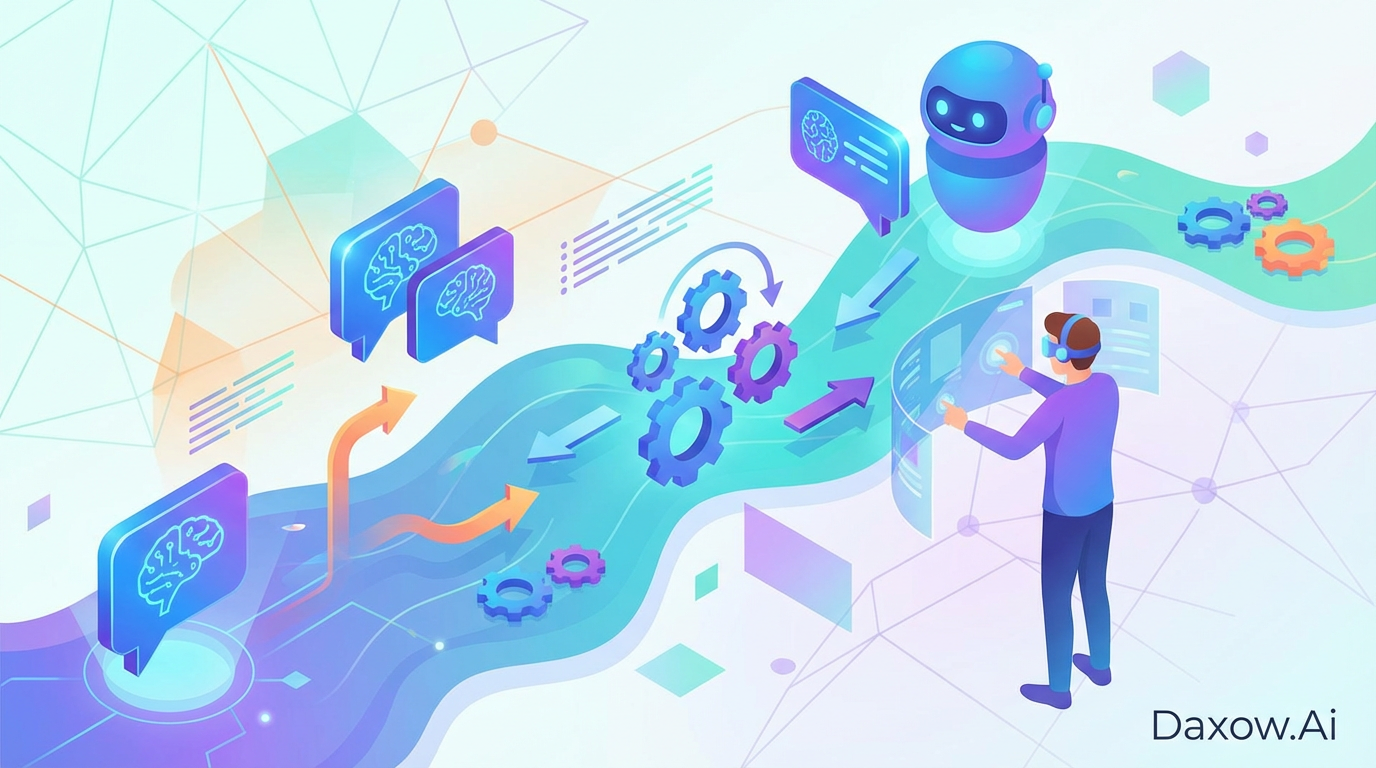
Daxow.ai connects these components into end-to-end systems, integrating with CRMs, ticketing tools, and business applications to ensure secure, auditable automation.
AI-powered customer service automation — Industry use cases and practical examples
E-commerce — Faster conversions and lower return friction
- Use case: Automated order status, returns processing, and refund approvals.
- How it works: An AI agent reads an incoming chat/email, authenticates the customer, checks order status via CRM, and initiates refunds or generates return labels using workflow automation.
- Business impact: Reduced average handling time, higher self-service resolution rates, and increased customer retention.
Practical example: A 24/7 chat agent accepts a return request, verifies purchase, triggers an automated RMA workflow, and updates both the customer and logistics partner without human intervention.
Healthcare — Secure, compliant patient support
- Use case: Appointment scheduling, pre-visit triage, and follow-up reminders.
- How it works: AI agents collect symptom information, verify insurance, schedule appointments, and push tasks to clinicians when necessary.
- Business impact: Reduced no-shows, improved patient experience, and lower administrative burden.
Practical example: An AI agent conducts pre-screening questions, escalates red-flag symptoms to clinicians, and posts structured data to EHR systems through secured integrations.
Finance — Faster account services and fraud detection
- Use case: Account inquiries, KYC document processing, and suspicious-activity triage.
- How it works: Automation extracts data from documents, updates account records, and flags anomalies for human review.
- Business impact: Improved compliance throughput, faster onboarding, and reduced fraud-related losses.
Practical example: An AI agent runs a KYC workflow that extracts identity information, matches against watchlists, and creates a compliance ticket when thresholds are exceeded.
Real estate — Streamlined lead qualification and property management
- Use case: Lead qualification, appointment scheduling, and maintenance requests.
- How it works: AI agents qualify leads through chat, book viewings, and generate tickets for maintenance crews with priority routing.
- Business impact: Shorter sales cycles, higher lead-to-conversion rates, and faster property turnaround.
Practical example: A lead messages with property interest; the AI verifies budget and timeline, pre-fills CRM data, and assigns a high-priority lead to a salesperson.
HR and administrative teams — Faster employee onboarding and support
- Use case: Employee FAQs, onboarding task automation, and benefits enrollment.
- How it works: Automated workflows provision accounts, collect documents, and answer HR policy questions via a virtual assistant.
- Business impact: Reduced HR admin time, faster new-hire productivity, and higher employee satisfaction.
Practical example: A new hire asks about benefits; the AI agent walks through plan options, captures selections, and triggers benefits enrollment APIs.
Designing AI Agents for customer service automation — Daxow.ai’s approach
Discovery and process mapping
- Map current workflows, systems, and pain points.
- Identify repetitive tasks that are cost-effective to automate.
- Define success metrics: AHT, FCR, SLA compliance, NPS, and cost per ticket.
- Deliverable: Process analysis and automation roadmap.
Data strategy and integrations
- Centralize customer interaction data and knowledge sources.
- Plan secure integrations with CRM, ticketing systems, billing, and ERP.
- Clean and structure data for intent classification and entity extraction.
- Deliverable: Data connectivity plan and integration blueprint.
AI agent design and orchestration
- Build intent classifiers, entity extractors, and dialogue flows.
- Design AI agents to perform actions (e.g., update CRM records, trigger refunds).
- Implement decision orchestration to handle exceptions and escalations.
- Deliverable: Custom AI agents that execute real tasks.
Workflow automation and RPA
- Automate back-office steps that follow conversational triggers.
- Use workflow engines to ensure audit trails and SLA enforcement.
- Combine RPA for legacy systems where APIs are not available.
- Deliverable: End-to-end workflow automation.
Pilot, measure, iterate
- Launch a controlled pilot for high-impact channels.
- Monitor performance, retrain models, and refine flows.
- Scale once KPIs meet targets.
- Deliverable: Continuous improvement plan.
Implementation roadmap — Step-by-step for business leaders
- Assess readiness (2–4 weeks)
- Inventory tools and processes.
- Quantify ticket volumes and repetitive task hours.
- Set target KPIs.
- Prioritize use cases (2 weeks)
- Rank by impact, feasibility, and compliance constraints.
- Start with high-frequency, low-risk tasks.
- Build integrations and data pipelines (4–8 weeks)
- Connect CRMs, ticketing systems, and databases.
- Establish secure access and logging.
- Develop AI agents and workflows (6–12 weeks)
- Train intent models on historical tickets.
- Build conversation flows and action execution modules.
- Pilot with monitoring (4–8 weeks)
- A/B test automation vs. manual handling.
- Collect metrics: automation rate, FCR, SLA attainment, user satisfaction.
- Scale and optimize (ongoing)
- Expand channels, add languages, and refine automations.
- Put governance in place for model updates and data privacy.
Measuring ROI — Metrics that matter
- Automation rate: Percentage of requests fully handled by automation.
- Average handling time (AHT): Time to resolution; automation should reduce this.
- First-contact resolution (FCR): Increased FCR indicates better agent efficacy.
- Cost per ticket: Reduced headcount and time lower this metric.
- SLA compliance: Fewer breaches due to automated prioritization.
- Customer satisfaction (CSAT/NPS): Measure customer acceptance and experience.
- Employee productivity: Time reclaimed for strategic work.
Example ROI calculation (illustrative)
- Baseline: 100,000 annual tickets; average cost per ticket $6; total cost $600,000.
- Automation handles 40% of tickets → 40,000 tickets automated.
- If automated ticket cost is $1 (platform + infra) vs. $6 manual, annual savings = 40,000 × ($6 − $1) = $200,000.
- Factor in additional savings from reduced escalations and higher retention for a fuller picture.
Risks, governance, and change management
Common risks
- Poorly trained models leading to incorrect responses.
- Over-automation that frustrates customers.
- Integration failures disrupting workflows.
- Data privacy and compliance breaches.
Mitigations
- Configure clear escalation paths and human-in-the-loop controls.
- Phased rollout with pilot and feedback loops.
- Strong access controls, encryption, and compliance checks.
- Ongoing monitoring and model validation.
How Daxow.ai helps you implement AI-powered customer service automation
Daxow.ai provides end-to-end AI automation services tailored to your business:
- Discovery and process analysis to identify the highest-value automation opportunities.
- Custom AI agents that understand context, extract entities, and execute actions.
- Workflow automation and RPA to close the loop across systems and teams.
- Secure integrations with CRMs, ticketing systems, ERPs, and communication channels.
- Continuous monitoring, retraining, and ROI tracking to ensure long-term value.
- Change management support to align teams, update KPIs, and ensure adoption.
Why partner with Daxow.ai
- Domain expertise in building production-grade AI automation systems.
- Business-first approach: solutions focused on measurable cost reductions and productivity gains.
- End-to-end delivery: from data integration to production AI agents and governance.
- Scalable systems that grow with your business needs.
Learn more about our solutions on our services page and explore case studies on Daxow.ai case studies.
Conclusion and next steps
AI-powered customer service automation is a strategic investment that reduces manual tasks, improves productivity, and enhances customer experience. For organizations across e-commerce, healthcare, finance, real estate, and HR, the combination of AI agents and workflow automation delivers measurable improvements in cost, speed, and quality of service.
To move forward:
- Identify a high-frequency support task for an initial pilot.
- Define clear success metrics and a 90-day roadmap.
- Choose a partner that can integrate your systems, build reliable AI agents, and take ownership of ROI tracking.
Book a free consultation with Daxow.ai to request a process analysis for your company and start building a custom AI system that automates support, reduces costs, and improves customer satisfaction. Contact us to design and deploy AI agents that execute real tasks and deliver measurable business value.
Frequently Asked Questions
What are AI agents in customer service automation?
AI agents are automated systems powered by natural language processing and machine learning that handle customer interactions, execute tasks, and integrate with backend workflows to deliver support without human intervention.
How quickly can businesses expect ROI from AI-powered automation?
ROI depends on the complexity and scale of implementation, but many organizations see measurable cost savings and improved KPIs within 3 to 6 months of piloting and optimizing their AI automation deployments.
Is workflow automation necessary alongside AI agents?
Yes, workflow automation orchestrates backend actions and business rules triggered by AI agents, ensuring seamless end-to-end processing and SLA adherence beyond conversational AI capabilities alone.
How does Daxow.ai ensure data privacy and compliance?
Daxow.ai implements strong encryption, access controls, and compliance checkpoints integrated within the automation framework, as well as continuous monitoring to safeguard sensitive customer data and meet regulatory requirements.