
AI Customer Service Automation: Agents, Workflows & ROI
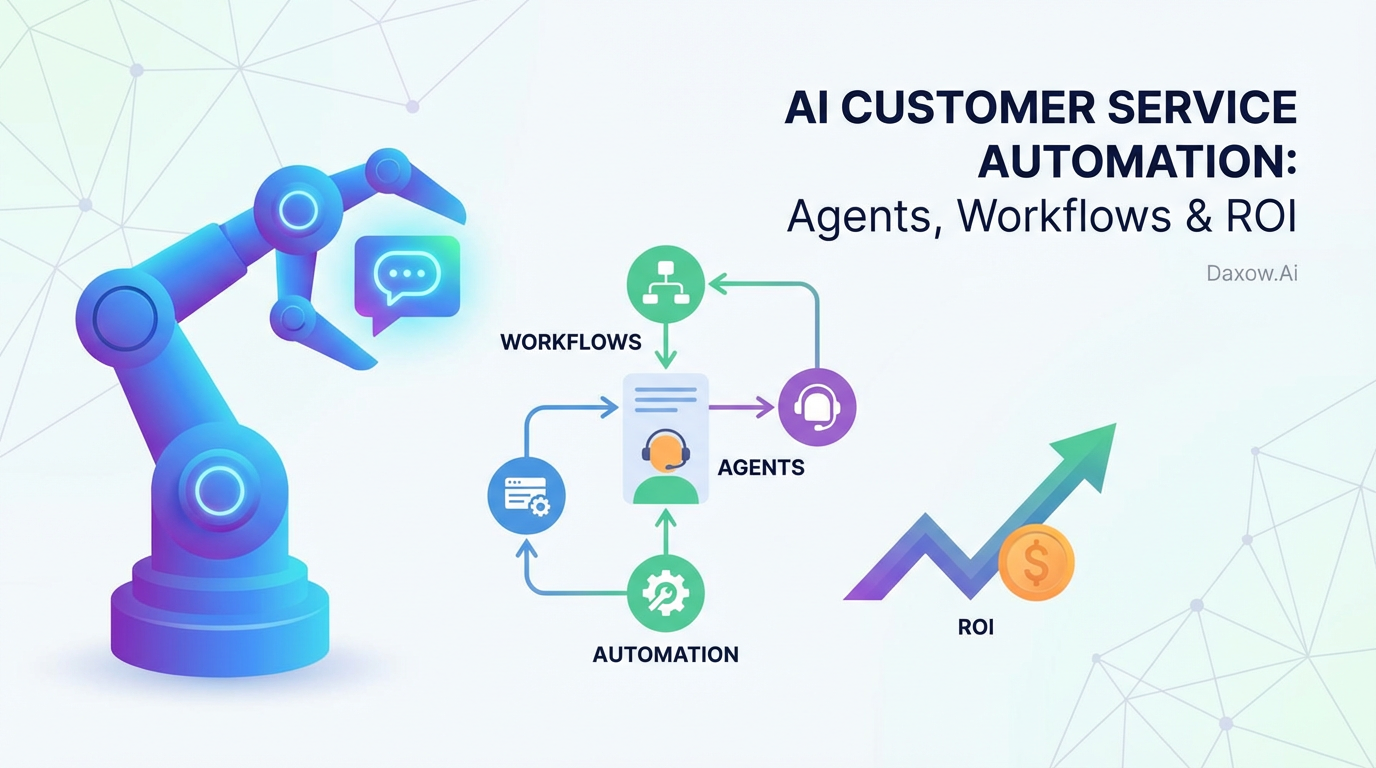
Practical guide to AI customer service automation—how AI agents and workflow automation reduce costs, speed responses, and scale support, with use cases and a roadmap.
AI customer service automation: How AI Agents and Workflow Automation Transform Support and Drive Business Value
Estimated reading time: 15 minutes
Key Takeaways
- AI customer service automation reduces costs, improves customer experience, and scales support efficiently.
- Combining AI agents with workflow automation handles routine tasks, escalates complex cases, and integrates backend systems.
- Use cases span e-commerce, finance, healthcare, real estate, and SaaS, delivering measurable business value.
- A structured implementation roadmap drives successful deployment and scaling of AI-powered support systems.
- Tracking KPIs and applying best practices ensures governance, compliance, and continuous improvement.
- Daxow.ai offers tailored services from discovery to scale and ongoing optimization.
Table of Contents
- AI customer service automation — why it matters for business leaders
- How AI agents and workflow automation work together
- Practical use cases across industries
- Implementation roadmap — from process analysis to production
- Measuring success — KPIs and ROI
- Best practices and risk management
- Technology stack considerations
- How Daxow.ai helps you implement AI customer service automation
- Quick-win project examples Daxow.ai delivers
- Getting started — a recommended first project
- Frequently Asked Questions
AI customer service automation — why it matters for business leaders
Customer expectations are rising: faster answers, consistent accuracy, and seamless multi-channel experiences. At the same time, operations teams face pressure to reduce cost-to-serve and increase agent capacity. AI customer service automation addresses both by combining AI agents with workflow automation to handle routine interactions, route complex cases to humans, and orchestrate backend processes.
Key business benefits
- Lower operational costs: Automating repeatable tasks reduces manual workload and cost per contact.
- Faster response times: AI agents provide immediate or near-immediate first responses across channels.
- Higher productivity: Support teams focus on high-value tasks instead of repetitive processes.
- Improved customer experience: Consistent, 24/7 support with fewer handoffs and faster resolution.
- Better insights: Automated logging and analytics surface trends, root causes, and SLA risks.
Core capabilities that enable this
- Conversational AI agents (chatbots and voice assistants)
- Automated ticket triage, routing, and escalation
- Knowledge base augmentation and retrieval-augmented generation (RAG)
- Document and form processing (OCR + NER)
- Workflow automation and system integrations (CRMs, billing, order systems)
- Human-in-the-loop orchestration and agent assist tools
How AI agents and workflow automation work together
AI agents excel at interpreting intent, retrieving relevant information, and performing predefined actions. Workflow automation ensures that those actions trigger end-to-end business processes reliably.
Typical interaction flow
- Customer initiates contact (chat, email, phone, social).
- AI agent performs intent detection and slot-filling.
- Knowledge retrieval or document extraction provides context and answers.
- If required, the AI executes automated actions (order status check, refund initiation, password reset).
- Workflow engine updates systems (CRM, ticketing, billing) and notifies stakeholders.
- Complex cases are escalated to human agents with context-rich handoff.
Where manual tasks are reduced
- Repetitive Q&A (shipping times, account status)
- Data entry and ticket categorization
- First-line troubleshooting and triage
- Routine approvals and refunds (within policy)
- Post-call summarization and follow-up scheduling
Practical use cases across industries
E-commerce — faster fulfillment and lower returns friction
Use cases:
- Automated order status checks and shipping updates across carriers.
- AI-driven returns and refund processing with policy validation and automatic refund initiation.
- Post-purchase outreach and personalized upsell or retention workflows.
Business impact: Reduced average handling time, fewer support tickets, and higher repeat purchase rates through timely communication.
Finance and banking — secure, compliant support at scale
Use cases:
- Secure identity verification and balance queries via conversational agents.
- Automated account reconciliation and dispute intake with document extraction.
- Proactive fraud alerts and automated workflow triggers for compliance review.
Business impact: Lower fraud review costs, faster dispute resolution, and reduced regulatory risk through audit-ready logs.
Healthcare — better patient experience and administrative relief
Use cases:
- Appointment scheduling and reminders integrated with EHR systems.
- Intake form processing and prior authorization requests automated via document extraction.
- Triage bots that route patients to the right clinician or escalate emergent cases.
Business impact: Improved patient access, lower no-show rates, and reduced administrative burden for clinicians.
Real estate and property management — streamline leasing and maintenance
Use cases:
- Tenant portals with AI agents for rent queries, maintenance requests, and lease renewals.
- Automated vetting and scheduling for showings, including calendar synchronization.
- Maintenance triage that files tickets, estimates cost, and schedules vendors.
Business impact: Faster response times to tenant issues, reduced vacancy days, and lower property management costs.
SaaS and B2B tech — scale customer success
Use cases:
- Automated onboarding sequences with interactive walkthroughs.
- In-product assistants that diagnose configuration issues and generate remediation steps.
- Lead qualification and routing from support channels into sales automation.
Business impact: Higher product adoption, shorter time-to-value, and improved churn metrics.
Implementation roadmap — from process analysis to production
1 — Discovery and process mapping
- Map current workflows end-to-end, identify volume, pain points, and SLA targets.
- Prioritize use cases based on cost-to-serve, customer impact, and automation feasibility.
- Output: Process inventory and prioritized automation backlog.
2 — Data and systems assessment
- Inventory knowledge bases, ticketing systems, CRMs, call recordings, and documents.
- Identify data quality gaps and compliance requirements (PII, HIPAA, GDPR).
- Output: Integration map and data readiness plan.
3 — Design AI agents and workflows
- Define conversational flows, escalation points, and action sets the AI can perform.
- Create fallback strategies and human-in-the-loop workflows for edge cases.
- Output: Agent specifications and workflow diagrams.
4 — Build and integrate
- Develop AI agents using retrieval-augmented generation, intent classifiers, and NLU.
- Connect to backend systems via APIs and automation platforms; implement secure credentials management.
- Implement document automation for claims, invoices, and forms.
- Output: Integrated test environment with end-to-end automation.
5 — Pilot and iterate
- Start with a limited channel or customer segment; measure intent recognition, deflection rate, and CSAT.
- Tune prompts, knowledge sources, and policy thresholds.
- Output: Pilot metrics and scaling plan.
6 — Scale and govern
- Roll out to additional channels, languages, and use cases.
- Implement monitoring, performance dashboards, and compliance auditing.
- Establish continuous improvement loops and retraining schedules.
- Output: Production system with governance and ROI tracking.
Measuring success — KPIs and ROI
Concrete metrics let you quantify business automation impact. Track these KPIs:
Operational KPIs
- Ticket deflection rate (percentage of contacts resolved by AI).
- Average handle time (AHT) for human agents.
- First response time and time to resolution.
- Cost per contact and overall cost-to-serve.
Customer KPIs
- CSAT and NPS for automated interactions.
- Self-service completion rate.
- Churn impact attributable to faster resolution.
Business KPIs
- Revenue influenced via automated upsell or lead qualification.
- Reduction in FTEs or redeployment of staff to higher-value work.
- Time savings on back-office processes (in hours saved per month).
Typical outcomes:
Many clients see significant reductions in manual tasks (30–60%), faster response times, and measurable cost reductions within months. Results will vary based on complexity, data quality, and integration depth.
Best practices and risk management
Maintain a human-centered design
- Design AI agents to be transparent about capabilities and handoffs.
- Provide clear escalation paths and agent assist tools so humans remain effective.
Ensure data privacy and compliance
- Apply role-based access, encryption, and audit logs.
- Keep sensitive workflows under stricter controls and human review where required.
Build for observability and continuous learning
- Log interactions and outcomes to retrain intent models and knowledge retrieval.
- Use A/B tests and guardrails to prevent regression.
Avoid over-automation
- Prioritize high-frequency, low-risk workflows for full automation.
- Use semi-automated workflows for higher risk or ambiguous tasks to minimize false actions.
Technology stack considerations
A practical architecture for customer support automation typically includes:
- Large language models and NLU engines for conversation understanding.
- Retrieval-augmented generation (RAG) layered on internal knowledge stores.
- OCR and document intelligence for invoices, contracts, and forms.
- Workflow automation and orchestration engines to connect systems and execute actions.
- CRM and ticketing system integrations for stateful context and logging.
- Monitoring dashboards and analytics for KPIs and compliance.
Daxow.ai specializes in assembling these components into robust, business-ready systems. We focus on secure integrations, custom agent behavior, and end-to-end workflow automation to ensure the AI does not work in isolation but as part of your operational backbone.
How Daxow.ai helps you implement AI customer service automation
Discovery and process analysis
- We map your current support workflows, quantify manual tasks, and prioritize automation candidates.
- Deliverable: A process analysis report and prioritized automation roadmap.
Custom AI agent development
- We design and build AI agents trained on your knowledge and integrated with your systems.
- Agents are built with clear escalation rules and human-in-the-loop capabilities.
Workflow automation and integrations
- We implement automated workflows that execute business actions (refunds, claims, ticket updates) and connect to CRMs, billing, and ERP systems.
- Security-first integrations and role-based access are standard.
Pilot, measure, scale
- Daxow.ai runs pilots, measures KPIs, tunes models, and scales successful automations.
- Continuous monitoring and retraining maintain performance as products, policies, and customer needs evolve.
Operational support and optimization
- We provide managed services to maintain your AI agents, implement new automations, and continuously improve ROI.
Quick-win project examples Daxow.ai delivers
- Automated triage and routing for a mid-market e-commerce platform: 45% ticket deflection in 90 days.
- AI-driven intake and case creation for a financial services firm: 60% reduction in manual processing time for disputes.
- Appointment scheduling and reminders for a multi-clinic healthcare provider: 30% reduction in no-shows and lower administrative overhead.
Getting started — a recommended first project
If you are evaluating AI customer service automation, start with a targeted pilot:
- Choose a high-volume, low-risk workflow (order status, password resets, appointment booking).
- Define success criteria: deflection rate, response time, cost savings.
- Implement a prototype AI agent with integrations to your primary systems.
- Measure results for 4–8 weeks and plan phased expansion.
This approach limits risk, demonstrates tangible value quickly, and establishes the foundation for broader business automation.
AI customer service automation is no longer optional for companies that want to grow efficiently while maintaining exceptional customer experience. By combining AI agents with workflow automation and deep system integrations, businesses can reduce manual tasks, increase productivity, and unlock measurable ROI.
Ready to transform your support operations? Book a free consultation with Daxow.ai or request a process analysis for your company. Contact us to build a custom AI system that automates your most time-consuming workflows and delivers measurable business automation value.
Frequently Asked Questions
What types of customer service tasks are best suited for AI automation?
Tasks that are repetitive, high volume, and rule-based such as FAQs, order status checks, ticket triage, and routine refunds are excellent candidates for AI automation. Complex or sensitive cases still benefit from human intervention with AI support.
How does workflow automation complement AI agents?
While AI agents handle natural language understanding and user interaction, workflow automation reliably triggers backend processes such as CRM updates, billing changes, and notifications, ensuring end-to-end task completion.
How do I measure the ROI of AI customer service automation?
Track KPIs like ticket deflection rate, handle time, customer satisfaction (CSAT), cost per contact, and business outcomes like revenue influenced or staff redeployment. Improvements in these metrics indicate positive ROI.
Is customer data privacy addressed in AI automation?
Yes, best practices include role-based access controls, encryption, audit logging, and human review for sensitive workflows to maintain compliance with regulations like GDPR and HIPAA.