
Mastering AI Implementation: Automation & Intelligent Agents
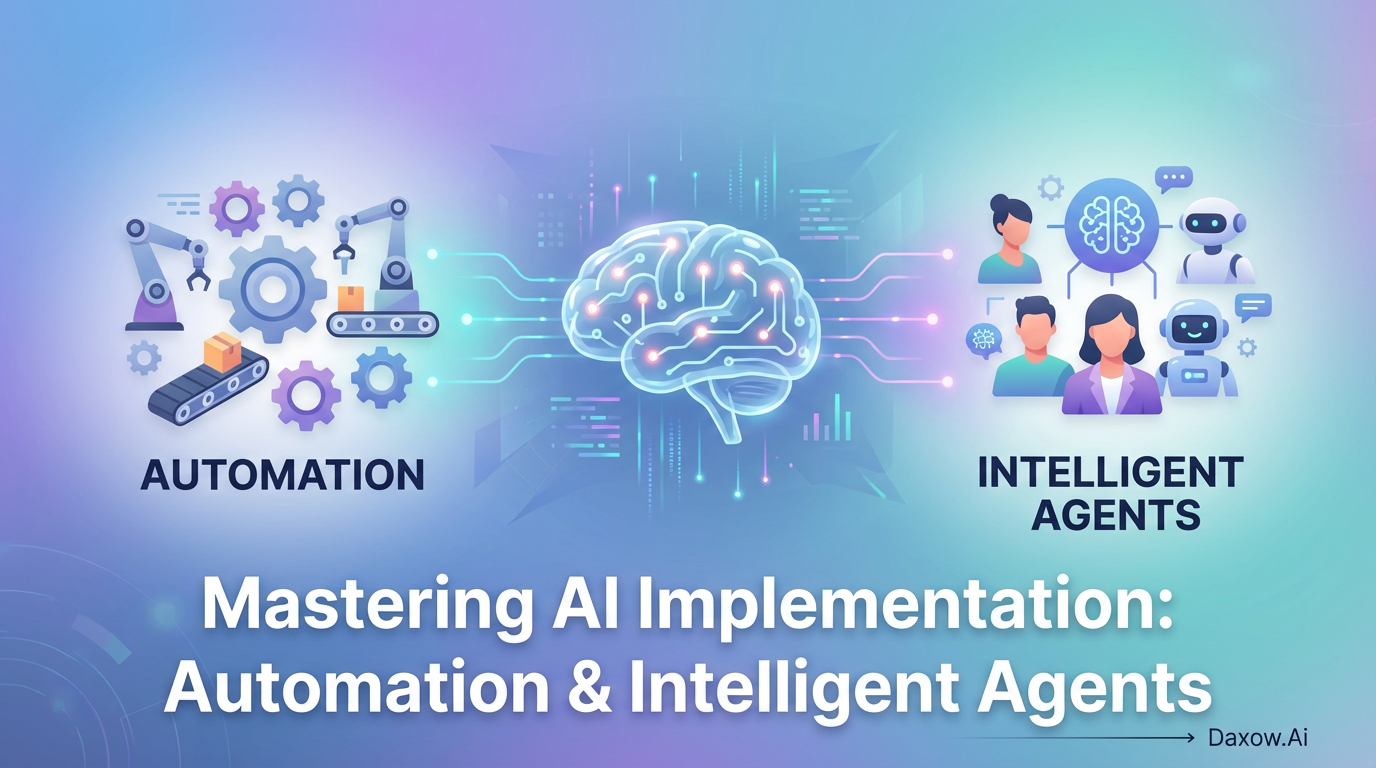
Practical guide to deploying AI agents and workflow automation to reduce manual work, boost productivity, and drive measurable ROI—includes practical use cases and Daxow.ai approach.
Mastering AI Implementation: Unlocking Business Transformation Through Automation and Agents
Estimated reading time: 15 minutes
Key Takeaways
- Successful AI implementation reduces manual tasks and improves productivity through automation and AI agents.
- Industry-specific AI use cases demonstrate measurable business impacts across e-commerce, healthcare, finance, real estate, HR, and manufacturing.
- Phased implementation with governance and data readiness ensures scalable and ethical deployments.
- Daxow.ai delivers custom AI solutions integrating workflow automation with existing systems to drive ROI and business transformation.
- Tracking KPIs and maintaining continuous optimization are critical for long-term AI success.
Table of Contents
- Mastering AI Implementation: Unlocking Business Transformation Through Automation and Agents
- What AI Implementation Means for Businesses
- Practical Use Cases Across Industries
- How AI Agents and Automation Drive Success
- Implementation Steps and Best Practices
- Calculating ROI and Measuring Success
- How Daxow.ai Delivers End-to-End Business Automation
- Quick Start Checklist for Decision-Makers
- Frequently Asked Questions
Mastering AI Implementation: Unlocking Business Transformation Through Automation and Agents
AI implementation refers to integrating machine learning, natural language processing, and autonomous AI agents into business operations to automate work, extract insights, and enable faster, smarter decisions. For business leaders, successful AI implementation delivers three outcomes:
- Reduced manual work through automation of repetitive, rule-based tasks.
- Improved productivity by augmenting human teams with AI agents that operate 24/7.
- Stronger business automation across customer support, sales, finance, HR, and operations.
Research and field experience show that well-executed AI initiatives commonly yield 20–40% operational efficiency gains, faster cycle times, and measurable customer satisfaction improvements. Conversely, poor implementation risks wasted investment, governance issues, and compliance failures. The right strategy balances rapid pilots for early wins with governance and data readiness for scalable deployment.
What AI Implementation Means for Businesses
From manual processes to autonomous operations
AI implementation transforms static, manual workflows into adaptive, data-driven systems. Key capabilities include:
- Predictive analytics to forecast demand, churn, or risk.
- Autonomous AI agents that perceive context, make decisions, and execute multi-step tasks.
- Workflow automation that connects data sources, business rules, and human approvals.
These capabilities enable organizations to scale operations without linear headcount increases and to redirect human effort toward strategic work.
Business risks and governance
Effective implementation must address data quality, privacy, and compliance. Organizations should classify sensitive data, build audit trails, and implement ethical AI governance aligned to regulations like GDPR or industry-specific rules (e.g., HIPAA in healthcare). Starting small with controlled pilots reduces risk while validating business value.
Practical Use Cases Across Industries
E-commerce — personalized experiences and conversion uplift
Use Case: An AI agent monitors site behavior and combines customer history, inventory signals, and pricing models to provide personalized recommendations and dynamic prices. A chat-based AI agent handles 24/7 inquiries, processes returns, and qualifies post-purchase issues.
Business impact:
- Reduced manual tasks in customer support and merchandising.
- Increased conversions via personalized product recommendations.
- Inventory efficiency: fewer stockouts and improved forecasting.
How Daxow helps: We build integrated AI agents that connect to your e-commerce platform, CRM, and warehouse systems to automate recommendations, price updates, and support flows.
Healthcare — triage, records automation, and compliance
Use Case: A symptom-triage chatbot collects initial information, schedules appropriate appointments, and extracts structured information from clinical notes and referral documents using NLP.
Business impact:
- Faster patient routing, reduced administrative burden on clinical staff.
- Improved compliance by redacting and classifying PHI for secure workflows.
- More time for clinicians to focus on care delivery.
How Daxow helps: We design HIPAA-aligned data pipelines and AI agents that integrate with EHRs to automate intake and documentation.
Finance — fraud detection and loan processing
Use Case: Real-time fraud-detection models flag anomalous transactions. A loan-processing agent pre-screens applications, pulls relevant documents, runs credit checks, and routes borderline cases to underwriters.
Business impact:
- Reduced error rates and faster approvals (days to minutes).
- Lower fraud losses and processing costs.
- Improved customer experience with faster decisions.
How Daxow helps: We integrate AI models with core banking systems and CRMs, automating decision logic while maintaining auditability.
Real Estate — lead qualification and virtual tours
Use Case: AI agents extract data from inquiries, qualify leads based on buyer intent and budget, and schedule virtual tours. Augmented reality and automated valuation models provide on-demand property insights.
Business impact:
- Shorter sales cycles, better agent productivity.
- Higher lead-to-client conversion through rapid follow-up.
How Daxow helps: We automate lead routing into CRMs and deploy conversational agents that move prospects through the funnel.
HR — recruitment automation and retention analytics
Use Case: AI screens resumes, scores candidates against job profiles, schedules interviews with intelligent calendars, and analyzes employee sentiment to predict churn.
Business impact:
- 50% faster hiring cycles and improved candidate matching.
- Proactive retention strategies based on predictive signals.
How Daxow helps: We implement candidate scoring systems and integrate interview scheduling with HRIS and calendar tools.
Manufacturing & Supply Chain — orchestration and predictive maintenance
Use Case: AI agents optimize production schedules based on demand forecasts and trigger maintenance workflows when sensors indicate wear.
Business impact:
- Reduced downtime, optimized inventory levels, and lower operational costs.
How Daxow helps: We link IoT data streams with workflow automation to create end-to-end supply chain orchestration.
How AI Agents and Automation Drive Success
AI agents are autonomous software entities that perceive context, make decisions, and execute tasks. Combined with workflow automation, they become “digital workers” that handle end-to-end processes.
Core capabilities of AI agents
- Unstructured data processing: NLP and computer vision to extract meaning from emails, invoices, images, and documents.
- Decision-making: Rule-based and probabilistic models that route tasks, escalate exceptions, and recommend actions.
- Systems integration: API-driven connectivity to ERPs, CRMs, ticketing systems, and databases.
- Continuous learning: Feedback loops that improve accuracy over time.
Example agent workflows
- Customer support agent: Triage incoming tickets, resolve common queries, escalate complex cases, and update the CRM.
- Sales qualification agent: Capture lead data, enrich profiles, score leads, and schedule discovery calls.
- Invoice processing agent: Extract line-item data, match to purchase orders, flag variances, and trigger approvals.
These workflows reduce human touchpoints for repetitive work and accelerate throughput for higher-value exceptions.
Implementation Steps and Best Practices
A structured, phased approach mitigates risk and maximizes ROI. The following hybrid framework synthesizes proven methodologies into a practical roadmap.
Phase 1 — Define goals and assess readiness
- Identify high-impact processes with measurable KPIs.
- Perform a data readiness audit: availability, quality, and access.
- Set realistic success criteria and stakeholder alignment.
Phase 2 — Collect and cleanse data
- Centralize data from silos and cleanse duplicates and errors.
- Prioritize datasets that enable quick wins for workflow automation.
Phase 3 — Condition and comply
- Classify data and implement protection policies.
- Ensure compliance with regulations and create audit trails.
Phase 4 — Choose tools and models
- Select platforms compatible with your tech stack (low-code options for speed; custom models where differentiation matters).
- Leverage transfer learning and pre-trained models to accelerate development.
Phase 5 — Build the team and integrate systems
- Form cross-functional squads (IT, operations, domain experts).
- Pilot in sandboxes with clear rollback plans.
Phase 6 — Deploy, monitor, and optimize
- Deploy incrementally, monitor KPIs, and iterate with feedback loops.
- Maintain model governance and versioning.
Best practices and pitfalls to avoid
- Start small: Validate ROI with pilots before scaling.
- Communicate change: Secure stakeholder buy-in through transparent plans.
- Govern AI ethically: Maintain logs, bias checks, and compliance.
- Avoid over-automation: Preserve human oversight for creative or high-risk decisions.
- Don’t neglect data quality: Poor inputs equal poor outputs.
Calculating ROI and Measuring Success
Measuring AI’s business impact requires clear KPIs and realistic timelines.
Key metrics to track
- Time saved per process (hours).
- Cost reduction on routine tasks (%).
- Error rate reduction (%).
- Revenue uplift from personalization or speed to customer.
- Customer satisfaction (CSAT, NPS).
- Lead-to-conversion or processing time improvements.
Example ROI scenario
A mid-size company automates invoice processing. Baseline: accounting team processes 1,000 invoices monthly, 10 FTEs, average handling time 3 hours per invoice. Post-automation: Handling time drops 75%, team reduced to 3 FTEs focused on exceptions.
Estimated savings include a labor cost reduction of 60–70% on that process. If labor and error costs were $300k annually, net gains after implementation costs can produce a payback within 6–12 months and 3x+ returns over 18–24 months when scaled.
Research shows enterprises following phased rollouts often achieve 3–5x returns within 18–24 months. Daxow.ai works with clients to build measurable KPIs and a roadmap to achieve these outcomes.
How Daxow.ai Delivers End-to-End Business Automation
Discovery and process mapping
We start by mapping current workflows, identifying bottlenecks, and quantifying opportunity areas where AI automation will have the most impact.
Data engineering and compliance
Our team designs secure data pipelines, handles cleansing and classification, and implements compliance controls to protect sensitive information.
Custom AI agents and integrations
We build AI agents tailored to your use cases — from customer support automation to sales automation and document extraction. Agents are integrated with your CRM, ERP, HRIS, and other systems via APIs to ensure seamless data flow.
Pilot, scale, and continuous improvement
We deploy pilot projects to validate KPIs and iterate rapidly. After proving value, we scale applications, optimize models, and embed monitoring to sustain performance.
Measurable outcomes
- Reducing operational costs by automating repetitive tasks.
- Increasing productivity through 24/7 AI agents that handle volume spikes.
- Improving customer experience with faster, more accurate support.
- Delivering ROI via phased rollouts and transparent measurement.
Learn more about how Daxow.ai’s AI solutions can transform your business.
Quick Start Checklist for Decision-Makers
- Identify 1–3 processes with high volume and clear KPIs for pilot projects.
- Conduct a data readiness assessment and secure data access.
- Appoint an executive sponsor and a cross-functional implementation team.
- Choose a partner with proven integration and compliance experience.
- Plan for change management: communication, training, and governance.
- Run a 6–12 week pilot with measurable goals before scaling.
Frequently Asked Questions
What industries benefit most from AI implementation?
AI implementation brings value across a wide range of industries including e-commerce, healthcare, finance, real estate, HR, manufacturing, and supply chain. Each industry leverages AI differently to automate tasks, improve customer experience, and increase operational efficiency.
How does Daxow.ai ensure compliance with data privacy regulations?
Daxow.ai incorporates data classification, redaction, and audit trail mechanisms to meet regulations such as GDPR and HIPAA. Our data engineering processes emphasize security, privacy, and ethical AI governance tailored to industry needs.
What is the typical timeline for AI implementation projects?
AI implementation projects usually begin with 6–12 week pilots focused on measurable KPIs. Successful pilots can then be scaled incrementally, with full enterprise rollout often achieved within 12–24 months depending on scope and complexity.
How can businesses measure the ROI of AI initiatives?
By defining clear KPIs such as time saved, cost reductions, error rate improvements, revenue uplift, and customer satisfaction metrics before implementation. Continuous monitoring and optimization enable quantifiable measurement of ROI throughout the project lifecycle.