
Mastering AI Implementation: Business Automation & Agents
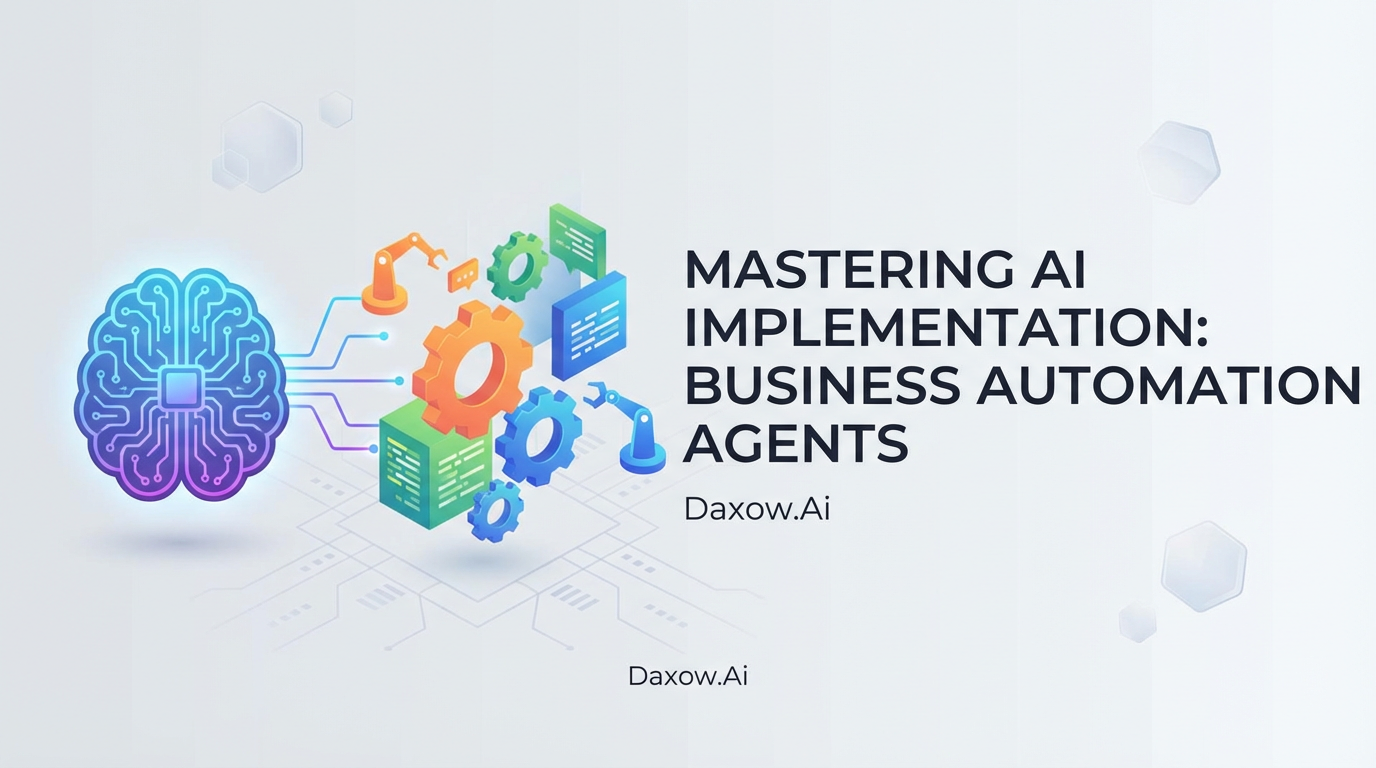
Practical roadmap for implementing AI agents and workflow automation - use cases, phased rollout, ROI benchmarks, and how Daxow.ai delivers end-to-end solutions.
Mastering AI Implementation: Unlocking Business Transformation Through Automation and Agents
Estimated reading time: 15 minutes
Key Takeaways
- AI implementation drives operational resilience, cost reduction, and scalable, accurate service delivery.
- Industry-specific AI automation use cases deliver measurable ROI within months.
- AI agents differ from traditional automation by enabling context, orchestration, adaptation, and governance.
- A phased, governance-focused implementation roadmap maximizes success and mitigates common pitfalls.
- Daxow.ai offers custom AI agents and workflow automation integrated deeply into enterprise systems.
Table of Contents
- Mastering AI Implementation: Unlocking Business Transformation Through Automation and Agents — Why it matters
- Practical Use Cases — Where AI automation and AI agents deliver immediate value
- How AI Agents and Workflow Automation Drive Success
- Implementation Steps and Best Practices — A pragmatic roadmap
- Common pitfalls and mitigation strategies
- Measuring ROI and Business Value
- How Daxow.ai Delivers End-to-End Business Automation
- Next steps — How to start mastering AI implementation in your organization
- Frequently Asked Questions
Mastering AI Implementation: Unlocking Business Transformation Through Automation and Agents — Why it matters
AI implementation transforms manual, repetitive processes into intelligent, scalable systems. The strategic value is clear:
- Operational resilience: AI agents and workflow automation handle peak demand without linear headcount increases.
- Cost reduction: Targeted automation can reduce operational costs by up to 40% in selected areas.
- Speed and accuracy: Routine tasks move from hours or days to seconds, reducing human error.
- Scalability of service: 24/7 AI-driven interactions improve customer satisfaction and conversion rates.
For leaders, the question shifts from whether to implement AI to how to implement it responsibly and profitably. The best programs prioritize high-impact workflows, strong data foundations, and continuous measurement.
Practical Use Cases — Where AI automation and AI agents deliver immediate value
E-commerce — Customer support automation and sales automation
- Use case: Deploy AI agents to handle FAQs, returns, order tracking, and dynamic upsell recommendations.
- Impact: AI handles up to 80% of routine chats, cutting response times from hours to seconds and increasing conversion with personalized product suggestions.
- Implementation elements: Integrate with CRM, inventory systems, and payment gateways. Use NLP models for intent recognition and recommendation engines for dynamic offers.
- Business outcome: Higher conversion rates, lower support headcount for routine tickets, and improved average order value.
Healthcare — Scheduling, triage, and administrative automation
- Use case: Chat-based triage, automated scheduling, insurance verification, and document extraction.
- Impact: Administrative burden reductions of ~30%, improved clinician time allocation, and HIPAA-compliant automation.
- Implementation elements: Secure data handling, role-based access, and workflows that escalate to clinicians when necessary.
- Business outcome: Faster patient onboarding, fewer missed appointments, and a measurable uplift in clinician productivity.
Finance — Invoice processing, fraud detection, and compliance automation
- Use case: Automate invoice reconciliation, real-time transaction monitoring, and regulatory reporting.
- Impact: Manual review reduction by ~50%, faster exception handling, and lower compliance risk.
- Implementation elements: Combine OCR/document automation with anomaly detection models and API integrations to core accounting systems.
- Business outcome: Reduced days payable outstanding, faster month-end close, and lower fraud losses.
Real Estate — Lead qualification and operational automation
- Use case: AI-driven lead qualification, automated property valuations, and scheduling virtual tours.
- Impact: Faster lead routing and prioritization of high-intent prospects, accelerating deal cycles.
- Implementation elements: CRM integration, valuation models, and calendar automation with multi-channel engagement.
- Business outcome: Higher lead-to-deal conversion, fewer missed opportunities, and improved agent productivity.
HR — Resume screening, candidate engagement, and churn prediction
- Use case: Automated screening for initial candidate fit, conversational interviews, onboarding workflows, and employee churn modeling.
- Impact: Faster hiring cycles, improved hire quality, and reduced turnover costs.
- Implementation elements: Structured interview bots, ATS integration, and predictive analytics layered on HRIS data.
- Business outcome: Lower cost-per-hire, higher retention, and more strategic talent acquisition.
How AI Agents and Workflow Automation Drive Success
What differentiates AI agents from traditional automation
- Contextual understanding: Agents use NLP and knowledge bases to interpret intent rather than rely solely on rigid rules.
- Orchestration: Agents execute multi-step processes across CRM, ERP, and third-party services via APIs.
- Adaptation: Agents learn from interactions and can trigger retraining or escalate to humans when confidence is low.
- Monitoring and governance: Continuous performance metrics and bias checks keep agents aligned to business goals.
Real-world orchestration example
Imagine an insurance claim:
- Customer submits claim via chat (NLP interprets intent).
- Agent extracts documents (document automation), validates policy data (CRM lookup), and scores risk (predictive model).
- Low-risk claims are auto-approved and scheduled for payout; high-risk claims route to human review.
This reduces cycle time, minimizes manual entry, and enforces compliance automatically.
Implementation Steps and Best Practices — A pragmatic roadmap
Phase 1 — Assessment and planning (4–8 weeks)
- Define clear objectives: target a measurable KPI like 20% cost reduction or NPS improvement.
- Audit data sources: identify gaps, formats, and integrations.
- Map processes: document decision points and handoffs for candidate workflows.
- Compliance check: ensure regulatory requirements (GDPR, HIPAA) are addressed.
- Daxow role: We run a process analysis to prioritize use cases and estimate ROI.
Phase 2 — Technology selection (6–12 weeks)
- Choose models and tooling aligned with the use case: supervised models, NLP stacks, or document extraction platforms.
- Evaluate integration capabilities with your CRM, ERP, and other systems.
- Decide on hosting and security posture (cloud, private cloud, or on-prem).
- Daxow role: We architect a modular stack that fits your ecosystem and avoids vendor lock-in.
Phase 3 — Preparation and data readiness (4–8 weeks)
- Clean and label data; construct a knowledge base and decision trees.
- Assemble cross-functional teams: IT, operations, compliance, and business SMEs.
- Prepare change management plans and training materials.
- Daxow role: We lead data engineering and create the governance framework for model lifecycle management.
Phase 4 — Pilot deployment and rollout (4–20 weeks)
- Launch a focused pilot for a single use case.
- Track defined KPIs (response time, automation rate, cost reduction).
- Iterate rapidly based on user feedback and model performance.
- Expand scope once reliability and ROI are proven.
- Daxow role: We deploy AI agents, monitor performance in real time, and manage phased scaling.
Phase 5 — Ongoing optimization
- Retrain models, update knowledge bases, and maintain audit trails.
- Monitor for model drift and bias; implement alerts for anomalies.
- Institutionalize continuous improvement and communicate wins internally.
- Daxow role: We provide long-term support, retraining, and enhancements as your business evolves.
Common pitfalls and mitigation strategies
- Vague objectives: Tie automation to specific KPIs.
- Poor data readiness: Invest early in data hygiene and ingestion pipelines.
- Ignoring change management: Train users and share short-term wins.
- Over-automation: Keep humans in the loop for exceptions and ethical decisions.
Daxow helps mitigate these by focusing on early wins, rigorous data preparation, and stakeholder alignment.
Measuring ROI and Business Value
Expected financial outcomes
- ROI: Projects often deliver 200–400% ROI within 12–18 months.
- Cost savings: Targeted processes can see 30–50% savings.
- Productivity: Teams accomplish objectives 3–5x faster, enabling staff to focus on strategic tasks.
- Revenue uplift: Personalized automation and sales automation can increase revenue 15–25%.
Key metrics to track
- Automation rate (percentage of tasks fully automated).
- Time-to-resolution or cycle time reduction.
- Error rate reductions and compliance exceptions avoided.
- Customer satisfaction (NPS/CSAT) and conversion lift.
- Total cost of ownership vs. manual processing costs.
Daxow’s approach ties automation outcomes to these metrics from day one and provides transparent dashboards to monitor progress and validate ROI.
How Daxow.ai Delivers End-to-End Business Automation
What we deliver
- Custom AI agents that execute multi-step workflows and make data-driven decisions.
- Workflow automation bridging CRM, ERP, ticketing systems, and internal databases.
- Customer support automation with handoffs to human agents for complex cases.
- Sales automation and lead qualification to prioritize high-intent prospects.
- Document automation and data extraction to eliminate manual entry.
- System integrations across APIs, webhooks, and enterprise connectors.
How we work
- Start with a process analysis and ROI estimate.
- Deliver a pilot in 8–12 weeks for most standard use cases.
- Iterate with your teams, then scale while maintaining governance and security.
- Provide ongoing monitoring, retraining, and performance optimization.
Why choose Daxow.ai
- Practicality: We prioritize high-impact, low-complexity workflows for early wins.
- Integration-first design: Our agents work with your systems from day one.
- Human-centered automation: We augment your teams and preserve oversight for exceptions.
- Outcome focus: We measure success by cost reduction, productivity gains, and customer impact.
Learn more about our solutions and how Daxow.ai can unlock your business transformation.
Next steps — How to start mastering AI implementation in your organization
If your organization is ready to reduce manual tasks, improve productivity, and deploy reliable AI agents, begin with a structured process analysis.
- Request a targeted process analysis to identify high-impact automation opportunities.
- Pilot a single use case with measurable KPIs.
- Scale iteratively with governance, monitoring, and continuous improvement.
Explore more about our services to get started now.
Frequently Asked Questions
What industries benefit most from AI automation?
Industries including e-commerce, healthcare, finance, real estate, and HR see immediate and measurable benefits from AI automation by streamlining customer support, administrative tasks, compliance, and lead management.
How long does a typical AI implementation project take?
Most pilots run between 3 to 6 months, followed by phased rollout and scaling. Full implementation timelines depend on complexity, but Daxow.ai pilots typically deliver actionable results within 8-12 weeks.
What differentiates AI agents from traditional automation tools?
AI agents use contextual understanding, orchestration, and adaptability far beyond scripted automation. They learn from interactions and maintain governance to align with business goals continuously.
How does Daxow.ai ensure compliance and data security?
We incorporate secure data handling, role-based access, and industry-standard compliance checks such as GDPR and HIPAA from the planning phase through ongoing operations.