
AI Process Automation: Enterprise Roadmap & Daxow.ai Solutions
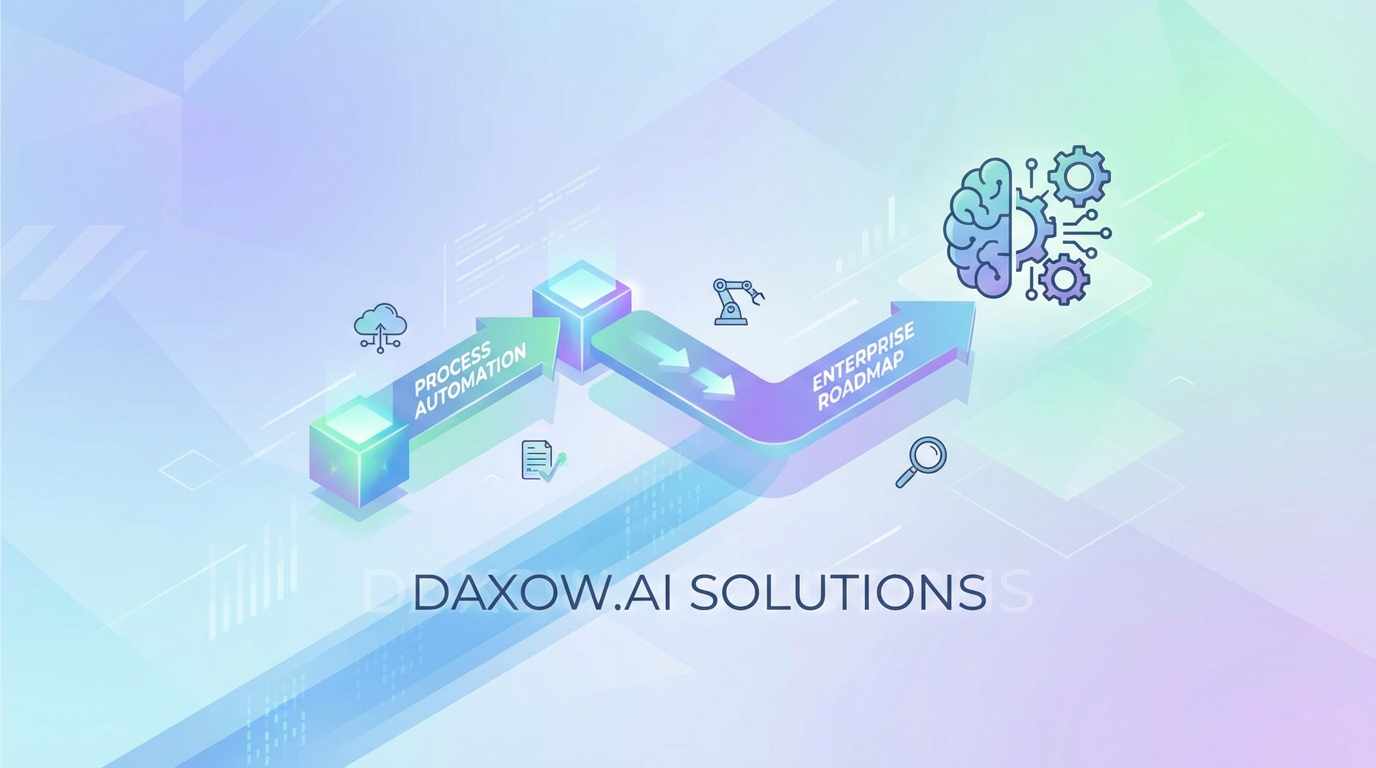
Learn how AI process automation transforms enterprise operations: use cases, ROI, implementation roadmap, and how Daxow.ai builds custom AI agents to scale workflows.
AI Process Automation: Transforming Business Operations for the Modern Enterprise
Estimated reading time: 15 minutes
Key Takeaways
- AI process automation integrates AI technologies with workflow orchestration for smarter, faster business operations.
- Industries like e-commerce, healthcare, financial services, and more benefit from reduced manual tasks and improved productivity.
- Implementation requires assessment, preparation, pilot testing, and scaling with best practices to ensure success.
- Daxow.ai offers end-to-end AI automation solutions designed to deliver measurable cost savings and operational scalability.
- Effective AI agents and governance improve accuracy, accelerate decision-making, and maintain compliance and security.
Table of Contents
- AI Process Automation: Transforming Business Operations for the Modern Enterprise
- Practical Use Cases: Industry-by-Industry Examples
- How AI Agents and Workflow Automation Drive Impact
- Implementation Roadmap: From Assessment to Scale
- ROI and Business Value
- How Daxow.ai Helps You Implement AI Process Automation
- Real-world Example: A Typical Engagement with Daxow.ai
- Actionable Next Steps for Decision-Makers
- Conclusion and Call to Action
- Frequently Asked Questions
AI Process Automation: Transforming Business Operations for the Modern Enterprise
What AI Process Automation Means for Business Leaders
Definition and core capabilities
AI process automation integrates artificial intelligence (machine learning, natural language processing, computer vision) with robotic process automation and workflow orchestration. The result is systems that:
- Process unstructured and structured data automatically.
- Make context-aware decisions and adapt over time.
- Orchestrate multi-step workflows across teams and systems.
- Execute actions through integrations and AI agents that behave like specialized virtual employees.
Why it matters now
In today’s fast-moving markets, manual workflows are a bottleneck to growth. Organizations that adopt business automation and AI automation report faster cycle times, lower error rates, and the ability to redeploy staff to strategic work. Key business outcomes include:
- Reduced manual tasks and operational costs.
- Improved productivity through automation of high-volume processes.
- Faster, more accurate customer support and sales processes.
- Scalable systems that support growth without linear increases in headcount.
Practical Use Cases: Industry-by-Industry Examples
E-commerce and Retail
- Inventory and fulfillment automation: AI agents predict demand, trigger replenishment orders, and optimize warehouse pick paths.
- Customer support automation: Chatbots triage inquiries, process returns, and escalate complex cases to human agents with context.
- Sales automation: Personalized recommendations and dynamic pricing engines that increase conversion and AOV.
Business impact: Lower stockouts, higher conversion rates, and reduced customer support costs.
Healthcare
- Clinical administration: Automated patient scheduling, prior authorization processing, and claims reconciliation.
- Clinical decision support: AI triage agents flag anomalies in imaging and lab results, reducing diagnostic delays.
- Compliance automation: Systems automatically validate documentation and enforce regulatory rules.
Business impact: Faster patient throughput, fewer billing errors, and improved compliance.
Financial Services
- Fraud detection and KYC: Real-time transaction analysis and automated identity verification reduce fraud exposure.
- Loan processing: Automated document extraction, credit scoring, and decisioning accelerate approvals.
- Audit and reporting: Continuous monitoring and automated generation of audit trails.
Business impact: Shorter processing times, reduced risk, and measurable cost savings.
Real Estate and Property Management
- Lead qualification: AI agents qualify inbound leads by analyzing intent and property criteria, routing hot leads to sales.
- Contract automation: NLP-based extraction and review speed due diligence and lease processing.
- Market intelligence: Predictive models for pricing and demand forecasting.
Business impact: Faster deal cycles and fewer manual appraisals.
HR and Administrative Operations
- Recruitment automation: Resume screening, interview scheduling, and candidate scoring reduce time to hire.
- Onboarding workflows: Automated document collection and training assignment streamline new hire workflows.
- Employee experience: Chat-based HR assistants answer policy questions and track requests.
Business impact: Faster hiring, lower administrative overhead, and improved retention.
How AI Agents and Workflow Automation Drive Impact
What AI agents can do
AI agents are autonomous software entities that combine LLM-driven reasoning, API integrations, and workflow orchestration. They can:
- Interpret unstructured inputs (emails, contracts, images).
- Make decisions based on rules and learned patterns.
- Execute transactions across CRM, ERP, ticketing, and other systems.
- Continuously learn from corrections and outcomes to improve accuracy.
Examples of agent-driven workflows
- A sales automation agent qualifies leads, enriches CRM records, schedules a demo, and notifies account executives with a summary and recommended next action.
- A customer support automation agent ingests an incoming support email, triages severity, applies known-resolutions, and escalates complex cases with contextual notes.
- A finance operations agent matches incoming invoices to purchase orders, routes exceptions to AP staff, and posts transactions automatically when rules are satisfied.
Implementation Roadmap: From Assessment to Scale
1 — Assess and prioritize
- Map current workflows and measure baseline metrics: volume, cycle time, error rates, and cost.
- Identify high-volume, rule-based, or exception-prone processes that will benefit most from AI automation.
- Prioritize use cases by expected ROI and ease of integration.
2 — Prepare data and systems
- Inventory data sources and integrate with existing systems (CRM, ERP, ticketing, document stores).
- Cleanse and label data where necessary; apply access controls and data governance.
- Ensure compliance and security are built in from day one.
3 — Select technology and governance
- Choose a technology stack that supports AI agents, RPA, and workflow orchestration with easy integrations.
- Establish governance: model validation, monitoring, and escalation rules.
- Create cross-functional teams combining IT, operations, and business owners.
4 — Pilot and iterate
- Run small pilots with clear KPIs (e.g., 30% time savings, 50% reduction in errors).
- Use user feedback to refine decision rules and agent behavior.
- Measure against baselines and quantify improvements.
5 — Scale and operationalize
- Standardize successful pilots into reusable components and templates.
- Invest in change management and training to maximize adoption.
- Build a center of excellence to maintain models, manage integrations, and govern usage.
Best practices and common pitfalls
- Start small to deliver quick wins and build organizational trust.
- Focus on measurable outcomes, not technical novelty.
- Avoid poor data hygiene and underestimating integration complexity.
- Prioritize user experience to ensure human-AI collaboration is seamless.
ROI and Business Value
Expected outcomes
Organizations report:
- Significant cost reductions in automated processes (often 40–70%).
- Large decreases in error rates (50–90%).
- Productivity gains of 3–5x in optimized workflows.
- Payback periods commonly within 6–18 months depending on scope.
How ROI materializes
- Lower operational headcount for repetitive tasks, enabling redeployment to high-value work.
- Faster revenue cycles through streamlined sales and finance operations.
- Better customer retention driven by faster and more accurate customer support.
- Scalability: systems scale with transaction volume without proportional staffing increases.
How Daxow.ai Helps You Implement AI Process Automation
End-to-end delivery and expertise
Daxow.ai is built to design and deliver bespoke AI automation solutions that align with business objectives. Our approach includes:
- Process discovery and value-mapping to identify the highest-impact automation opportunities.
- Custom AI agent design that executes real tasks — from document extraction to CRM updates and multichannel customer interactions.
- Full-stack integrations with enterprise systems to ensure workflows run reliably across tools.
Practical services we provide
- Workflow automation and orchestration to connect systems and eliminate manual handoffs.
- Chatbots and customer support automation that reduce response times and improve NPS.
- Sales automation and lead qualification agents to increase conversion and pipeline velocity.
- Document automation and data extraction to reduce processing times and errors.
- Systems integration and API-based connectors to preserve existing investments.
Risk reduction and governance
- We incorporate data governance, security controls, and ethical AI practices into every deployment.
- Pilots are designed to prove value quickly, with metrics and monitoring dashboards for transparency.
- Ongoing support and continuous optimization ensure models and automations remain accurate as business needs change.
Real-world Example: A Typical Engagement with Daxow.ai
Phase 1 — Discovery
- Stakeholder workshops to map workflows for customer support and finance.
- Baseline measurement: ticket volumes, average resolution time, invoice processing time.
Phase 2 — Pilot
- Deploy a customer support automation agent that triages 40% of tickets autonomously.
- Implement an invoice extraction pipeline that reduces manual data entry by 70%.
Phase 3 — Scale
- Expand to handle exceptions end-to-end, integrate with CRM and accounting systems.
- Implement monitoring, reporting, and an improvement cadence that delivers continuous gains.
Measured outcomes
- 30–50% reduction in support resolution time.
- 60–80% reduction in manual invoice handling.
- Faster SLA compliance and improved customer satisfaction.
Actionable Next Steps for Decision-Makers
How to get started in your company
- Conduct a rapid process scan to identify 3–5 candidate workflows suitable for AI process automation.
- Choose a pilot that balances high impact and manageable integration complexity.
- Secure executive sponsorship and assemble a cross-functional team to support deployment and adoption.
Questions to evaluate potential partners
- Do they provide end-to-end delivery, from discovery to ongoing optimization?
- Can they integrate with your core systems (CRM, ERP, ticketing) and maintain security?
- Do they measure outcomes and provide transparent reporting on ROI?
Daxow.ai brings this breadth of capability and accountability to each engagement.
Conclusion and Call to Action
AI Process Automation: Transforming Business Operations for the Modern Enterprise is a proven route to reduce manual tasks, improve productivity, and unlock long-term competitive advantage. Whether your priority is customer support automation, sales automation, data extraction, or full workflow automation, the right combination of AI agents, integrations, and governance will deliver measurable business value.
Book a free consultation with Daxow.ai to request a process analysis for your company and explore a tailored roadmap to build a custom AI system that reduces operational costs and accelerates growth. Contact us today to start automating the workflows that matter most.
Frequently Asked Questions
What is AI process automation?
AI process automation combines artificial intelligence technologies like machine learning and natural language processing with workflow and robotic process automation to streamline and optimize business processes.
Which industries benefit most from AI automation?
E-commerce, healthcare, financial services, real estate, and HR operations are among the industries that gain significant value from AI process automation through cost reduction, improved accuracy, and enhanced customer experiences.
How do AI agents improve business workflows?
AI agents autonomously handle tasks such as interpreting unstructured inputs, making decisions based on rules and patterns, and integrating with enterprise systems to execute transactions and orchestrate workflows, continuously learning to improve accuracy.
What should companies consider before implementing AI automation?
Companies should assess current workflows, prioritize use cases based on ROI and ease of integration, ensure data quality and governance, select appropriate technology stacks, and execute pilots with clear KPIs before scaling interventions.