
AI Process Automation: Transforming Enterprise Operations
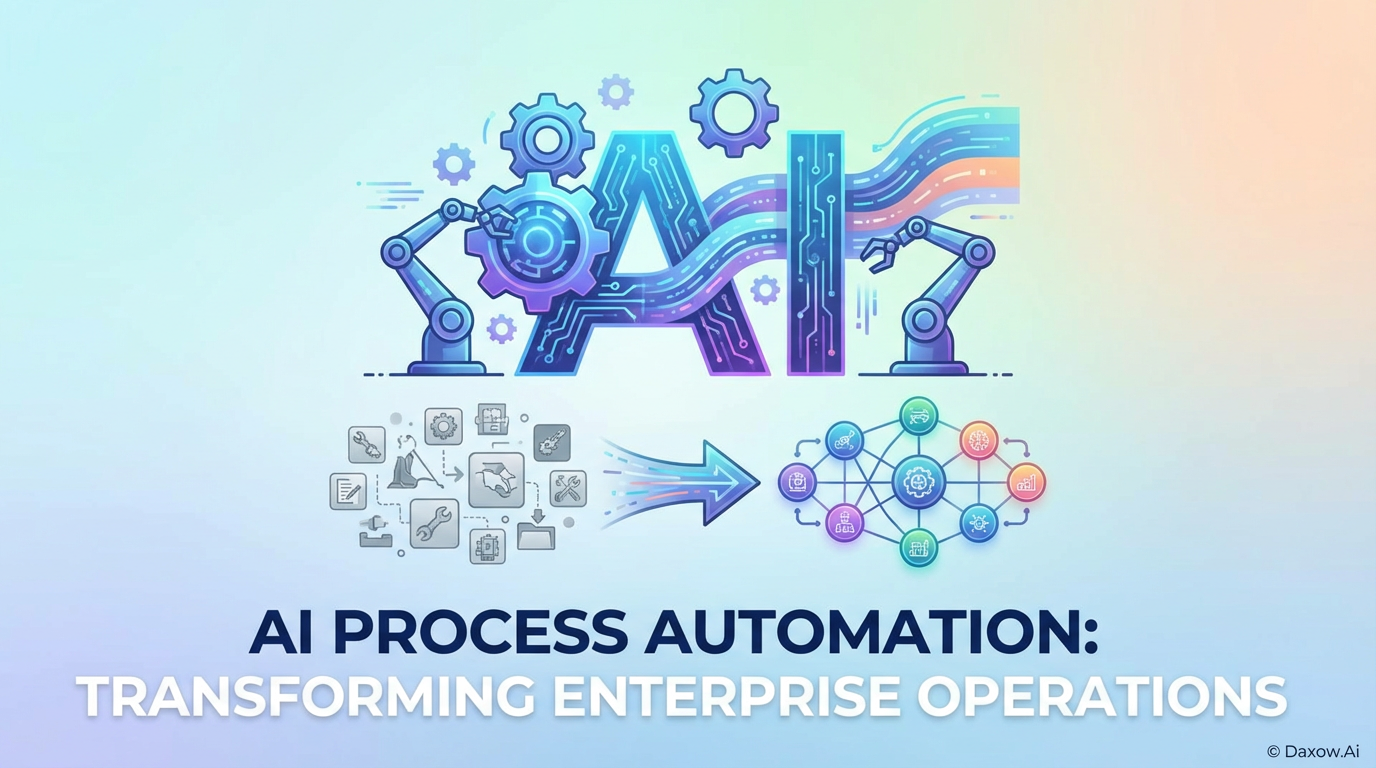
Practical guide to AI process automation: use AI agents and workflow orchestration to reduce manual work, improve accuracy, and scale operations with Daxow.ai.
AI Process Automation: Transforming Business Operations for the Modern Enterprise
Estimated reading time: 15 minutes
Key Takeaways
- AI process automation integrates advanced AI technologies with workflow automation to boost productivity and reduce manual tasks.
- Organizations achieve measurable ROI including faster cycle times, higher accuracy, and resource reallocation to value-added activities.
- Effective implementation involves a disciplined roadmap from process assessment to scaling with continuous improvement.
- Daxow.ai provides end-to-end AI automation solutions tailored for diverse industries.
- Overcoming common pitfalls and focusing on measurable KPIs ensures successful adoption and scaling of AI automation.
Table of Contents
- AI Process Automation: Transforming Business Operations for the Modern Enterprise
- The Business Outcomes to Expect
- How AI Agents and Workflow Automation Drive Efficiency
- Practical Use Cases Across Industries
- Implementation Roadmap — From Pilot to Scale
- Overcoming Common Pitfalls
- Measuring ROI and Business Value
- How Daxow.ai Helps Organizations Implement AI Process Automation
- Getting Started — Practical Next Steps
- Frequently Asked Questions
AI Process Automation: Transforming Business Operations for the Modern Enterprise
AI Process Automation: Transforming Business Operations for the Modern Enterprise is no longer a theoretical advantage — it is a practical, measurable strategy for organizations that want to reduce manual tasks, boost productivity, and compete on speed and quality. Decision-makers across industries are replacing brittle, rule-based automation with cognitive systems that use machine learning, natural language processing, computer vision, and decision engines to execute, adapt, and scale workflows. This article explains how AI process automation delivers business value, provides actionable implementation steps, and shows concrete use cases where AI agents and workflow automation create measurable ROI. Throughout, we highlight how Daxow.ai partners with companies to design, build, and operationalize these systems end-to-end.
Why this matters now
- Scale and complexity of operations demand automation that goes beyond fixed rules.
- Expectations from customers and stakeholders require faster, personalized interactions.
- Data availability and improved AI models make cognitive automation viable for core processes.
- Cost pressures and talent shortages push organizations to reduce repetitive work and reallocate human effort to higher-value tasks.
What AI process automation does
- Integrates AI technologies (ML, NLP, computer vision) with workflow automation.
- Enables AI agents to perceive inputs, make decisions, and execute tasks across systems.
- Moves organizations from manual, error-prone processes to scalable, adaptive operations.
The Business Outcomes to Expect
- Reduced manual tasks in targeted areas by up to 30–50%.
- Faster cycle times and response rates (e.g., 30% faster support resolution).
- Higher accuracy with error reductions up to 90% in data-heavy processes.
- Reallocation of human resources to innovation, sales, and customer experience.
How AI Agents and Workflow Automation Drive Efficiency
What an AI agent does in practice
- Listens and interprets inputs (emails, chat, documents, images) using NLP and computer vision.
- Makes decisions using trained models and business rules.
- Executes tasks via integrations (CRMs, ERPs, ticketing systems).
- Learns from outcomes and adapts behavior to improve performance.
Operational capabilities unlocked
- Proactive issue resolution — predictive maintenance or supply chain alerts before incidents escalate.
- End-to-end workflow orchestration — automated order-to-cash or case-to-resolution flows spanning multiple systems.
- Real-time triage and routing — intelligent ticket assignment, lead qualification, and escalation.
- Automated compliance and audit trails — decision logs and explainability built into workflows.
Example architecture elements
- Data ingestion and preprocessing pipelines.
- Model inference services for NLP, classification, and anomaly detection.
- Orchestration layer connecting AI decisions to automation engines.
- Integration adapters to CRMs, ERPs, email, and document repositories.
- Monitoring and retraining loops for continuous improvement.
Practical Use Cases Across Industries
AI process automation delivers concrete value across verticals. Below are high-impact examples with the kind of outcomes organizations can expect.
E-commerce — faster fulfillment, better retention
- Use case: Automated order-to-cash and returns handling.
- How it works: AI agents validate orders, predict inventory shortfalls, route exceptions to the correct team, and handle common customer inquiries via chatbots.
- Business impact: Reduced order processing time, fewer lost orders, and improved customer satisfaction through faster resolutions.
- Role for Daxow: Design workflows that integrate e-commerce platforms with warehouses and CRMs, build NLP models for customer intent, and deploy chat agents for customer support automation.
Healthcare — reduce admin burden, improve care delivery
- Use case: Patient intake, scheduling, and diagnostic support.
- How it works: Document automation extracts patient data, AI schedules appointments based on capacity predictions, and imaging models provide triage support to clinicians.
- Business impact: Lower administrative overhead, improved appointment utilization, and faster diagnostic workflows.
- Role for Daxow: Implement secure data pipelines, integrate with EHRs, and develop compliant NLP/document automation to reduce manual tasks.
Finance — automate compliance and reduce fraud risk
- Use case: Invoice processing, anomaly detection, and compliance checks.
- How it works: Computer vision extracts invoice fields, decision engines validate approvals, and ML models detect suspicious transaction patterns.
- Business impact: Faster invoice cycles, lower error rates, and reduced fraud losses.
- Role for Daxow: Build data extraction systems, connect to accounting platforms, and implement continuous monitoring to maintain model performance.
Real estate — accelerate deals and lead conversion
- Use case: Lead qualification, contract review, and listing automation.
- How it works: AI agents qualify inbound leads via chat and email, auto-generate listing content, and flag clauses in contracts that need legal review.
- Business impact: Shorter sales cycles and higher conversion rates.
- Role for Daxow: Create lead scoring models, integrate with property CRMs, and deploy agents to manage pipeline tasks.
HR — faster recruitment and better employee experience
- Use case: Resume screening, onboarding automation, and employee self-service.
- How it works: NLP-based screening narrows candidate pools, automated onboarding workflows provision access and tasks, and bots handle routine HR queries.
- Business impact: Reduced time-to-hire and improved employee retention.
- Role for Daxow: Automate background workflows, design secure integrations with HRIS, and deliver conversational bots for employee support.
Manufacturing — predictive maintenance and quality control
- Use case: Predict equipment failures and automate maintenance workflows.
- How it works: Sensor data fed to anomaly detection models triggers work orders; AI agents schedule maintenance and order parts.
- Business impact: Reduced downtime, improved throughput, and lower maintenance costs.
- Role for Daxow: Implement data integrations from IoT systems, build predictive models, and automate repair and procurement processes.
Implementation Roadmap — From Pilot to Scale
Adopting AI process automation requires discipline and a phased approach to manage risk and demonstrate value.
1. Assess and prioritize processes
- Audit workflows for high-volume, repetitive, or error-prone tasks.
- Score candidate processes on impact, feasibility, and data readiness.
- Action: Create a prioritized backlog with business owners.
2. Define objectives and KPIs
- Set measurable targets (e.g., reduce handling time by 30%, cut processing costs by 25%).
- Secure executive sponsorship and align KPIs to strategic goals.
- Action: Define baseline metrics and success criteria before pilot launch.
3. Prepare data and choose technology
- Cleanse and standardize data sources; implement access controls and governance.
- Select technologies that support integration, scalability, and required AI capabilities.
- Action: Run a data readiness assessment and prototype critical integrations.
4. Build cross-functional teams
- Include IT, process owners, data scientists, and frontline staff.
- Establish a center of excellence to capture best practices and training materials.
- Action: Appoint process champions and create training plans for end-users.
5. Pilot, test, and validate
- Run controlled pilots with well-defined scopes.
- Measure performance against KPIs, iterate on models and workflows.
- Action: Use A/B tests and shadow modes to validate decisions before full automation.
6. Scale with monitoring and governance
- Deploy continuous monitoring for model drift, bias, and performance.
- Use feature flags and phased rollouts to manage risk.
- Action: Implement retraining pipelines and operational dashboards.
7. Continuous improvement
- Capture feedback, refine models, and extend automation to adjacent processes.
- Maintain documentation and knowledge transfer to in-house teams.
- Action: Schedule quarterly reviews and optimization sprints.
Overcoming Common Pitfalls
- Poor data quality — mitigate with preprocessing, audits, and human-in-the-loop validation.
- Misaligned tools — prioritize integrations and scalability testing before procurement.
- Resistance to change — involve stakeholders early and provide targeted training.
- Lack of metrics — define KPIs pre-pilot and use them to guide scaling decisions.
Daxow.ai supports clients through each of these steps, providing both technical delivery and change management to ensure adoption and measurable outcomes.
Measuring ROI and Business Value
How to quantify the impact
- Calculate labor cost savings from reduced manual tasks.
- Measure cycle time improvements for process throughput.
- Track error rate reductions and compliance improvements.
- Quantify revenue impact from faster customer responses and improved conversion.
Benchmark outcomes from industry research
- Efficiency improvements of 40–60% in automated processes.
- Error reductions up to 90% in structured data tasks.
- Reported returns of 3–5x within 12–18 months for well-executed deployments.
Practical example: invoice automation ROI
- Scenario: 10,000 invoices/year with manual processing cost of $10 per invoice.
- After automation: processing cost drops to $2 per invoice; error rate drops sharply; vendor satisfaction improves.
- Result: Annual labor savings of $80,000 plus faster payment cycles and improved cash flow.
How Daxow.ai Helps Organizations Implement AI Process Automation
Discovery and process analysis
- Conduct process mapping and data audits to identify high-impact automation targets.
- Provide prioritized roadmaps with clear KPIs and timelines.
- Benefit: You get a clear business case and execution plan.
Custom AI system design and development
- Build AI agents tailored to your workflows using NLP, ML, and computer vision.
- Develop workflow automation and orchestration layers that integrate with CRMs, ERPs, HRIS, and third-party tools.
- Benefit: A production-ready system that reduces manual work and improves productivity.
Integration and deployment
- Implement secure connectors and API integrations to ensure seamless data flow.
- Deploy staged rollouts with monitoring, retraining pipelines, and governance frameworks.
- Benefit: Fast, low-risk deployment with built-in reliability.
Ongoing optimization and support
- Monitor model performance, retrain with new data, and optimize business rules.
- Provide knowledge transfer, training, and co-managed services as needed.
- Benefit: Sustained ROI and continuous process improvement.
Example engagements
- Automating support ticket triage and response for a SaaS provider — reduced mean time to resolution and improved NPS.
- End-to-end invoice processing for a finance department — lower costs and fewer exceptions.
- Lead qualification and routing for a real estate agency — higher conversion and faster follow-up.
Getting Started — Practical Next Steps
- Conduct a short diagnostic to identify 3–5 immediate automation opportunities.
- Run a one-month pilot focused on a single high-impact process.
- Establish KPIs and a governance model for scaling.
AI Process Automation: Transforming Business Operations for the Modern Enterprise is a pragmatic path to reduce manual tasks, boost productivity, and unlock strategic value across functions. By combining AI agents with workflow automation, organizations can achieve measurable improvements in efficiency, accuracy, and customer experience. Daxow.ai partners with businesses to assess workflows, design custom AI systems, integrate enterprise tools, and scale automation while ensuring strong governance and ROI.
Frequently Asked Questions
What is AI process automation?
AI process automation combines artificial intelligence technologies like machine learning and natural language processing with workflow automation to execute, optimize, and scale business processes.
How does AI automation improve business operations?
It reduces manual and error-prone tasks, accelerates processing times, improves accuracy, and allows human employees to focus on higher-value activities such as strategy, innovation, and customer engagement.
What industries benefit most from AI process automation?
Industries such as e-commerce, healthcare, finance, real estate, HR, and manufacturing have demonstrated significant gains through AI automation implementations.
How does Daxow.ai support AI automation deployments?
Daxow.ai offers end-to-end services including discovery, AI system design, integration, deployment, and ongoing optimization to ensure measurable ROI and smooth adoption.