
Mastering AI Workflow Automation for Business in 2026
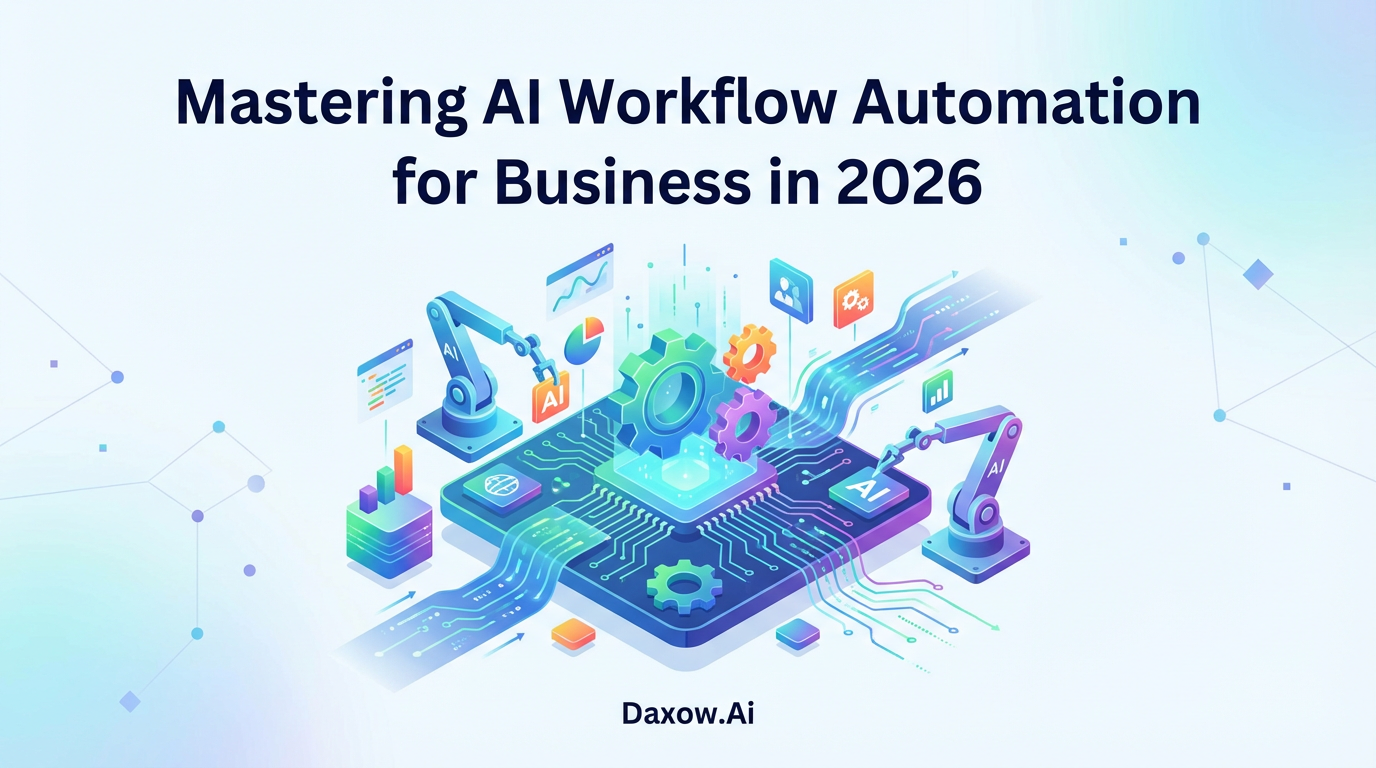
Practical 2026 playbook for AI workflow automation: use cases, ROI, implementation steps, and how Daxow.ai designs custom AI agents to scale operations.
Mastering AI Workflow Automation: Transforming Business Operations in 2026
Estimated reading time: 14 minutes
Key Takeaways
- AI workflow automation improves efficiency, reduces costs, and enhances customer experience by automating repetitive and complex tasks.
- Industry-specific AI automation use cases deliver measurable business impact across e-commerce, healthcare, finance, real estate, HR, and customer support.
- AI agents enable end-to-end workflow execution, adaptability, scalability, and continuous optimization beyond traditional automation.
- A disciplined, phased implementation roadmap reduces risks and maximizes ROI with clear objectives, data readiness, tool selection, and continuous iteration.
- Daxow.ai offers tailored AI agent design, data engineering, and phased deployment to accelerate automation initiatives and deliver measurable business value.
Table of Contents
- Mastering AI Workflow Automation: Transforming Business Operations in 2026
- Practical Use Cases: AI Workflow Automation Across Industries
- How AI Agents and Automation Drive Transformation
- Implementation Roadmap and Best Practices
- Measuring ROI and Business Value
- How Daxow.ai Helps You Master AI Workflow Automation
- Practical Next Steps for Decision-Makers
- Frequently Asked Questions
Mastering AI Workflow Automation: Transforming Business Operations in 2026
AI workflow automation integrates intelligent models with process orchestration to replace repetitive, error-prone manual work and to improve decision speed and accuracy. Leading organizations report efficiency gains of 40–60% in targeted processes and typical payback periods of 6–12 months for focused implementations. The result is faster processing, reduced labor costs, and better customer outcomes — essential for both startups and large enterprises navigating 2026’s competitive landscape.
What AI Workflow Automation Really Means
- Automating repetitive, rule-based tasks such as data entry, invoice processing, and basic customer inquiries.
- Applying AI to variable, complex tasks like document understanding, fraud detection, demand forecasting, and natural language interactions.
- Orchestrating multi-step flows where AI agents make decisions, trigger systems, update records, and escalate exceptions to humans only when needed.
- Continuous learning and optimization so processes improve over time as models retrain on new data.
Core Business Outcomes
- Reduce manual tasks across back-office and customer-facing functions.
- Increase productivity by enabling teams to focus on strategic work.
- Improve accuracy and compliance through standardized, auditable workflows.
- Accelerate throughput with faster processing and fewer bottlenecks.
- Unlock new revenue via better lead qualification, personalized experiences, and faster time-to-market.
Practical Use Cases: AI Workflow Automation Across Industries
E‑commerce — Order-to-Cash and Customer Support
- Problem: High volume of orders, inventory mismatches, and repetitive customer queries.
- Solution: AI agents automate order validation, inventory reconciliation, returns processing, and personalized post-purchase outreach. Chatbots handle tier-1 support, escalating only complex cases.
- Impact: Faster order cycles, fewer stockouts, reduced support costs, and higher customer lifetime value from timely, personalized engagement.
Healthcare — Records, Triage, and Predictive Care
- Problem: Administrative overload, slow patient triage, and fragmented patient data.
- Solution: AI-driven document extraction automates patient record ingestion. Virtual assistants triage appointment requests, schedule follow-ups, and flag anomalies in diagnostics for clinician review.
- Impact: Lower administrative burden, improved patient throughput, and earlier detection of anomalies, enabling better outcomes and staff satisfaction.
Finance — Fraud Detection and Compliance Reporting
- Problem: Large transaction volumes, manual compliance checks, and risk of fraud.
- Solution: Automated transaction scoring using ML models, automated compliance report generation, and anomaly detection agents that trigger investigations.
- Impact: Reduced fraud losses, faster compliance cycles, and lower audit costs, with continuous improvement in detection accuracy.
Real Estate — Lead Qualification and Contract Automation
- Problem: High volume of inquiries, slow lead follow-up, and manual contract reviews.
- Solution: AI agents qualify leads via conversational flows, schedule viewings, and extract key clauses and dates from contracts to populate CRMs.
- Impact: Higher conversion rates, shorter sales cycles, and reduced legal review time, enabling agents to focus on high-value negotiations.
HR — Recruitment and Onboarding
- Problem: Time-consuming resume screening, manual onboarding tasks, and retention prediction gaps.
- Solution: AI screens resumes for role fit, automates interview scheduling and onboarding checklists, and analyzes employee feedback to predict attrition risk.
- Impact: Faster hiring, smoother onboarding experiences, and proactive retention measures, reducing turnover costs.
Customer Support Automation — Across Sectors
- Problem: Repetitive tickets, inconsistent responses, and limited self-service options.
- Solution: Omnichannel chatbots, automated ticket routing, and knowledge-base summarization by AI agents.
- Impact: Lower average handle time, higher first-contact resolution, and improved customer satisfaction, while reducing support headcount growth.
How AI Agents and Automation Drive Transformation
AI agents are autonomous software entities that execute multi-step tasks, make decisions, and iterate based on outcomes. When combined with workflow automation platforms, they achieve far more than traditional RPA:
- Adaptability: AI agents handle natural language inputs, incomplete data, and process variability.
- End-to-end execution: From reading unstructured documents to updating enterprise systems and notifying stakeholders.
- Scalability: Agents scale horizontally to process surges without proportional headcount increases.
- Continuous optimization: Agents retrain on new data and performance metrics to reduce error rates over time.
Business leaders can expect productivity improvements of 30–50% in workflows where AI agents replace or augment manual steps. More importantly, automating the right processes reduces exceptions and allows human experts to focus on exceptions that truly require judgment.
Implementation Roadmap and Best Practices
1. Define Clear Objectives and Identify Processes
- Set measurable goals (e.g., reduce invoice cycle time by 50%, cut support costs by 30%).
- Use process mining and stakeholder interviews to map workflows and identify repetitive, high-volume tasks.
- Prioritize processes with clear ROI, regulatory importance, or high customer impact.
Common pitfall: Scope creep. Mitigation: Start with a single, high-impact use case and expand iteratively.
2. Assess and Prepare Data
- Audit data for accuracy, completeness, and accessibility.
- Standardize formats and establish data governance policies.
- Ensure privacy and compliance controls are in place for sensitive data.
Common pitfall: Poor data leading to flawed outputs. Mitigation: Invest in data cleanup and pipeline reliability before large-scale deployment.
3. Select Tools and Build Cross-Functional Teams
- Choose platforms that support secure integrations, model governance, and versioning.
- Assemble teams combining business owners, data engineers, ML specialists, and product managers.
- Provide training to reduce resistance and surface practical constraints early.
Common pitfall: Siloed teams and mismatched tools. Mitigation: Appoint a program owner to coordinate stakeholders and vendor integrations.
4. Prototype and Integrate Phasedly
- Build a minimum viable automation for a non-critical but representative workflow.
- Integrate with key systems (CRM, ERP, ticketing) and include manual fallback paths.
- Conduct security and legal reviews early, especially for regulated industries.
Common pitfall: Skipping security reviews. Mitigation: Include IT and compliance in planning from day one.
5. Monitor, Measure, and Iterate
- Define KPIs: cycle time, error rate, cost per transaction, NPS, and model performance metrics.
- Implement dashboards and regular review cadences.
- Retrain models as data drifts and refine decision thresholds based on outcomes.
Common pitfall: No feedback loop. Mitigation: Embed operational owners to continuously refine automations.
Measuring ROI and Business Value
Quantifying benefits is essential for executive buy-in. Use both operational and financial metrics:
- Operational metrics: Processing time reduction (e.g., 50–70% faster), error rate reduction, automation coverage, and first-contact resolution improvements.
- Financial metrics: Labor cost savings (20–40% on automated processes), reduced fraud losses, and revenue uplift from improved conversion rates.
Example: Automating invoice processing can reduce cycle time from days to hours, cut manual labor by 30%, and shrink late-payment penalties — delivering payback often within 6–12 months. When several workflows are automated in sequence — for example, lead qualification into opportunity routing into contract generation — the cumulative ROI compounds quickly.
How Daxow.ai Helps You Master AI Workflow Automation
Discovery and Process Analysis
- We start with a structured process audit to identify high-impact automation candidates.
- Deliverable: Prioritized automation roadmap with estimated ROI and resource requirements.
Custom AI Agents and Workflow Design
- We design AI agents that execute real tasks — from document extraction and lead qualification to multistep orchestration across CRMs, ERPs, and support platforms.
- Deliverable: Tailored AI agents integrated with your systems, able to reduce manual tasks and improve productivity immediately.
Data Engineering and Integrations
- We build reliable data pipelines, enforce governance, and integrate with existing business tools to ensure data quality and compliance.
- Deliverable: Secure, auditable data layer that supports continuous model improvement.
Phased Deployment and Change Management
- We implement prototypes in production-safe sandboxes, measure impact, and scale with governance in place.
- We provide training and documentation to drive adoption across functions.
- Deliverable: Scaled automation with clear KPIs, operational ownership, and minimal disruptions.
Continuous Support and Optimization
- We monitor performance, retrain models, and iterate workflows to maintain and improve ROI.
- Deliverable: Ongoing performance reports and roadmap for future automation initiatives.
Why Daxow.ai Delivers Business Value
- End-to-end expertise: From strategy to production, minimizing vendor handoffs.
- Focus on measurable outcomes: Prioritize automations with fast payback and long-term scaling potential.
- Security and compliance: Built-in controls for regulated industries.
- Industry experience: Solutions across e-commerce, finance, healthcare, real estate, HR, and customer support automation.
Practical Next Steps for Decision-Makers
If you are evaluating AI automation initiatives, consider this starter checklist:
- Identify 2–3 candidate processes with clear volume and measurable outcomes.
- Conduct a quick data readiness assessment.
- Estimate conservative ROI and define stakeholders.
- Run a 6–12 week pilot with clear success criteria.
- Plan for integration and change management from day one.
Mastering AI Workflow Automation: Transforming Business Operations in 2026 is within reach when you combine the right strategy, data discipline, and AI agents that execute real work. The business upside — reduced manual tasks, improved productivity, faster processing, and clear cost savings — is substantial and measurable.
Ready to accelerate your automation journey? Book a free consultation with Daxow.ai or request a process analysis for your company. Contact us to build a custom AI system that reduces operational costs, improves ROI, and scales your business with confidence.
Frequently Asked Questions
What types of tasks are best suited for AI workflow automation?
Tasks that are repetitive, rule-based, high-volume, or complex variable processes such as data entry, invoice processing, fraud detection, and natural language interactions are well suited for AI workflow automation.
How quickly can companies expect ROI from AI automation?
Typical payback periods for focused AI automation implementations range from 6 to 12 months, depending on process complexity and scale.
How does Daxow.ai support change management during automation projects?
Daxow.ai provides training, documentation, and phased deployment strategies to promote adoption, minimize disruptions, and embed operational ownership for sustained success.
Can AI agents handle exceptions in workflows?
Yes, AI agents orchestrate multi-step flows and escalate exceptions to humans only when necessary, allowing greater focus on judgmental decisions and reducing manual burden.