
AI Workflow Automation: 90-Day Plan to Transform Operations
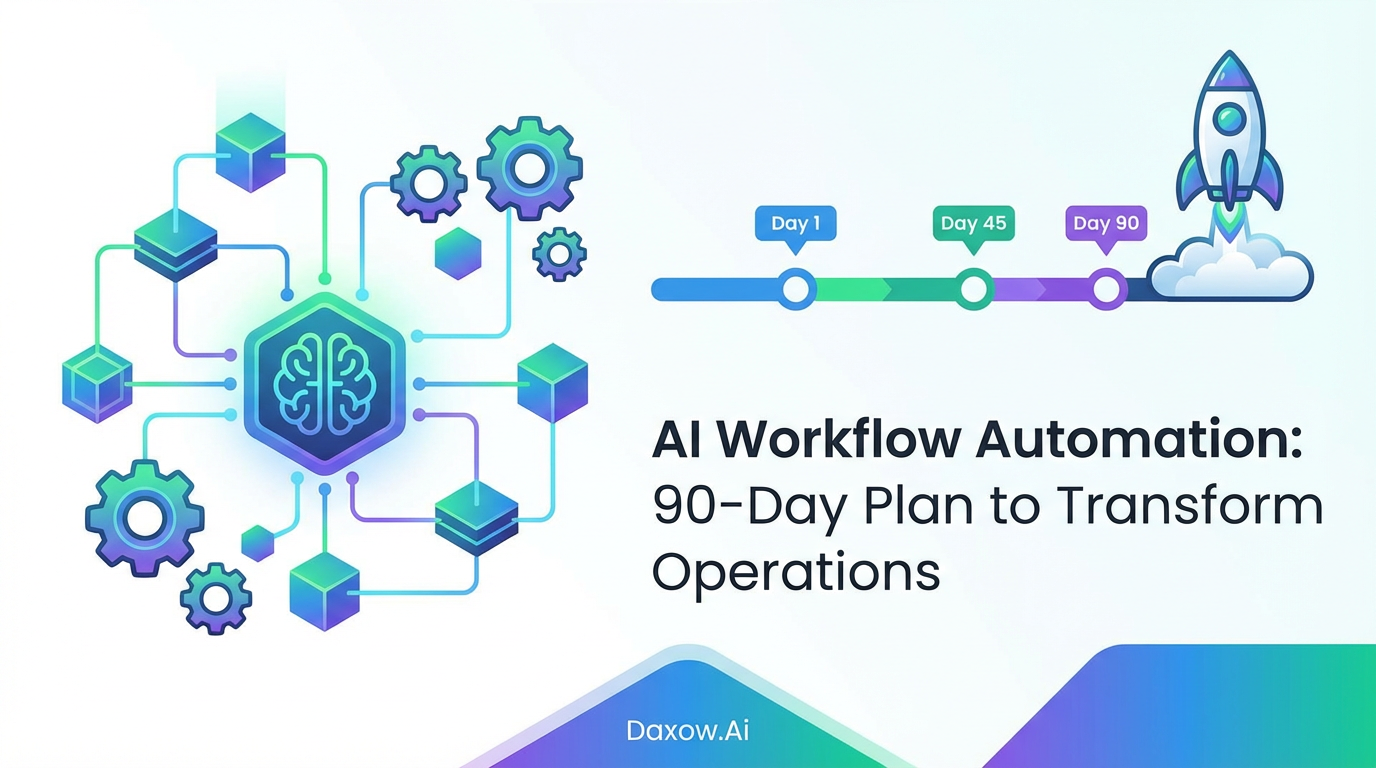
Daxow.ai's practical guide to AI workflow automation: use cases, implementation steps, and a 90-day roadmap to reduce manual work and deliver measurable ROI.
AI Workflow Automation: Transforming Business Operations for the AI Era
Estimated reading time: 13 minutes
Key Takeaways
- AI workflow automation drives up to 50% process time reduction and 70-80% automation of routine tasks.
- Key technologies include AI agents, RPA, NLP, and seamless system integrations via APIs.
- Industries from e-commerce to healthcare benefit from smarter, faster, and more compliant operations.
- Successful adoption requires clear objectives, data preparation, the right tools, and cross-functional teams.
- Daxow.ai offers custom AI agent design, integration, and continuous improvement for measurable ROI.
- A practical 90-day plan accelerates from discovery to production scale with measurable outcomes.
Table of Contents
- What Is AI Workflow Automation?
- Practical Use Cases Across Industries
- How AI Agents and Automation Drive Transformation
- Implementation Steps and Best Practices
- Measuring ROI and Business Value
- How Daxow.ai Accelerates AI Workflow Automation
- A Practical 90-Day Plan to Get Started
- Conclusion and Next Steps
- Frequently Asked Questions
What Is AI Workflow Automation?
AI workflow automation: transforming business operations for the AI era is reshaping how organizations operate, compete, and scale. Integrating AI into everyday processes converts manual, error-prone tasks into intelligent, measurable workflows. For decision-makers, that means faster cycle times, lower operational costs, and teams freed to focus on strategic priorities. This section explains what that transformation looks like and the key technologies powering this change.
Definition
AI workflow automation embeds machine learning, natural language processing, and rule-based automation into process orchestration so tasks are executed autonomously or with minimal human oversight.
Immediate benefits
- 40–50% reductions in process time
- 30–70% fewer errors
- Capacity to automate 70–80% of routine work, freeing staff for client-facing and high-value activities.
Strategic benefits
Improved forecasting, anomaly detection, and decision-support turn operations into a source of competitive advantage.
Key technologies powering the change
- AI agents: Autonomous systems that perceive inputs (emails, documents, voice), make decisions, and act across systems.
- RPA + AI: Robotic process automation handles structured, repetitive tasks while AI manages unstructured data and decisioning.
- NLP and document automation: Extract structured data from invoices, contracts, and messages to feed downstream systems.
- Integrations and APIs: Connect CRM, ERP, support platforms, and data warehouses to create end-to-end automated flows.
Why this matters now
Rising costs, talent shortages, and customer expectations demand faster, more accurate operations. AI workflow automation converts these pressures into opportunity by increasing productivity, reducing manual tasks, and improving customer experience.
Practical Use Cases Across Industries
E-commerce: Faster fulfillment and smarter personalization
Use case:
- Automate order-to-cash: extract order details from multiple channels, reconcile payments, and update ERP.
- Automate returns processing and fraud screening with AI scoring.
- Use agents to route customer inquiries and provide accurate order status.
Impact:
- 30% reduction in fulfillment errors.
- Higher conversion from personalized recommendations.
- Faster response times in customer support through customer support automation.
Example flow:
- Order received through marketplace API.
- AI agent verifies payment and inventory levels.
- RPA posts shipment instruction to WMS; customer notified via automated message.
- Post-purchase signals feed personalization engine for next-best offers.
Healthcare: Safer, more efficient patient administration
Use case:
- Automate patient scheduling and triage using symptom-based chatbots.
- Use document automation for billing reconciliation and claims processing.
- Flag anomalies in records for compliance review.
Impact:
- 25% reduction in administrative costs.
- Faster patient intake and more accurate billing.
- Improved compliance with auditable automated trails.
Finance: Risk-aware, faster decisioning
Use case:
- Automate fraud detection and real-time transaction monitoring.
- AI-assisted loan underwriting and KYC verification using document extraction and scoring.
- Automate reconciliation of invoices and payments.
Impact:
- Reduced risk exposure through continuous anomaly detection.
- Faster loan decisions with consistent scoring.
- Improved forecast accuracy and auditability.
Real Estate: Accelerated sales cycles and lead conversion
Use case:
- Automate lead qualification, property matching, and virtual tour scheduling.
- Use AI agents to draft contract summaries and flag negotiation points.
- Automate market-trend reporting for pricing decisions.
Impact:
- 20–40% shorter sales cycles.
- Higher lead-to-client conversion through rapid qualification and follow-up.
HR: Streamlined hiring and employee lifecycle management
Use case:
- Resume screening and candidate shortlisting.
- Automated onboarding workflows and payroll integration.
- Employee query handling via HR chatbots.
Impact:
- 50% reduction in hiring time.
- Better retention through data-driven onboarding and engagement monitoring.
These industry examples illustrate how workflow automation adapts to high-volume, variable data and delivers consistent business outcomes.
How AI Agents and Automation Drive Transformation
Beyond scripts: autonomous workflows that learn and improve
- Autonomy with accountability: AI agents can triage support tickets, initiate service escalations, and close repetitive tasks autonomously while maintaining audit logs for human review.
- Handling unstructured inputs: Agents process emails, voice transcripts, and scanned documents to make decisions that traditionally required manual review.
- Orchestration: Automation platforms coordinate AI tasks with RPA bots and business systems, preserving transactional integrity and compliance.
- Continuous learning: Agents refine decisions using feedback loops and retraining to reduce error rates over time.
Business impact
- 60–80% reduction in human intervention for routine processes.
- Faster adaptation to change through continuous model updates.
- Real-time response capabilities that improve customer satisfaction and reduce operational risk.
Implementation Steps and Best Practices
A phased, measurable approach to success
-
Define clear objectives
- Focus on measurable KPIs: cost per process, time to resolution, automation rate.
- Avoid vague goals; align automation projects with business priorities.
-
Assess and prepare data
- Audit data quality, standardize formats, and ensure access to required systems.
- Maintain GDPR and industry-specific compliance through secure pipelines.
-
Select and integrate the right tools
- Prioritize platforms that integrate with your CRM, ERP, and analytics stack.
- Combine RPA for structured tasks and AI for unstructured decisioning.
-
Build a cross-functional team
- Include process owners, data engineers, ML specialists, and compliance leads.
- Invest in change management and user training to accelerate adoption.
-
Prototype and scale
- Start with high-impact, low-risk workflows.
- Use short sprints to validate performance and refine models.
-
Monitor, retrain, and optimize
- Track drift, maintain model performance, and update based on new data.
- Define SLAs and escalation paths for edge cases.
Common pitfalls to avoid
- Skipping data preparation — poor data yields poor decisions.
- Deploying without human oversight — risk of “agent sprawl.”
- Choosing point tools that don’t integrate — leads to fragile automations.
Measuring ROI and Business Value
How organizations justify investment
- Typical outcomes:
- 20–50% cost savings on labor-intensive processes.
- 30–70% reduction in errors.
- 15–40% productivity improvement.
- Time to value:
- Many projects deliver ROI within 6–12 months when focused on high-impact workflows.
- Metrics to track:
- Automation rate (percentage of tasks handled without human input).
- Cycle time reductions (e.g., invoice processing from days to hours).
- Cost per transaction.
- Customer metrics (NPS, first response time).
- Compliance and error rates.
Decision-makers should treat early wins as building blocks — reinvesting gains to expand automation scope and scale savings across the organization.
How Daxow.ai Accelerates AI Workflow Automation
End-to-end delivery tailored to your business
At Daxow.ai, we combine strategy, engineering, and domain expertise to turn automation ambitions into operational reality. Our engagement is structured to deliver measurable outcomes and long-term value.
Discovery & process analysis
- We map your workflows, quantify manual tasks, and identify high-impact automation candidates.
- Deliverable: Prioritized automation roadmap with estimated ROI and timelines.
Design & prototyping
- We design AI agents and automation flows tailored to your systems and data.
- Rapid prototypes validate models on real data to ensure feasibility.
- Deliverable: Working prototype and acceptance criteria for production.
Integration & deployment
- End-to-end system integration with CRM, ERP, ticketing systems, and data warehouses.
- Secure, compliant pipelines and role-based access control to meet regulatory requirements.
- Deliverable: Production-grade automation with monitoring and rollback strategies.
Monitoring & continuous improvement
- We implement performance monitoring, drift detection, and retraining workflows.
- Ongoing optimization ensures accuracy improves over time and business KPIs are met.
- Deliverable: SLA-backed support, model governance, and optimization roadmap.
Where Daxow.ai adds unique value
- Custom AI agents that execute real tasks, not just provide recommendations.
- Full-stack integration: from document automation to sales automation and customer support automation.
- Outcome-driven approach focused on reducing manual tasks and improving productivity.
- Scalable architectures designed to evolve with your business.
Learn more on our services page about how we tailor solutions to meet your exact needs.
A Practical 90-Day Plan to Get Started
An actionable path to initial automation outcomes
Days 0–30: Discovery and quick wins
- Conduct process workshops and data audits.
- Identify 1–3 high-impact workflows for prototyping.
- Deliver an automation roadmap and success metrics.
Days 31–60: Prototype and early deployment
- Build a working prototype for one workflow (e.g., invoice processing or lead qualification).
- Integrate with one or two core systems (CRM, ERP).
- Validate performance and adjust.
Days 61–90: Production and scale planning
- Deploy the first production automation with monitoring.
- Train staff and put governance in place.
- Plan the next phase to scale successful automations across departments.
By focusing on measurable outcomes and short iterations, organizations can realize quick ROI and build momentum for broader automation.
Conclusion and Next Steps
AI workflow automation is no longer an experimental play — it is a strategic imperative for organizations that want to reduce manual tasks, increase productivity, and deliver superior customer experiences. From AI agents that autonomously handle support triage to end-to-end sales automation and document extraction, the technologies are mature and ready for enterprise adoption.
If you are ready to transform operations, Daxow.ai provides the expertise to design, build, and scale custom AI systems that deliver measurable business value.
Book a free consultation with Daxow.ai or request a process analysis for your company to identify the highest-value opportunities for AI automation and start your transformation. Contact us to build a custom AI system that reduces manual work and improves ROI.
Frequently Asked Questions
What types of tasks can AI workflow automation handle?
AI workflow automation can handle a wide range of tasks including data extraction, customer inquiry routing, fraud detection, loan underwriting, patient scheduling, lead qualification, document processing, and many other repetitive or decision-based tasks that were traditionally manual.
How quickly can my organization see ROI from AI automation?
Many organizations begin to see measurable ROI within 6 to 12 months when starting with high-impact, well-scoped workflows. A practical phased approach accelerates value delivery and helps build momentum.
Is human oversight still necessary with AI agents?
Yes, human oversight is critical especially during initial deployment and for edge cases. AI agents maintain audit logs and support escalation to ensure accountability and compliance.
How does Daxow.ai ensure compliance with data privacy regulations?
Daxow.ai follows strict data governance practices, maintains secure data pipelines, and integrates role-based access controls to ensure GDPR and industry-specific compliance in every automation project.